
ความแปรปรวนของสมบัติของดินที่สัมพันธ์กับผลผลิตและคุณภาพผลผลิตของบักวีต
Article Sidebar
Main Article Content
บทคัดย่อ
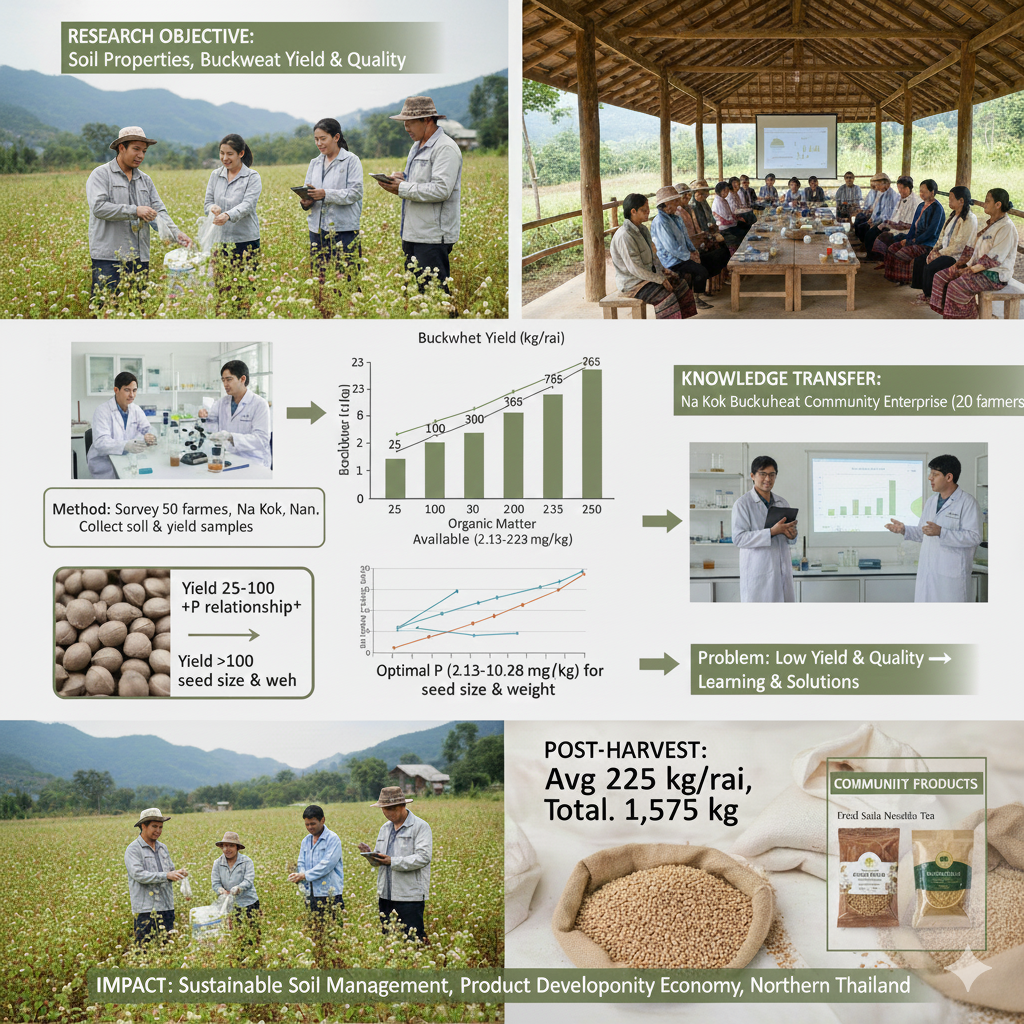
การวิจัยนี้มีวัตถุประสงค์เพื่อประเมินความสัมพันธ์ของสมบัติดินต่อกับผลผลิตและคุณภาพของบักวีต และเพื่อถ่ายทอดองค์ความรู้การเพิ่มผลผลิตและคุณภาพของบักวีตสู่ชุมชน โดยใช้การวิจัยเชิงสำรวจ กลุ่มตัวอย่าง คือ เกษตรกรผู้ปลูกบักวีตในพื้นที่บ้านนากอก ตำบลภูฟ้า อำเภอบ่อเกลือ จังหวัดน่าน จำนวน 50 ราย ซึ่งคัดเลือกโดยวิธีการสุ่มแบบเจาะจงจากแปลงที่มีการส่งเสริมการปลูกบักวีตพันธุ์ Taiwan 01 และเก็บตัวอย่างดินหลังการเก็บเกี่ยว โดยใช้วิธีการสุ่มแบบรวมจากแต่ละแปลง นำมาวิเคราะห์สมบัติทางกายภาพและเคมีของดิน และสุ่มตัวอย่างผลผลิตมาประเมินผลผลิตและคุณภาพเมล็ดของบักวีต ผลการศึกษาพบว่า ผลผลิตบักวีตมีความแปรปรวนสูงตั้งแต่ 25-233 กิโลกรัม/ไร่ ซึ่งสัมพันธ์กับปริมาณอินทรียวัตถุในช่วงร้อยละ 1.03-2.85 และฟอสฟอรัสที่เป็นประโยชน์ 2.13-25.23 มิลลิกรัม/กิโลกรัม โดยระดับฟอสฟอรัสในช่วง 2.13-10.28 มิลลิกรัม/กิโลกรัม มีความเพียงพอสำหรับการสร้างเมล็ดที่มีขนาดและน้ำหนักเมล็ดที่ดี และพบปริมาณผลผลิตบักวีตมีความสัมพันธ์กับอินทรียวัตถุและฟอสฟอรัสที่เป็นประโยชน์ในดิน โดยแปลงที่มีผลผลิตน้อยกว่า 100 กิโลกรัม/ไร่ มีความสัมพันธ์เชิงบวกกับฟอสฟอรัสที่เป็นประโยชน์ ในขณะที่แปลงที่ผลผลิตมากกว่า 100 กิโลกรัม/ไร่ มีความสัมพันธ์เชิงบวกกับปริมาณอินทรียวัตถุ ตามลำดับ สำหรับการถ่ายทอดองค์ความรู้ผลวิจัยให้กับกลุ่มวิสาหกิจชุมชนผู้ปลูกบักวีตบ้านนากอกจำนวน 20 คน ที่ประสบปัญหาการผลิตที่ได้ผลผลิตต่ำและผลผลิตไม่ได้คุณภาพ ทำให้เกษตรกรเกิดการเรียนรู้และร่วมกันหาแนวทางการแก้ปัญหาการผลิตในพื้นที่ นำไปสู่การยอมรับผลวิจัยและการประยุกต์ใช้ในชุมชน เมื่อเก็บเกี่ยวแล้วพบว่ามีผลผลิตเฉลี่ย 225 กิโลกรัม/ไร่ ได้ผลผลิตรวมทั้งสิ้น 1,575 กิโลกรัม และสามารถนำไปแปรรูปเป็นผลิตภัณฑ์ของชุมชน ได้แก่ เส้นโซบะแห้งและชาบักวีต ผลการวิจัยนี้สามารถใช้เป็นแนวทางในการจัดการดินและการเลือกพื้นที่ปลูกที่เหมาะสม รวมถึงสนับสนุนการประยุกต์ใช้ผลวิจัยสู่การพัฒนาผลิตภัณฑ์และเศรษฐกิจระดับชุมชนอย่างยั่งยืนในพื้นที่สูงของภาคเหนือต่อไป
Downloads
Article Details

อนุญาตภายใต้เงื่อนไข Creative Commons Attribution-NonCommercial-NoDerivatives 4.0 International License.
เอกสารอ้างอิง
ดารากร อัคฮาดศรี, จุไรรัตน์ ฝอยถาวร, ชฎาพร อุปนันท์, และกาญจนัษ อนันตะ. (2560). รายงานฉบับสมบูรณ์ โครงการวิจัยเพื่อฟื้นฟูความอุดมสมบูรณ์ของดิน. สถาบันวิจัยและพัฒนาพื้นที่สูง (องค์การมหาชน).
เนตรนภา อินสลุด, พีรพันธ์ ทองเปลง, วิชญ์ภาส สังพาลี, สุธีระ เหิมฮึก, และทัศนีย์ สีเสนซุย. (2563). คุณสมบัติทางเคมีของดินที่มีอิทธิพลต่อการเจริญเติบโตและการดูดใช้ธาตุอาหารของบักวีต. วารสารแก่นเกษตร, 48 (ฉบับพิเศษ 1), 561-566. https://ag2.kku.ac.th/kaj/PDF.cfm?filename=18_Agr26.pdf&id=4052&keeptrack=39
อาคม กาญจนประโชติ, ศิวะพงศ์ นฤบาล, วิมล ปันสุภา, ประกิตต์ โกะสูงเนิน, สัมพันธ์ ตาติวงค, และศุภวัฒน์ วดีศิริศักดิ์. (2548). การศึกษาพันธ์และศึกษาเทคโนโลยีการผลิตบักวีตบนพื้นที่สูงในเขตภาคเหนือตอนบนของประเทศไทย. งานพัฒนาและส่งเสริมการผลิตพืชไร่บนพื้นที่สูง มูลนิธิโครงการหลวง.
Alvarez-Jubete, L., Arendt, E. K., & Gallagher, E. (2009). Nutritive value and chemical composition of pseudocereals as gluten-free ingredients. International journal of food sciences and nutrition, 60(sup4), 240-257. https://doi.org/10.1080/09637480902950597
Association of Official Analytical Chemists. (1991). Quality assurance principles for analytical laboratories (2nd ed.). AOAC.
Babu, S., Yadav, G., Singh, R., Avasthe, R., Das, A., Mohapatra, K. P., Tahashildar, M., Kumar, K., Thoithoi Devi, M., Rana, D. S., & Prakash, N. (2018). Production technology and multifarious uses of buckwheat (Fagopyrum spp.) A review. Indian Journal of Agronomy, 63(4), 415-427. https://www.researchgate.net/publication/330451258_Production_technology_and_multifarious_uses_of_buckwheat_Fagopyrum_spp_A_review
Barrow, N., & Hartemink, A. (2023). The effects of pH on nutrient availability depend on both soils and plants. Plant and Soil, 487, 21-37. https://doi.org/10.1007/s11104-023-05960-5
Bray, R. H., & Kurtz, L. T. (1945). Determination of total, organic, and available forms of phosphorus in soils. Soil Science, 59(1), 39–46. https://doi.org/10.1097/00010694-194501000-00006
Boglaienko, D., Soti, P., Shetty, K. G., & Jayachandran, K. (2014). Buckwheat as a cover crop in Florida: Mycorrhizal status and soil analysis. Agroecology and Sustainable Food Systems, 38(9), 1033-1046. https://doi.org/10.1080/21683565.2014.906016
Canadian Grain Commission. (2021). Official grain grading guide, 13-3-13-15. Canadian Grain Commission.
Che, J., Yamaji, N., Miyaji, T., Mitani-Ueno, N., Kato, Y., Shen, R. F., & Ma, J. F. (2020). Node-localized transporters of phosphorus essential for seed development in Rice. Plant and Cell Physiology, 61(8), 1387-1398. https://doi.org/10.1093/pcp/pcaa074
Clark, A. (2007). Managing cover crops profitably (3rd ed.). Sustainable Agriculture Network.
Day, P. R. (1965). Particle fractionation and particle-size analysis. In C. A. Black (Ed.), Methods of soil analysis. Part I. Agronomy Monograph No. 9 (pp.545-567). American Society of Agronomy.
Doley, M., Phukon, S. K., Borah, K., Bora, S. S., & Rahman, S. W. (2020). Role of soil organic matter in maintaining sustainability of cropping systems. Journal of Pharmacognosy and Phytochemistry, 9(1), 1050-1058. https://www.phytojournal.com/archives/2020/vol9issue1/PartR/8-6-248-806.pdf
Giménez-Bastida, J. A., & Zieliński, H. (2015). Buckwheat as a functional food and its effects on health. Journal of Agricultural and Food Chemistry, 63(36), 7896-7913. https://doi.org/10.1021/acs.jafc.5b02498
Kaur, H. (2019). Availability of micronutrient cations in soils as influenced by phosphorus fertilization – a review. International Journal of Current Microbiology and Applied Sciences, 8(9), 1946–1952. https://doi.org/10.20546/ijcmas.2019.809.224
Possinger, A. R., Byrne, L. B., & Breen, N. E. (2013). Effect of buckwheat (Fagopyrum esculentum) on soil-phosphorus availability and organic acids. Journal of Plant Nutrition and Soil Science, 176(1), 16–18. https://doi.org/10.1002/jpln.201200337
R Core Team. (2024). R: A language and environment for statistical computing. R Foundation for Statistical Computing. https://www.r-project.org
Tang, L., Tang, J., Huang, K., & Huang, X. (2024). Potassium fertilizer promotes the thin-shelled Tartary buckwheat yield by delaying senescence and promoting grain filling. Frontiers in Plant Science, 15. https://doi.org/10.3389/fpls.2024.1385548
Thomas, G. W. (1982). Exchangeable cations. In A. L. Page (Ed.), Methods of soil analysis. Part 2. Chemical and microbiological properties (2nd ed., pp.159–165). American Society of Agronomy and Soil Science Society of America.
Vijaya Bhaskar Reddy, U., Prabhakara Reddy, G., Srinivasa Reddy, M., & Kavitha, P. (2018). Effect of different nitrogen and phosphorus levels on growth and yield of maize during kharif season. International Journal of Current Microbiology and Applied Sciences, 7(1), 3548–3555. https://doi.org/10.20546/ijcmas.2018.701.416
Walkley, A., & Black, I. A. (1934). An examination of the degtjareff method for determining soil organic matter, and a proposed modification of the chromic acid titration method. Soil Science, 37(1), 29–38. https://doi.org/10.1097/00010694-193401000-00003
Zhou, L., Chu, J., Zhang, Y., Wang, Q., Ye, Y., & Zhao, B. (2024). Effect of biochar application on the improvement of soil properties and buckwheat (fagopyrum esculentum moench) yield on two contrasting soil types in a semi-arid region of inner Mongolia. Agronomy, 14(6), 1137. https://doi.org/10.3390/agronomy14061137
Zhu, Y. G., He, Y. Q., Smith, S. E., & Smith, F. A. (2002). Buckwheat (Fagopyrum esculentum Moench) has high capacity to take up phosphorus (P) from a calcium (Ca)-bound Source. Plant and Soil, 239, 1-8. https://doi.org/10.1023/A:1014958029905
