Development and evaluation of antioxidant and antibacterial herbal cream with Elateriospermum tapos Blume seed oil
DOI:
https://doi.org/10.55674/cs.v18i1.264320Keywords:
Antioxidant activity; Antibacterial activity; Elateriospermum tapos Blume oil; Herbal cream; Omega fatty acidAbstract
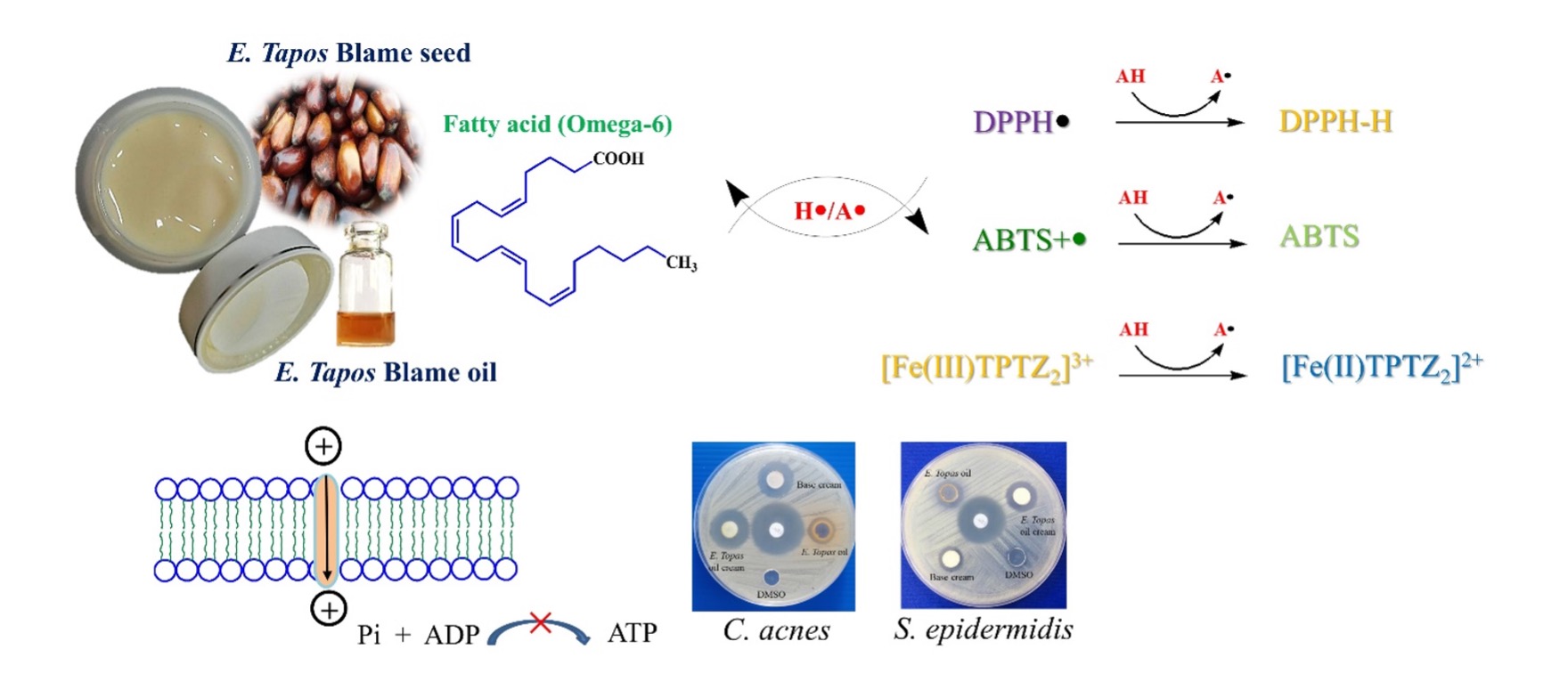
In this study, an herbal cream incorporating Elateriospermum tapos Blume seed oil was developed and evaluated, highlighting the oil’s unique composition of omega-3, omega-6, and omega-9 fatty acids confirmed by GC-MS. This study presents E. tapos, a locally plentiful but underutilized Southeast Asian seed oil, as a novel bioactive ingredient, distinguishing itself from previous herbal cream formulations that predominantly utilize common plant oils due to its unique profile of polyunsaturated fatty acids and phytochemicals. The cream's antioxidant capacity, measured by DPPH, ABTS, and FRAP tests, showed that it was better at scavenging radicals and reducing ferric ions than the base cream. The formulation also exhibited notable antibacterial activity, producing inhibition zones of 27.25 ± 0.87 mm against Cutibacterium acnes and 25.17 ± 1.20 mm against Staphylococcus epidermidis, both Gram-positive skin-associated bacteria. The E. tapos oil cream was developed, and it showed the strongest antioxidant activity against DPPH and ABTS radicals with an IC50 of 32.67 ± 1.34 mg L⁻¹ and 17.97 ± 0.04 mg L⁻¹, respectively. The resulting formulation possessed desirable physicochemical properties, including skin-compatible pH, homogeneity, and stability. Overall, this study provides the first scientific validation of E. tapos seed oil as a high-value cosmetic ingredient and demonstrates its potential for developing natural anti-acne and antioxidant topical products, supporting future dermatological applications and value-added utilization of a regional botanical resource.
GRAPHICAL ABSTRACT
HIGHLIGHTS
- Herbal cream formulated with tapos seed oil, containing ω-3, ω-6, and ω-9 fatty acids confirmed by GC-MS.
- Cream showed strong antioxidant activity (IC50: DPPH 40.45 ±1.80 mg L-1; ABTS 23.15 ±0.01 mg L-1) and antibacterial effects against epidermidis and C. acnes.
- Developed cream had homogeneous texture, skin-friendly pH, pleasant odor, and potential as a natural topical product for skin infections.
References
Liu, J. K. (2022). Natural products in cosmetics. Natural Products and Bioprospecting, 12(40), 1–43. https://doi.org/10.1007/s13659-022-00363-y
Yarkent, C., Gürlek, C., & Oncel, S. S. (2020). Potential of microalgal compounds in trending natural cosmetics: A review. Sustainable Chemistry and Pharmacy, 17, 100304. https://doi.org/10.1016/j.scp.2020.100304
Mohiuddin, A. K. (2019). Cosmetics in use: A pharmacological review. Journal of Dermatology and Cosmetology, 3(2), 50–67. https://doi.org/10.15406/jdc.2019.03.00115
Yadav, A., Karmokar, K., Gop, R., Mudartha, D., & Maheshwari, V. (2020). Formulation and evaluation of herbal lipbalm from amaranth leaf colour pigment. International Journal for Research in Applied Science & Engineering Technology, 8, 653–663. http://doi.org/10.22214/ijraset.2020.6107
Balkrishna, A., Sharma, N., Srivastava, D., Kukreti, A., Srivastava, S., & Arya, V. (2024). Exploring the safety, efficacy, and bioactivity of herbal medicines: Bridging traditional wisdom and modern science in healthcare. Future Integrative Medicine, 3(1), 35–49. https://doi.org/10.14218/FIM.2023.00086
Mishra, A. P., Saklani, S., Milella, L., & Tiwari, P. (2014). Formulation and evaluation of herbal antioxidant face cream of Nardostachys jatamansi collected from Indian Himalayan region. Asian Pacific Journal of Tropical Biomedicine, 4(2), S679–S682. https://doi.org/10.12980/APJTB.4.2014APJTB-2014-0223
Misar, K. S., Kulkarni, S. B., & Gurnule, W. B. (2020). Formulation and evaluation of antiacne cream by using clove oil. Materials Today: Proceedings, 29(4), 1251–1258. https://doi.org/10.1016/j.matpr.2020.06.106
Dumsud, T., Chooklin, C. S., & Sagulsawasdipan, K. (2024). Antioxidant and tyrosinase inhibitory activity of essential oil from pomelo peel. Wichcha Journal Nakhon Si Thammarat Rajabhat university, 43(2), 39–48.
Ijaz, N., Durrani, A. I., Rubab, S., & Bahadur, S. (2022). Formulation and characterization of Aloe vera gel and tomato powder containing cream. Acta Ecologica Sinica, 42(2), 34–42. https://doi.org/10.1016/j.chnaes.2021.01.005
Anjum, H., Sofi, G., Shahwan, M., Khan, M., Shamsi, A., & Shamsi, S. (2023). In vitro and in vivo study targeting the development of Unani antidermatophytic cream: Implication of herbal formulations in treatment of dermatophytosis. Heliyon, 9, e16154. https://doi.org/10.1016/j.heliyon.2023.e16154
Tran, N., Pham, B., & Le, L. (2020). Bioactive compounds in anti-diabetic plants: From herbal medicine to modern drug discovery. Biology, 9(9), 252. https://doi.org/10.3390/biology9090252
Riaz, M., Khalid, R., Afzal, M., Anjum, F., Fatima, H., Zia, S., Rasool, G., Egbuna, C., Mtewa, A. G., Uche, C. Z., & Aslam, M. A. (2023). Phytobioactive compounds as therapeutic agents for human diseases: A review. Food Science and Nutrition, 11, 2500–2529. https://doi.org/10.1002/fsn3.3308
Alzamel, N. M. (2022). Bioactive compounds in some medicinal plants from different habitats in KSA. Pakistan Journal of Medicine Health Science, 16(2), 1085. https://doi.org/10.53350/pjmhs221621085
Wu, J., & Xie, W. (2019). Modulating effect of fatty acids and sterols on skin aging. Journal of Functional Foods, 57, 135–140. https://doi.org/10.1016/j.jff.2019.04.011
Karageorgou, D., Rova, U., Christakopoulos, P., Katapodis, P., Matsakas, L., & Patel, A. (2023). Benefits of supplementation with microbial omega-3 fatty acids on human health and the current market scenario for fish-free omega-3 fatty acid. Trends in Food Science and Technology, 136, 169–180. https://doi.org/10.1016/j.tifs.2023.04.018
Emebet, A. H., & Abdu, M. A. (2021). Overconsumption of omega-6 polyunsaturated fatty acids (PUFAs) versus deficiency of omega-3 PUFAs in modern-day diets: The disturbing factor for their “balanced antagonistic metabolic functions” in the human body. Journal of Lipids, 8848161.http://dx.doi.org/10.1155/2021/8848161
Moore, E. M., Wagner, C., & Komarnytsky, S. (2020). The enigma of bioactivity and toxicity of botanical oils for skin care. Frontiers in Pharmacology, 11, 785. https://doi.org/10.3389/fphar.2020.00785
Bultosa, G. (2016). Functional foods: Overview. In C. Wrigley, H. Corke, K. Seetharaman & J. Faubion (Eds.), Encyclopedia of Food Grains (2nd ed, Vol. 2, pp. 1–10). Academic Press. https://doi.org/10.1016/B978-0-12-394437-5.00071-1
Sumara, A., Stachniuk, A., Montowska, M., Kotecka-Majchrzak, K., Grywalska, E., Mitura, P., Martinović, L. S., Pavelić, S. K., & Fornal, E. (2023). Comprehensive review of seven plant seed oils: Chemical composition, nutritional properties, and biomedical functions. Food Reviews International, 39(8), 5402–5422. https://doi.org/10.1080/87559129.2022.2067560
Afzal, F. M., Khalid, W., Khalid, M. A., Zubair, M., Akram, S., Kauser, S., Noreen, S., Jamal, A., Khan, M. K., & Al-Farga, A. (2024). Recent industrial extraction of plant seed oils used in the development of functional food products: A review. International Journal of Food Properties, 25(1), 2530–2550. https://doi.org/10.1080/10942912.2022.2144882
Yang, Y., & Benning, C. (2018). Functions of triacylglycerols during plant development and stress. Current Opinion in Biotechnology, 49, 191–198. https://doi.org/10.1016/j.copbio.2017.09.003
Wang, X., Jia, Y., & He, H. (2025). The role of linoleic acid in skin and hair health: A review. International Journal of Molecular Sciences, 26(1), 246.https://doi.org/10.3390/ijms26010246.
Linder, J. (2008). Role of oils in the topical treatment of acne. Cosmetic Dermatology, 21(4), 211–214.
Tisadondilok, S., Senawong, T., Swatsitang, P., & Rattanasing, A. (2018). Antioxidant and antiproliferative activities of ethanolic extracts of Elateriospermum tapos Blume (Euphorbiaceae). Journal of Medicinal Plants Research, 12(27), 474–482. https://doi.org/10.5897/JMPR2018.6666
Charoensuk, A., Jaroensutasinee, M., & Jaroensutasinee, K. (2018). Seed production and seedling establishment of Parah trees in Khao Nan National Park, Thailand. Walailak Journal of Science and Technology, 15(3), 213–223. https://doi.org/10.48048/wjst.2018.3928
Yong, O. Y., & Salimon, J. (2006). Characteristics of Elateriospermum tapos seed oil as a new source of oilseed. Industrial Crops and Products, 24(2), 146–151. https://doi.org/10.1016/j.indcrop.2006.03.001
Parbuntari, H., Prestica, Y., Gunawan, R., Nurman, M. N., & Adella, F. (2018). Preliminary phytochemical screening (qualitative analysis) of cacao leaves (Theobroma cacao L.). Eksakta: Berkala Ilmiah Bidang MIPA, 19(2), 40–45. https://doi.org/10.24036/eksakta/vol19-iss2/142
Hossain, M. A., Salim AL-Raqmi, K. A., Hamood AL-Mijizy, Z., Weli, A. M., & Al-Riyami, Q. (2013). Study of total phenol, flavonoid contents, and phytochemical screening of various leaves crude extracts of locally grown Thymus vulgaris. Asian Pacific Journal of Tropical Biomedicine, 3(9), 705–710. https://doi.org/10.1016/S2221-1691(13)60142-2
Cieśla, Ł., Kowalska, I., Oleszek, W., & Stochmal, A. (2012). Free radical scavenging activities of polyphenolic compounds isolated from Medicago sativa and Medicago truncatula assessed by means of thin-layer chromatography DPPH˙ rapid test. Phytochemical Analysis, 24(1), 47–52. https://doi.org/10.1002/pca.2379
Duffa, M. F., & Lisec, C. (2022). Topical steroids in burn patients: A systematic review of the literature and a descriptive analysis of topical KENACOMB use at a major tertiary burn centre. JPRAS Open, 33, 184–194. https://doi.org/10.1016/j.jpra.2022.05.004
Huang, T. H., Wang, P. W., Yang, S. C., Chou, W. L., & Fang, J. Y. (2018). Cosmetic and therapeutic applications of fish oil’s fatty acids on the skin. Marine Drugs, 16(8), 256. https://doi.org/10.3390/md16080256
Ahmad, A., & Ahsan, H. (2020). Lipid-based formulations in cosmeceuticals and biopharmaceuticals. Ahmad and Ahsan Biomedical Dermatology, 4, 12. https://doi.org/10.1186/s41702-020-00062-9
Hernández-Martínez, M., Gallardo-Velázquez, T., Osorio-Revilla, G., Almaraz-Abarca, N., Ponce-Mendoza, A., & Vásquez-Murrieta, M. S. (2013). Prediction of total fat, fatty acid composition and nutritional parameters in fish fillets using MID-FT-IR spectroscopy and chemometrics. LWT - Food Science and Technology, 52(1), 12–20. http://dx.doi.org/10.1016/j.lwt.2013.01.001
Gieroba, B., Kalisz, G., Krysa, M., Khalavka, M., & Przekora, A. (2023). Application of vibrational spectroscopic techniques in the study of the natural polysaccharides and their cross-linking process. International Journal of Molecular Sciences, 24(3), 2630. https://doi.org/10.3390/ijms24032630
Akbari, S., Abdurahman, N. H., Yunus, R., & Oluwaseun Ruth Alara, M., Olalere Olusegun Abayomi. (2019). Extraction, characterization, and antioxidant activity of fenugreek (Trigonella foenum-graecum) seed oil. Materials Science for Energy Technologies, 2(2), 349–355. https://doi.org/10.1016/j.mset.2018.12.001
Kumar, S. S., Manasa, V., Tumaney, A. W. B., Bettadaiah, K., Chaudhariad, S. R., & Giridhar, P. (2020). Chemical composition, nutraceuticals characterization, NMR confirmation of squalene and antioxidant activities of Basella rubra L. seed oil. RSC Advances, 10(53), 31863–31873. https://doi.org/10.1039/d0ra06048h
Geyesa, J. M., Esho, T. B., Legesse, B. A., & Wotango, A. S. (2024). Antibacterial and antioxidant potential analysis of Verbascum sinaiticum leaf extract and its synthesized silver nanoparticles. Heliyon, 10(2), e24215. https://doi.org/10.1016/j.heliyon.2024.e24215
Meeboon, N., Keawsaard, Y., Ruang-On, S., Rodjaroen, S., & Sintupachee, S. (2025). Assessment of species diversity, nutritional content, and antioxidant activity of indigenous vegetables in the rice noodles with fish curry sauce dish from Nakhon Si Thammarat, Thailand. Wichcha Journal Nakhon Si Thammarat Rajabhat university, 44(2), 102–120. https://doi.org/10.65217/wichchajnstru.2025.v44i2.264856
Fakhry, G., Omar, M., Mahmoud, M., Elrahman Fakhry, A. A., & Aboelainin, M. A. (2023). Physicochemical characteristics, inhibition of lipid peroxidation, and oxidative stability index by antioxidant alternatives of promising binary oil blend (canola and olive oils). Scientific Journal of Agricultural Sciences, 5(4), 141–160. https://doi.org/10.21608/sjas.2023.242600.1348
Yoon, B. K., Jackman, J. A., Valle-González, E. R., & Cho, N. J. (2018). Antibacterial free fatty acids and monoglycerides: Biological activities, experimental testing, and therapeutic applications. International Journal of Molecular Sciences, 19(4), 1114. https://doi.org/10.3390/ijms19041114
Casillas-Vargas, G., Ocasio-Malavé, C., Medina, S., Morales-Guzmán, C., García Del Valle, R., Carballeira, N. M., & Sanabria-Ríos, D. J. (2021). Antibacterial fatty acids: An update of possible mechanisms of action and implications in the development of the next-generation of antibacterial agents. Progress in Lipid Research, 82, 101093. https://doi.org/10.1016/j.plipres.2021.101093
Coraça-Huber, D. C., Steixner, S., Wurm, A., & Nogler, M. (2021). Antibacterial and anti-biofilm activity of omega-3 polyunsaturated fatty acids against periprosthetic joint infection–isolated multidrug-resistant strains. Biomedicines, 9(4), 334. https://doi.org/10.3390/biomedicines9040334
Nakamura, K., O’Neill, A. M., Williams, M. R., Cau, L., Nakatsuji, T., & Gallo, R. L. (2020). Short-chain fatty acids produced by Cutibacterium acnes inhibit biofilm formation by Staphylococcus epidermidis. Scientific Reports, 10(1), 21237. https://doi.org/10.1038/s41598-020-77790-9
Downloads
Published
How to Cite
Issue
Section
Categories
License
Copyright (c) 2025 : Naengnoi Saengsane, Rungnapa Pimsen, Prawit Nuengmatcha, Benjawan Ninwong, Montakarn Thongsom, Nathaporn Jirawattanasomkul, Nichapa Rattanakomon, Paweena Porrawatkul

This work is licensed under a Creative Commons Attribution-NonCommercial-NoDerivatives 4.0 International License.