
The quality assessment of starch based noodles enriched with Noui Khuea brown rice starch, physicochemical characteristics and functional properties
DOI:
https://doi.org/10.55674/cs.v18i1.263114Keywords:
Noui Khuea brown rice starch, Functional noodles, Physicochemical properties, Antioxidant activity, Local rice innovationAbstract
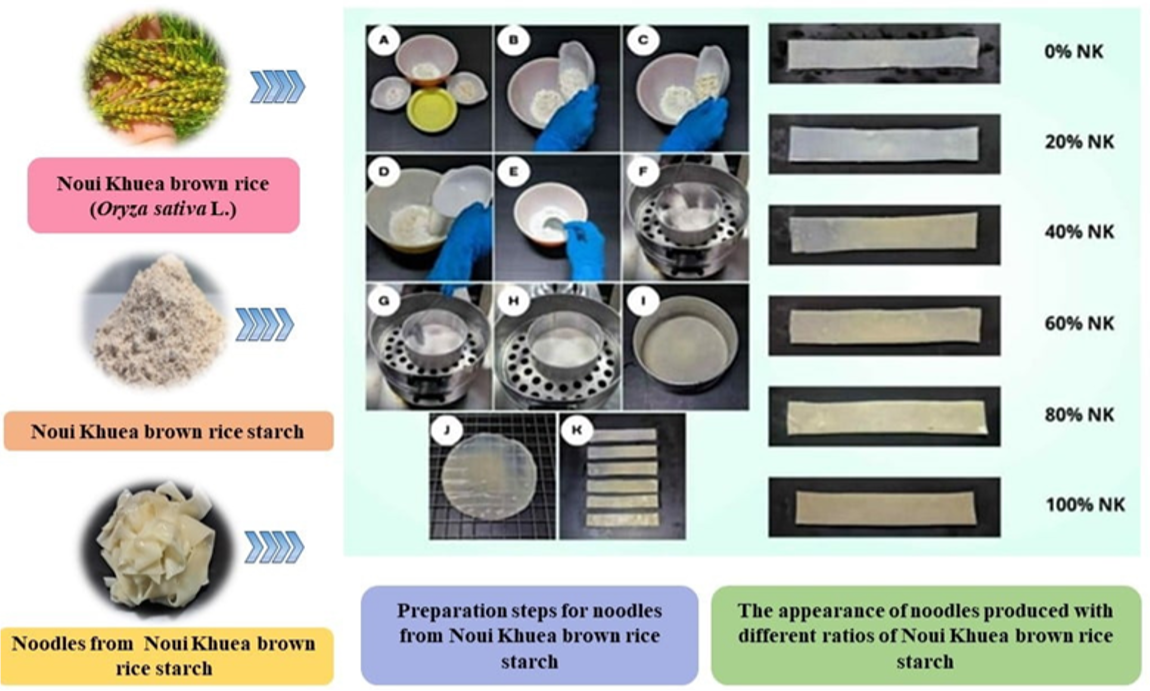
This study aimed to develop starch-based noodles enriched with Noui Khuea (NK) brown rice starch by substituting rice starch at six different levels (0%, 20%, 40%, 60%, 80%, and 100%). The research was designed to investigate how varying proportions of NK brown rice starch influence the physicochemical, functional, and quality characteristics of the noodles. Specifically, the study evaluated parameters such as color, moisture, and water activity (aw) and viscosity and bulk density. By systematically substituting rice starch with NK brown rice starch, the study sought to determine the optimal substitution level that balances desirable noodle quality with enhanced nutritional value. The physicochemical characteristics and functional properties of the noodle samples were systematically evaluated. Substitution with NK brown rice starch resulted in significant improvements in nutritional and functional properties. At 100% substitution, the noodles exhibited the highest DPPH radical scavenging activity (35.7%), indicating superior antioxidant potential compared to the control (11.18%). Water absorption capacity and swelling index increased from 1.30 to 1.80 g g-1 and 5.06 to 6.50 g g-1, respectively, while peak viscosity rose from 225.60 cP in the control to 307.93 cP, reflecting better gelatinization behavior and stability under heat. This research introduces an innovative approach to noodle development by incorporating Noui Khuea brown rice—a local, underutilized rice variety from Southern Thailand—into functional food applications. The study demonstrates how local agricultural resources can be creatively transformed into high-value products with enhanced health benefits, aligning with the principles of Creative Science and sustainable development.
GRAPHICAL ABSTRACT
HIGHLIGHTS
- Noui Khuea brown rice starch was used to enrich starch-based noodles formulation.
- Physicochemical and functional properties of the enriched noodles were evaluated.
- Noodles with Noui Khuea starch showed improved viscosity and water/oil absorption.
References
Zhang, S., Ma, Y., Ren, X., Wu, W., & Liao, L. (2025). Combined Lactobacillus plantarum fermentation and heat-moisture treatment: correlation analysis of physicochemical properties of rice flour and quality of rice noodles. International Journal of Gastronomy and Food Science, 39, 101120. https://doi.org/10.1016/j.ijgfs.2025.101120
Low, Y. K., Effarizah, M. E., & Cheng, L. H. (2020). Factors influencing rice noodles qualities. Food Reviews International, 36(8), 781-794.
https://doi.org/10.1080/87559129.2019.1683747
Weiling, M., Yingjiao, P., Chunmin, G., Yakun, S., Jianhua, Z., Yuqin, D., & Chun, L. (2024). Effects of different fermentation processes on cooking and eating quality of brown rice noodles. LWT, 208, 116706.https://doi.org/10.1016/j.lwt.2024.116706
Liu, H., Liang, Y., Guo, P., Liu, M., Chen, Z., Qu, Z., .He, B., Zhang, X., & Wang, J. (2022). Understanding the influence of curdlan on the quality of frozen cooked noodles during the cooking process. LWT, 161, 113382.https://doi.org/10.1016/j.lwt.2022.113382
Wang, A. X., Yi, C., Xiao, T., Qin, W., Chen, Z., He, Y., Wang, L., Liu, L., Wang, F., & Tong, L. T. (2021). Volatile compounds, bacteria compositions and physicochemical properties of 10 fresh fermented rice noodles from southern China. Food Research International, 150, 110787. https://doi.org/10.1016/j.foodres.2021.110787
Zhang, Q., Chen, M., Li, W., Liang, C., Huang, X., Hu, H., Huang, Z., Gan, T., & Zhang, Y. (2025). Effects of the addition of cassava starch and the size of water clusters on physicochemical and cooking properties of rice noodles. Food Chemistry, 470, 142665. https://doi.org/10.1016/j.foodchem.2024.142665
Wu, Q. Y., Yang, Y., Ma, C. M., Wang, B., Bian, X., Zhang, G., Liu, X., Wang, Y., Wu, N., Xu, Z., & Zhang, N. (2025). Impact of soy protein isolate on the aging and quality of rice cakes during storage. Journal of Stored Products Research, 111, 102581. https://doi.org/10.1016/j.jspr.2025.102581
Tuncel, N. Y., Andac, A. E., Kaya, H. P., & Tuncel, N. B. (2025). The impact of milling degree on physicochemical, nutritional, rheological, textural properties, and in vitro digestibility of rice: From brown rice to white rice. Food Chemistry, 464, 141795. https://doi.org/10.1016/j.foodchem.2024.141795
Sudheesh, C., & Pillai, S. (2025). A review on research advances in efficient approaches to augment hydrothermal techniques for starch functionalization: Mechanisms, properties and potential food applications. Carbohydrate Polymers, 357, 123441. https://doi.org/10.1016/j.carbpol.2025.123441
Jiao, A., Yang, Y., Li, Y., Chen, Y., Xu, X., & Jin, Z. (2020). Structural properties of rice flour as affected by the addition of pea starch and its effects on textural properties of extruded rice noodles. International Journal of Food Properties, 23(1), 809–819. https://doi.org/10.1080/10942912.2020.1761830
Chen, J., Yang, S., Zhang, M., Shan, C., & Chen, Z. (2022). Effects of potato starch on the characteristics, microstructures and quality attributes of indica rice flour and instant rice noodles. International Journal of Food Science & Technology, 57(4), 2285–2297. https://doi.org/10.1111/ijfs.15580
Geng, D. H., Tang, N., Zhang, X., Zhao, M., Jia, X., & Cheng, Y. (2023). Insights into the textural properties and starch digestibility on rice noodles as affected by the addition of maize starch and rice starch. LWT, 173, 114265. https://doi.org/10.1016/j.lwt.2022.114265
Wang, D., Fan, H., Wang, B., Liu, L., Shi, Y., & Zhang, N. (2023). Effects of lactic acid bacteria fermentation on the physicochemical and structural characteristics of starch in blends of glutinous and japonica rice. Journal of Food Science, 88(4), 1623–1639. https://doi.org/10.1111/1750-3841.16524
Geng, D. H., Lin, Z., Liu, L. U., Qin, W., Wang, A., Wang, F., & Tong, L. T. (2021). Effects of ultrasound-assisted cellulase enzymatic treatment on the textural properties and in vitro starch digestibility of brown rice noodles. LWT, 146, 111543. https://doi.org/10.1016/j.lwt.2021.111543
Chumsri, P., Chaijan, M., & Panpipat, W. (2021). A comparison of nutritional values, physicochemical features and in vitro bioactivities of Southern Thai short‐grain brown rice with commercial long‐grain varieties. International Journal of Food Science & Technology, 56(12), 6515–6526. https://doi.org/10.1111/ijfs.15371
Chumsri, P., Panpipat, W., Cheong, L. Z., Nisoa, M., & Chaijan, M. (2022). Comparative evaluation of hydrothermally produced rice starch–phenolic complexes: contributions of phenolic type, plasma-activated water, and ultrasonication. Foods, 11(23), 3826. https://doi.org/10.3390/foods11233826
Konya, S., & Aktaş, K. (2024). The Quality Assessment of Starch Based Noodles Enriched with Acorn Flour, Cooking Characteristics, Physical, Chemical and Sensorial Properties. Brazilian Archives of Biology and Technology, 67, e24220582. https://doi.org/10.1590/1678-4324-2024220582
AOAC. (2000). Official Methods of Analysis of AOAC International (17th ed.). Method 925.10 (Moisture in Flour) and Method 978.18 (Water activity). Gaithersburg, MD: AOAC International.http://lib3.dss.go.th/fulltext/scan_ebook/aoac_1995_v78_n1.pdf
Zhang, J., Kong, H., Ban, X., Li, C., Gu, Z., & Li, Z. (2022). Rice noodle quality is structurally driven by the synergistic effect between amylose chain length and amylopectin unit-chain ratio. Carbohydrate Polymers, 295, 119834. https://doi.org/10.1016/j.carbpol.2022.119834
Deka, P., & Sit, N. (2025). Exploring the Unique Characteristics of Bora rice: A key ingredient in Assamese Cuisine and its comparative analysis. International Journal of Gastronomy and Food Science, 41, 101233. https://doi.org/10.1016/j.ijgfs.2025.101233
Chumsri, P., Panpipat, W., Cheong, L. Z., & Chaijan, M. (2022). Formation of intermediate amylose rice starch–lipid complex assisted by ultrasonication. Foods, 11(16), 2430. https://doi.org/10.3390/foods11162430
Chokchaithanawiwat, P., Rungsardthong, V., Thumthanaruk, B., Puttanlek, C., Uttapap, D., Boonraksa, S., & Wonngsa, J. (2019). Product development of dried noodle from wheat flour and Riceberry rice flour by extrusion. IOP Conference Series: Earth and Environmental Science, 346(1), 012043. https://doi.org/10.1088/1755-1315/346/1/012043
Naivikul, O., & Arlai, A. (2022). The effect of drying methods on the characteristics and functional properties of unripe banana (Musa spp.) flour: Air drying, freeze drying and extrusion. Interdisciplinary Research Review, 17(2), 1–7.
Obadi, M., & Xu, B. (2021). Review on the physicochemical properties, modifications, and applications of starches and its common modified forms used in noodle products. Food Hydrocolloids, 112, 106286.https://doi.org/10.1016/j.foodhyd.2020.106286
Lucisano, M., Cappa, C., Fongaro, L., & Mariotti, M. (2012). Characterisation of gluten-free pasta through conventional and innovative methods: Evaluation of the cooking behaviour. Journal of Cereal Science, 56(3), 667–675.https://doi.org/10.1016/j.jcs.2012.08.014
Liu, Y., Luo, Q., Chen, J., Zhao, G., & Ye, F. (2024). Physicochemical quality improvement of dried rice noodles by direct heat-moisture treatment during the drying process. Journal of Cereal Science, 118, 103986.https://doi.org/10.1016/j.jcs.2024.103986
[Solaesa, Á. G., Villanueva, M., Muñoz, J. M., & Ronda, F. (2021). Dry-heat treatment vs. heat-moisture treatment assisted by microwave radiation: Techno-functional and rheological modifications of rice flour. LWT, 141, 110851.https://doi.org/10.1016/j.lwt.2021.110851
Ma, M., Gu, Z., Cheng, L., Li, Z., Li, C., & Hong, Y. (2024). Chewing characteristics of rice and reasons for differences between three rice types with different amylose contents. International Journal of Biological Macromolecules, 278, 134869 https://doi.org/10.1016/j.ijbiomac.2024.134869
Dou, X., Ren, X., Zheng, Q., He, Y., Lv, M., Liu, L., Yang, P., Hao, Y., Chen, F., & Tang, X. (2023). Effects of lactic acid bacteria fermentation on the physicochemical properties of rice flour and rice starch and on the anti-staling of rice bread. Foods, 12(20), 3818. https://doi.org/10.3390/foods12203818
Downloads
Published
How to Cite
Issue
Section
Categories
License
Copyright (c) 2025 : Nounhong Kaewnak, Paramee Chumsri

This work is licensed under a Creative Commons Attribution-NonCommercial-NoDerivatives 4.0 International License.