Total phenolic content and phytochemicals of broken landrace rice and their utilization in food products
DOI:
https://doi.org/10.55674/cs.v18i1.263023Keywords:
Broken rice, Ethanolic extract, Phytochemical, Total phenolic contentAbstract
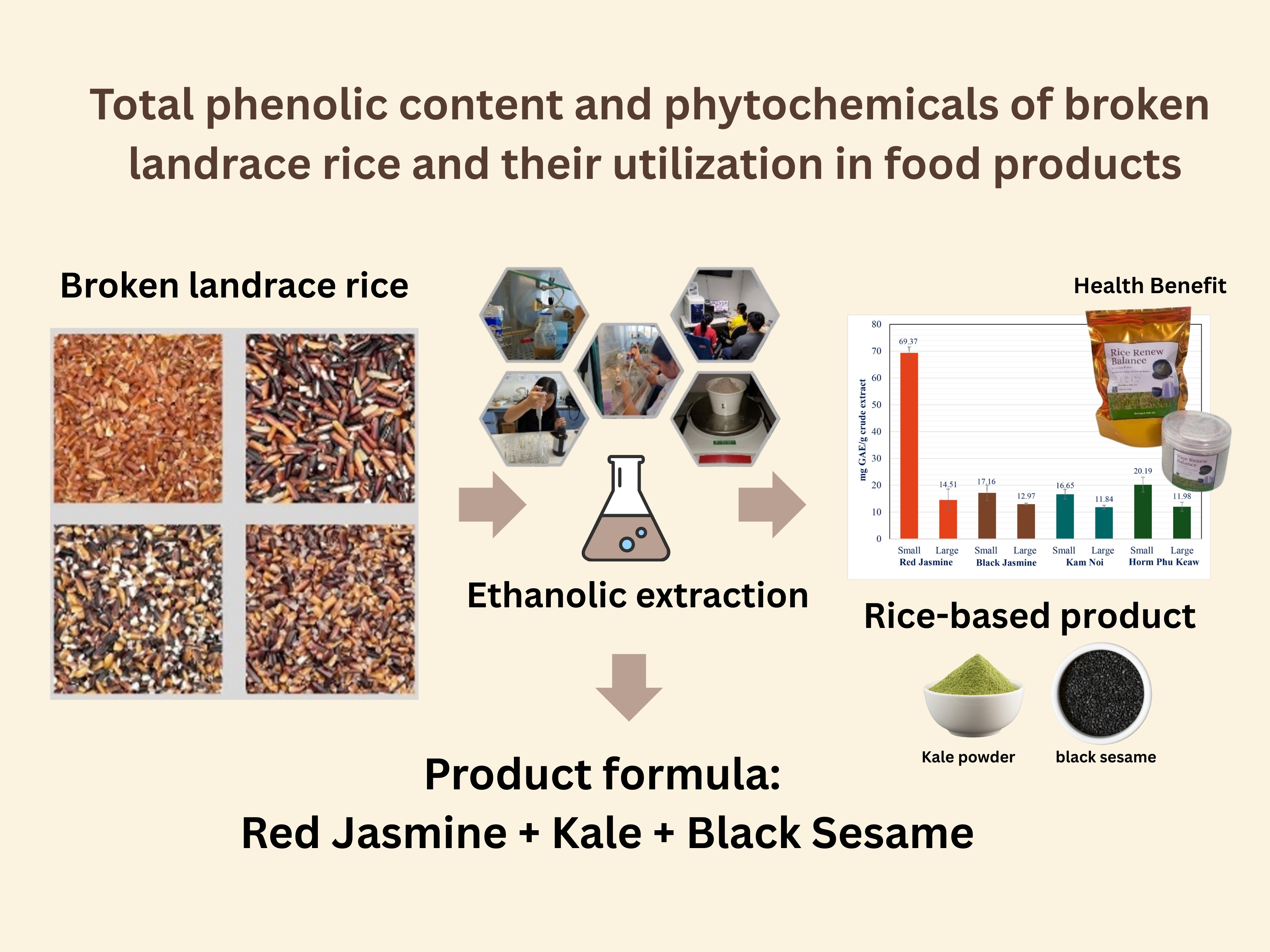
The aim of this research was to investigate the total phenolic content and phytochemical constituents of broken landrace rice flour from the Hom Dok Hang group, Ban Khok Sa-At, Sakon Nakhon province. Four types of rice—Red Jasmine, Black Jasmine, Kam Noi, and Hom Phu Keaw—were studied. The rice samples were crushed and sifted into two grain sizes: large grains, greater than 250 µm, and small grains, less than 250 µm. The rice samples were then extracted using ethanol as the solvent. The total phenolic content was determined, and the highest quantity of total phenolic content was found in the small grains of Red Jasmine flour, measured at 69.37 ± 2.22 mg GAE g⁻¹ crude extract. For all rice types, the small grain size was found to have a higher phenolic content compared to the large grain size. The phytochemical was evaluated by qualitative analysis. It was found to contain anthraquinone, saponin, cardiac glycosides, terpenoids, flavonoids, coumarins, alkaloids, and tannins: however, steroids were not detected. Red Jasmine rice was selected as the main ingredient for product development. Kale powder and roasted black sesame powder were added to create a rice-based product targeted at menopausal women. The sensory properties of the product were evaluated, and the highest score was achieved with a recipe containing 85 g of Red Jasmine rice flour, 5 g of kale powder, and 15 g of black sesame powder. This study suggests that broken landrace rice flours are promising ingredients for food products, as they contain high levels of phytochemicals and antioxidants beneficial for health. Additionally, this approach adds value to raw materials that would otherwise be considered waste, such as broken rice, by transforming them into prototype food products.
GRAPHICAL ABSTRACT
HIGHLIGHTS
- This research provides a guideline for adding value to low-priced broken rice by transforming it into an instant rice product.
- This study found that rice ground into a finer size contains higher levels of important compounds, such as phenolic compounds and many phytochemicals, compared to coarsely ground rice.
References
Snansiang, N. (2022). Investigating efficiency and total factor productivity of rice production in Thailand: Provincial and spatial analysis (Master’s thesis). Thammasat University.
Sukpanich, S., & Weiqiang, W. (2021). The influencing factors of Thai white rice export to international trade (2015-2020). International Journal of Scientific and Research Publications, 11(12), 278-286.
MySakonNakhon.com. (2025, July 1). Sakon Nakhon rice testing-The best rice in Thailand. https://mysakonnakhon.com/sakon-nakhon-rice-tasting/
Montreewat, R. (2025, July 1). Homdokhung rice. https://readthecloud.co/homdokhung-rice/
Zhang, Y.C., Luo, M., Fang, X. Y., Zhang, F. Q., & Cao, M. H. (2021). Energy value of rice, broken rice, and rice bran for broiler chickens by the regression method. Poultry Science, 100(4), 100972. https://doi.org/10.1016/j.psj.2020.12.069
Bautista, R. C., & Counce, P. A. (2020). An overview of rice and rice quality. Cereal Foods World, 65(5).https://doi.org/10.1094/CFW-65-5-0052
MASI. (2025, July 1). Broken rice in farming – A rich source of nutrition for animals. https://masi.vn/broken-rice-in-farming-a-rich-source-of-nutrition-for-animals
Abd. Razak, D. L., Abd. Rashid, N. Y., Jamaluddin, A., Abd. Ghani, A., & Abd. Manan, M. (2021). Antioxidant activities, tyrosinase inhibition activity and bioactive compounds content of broken rice fermented with Amylomyces rouxii. Food Research5, 1, 65-72. https://doi.org/10.26656/fr.2017.5(S1).026
Loyda, C., Singanusong, R., Jaranrattanasri, A., & Tochampa, W. (2021). Physicochemical characterization of broken rice and analysis of its volatile compounds. Walailak Journal of Science and Technology, 18(6), 9136. https://doi.org/10.48048/wjst.2021.9136
Richardson, M. G., Crandall, P G., Seo, H. S., & O’Bryan, C. A. (2021). Us Consumers’s perceptions of raw and cooked broken rice. Foods, 10(12), 2899. https://doi.org/10.3390/foods10122899
Bruce, R. M., & Atungilu, G. G. (2018). Assessment of pasting characteristics of size fractionated industrial parboiled and non-parboiled broken rice. Cereal Chemistry, 95(6), 889-899.
Kamdaeng, P. (2020). The management of menopausal symptoms. Nursing Journal, 47(1), 478-488.
Sharan, K., Siddiqui, J. A., Swarnkar, G., Maurya, R., & Chattopadhyay, N. (2009). Role of phytochemicals in the prevention of menopausal bone loss: evidence from in vitro and in vivo, Human Interventional and Pharmacokinetic studies. Current Medicinal Chemistry, 16, 1138-1157.
Bolla, K. N. (2020). Application of phytochemicals to enhance the quality of life of women. Insights in Nutrition and Metabolism, S(3), 7.
Suwannatrai, K., Namwongsa, K., Phanomkhet, N., Nuntapanich, H., & Roschat, W. (2022). The analysis of nutritional value, total phenolic and flavonoid contents, and antioxidant activities form the ethanolic extracts of the roasted broken brown rice powder. SNRU Journal of Science and Technology, 14(2), 246426. https://doi.org/10.55674/snrujst.v14i2.246426
Yafang, S., Gan, Z., & Jinsong, B. (2020). Total phenolic content and antioxidant capacity of rice grains with extremely small size. African Journal of Agricultural Economics and Rural Development, 8(11), 001-005.
Ikpe, E. E., & Akpabio, U. D. (2013). Phytochemical screening and anti-tussive studies of aqueous and alcoholic extracts of Aneilema aequinoctiale. Elixir Applied Chemistry, 58, 14868-14873.
Jothi Muniyandi, M., & Lakshman, K. (2018). Preliminary studies of phytochemical investigation on coastal medicinal plants of Boloor, Mangalore. Indo American Journal of Pharmaceutical Sciences, 05(02), 1309-1315.
Tirasarot, J., & Thanomwong, C. (2015). Production of healthy beverage from Homnil rice. KKU Science Journal, 3(3), 395-402
Phonpannawit, A. (2022). Healthy instant powdered drink product from Leum Pua rice and purple corn silk. NSRU Science and Technology Journal, 14(20), 1-14.
Bioway. (2024, December 26). How much organic kale powder per day. https://www.biowayorganicinc.com/info/how-much-organic-kale-powder-daily-take-per-da-94556961.html
AOAC. (2012). Official Methods of Analysis of AOAC International (19th Ed.). AOAC International.
Bacteriological Analytical Manual Online. (2024, December 26). Enumeration of Escherichia coli and the Coliform Bacteria.
https://www.fda.gov/food/laboratory-methods-food/bacteriological-analytical-manual-bam
CIQTEK. (2025, July 3). Exploring rice-Scanning electron microscope (SEM) application. https://www.ciqtekglobal.com/exploring-rice-scanning-electron-microscope-sem-applications_n14
Gu, X., Wang, P., Huang, J., Chen, S., Li, D., Pu, S., Li, J., & Wen, J. (2024). Structural and physicochemical properties of rice starch from a variety with high resistant starch and low amylose content. Frontiers in Nutrition, 11,1413923. https://doi.org/10.3389/fnut.2024.1413923
Riceland. (2025, July 3). Anatomy of rice. https://www.riceland.com/anatomy-of-rice
Kalpanadevi, C., Singh, V., & Subramanian, R. (2018). Influence of milling on the nutritional composition of bran from different rice varieties. Journal of Food Science and Technology, 55, 2259-2269.
Memon, A. A., Mahar, I., Memon, R., Soomro, S., Harnly, J., Memon, N., Bhangar, M. I., & Luthria, D. L. (2020). Impact of flour particle size on nutrient and phenolic acid composition of commercial wheat varieties. Journal of Food Composition and Analysis, 86, 103358. https://doi.org/10.1016/j.jfca.2019.103358
Tikapunya, T., Pompimon, W., Khamjainuk, P., & Sansomchai. (2022). Biological activity and its related compounds of red jasmine rice extracts linked to normal fibroblast viability for cosmetic product. Current Chemistry Letters, 11, 69-74.
Shao, Y., Xu, F., Chen, Y., Huang, Y., Beta, T., & Bao, J. (2015). Analysis of genotype, environment, and their interaction effects on the phytochemicals and antioxidant capacities of red rice (Oryza sativa L.). Cereal Chemistry, 92(2), 204-210. https://doi.org/10.1094/CCHEM-06-14-0126-R
Nawaz, H., Rehman, H., Aslam, M., Gul, H., Zakir, I., Fatima, Z., Iqbal, P., Khan, A., & Nahar, K. (2022). Phytochemical composition of rice. In N. Sarwar, A. Rehman, A. Amad & M. Hasanuzzaman (Eds.) Modern Techniques of rice crop production (pp.757-780). Springer Singapore.
Palis, C. N., Safitri, A., & Fatchiyah, F. (2024). Phytochemical screening of Indonesian brown rice (Oryza sativa L.) extracts compounds. AIP Conference Proceedings, 3055, 020005. https://doi.org/10.1063/5.0193626
Ghasemzadeh, A., Karbalaii, M. T., Jaafar, H. Z. E., & Rahmat, A. (2018). Phytochemical constituent, antioxidant activity, and antiproliferative properties of black, red, and brown rice bran. Chemistry Central Journal, 12, 17.
Nakornriab, M., & Krasaetep, J. (2018). Phytochemicals and antioxidant activity of Thai rice flowers. Journal of Food Health and Bioenvironmental Science, 11(1), 97-111.
Kammapana, L. (2023). Physical characteristics, phytochemical contents and antioxidant activity of ten organic-pigmented rice variety from Surin province. Trend in Science, 20(4), 4566. https://doi.org/10.48048/tis.2023.4566
Thai Industrial Standard Institute, Ministry of Industry. (2019). Thai Community Product Standard Instant rice (CPS.1068/2019). Thai Industrial Standard Institute.
Kuhnle, G. G., Dell’Aquila, C., Aspinall, S. M., Runswick, S. A., Joosen, A. M., Mulligan, A. A., & Bingham, S. A. (2009). Phytoestrogen content of fruits and vegetables commonly consumed in the UK based on LC–MS and 13C-labelled standards. Food Chemistry, 116(2), 542-554. https://doi:10.1016/j.foodchem.2009.03.002
Vanisha, K., Atwal, A. K., Dhaliwal, S. S., & Banga, S. K. (2013). Assessment of Diverse Sesame (Sesamum indicum L.) Germplasm for Mineral Composition. The Journal of Plant Science Research, 29(1), 29-36.
Downloads
Published
How to Cite
Issue
Section
Categories
License
Copyright (c) 2025 : Thatchaphol Tassana-iem, Kotchakorn Sangkla, Warissara Srina, Yanisa Charoenrat, Pannaphorn Sittiwong, Sakolrat Sawatmoon

This work is licensed under a Creative Commons Attribution-NonCommercial-NoDerivatives 4.0 International License.