Effect of drying methods on phenolics, flavonoids and antioxidant activities in yellow bell flower (Tecoma stans (L.) Juss. ex Kunth) powder
DOI:
https://doi.org/10.55674/cs.v18i1.262946Keywords:
drying methods, yellow bell flower, Antioxidant, Tecoma stans (L.) Juss. ex KunthAbstract
The objective of this research is to study the effect of different drying methods on phenolics, flavonoids and antioxidant activities in yellow bell flower (Tecoma stans (L.) Juss. ex Kunth) powder. These methods include sun and hot air drying at 60 °C for 6 h and 7 h. The flower powder was extracted by water under temperature at 70 °C for 7 min. The extract was analyzed for phenolics, flavonoids, and antioxidant activities. The results found that the powder of hot air drying at 60o C for 6 h has antioxidant activity higher than that of the powder of hot air drying at 60 °C for 7 h and sun drying, respectively. The powder has total phenolics and flavonoids as 16.381±0.836 mg GAE g-1 powder and 4.920±0.154 mg CE g-1 powder, respectively. DPPH free radical scavenging activity is 0.520±0.039 mg AAE g-1 powder. ABTS free radical scavenging activity is 6.186±0.046 mg AAE g-1 powder). Ferric reducing antioxidant power is 17.582±0.682 µmol Fe2+ E g-1 powder. Total antioxidant capacity is 71.030±0.902 mg AAE g-1 powder. These results indicated that the sun and hot air drying under different temperature and time, affected on content of phenolics, flavonoids and antioxidant activities in yellow bell flower (T. stans) powder.
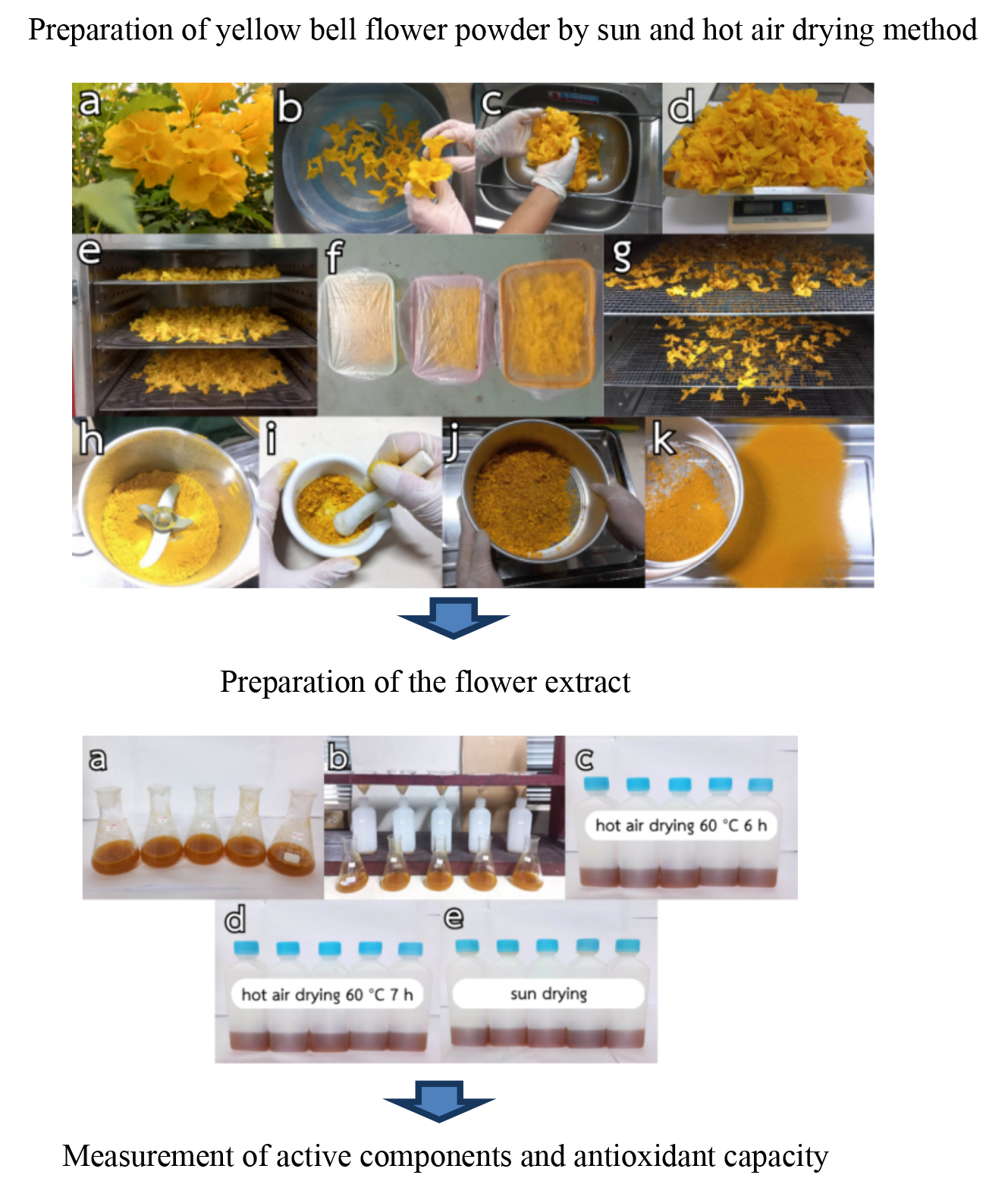
GRAPHICAL ABSTRACT
HIGHLIGHTS
- Preparation of yellow bell flower powder by sun and hot air drying method
- Preparation of the flower extract
- Measurement of active components and antioxidant capacity
References
Pallavi, K., Vishnavi, B., Mamatha, Vanitha Prakash, K., & Amrutha Priyanka, A. (2014). Phytochemical investigation and anti-microbial activity of Tecoma stans, World Journal of Pharmaceutical Research, 3(2), 2070 – 2083.
Anand, M., & Basavaraju, R. (2018). Antimicrobial efficacy of Tecoma stans (L.) Juss. ex Kunth: A review. European Journal of Biotechnology and bioscience, 7(1), 27 - 30.
AnJu, S., Vikas, K., Rajendiran, A., & Pooja, G. (2021). Phytochemical, pharmacogenetic and hepatoprotective activity of the leaves of Tecoma stans. Journal of Medical Pharmaceutical and Allied Science, 10(5) 3564 3568. https://doi.org/10.22270/jmpas.V10I5.1393
Gonçalves, T. P. R., Parreira, A. G., dos Santos Zanuncio, V. S., de Souza Farias, K., da Silva, D. B., & dos Santos Lima, L. A. R. (2022). Antibacterial and antioxidant properties of flowers from Tecoma stans (L.) Juss. ex Kunth (Bignoniaceae). South African Journal of Botany, 144, 156 - 165. https://doi.org/10.1016/j.sajb.2021.08.028
Oh, J., Jo, H., Cho, A.R., Kim, S. J., & Han, J. (2013). Antioxidant and antimicrobial activities of various leafy herbal teas. Food Control, 31, 403 - 409. https://doi.org/10.1016/j.foodcont.2012.10.021
Chahmi, N., Anissi, J., Jennan, S., Farah, A., Sendide, K., & Hassouni, M. E. (2015). Antioxidant activities and total phenol content of Inula viscosa extracts selected from three regions of Morocco. Asian Pacific Journal of Tropical Biomedicine, 5(3) 228 233. https://doi.org/10.1016/S2221-1691(15)30010-1
Chen, X., Li, X., Mao, X., Huang, H., Wang, T., Qu, Z., Miao, J., & Gao, W. (2017). Effects of drying processes on starch-related physicochemical properties, bioactive components and antioxidant properties of yam flours. Food Chem, 224, 224 232. https://doi.org/10.1016/j.foodchem.2016.12.028
Yuan, J., Hao, L. J., Wu, G., Wang, S., Duan, J., Xie, G. Y., & Qin, M. J. (2015). Effect of drying methods on the phytochemicals contents and antioxidant properties of chrysanthemum flower heads harvested at two developmental stanges. Journal of Functional Foods, 19, 786 - 795.
Liu, S. C., Lin, J. T., Hu, C. C., Shen, B. Y., Chen, T. Y., Chang, Y. L., Shih, C. H., & Yang, D. J. (2017). Phenolic inbred varieties of Lycium chinense Miller harvested at various times. Food Chem, 215, 284 - 291. https://doi.org/10.1016/j.foodchem.2016.06.072
Shankar, S., Settu, S., Segaran, G., Sundar, R. D. V., & Ravi, L. (2018). Phytochemical constituents of Dracaena mahatma leaves and their anti-bacterial, antioxidant and anti-inflammatory significance. Biotechnology Research and Innovation, 2, 1 - 8. http://dx.doi.org/10.1016/j.biori.2018.09.002
AOAC. (1990). Official Method of Analysis. 15th ed. Association of the Analytical Chemists. AOAC, Washington, DC.
Wongklom, A. (2018). Effect of different drying methods on the water soluble total phenolics and flavonoids contents, and antioxidant activities of sunchoke (Helianthus tuberosus L.) powder. SNRU Journal of Science and Technology, 10(3), 170 - 177.
Wongklom, A., & Panboon, S. (2024). Effect of the drying methods on total phenolics, total flavonoids and antioxidant activities in Ya-Nang leaf (Tiliacora triandra) powder. Creative Science, 16(1), 251037. https://doi.org/10.55674/cs.v16i1.251037
Zheng, M., Xia, Q., & Lu, S. (2015). Study on drying methods and their influences on effective components of loquat flower tea. LWT - Food Science and Technology, 63,14 - 20. https://doi.org/10.1016/j.lwt.2015.03.090
Wongklom, A., Siriwan, K., & Krairam, S. (2023). Effect of drying methods on the water soluble phenolics, flavonoids and antioxidant activities in baby jackfruit leaves (Momordica cochinchinensis (Lour.) Spreng.) powder. Creative Science, 15(1), 240449.
Silva, K. D. R. R., & Sirasa, M. S. F. (2016). Antioxidant properties of selected fruit cultivars grown in Sri Lanka. Food Chem, 238, 203 - 208. https://doi.org/10.1016/j.foodchem.2016.08.102
Dravie, E. E., Kortei, N. K., & Essuman, E. K. (2020). Antioxidant, phytochemical and physicochemical properties of sesame seed (Sesamum indicum L). Scientific African, 8, e00349. https://doi.org/10.1016/j.sciaf.2020.e00349
Miao, J., Liu, J., Gao, X., Lu, F., & Yang, X. (2022). Effects of different drying methods on chemical compositions, antioxidant activity and anti-α-glucosidase activity of Coreopsis tinctoria flower tea. Heliyon, 8, e11784. https://doi.org/10.1016/j.heliyon.2022.e11784
Kolla, M. C., Laya, A., Bayang, J. P., & Koubal, B. B. (2021). Effect of different drying methods and storage conditions on physical, nutritional, bioactive compounds and antioxidant properties of doum (Hyphaene thebaica) fruits. Heliyon, 7, e06678.
https://doi.org/10.1016/j.heliyon.2021.e06678
Roslan, A. S., Ismail, A., Ando, Y., & Azlan, A. (2020). Effect of drying methods and parameters on the antioxidant properties of tea (Camellia sinensis) leaves, Food Production. Processing and Nutrition, 2(8), 1 - 11. https://doi.org/10.1186/s43014-020-00022-0
Hossain, M. B., Barry-Ryan, C., Martin-Diana, A. B., & Brunton, N. P. (2010). Effect of drying method on the antioxidant capacity of six Lamiaceae herbs. Food Chemistry, 123, 85 - 91. https://doi.org/10.1016/j.foodchem.2010.04.003
Heim, K. E., Tagliaferro, A. R., & Bobilya, D. J. (2002). Flavonoid antioxidants: Chemistry, metabolism and structure-activity relationships. Journal of Nutritional Biochemistry, 13, 572 – 584. https://doi.org/10.1016/S0955-2863(02)00208-5
Ioannou, I., Hafsa, I., & Ghoul, M. (2012). Review of the effects of food processing and formulation on flavonol and anthocyanin behaviour. Journal of Food Engineering, 111, 208 – 217. https://doi.org/10.1016/j.jfoodeng.2012.02.006
Ioannou, I., Chekir, L., & Ghoul, M. (2020). Effect of Heat Treatment and Light Exposure on the Antioxidant Activity of Flavonoids. Processes, 8, 1078.https://doi.org/10.3390/pr8091078
Downloads
Published
How to Cite
Issue
Section
Categories
License
Copyright (c) 2025 : Amornrat Wongklom, Temsiri Tharakhachat , Thatdawan Khamphachat

This work is licensed under a Creative Commons Attribution-NonCommercial-NoDerivatives 4.0 International License.