Study of active compounds in Zingiberaceae and Niacin content in Broken Rice for herbal soap formulation
DOI:
https://doi.org/10.55674/cs.v18i1.262942Keywords:
Active Compounds, Broken Rice, Herbal Soap, Niacin, Zingiberaceae familyAbstract
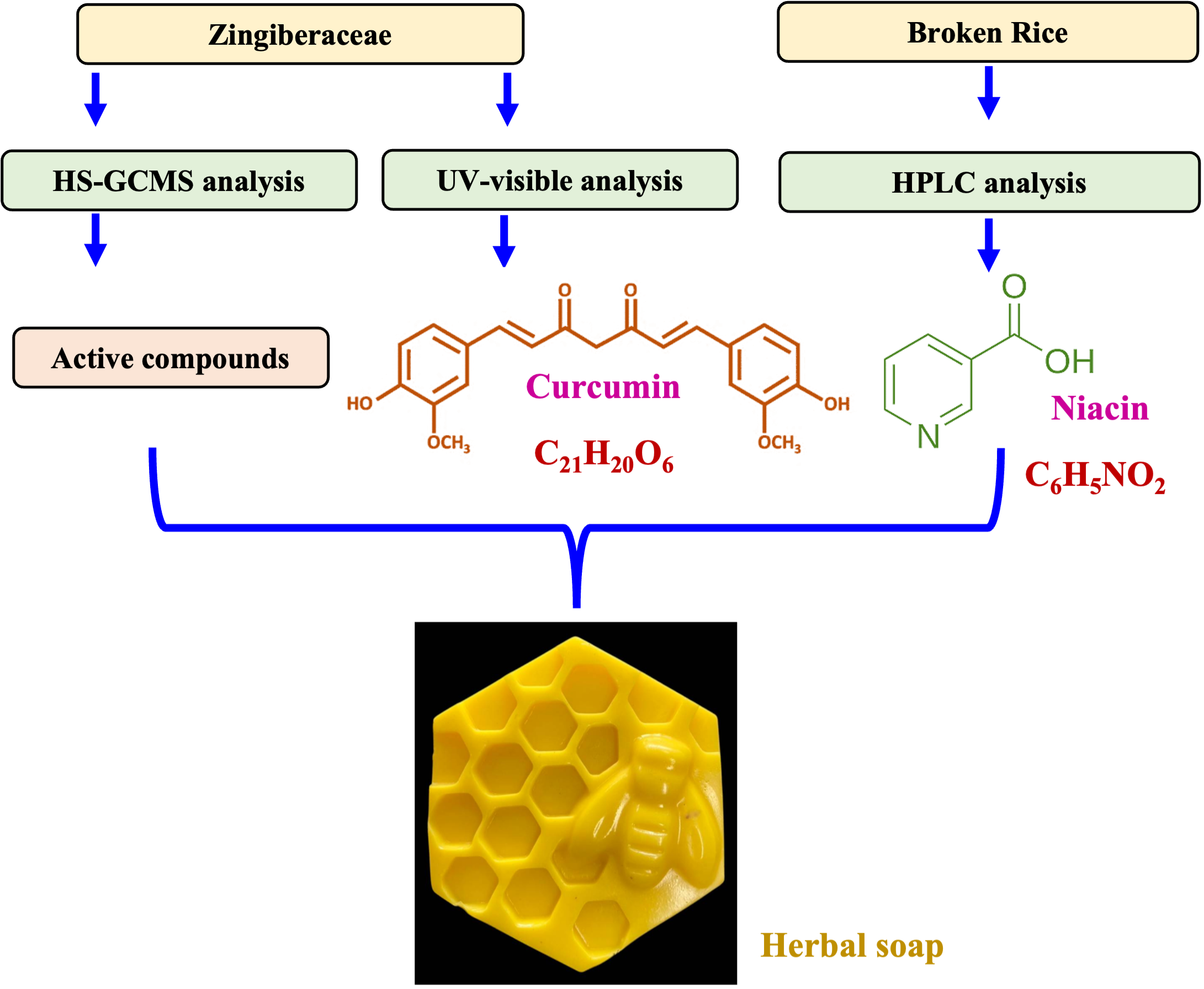
This research studied the chemical composition of three species from the Zingiberaceae family (Curcuma longa L., Curcuma aromatica Salisb. and Zingiber montanum (J.Koening) Link ex A.Dietr.) and analyzed the niacin content in extracts from four cultivars of broken rice, namely Daeng Mueang Loei, Siw Kliang Mueang Loei, Black Sticky Rice and Sticky Rice RD6, for use as active ingredients in the development of herbal soap formulations, as an option to add value to the rice farming community of Ban Nam Yen, Dan Sai District, Loei Province. The study of active compounds Zingiberaceae using HS-GCMS revealed that C. longa L. and Z. montanum (J.Koening) Link ex A.Dietr.) contained Bicyclo[3.1.0] hexane, 4-methylene-1-(1-methylethyl)- (cis-sabinene) as the highest component, while C. aromatica Salisb. had (R)-1-Methyl-4-(6-methylhept-5-en-2-yl)cyclohexa-1,4-diene (beta-Curcumene) as the predominant compound. Quantitative analysis of curcumin by UV-Visible spectrophotometry showed that C. longa had the highest curcumin content at 2.92± 0.13 g 100g-1. For the analysis of niacin content in broken rice by HPLC, Daeng Mueang Loei was found to have the highest content at 5.69±0.19 mg kg-1, whereas niacin was not detected in Black Sticky Rice. Method validation confirmed reliability for the quantitative analysis (R² ≥ 0.9950, %RSD ≤11%, 80-110% recovery). Formula 1 demonstrated superior physical and chemical properties in the base formula, identifying it as suitable for herbal soap development. These results establish foundational data for developing products incorporating rice and Zingiberaceae extracts.
GRAPHICAL ABSTRACT
HIGHLIGHTS
- Active Compounds in Zingiberaceae: The study using HS-GCMS identified that longa and Z. montanum contained cis-sabinene as the highest component, while C. aromatica had β-Curcumene as the predominant compound.
- Curcumin content in longa: The quantitative analysis of curcumin by UV-visible spectroscopy revealed that C. longa contained the highest curcumin content at 2.9173±0.13 g/100g.
- Niacin content in broken rice: The HPLC analysis showed that Daeng Mueang Loei had the highest niacin content at 5.6943±0.19 mg/kg, while niacin was not detected in Black Sticky Rice.
- Method validation: The method validation confirmed the reliability of the quantitative analysis, with R² ≥ 0.9950, %RSD < 11%, and a recovery rate between 80-110%.
- Herbal soap development: Formula 1 exhibited superior physicochemical properties compared to the base formula, indicating its suitability for herbal soap development.
- Foundational data: The results provide basic data for the development of products incorporating rice and Zingiberaceae plant extracts.
References
Reveny, J., Tanuwijaya, J., & Tias, A. (2016). Comparison of anti-aging effect between vitamin B3 and provitamin B5 using skin analyzer. International Journal of PharmTech Research, 9(7), 99–104.
Bissett, D. L., Oblong, J. E., & Berge, C. A. (2005). Niacinamide: A B vitamin that improves aging facial skin appearance. Dermatologic Surgery, 31(7 Pt 2), 860-865. https://doi.org/10.1111/j.1524-4725.2005.31732
Vaughn, A. R., Branum, A., & Sivamani, R. K. (2016). Effects of turmeric (Curcuma longa) on skin health: a systematic review of the clinical evidence. Phytotherapy Research, 30(8), 1243-1264. https://doi.org/10.1002/ptr.5640
Chattopadhyay, I., Biswas, K., Bandyopadhyay, U., & Banerjee, R. K. (2004). Turmeric and curcumin:
Biological actions and medicinal applications. Current science, 87(1), 44-53.
Thangapazham, R. L., Sharad, S., & Maheshwari, R. K. (2013). Skin regenerative potentials of curcumin. BioFactors, 39(1), 141-149. https://doi.org/10.1002/biof.1078
Mun, S. H., Joung, D. K., Kim, Y. S., Kang, O. H., Kim, S. B., Seo, Y. S., Kim, Y. C., Lee, D. S., Shin, D. W., Kweon, K. T., & Kwon, D. Y. (2019). Synergistic antibacterial effect of curcumin against methicillin-resistant Staphylococcus aureus. Phytomedicine, 15(12), 1246-1253.
https://doi.org/10.1016/j.phymed.2019.02.002
Kamfu, J., & Jamjang, K. (2018, December 21). Determination of curcumin from Alpinia galanga, Boesenbergia rotunda, and Curcuma xanthorhiza. The 5th National Academic Conference, Kampheang Phet Rajabhat University, 642-647.
Ling, Y.L., Morad, N., Alkarkhi, A.F.M., & Norli, I. (2018).Validation of HPLC method for the determination of 17α-ethynylestradiol (EE2) in aqueous phase. J. Phys. Sci., 29(Supp. 3), 87–94. https://doi.org/10.21315/jps2018.29.s3.11
Singh, G., Kapoor, I. P. S., Singh, P., de Heluani, C. S., de Lampasona, M. P., & Catalan, C. A. N. (2010). Comparative study of chemical composition and antioxidant activity of fresh and dry rhizomes of turmeric (Curcuma longa Linn.). Food and Chemical Toxicology, 48(4), 1026-1031. https://doi.org/10.1016/j.fct.2010.01.015
Dosoky, N. S., & Setzer, W. N. (2018). Chemical composition and biological activities of essential oils of Curcuma species. Nutrients, 10(9), 1196. https://doi.org/10.3390/nu10091196
Aggarwal, B. B., Yuan, W., Li, S., & Gupta, S. C. (2013). Curcumin-free turmeric exhibits anti-inflammatory and anticancer activities: Identification of novel components of turmeric. Molecular Nutrition & Food Research, 57(9), 1529-1542. https://doi.org/10.1002/mnfr.201200838
Poonam, Verma, M., Kumawat, O. P., Maurya, I. B., & Kumawat, S. (2023). Analysis of the curcumin content of various turmeric genotypes (Curcuma longa L.). Biological Forum An International Journal, 15(2), 606-608.
Wiphada, K., & Yingyod, P. (2011). Antioxidant activity and total curcuminoid content in some ginger species in Thailand. Agricultural Science Journal, 42(2) (Special Issue), 389–392.
Lichanporn, I., Nantachai, N., Tunganurat, P., & Akkarakultron, P. (2020). Vitamin and mineral content of six native varieties of rice in Thailand. International Journal of Geomate, 18(67), 51-56. https://doi.org/10.21660/2020.67.5696
International Conference on Harmonisation of Technical Requirements for Registration of Pharmaceuticals for Human Use. (2023, November 25). ICH harmonised tripartite guideline: Validation of analytical procedures: Text and methodology (Q2(R1)). International Council for Harmonisation. https://database.ich.org/sites/default/files/Q2%28R1%29%20Guideline.pdf
AOAC International. (2023, November 25). AOAC guidelines for single laboratory validation of chemical methods for dietary supplements and botanicals. https://s27415.pcdn.co/wp-content/uploads/2020/01/64ER20-7/Validation_Methods/dAOAC_Guidelines_For_Single_Laboratory_Validation_Dietary_Supplements_and_Botanicals.pdf
Thai Industrial Standards Institute. (2010). Announcement of the Thai Industrial Standards Institute No. 1624 (B.E. 2010) regarding the cancellation and determination of community product standards for glycerin soap bars (CPS.665/2010). Ministry of Industry.
Downloads
Published
How to Cite
Issue
Section
Categories
License
Copyright (c) 2025 : Napatsorn Wongpriaw, Thitinan Thammasom, Bussabavadee Puttanu, Kitti Tanmuangpak, Wilailux Sudwilai

This work is licensed under a Creative Commons Attribution-NonCommercial-NoDerivatives 4.0 International License.