The antibacterial activity and chemical components of Ginger (Zingiber officinale) and Phlai (Zingiber purpureum) essential oils against Propionibacterium acnes
DOI:
https://doi.org/10.55674/cs.v18i1.262861Keywords:
Chemical components, Antibacterial activity, Essential oil, Zingiber, Propionibacterium acnesAbstract
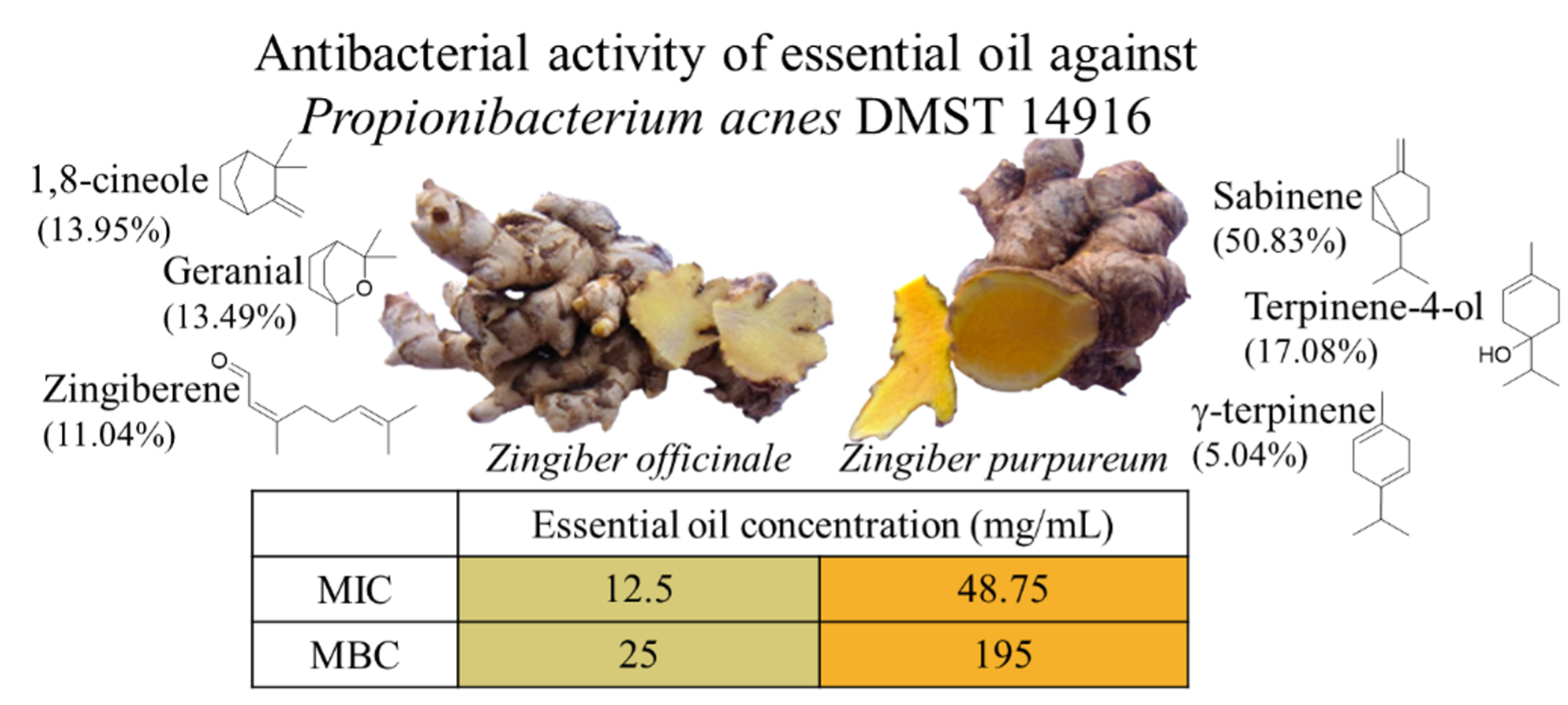
Zingiber officinale, commonly known as Ginger, and Zingiber purpureum, referred to as Phlai, are members of the Zingiberaceae family, extensively utilized in culinary practices and traditional medicinal applications. Nevertheless, there exists a paucity of information regarding their chemical constituents and antibacterial properties. In this work, we aim to elucidate the antibacterial properties and chemical constituents of the essential oils derived from the rhizomes of Ginger and Phlai. The essential oils were obtained through steam distillation. The antibacterial efficacy against Propionibacterium acnes DMST 14916 was determined utilizing both the Agar disc diffusion and broth microdilution methodologies. The chemical components of the essential oil were examined via Gas Chromatography-Mass Spectrometry. The Minimum Inhibitory Concentration (MIC) values for the antibacterial activity against P. acnes DMST 14916 were 1.56% and 6.25% V/V, respectively, whereas the Minimum Bactericidal Concentration (MBC) values were 3.12% and 25.00% V/V, respectively. The results indicated the presence of 11 distinct chemical constituents in Ginger oil, with the predominant components being 1,8-cineole (13.95%) and geranial (13.49%). In contrast, Phlai oil exhibited 17 constituents, with sabinene (50.83%) identified as the major component.
GRAPHICAL ABSTRACT
HIGHLIGHTS
- Essential oils from Zingiber officinale and Zingiber purpureum exhibit antibacterial activity against Propionibacterium acnes.
- GC-MS analysis revealed 1,8-cineole and sabinene as the major components in Ginger and Phlai oils, respectively.
- The research harnesses indigenous herbal knowledge and scientific methods to promote sustainable health care and lay the groundwork for community-driven commercial applications.
References
Rachkeeree, A., Kantadoung, K., Suksathan, R., Puangpradab, R., Page, P. A., & Sommano, S. R. (2018). Nutritional compositions and phytochemical properties of the edible flowers from selected Zingiberaceae found in Thailand. Frontiers in Nutrition, 5, 3. https://doi.org/10.3389/fnut.2018.00003
Ragsasilp, A., Saensouk, P., & Saensouk, S. (2022). Ginger family from Bueng Kan Province, Thailand: Diversity, conservation status, and traditional uses. Biodiversitas Journal of Biological Diversity, 23(5), 2739–2752. https://doi.org/10.13057/biodiv/d230556
Khunawattanakul, W., Caichompoo, W., Mekjaraskul, C., Charoenmit, A., Lekdee, C., & Srichan, N. (2017). Anti- Propionibacterium acnes from Thai herbal medicines. Journal of Science and Technology Mahasarakham University, 36(5), 607–613.
Samappito, W., Samappito, S., & Butkhup, L. (2017). Antibacterial activity of peel extracted from mangosteen (Garcinia mangostana Linn.) and phlai (Zingiber montanum Koenig) root extracted and phlai oil. Journal of Science and Technology Mahasarakham University, 36(1), 53–60.
Verma, R. S., Joshi, N., Padalia, R. C., Singh, V. R., Goswami, P., Verma, S. K., Iqbal, H., Chanda, D., Verma, R. K., Darokar, M. P., Chauhan, A., & Kandwal, M. K. (2018). Chemical composition and antibacterial, antifungal, allelopathic and acetylcholinesterase inhibitory activities of cassumunar-ginger. Journal of the science of food and agriculture, 98(1), 321–327. https://doi.org/10.1002/jsfa.8474
Silva, F. T. D., Cunha, K. F. D., Fonseca, L. M., Antunes, M. D., Halal, S. L. M. E., Fiorentini, Â. M., Zavareze, E. D. R., & Dias, A. R. G. (2018). Action of ginger essential oil (Z. officinale) encapsulated in proteins ultrafine fibers on the antimicrobial control in situ. International journal of biological macromolecules, 118, 107–115. https://doi.org/10.1016/j.ijbiomac.2018.06.079
Lertsatitthanakorn, P., Manwiwattanakun, K., Paengnakorn, N., & Khunkitti, W. (2014). Antibacterial Activity of an Effective Essential Oil Formulated in Liquid Soap Against Skin Bacteria. Chiang Mai Journal of Science, 41(1), 71–81.
Barnard, E., & Li, H. (2017). Shaping of cutaneous function by encounters with commensals. The Journal of physiology, 595(2), 437–450. https://doi.org/10.1113/JP271638
Walsh, T. R., Efthimiou, J., & Dréno, B. (2016). Systematic review of antibiotic resistance in acne: an increasing topical and oral threat. The Lancet Infectious Diseases, 16(3), e23–e33. https://doi.org/10.1016/s1473-3099(15)00527-7
Sukatta, U., Chidchuenchey, S., Rakthavorn, P., & Keeratinitakarn, W. (2010). In: Research Exhibition on the research path Kasetsart University 2010 Kasetsart Fair 2010. The Yield and Essential Oil Composition of Plai from Various Sources of Thailand and Its Applications in Healthcare Products. (pp. 2). Kasetsart University.
Duanyai, S., Manok, S., & Rodpo, P. (2020). Antioxidant and antimicrobial activities of essential oil from Thai Herbs to microorganisms causing dermatitis. KKU Science Journal, 48(1), 76–85.
Luangnarumitchai, S., Lamlertthon, S., & Tiyaboonchai, W. (2007). Antimicrobial Activity of Essential Oils Against Five Strains of Propionibacterium acnes. Mahidol University Journal of Pharmaceutical Sciences, 34(1–4), 60–64.
Al-Dhahli, A. S., Al-Hassani, F. A., Alarjani, K. M., Yehia, H. M., Al Lawati, W. M., Azmi, S. N. H., & Khan, S. A. (2020). Essential oil from the rhizomes of the Saudi and Chinese Z. officinale cultivars: Comparison of chemical composition, antibacterial and molecular docking studies. Journal of King Saud University – Science, 32(8), 3343–3350. https://doi.org/10.1016/j.jksus.2020.09.020
Paisooksantiwattana, Y. (2008). Talking about medicinal plants. Kasetsart University.
Saensouk, S., Saensouk, P., Pasorn, P., & Chantaranothai, P. (2016). Diversity and uses of Zingiberaceae in Nam Nao National Park, Chaiyaphum and Phetchabun provinces, Thailand, with a new record for Thailand. Agriculture and Natural Resources, 50(6), 445–453. https://doi.org/10.1016/j.anres.2016.08.002
Saensouk, S., Saensouk, P., & Chanshotikul, N. (2017). Diversity and traditional uses of Zingiberaceae in Nong Khai Province, Thailand. KKU Science Journal, 45(3), 574–594.
Nookong, M., Narkprasom, N., & Areesrisom, P. (2013). Optimization in essential oils extraction of Zingiber cassumunar Roxb. By water and steam distillation. Faculty of engineering and agro-industry, Maejo University.
Boonyune, T. (2013). Stability and antibacterial activity of emulsions prepared from cinnamon and citrus volatiles oils (Master's thesis). Chulalongkorn University. https://doi.org/10.58837/CHULA.THE.2013.792
Sebiomo, A., Awofodu, A. D., Awosanya, A. O., Awotona, F. E., & Ajayi, A. J. (2011). Comparative studies of antibacterial effect of some antibiotics and ginger (Zingiber officinale) on two pathogenic bacteria. Journal of Microbiology and antimicrobials, 3(1), 18–22.
Prathumtet, J., Sriraj, P., Aukkanimart, R., Poowanna, R., Kaewsoongnern, T., Jongjitt, K., & Donthuan, J. (2021). Comparison of antioxidant and anti-acne causing bacteria (P. acnes) activities of methanolic extracts from Triphala herbals. Journal of Traditional Thai Medical Research, 7(1), 1–14.
Thananant, H., & Satnako, N. (2015, April 24).. Antimicrobial activity of Mao Berry extract against Staphylococcus aureus and Propionibacterium acnes. RSU National Research Conference. Rangsit University, 184-191. https://doi.org/10.14458/RSU. res.2015.160
Alnabati, N. A., Al-Hejin, A. M., Noor, S. O., Ahmed, M. M. M., Abu-Zeid, M., & Mleeh, N. T. (2021). The antibacterial activity of four Saudi medicinal plants against clinical isolates of Propionibacterium acnes. Biotechnology & Biotechnological Equipment, 35(1), 415–424. https://doi.org/10.1080/13102818.2021.1885992
Zainol, M. I., Mohd Yusoff, K., & Mohd Yusof, M. Y. (2013). Antibacterial activity of selected Malaysian honey. BMC complementary and alternative medicine, 13, 129. https://doi.org/10.1186/1472-6882-13-129
Zu, Y., Yu, H., Liang, L., Fu, Y., Efferth, T., Liu, X., & Wu, N. (2010). Activities of ten essential oils towards P. acnes and PC-3, A-549 and MCF-7 cancer cells. Molecules, 15(5), 3200–3210. https://doi.org/10.3390/molecules15053200
Calo, J. R., Crandall, P. G., O’Bryan, C. A., & Ricke, S. C. (2015). Essential oils as antimicrobials in food systems – A review. Food Control, 54, 111–119. https://doi.org/10.1016/j.foodcont.2014.12.040
Boonyanugomol, W., Kraisriwattana, K., Rukseree, K., Boonsam, K., & Narachai, P. (2017). In vitro synergistic antibacterial activity of the essential oil from Zingiber cassumunar Roxb. against extensively drug-resistant Acinetobacter baumannii strains. Journal of Infection and Public Health, 10(5), 586–592. https://doi.org/10.1016/j.jiph.2017.01.008
Sharifzadeh, A., Javan, A. J., Shokri, H., Abbaszadeh, S., & Keykhosravy, K. (2016). Evaluation of antioxidant and antifungal properties of the traditional plants against foodborne fungal pathogens. Journal de Mycologie Médicale, 26(1), e11–e17. https://doi.org/10.1016/j.mycmed.2015.11.002
Kamal, G. M., Nazi, N., Sabir, A., Saqib, M., Zhang, X., Jiang, B., Khan, J., Noreen, A., Uddin, J., & Murtaza, S. (2023). Yield and Chemical Composition of Ginger Essential Oils as Affected by Inter-Varietal Variation and Drying Treatments of Rhizome. Separations, 10(3), 186. https://doi.org/10.3390/separations10030186
Kiran, C. R., Chakka, A. K., Amma, K. P. P., Menon, A. N., Kumar, M. M. S., & Venugopalan, V. V. (2013). Influence of Cultivar and Maturity at Harvest on the Essential Oil Composition, Oleoresin and [6]-Gingerol Contents in Fresh Ginger from Northeast India. Journal of Agricultural and Food Chemistry, 61(17), 4145–4154. https://doi.org/10.1021/jf400095y
Chrubasik, J. E., Roufogalis, B. D., & Chrubasik, S. (2007). Evidence of effectiveness of herbal antiinflammatory drugs in the treatment of painful osteoarthritis and chronic low back pain. Phytotherapy Research, 21(7), 675–683. https://doi.org/10.1002/ptr.2142
Prasad, S., & Tyagi, A. K. (2015). Ginger and its constituents: role in prevention and treatment of gastrointestinal cancer. Gastroenterology research and practice, 2015(1), 142979. https://doi.org/10.1155/2015/142979
Schadich, E., Hlaváč, J., Volná, T., Varanasi, L., Hajdúch, M., & Džubák, P. (2016). Effects of ginger phenylpropanoids and quercetin on Nrf2‐ARE pathway in human BJ fibroblasts and HaCaT keratinocytes. BioMed research international, 2016, 2173275. https://doi.org/10.1155/2016/2173275
Yeh, H.-Y., Chuang, C.-H., Chen, H.-C., Wan, C.-j., Chen, T.-L., & Lin, L.-Y. (2014). Bioactive components analysis of two various gingers (Zingiber officinale Roscoe) and antioxidant effect of ginger extracts. LWT - Food Science and Technology, 55(1), 329–334. https://doi.org/10.1016/j.lwt.2013.08.003
Bua-in, S., & Paisooksantivatana, Y. (2009). Essential Oil and Antioxidant Activity of Cassumunar Ginger (Zingiberaceae: Zingiber montanum (Koenig) Link ex Dietr.) Collected from Various Parts of Thailand. Kasetsart Journal Natural Science, 43(3), 467–475.
Wang, Y., You, C. X., Yang, K., Wu, Y., Chen, R., Zhang, W. J., Liu, Z. L., Du, S. S., Deng, Z. W., Geng, Z. F., & Han, J. (2015). Bioactivity of Essential Oil of Z. purpureum Rhizomes and Its Main Compounds against Two Stored Product Insects. Journal of economic entomology, 108(3), 925–932. https://doi.org/10.1093/jee/tov030
Charoenchai, L., Saohin, W., & Boonchoong, P. (2013). The Study of Chemical Compositions of Volatile Oil from Fresh Ginger Rhizomes and Ginger Capsules in Thailand. Isan Journal of Pharmaceutical Sciences, 9(1), 52–63. https://doi.org/10.14456/ ijps.2013.5
Wohlmuth, H., Smith, M. K., Brooks, L. O., Myers, S. P., & Leach, D. N. (2006). Essential oil composition of diploid and tetraploid clones of ginger (Zingiber officinale Roscoe) grown in Australia. Journal of agricultural and food chemistry, 54(4), 1414–1419. https://doi.org/10.1021/jf0521799
Bhattarai, K., Pokharel, B., Maharjan, S. & Adhikari, S. (2018). Chemical Constituents and Biological Activities of Ginger Rhizomes from Three Different Regions of Nepal. Journal of Nutritional Dietetics & Probiotics, 1(1), 1–12.
Manochai, B., Paisooksantivatana, Y., Choi, H. & Hong, J. H. (2010). Variation in DPPH scavenging activity and major volatile oil components of cassumunar ginger, Zingiber montanum (Koenig), in response to water deficit and light intensity. Scientia Horticulturae, 126(4), 462–466. https://doi.org/10.1016/j.scienta.2010.07.011
Charalambous, G. (1994). Spices, herbs and edible fungi (1st ed.). Elsevier Science.
Farhanghi, A., Aliakbarlu, J., Tajik, H., Mortazavi, N., Manafi, L., & Jalilzadeh‐Amin, G. (2022). Antibacterial interactions of pulegone and 1,8‐cineole with monolaurin ornisin against Staphylococcus aureus. Food Science & Nutrition, 10(8), 2659–2666. https://doi.org/10.1002/fsn3.2870
Kifer, D., Mužinić, V., & Klarić, M. Š. (2016). Antimicrobial potency of single and combined mupirocin and monoterpenes, thymol, menthol and 1,8-cineole against Staphylococcus aureus planktonic and biofilm growth. The Journal of Antibiotics, 69, 689–696. https://doi.org/10.1038/ja.2016.10
Vijayakumar, K., Manigandan, V., Jeyapragash, D., Bharathidasan, V., Anandharaj, B., & Sathya, M. (2020). Eucalyptol inhibits biofilm formation of Streptococcus pyogenes and its mediated virulence factors. Journal of medical microbiology, 69(11), 1308–1318. https://doi.org/10.1099/jmm.0.001253
Soković, M., Glamočlija, J., Marin, P. D., Brkić, D., & Griensven, L. J. L. D. v. (2010). Antibacterial Effects of the Essential Oils of Commonly Consumed Medicinal Herbs Using an In Vitro Model. Molecules, 15(11), 7532–7546. https://doi.org/10.3390/molecules15117532
Wang, Y., Zhang, Y., Song, X., Fang, C., Xing, R., Liu, L., Zhao, X., Zou, Y., Li, L., Jia, R., Ye, G., Shi, F., Zhou, X., Zhang, Y., Wan, H., Wei, Q., & Yin, Z. (2022). 1,8-Cineole inhibits biofilm formation and bacterial pathogenicity by suppressing luxS gene expression in Escherichia coli. Frontiers in pharmacology, 13, 988245. https://doi.org/10.3389/fphar.2022.988245
Moo, C. L., Osman, M. A., Yang, S. K., Yap, W. S., Ismail, S., Lim, S. H. E., Chong, C. M., & Lai, K. S. (2021). Antimicrobial activity and mode of action of 1,8-cineol against carbapenemase-producing Klebsiella pneumoniae. Scientific Reports, 11(1), 20824. https://doi.org/10.1038/s41598-021-00249-y
Ojeda-Sana, A. M., van Baren, C. M., Elechosa, M. A., Juárez, M. A., & Moreno, S. (2013). New insights into antibacterial and antioxidant activities of rosemary essential oils and their main components. Food Control, 31(1), 189–195. https://doi.org/10.1016/j.foodcont.2012.09.022
Nikolic, I., Aleksic Sabo, V., Gavric, D., & Knezevic, P. (2024). Anti-Staphylococcus aureus Activity of Volatile Phytochemicals and Their Combinations with Conventional Antibiotics Against Methicillin-Susceptible S. aureus (MSSA) and Methicillin-Resistant S. aureus (MRSA) Strains. Antibiotics 13(11), 1030. https://doi.org/10.3390/antibiotics13111030
Park, B.-I., Kim, B.-S., Kim, K.-J., & You, Y.-O. (2019). Sabinene suppresses growth, biofilm formation, and adhesion of Streptococcus mutans by inhibiting cariogenic virulence factors. Journal of Oral Microbiology, 11(1), 1632101. https://doi.org/10.1080/20002297.2019.1632101
Bassolé, I. H. N., & Juliani, H. R. (2012). Essential Oils in Combination and Their Antimicrobial Properties. Molecules, 17(4), 3989–4006. https://doi.org/10.3390/molecules17043989
Downloads
Published
How to Cite
Issue
Section
Categories
License
Copyright (c) 2025 : Pornchanok Boonlub, Bunliang Suphim, Kitti Tanmuangpak, Piyapong Choomsri, Napatsorn Wongpriaw

This work is licensed under a Creative Commons Attribution-NonCommercial-NoDerivatives 4.0 International License.