
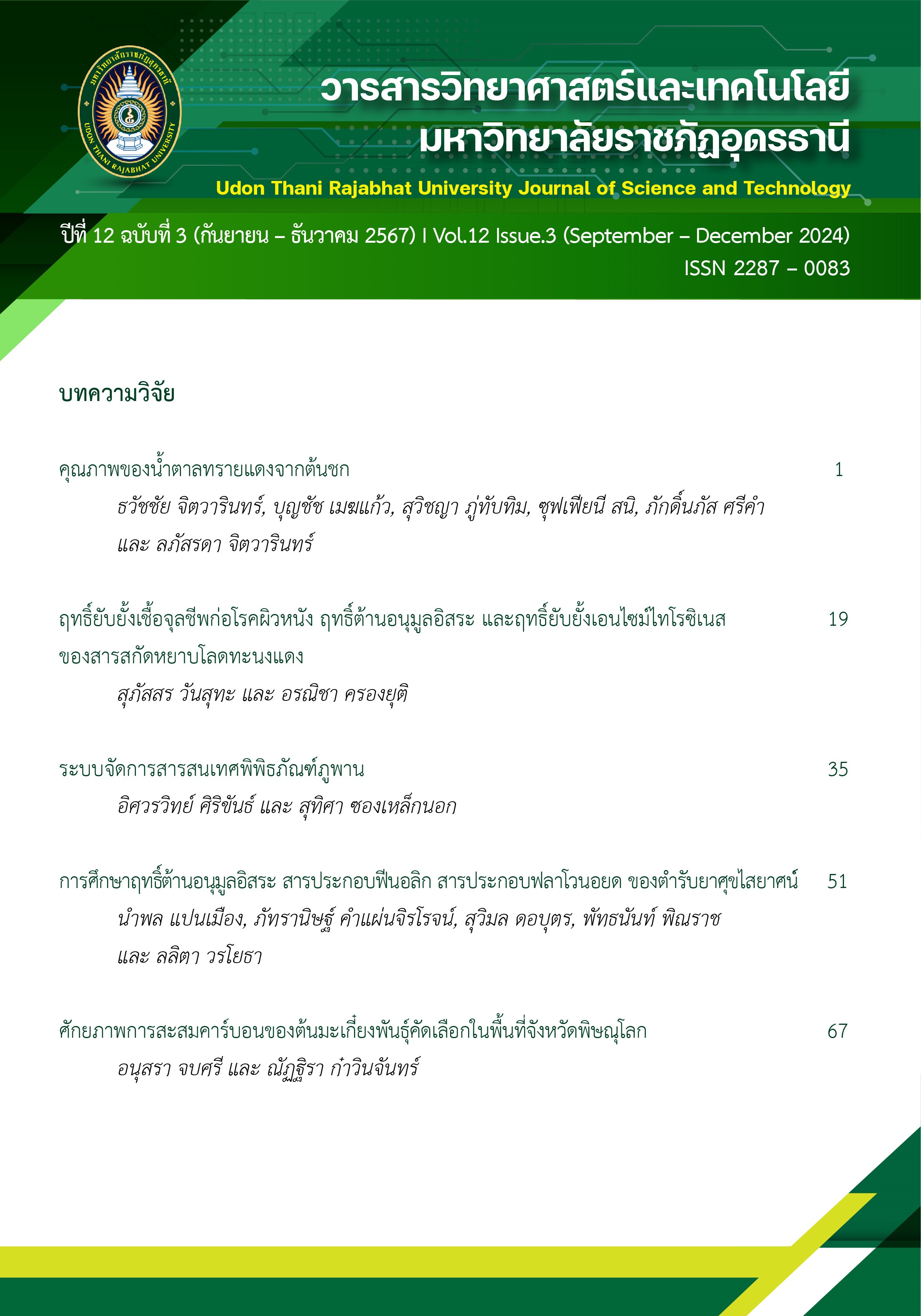
THE MANAGEMENT INFORMATION SYSTEM FOR PHU PHAN MUSEUN
Article Sidebar
Main Article Content
Abstract
This research aimed to 1) study the current conditions, problems, and information needs of the Phu Phan Museum, 2) develop an information management system for the Phu Phan Museum, 3) evaluate the effectiveness of the information management system, and 4) assess user satisfaction with the information management system of the Phu Phan Museum. The sample consisted of 402 participants, including 1 head of the Phu Phan Museum, 5 staff members, and 396 tourists. Data were collected using questionnaires, and statistical analysis included frequency, percentage, mean, and standard deviation, along with content analysis for qualitative data.
The findings revealed that: 1) The current conditions, problems, and information needs of the Phu Phan Museum showed that it lacks a dedicated website; information is disseminated via Facebook. The problems include insufficient technology, a lack of IT personnel, and inadequate budget, while there is a need for an exhibition zone to be presented in website format. 2) The development results were divided into three parts: the administrator manages public relations data, exhibition zone information, and museum bookings; members can view news, exhibition zone information, and make reservations; and general users can access news, exhibition zone information, and register as members. 3) The evaluation of system effectiveness by experts was at a very high level ( =4.80, S.D.=0.55), with the highest mean in security ( =4.93, S.D.=0.15). 4) Overall user satisfaction was also at a very high level ( =4.52, S.D.=0.38), with the highest mean for functionality ( =4.60, S.D.=0.56).
Article Details
References
กวิน งามจินดาวงศ์, ชาวี บุษยรัตน์ และ กิตติศักดิ์ อาภรณ์วิชานพ. (2562). การออกแบบระบบนําาเสนอข้อมูลโบราณสถานด้วยเทคโนโลยีที่ผสานโลกจริงเข้ากับโลกเสมือน: กรณี ศึกษาโบราณสถานปราสาทเขาโล้น จังหวัดสระแก้ว. วิจัยและสาระสถาปัตยกรรม/การผังเมือง, 16(2), 13-30.
จิณณวัตร ปะโคทัง. (2561). ภาวะผู้นำยุคดิจิทัล สำหรับผู้บริหารสถานศึกษามืออาชีพ. อุบลราชธานี: ศิริธรรมออฟเซ็ท.
เจริญ รุ่งกลิ่น, ธนวัฒน์ ชินสำราญวงศ์, กิตติภูมิ แซ่ลิ้ม และ รามิลศร เชาว์ช่าง. (2562). การพัฒนาเว็บไซต์พิพิธภัณฑ์เมืองหาดใหญ่แบบเสมือนจริง. น. 687-698. ใน: การประชุมหาดใหญ่วิชาการระดับชาติและนานาชาติ ครั้งที่ 10. วันที่ 12 – 13 กรกฎาคม 2562. มหาวิทยาลัยหาดใหญ่, สงขลา.
นฤพนธ์ ด้วงวิเศษ. (2564). มนุษย์วิทยาคลื่นวิทยาศาสตร์ เทคโนโลยี และโลกดิจิทัล. กรุงเทพ: ศูนย์มนุษย์วิทยาสิรินธร (องค์กรมหาชน).
ปรีดี ปลื้มสำราญกิจ และ ฟ้า วิไลขำ. (2561). พิพิธภัณฑ์: แหล่งเรียนรู้เพื่อพัฒนาผู้เรียนในศตวรรษที่ 21. ห้องสมุด, 62(1), 43-67.
พระครูสิริธรรมบัณฑิต, ณฤณีย์ ศรีสุข, อนุกูล ศิริพันธ์ และ บุษกร วัฒนบุตร. (2564). การจัด การพิพิธภัณฑ์ชุมชนในระบบอิเล็กทรอนิกส์ของจังหวัดลำปาง. ปัญญา, 28(2), 29–44.
ยลพรรณ รอดรักบุญ, เกรียงศักดิ์ เขียวมั่ง และ อภิสักก์ สินธุภัค. (2561). การออกแบบสื่อปฏิสัมพันธ์พิพิธภัณฑ์วังสวนผักกาด. มหาวิทยาลัยศิลปากร, 38(3), 90-104.
สิรวิชญ์ สงวนศรี, ธนกร เพ็งกระจ่าง, นวัตรกร โพธิสาร และ วินิต ยืนยิ่ง. (2567). การพัฒนาเว็บไซต์เพื่อประชาสัมพันธ์หลักสูตรเทคโนโลยีมัลติมีเดีย มหาวิทยาลัยเทคโนโลยีราชมงคลอีสาน วิทยาเขตสุรินทร์. วิศวกรรมและเทคโนโลยีอุตสาหกรรม มหาวิทยาลัยกาฬสินธุ์, 2(4), 35–43.
อนาวิล แก้วสอาด และ ณัฐวี อุตกฤษฏ์. (2564) แนวทางการบริหารความเสี่ยงด้านความปลอดภัยไซเมอร์ระดับองค์กร. สถาบันการป้องกันประเทศ, 12(1), 6-20.
อมลรดา ยุตาคม. (2563). การศึกษาลักษณะพิพิธภัณฑ์เสมือนจริงที่ส่งผลต่อความสนใจของ Gen Y และ Gen Z ระหว่างสถานการณ์โควิด 19. (วิทยานิพนธ์ศิลปศาสตรมหาบัณฑิต, มหาวิทยาลัยธรรมศาสตร์).
Wixom, B. H., & Roth, R. M. (2014). Systems analysis and design. (6th ed.). New York: John Wiley.
