
USING THE HYBRID AHP-TOPSIS TECHNIQUE FOR SELECTING PRODUCT PROCESSING AND DEVELOPMENT FOR BAMBOO PRODUCTS
Article Sidebar
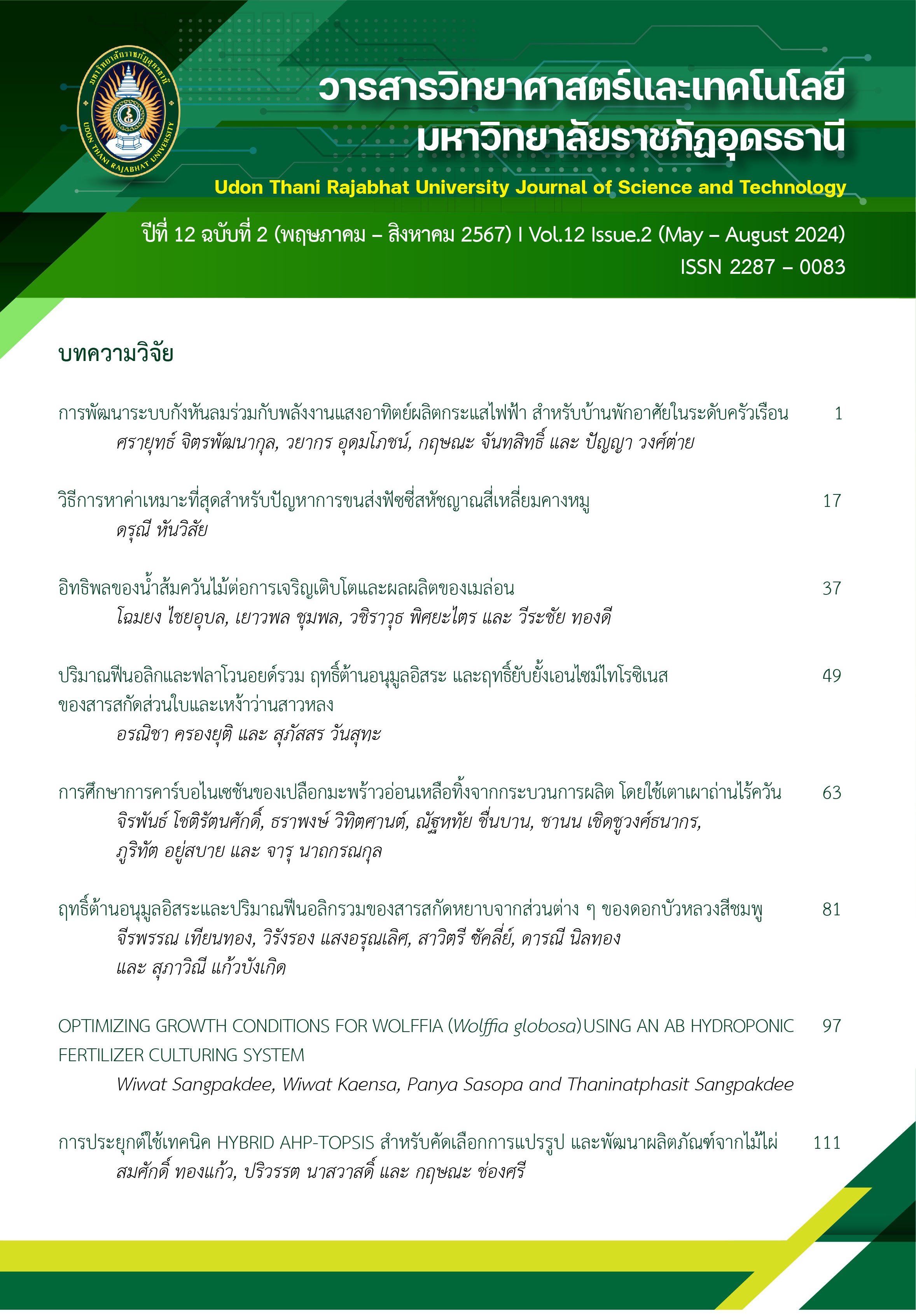
Main Article Content
Abstract
The decision-making process for selecting the processing and development of bamboo products to enhance product value is a complex problem due to the various criteria that need to be considered simultaneously. Therefore, this research proposes the hybrid AHP-TOPSIS technique for evaluating and prioritizing importance. It begins by defining relevant criteria used in decision-making, dividing them into sub-criteria, and assigning importance levels to each criterion. Then, scores are given to each criterion based on their importance levels using the AHP technique. Subsequently, the TOPSIS technique is utilized to rank and select the most efficient alternatives. By calculating the positive ideal solution (Si*) and negative ideal solution (Si'), as well as the relative closeness coefficient (Ci*), the criteria deemed important according to the needs of the decision-makers, 7 decision-making criteria, and all 5 alternative product processing methods from bamboo are assessed. The results of calculating the relative closeness coefficient (Ci*) are as follows: bamboo pressed product (A3) = 0.764, followed by bamboo reed product (A1) = 0.502, bamboo charcoal product (A5) = 0.258, bamboo skewer product (A2) = 0.167, and bamboo toothpick product (A4) = 0.154, respectively. Therefore, the method proposed in this research can serve as a guideline for selecting the processing and development of suitable products to enhance the value of other products.
Article Details
References
กรมส่งเสริมการเกษตร. (2563). คู่มือโครงการส่งเสริมการเกษตรประจำปีงบประมาณ พ.ศ.2563. กรุงเทพฯ: สำนักส่งเสริมและจัดการสินค้าเกษตร.
สถาบันสิ่งแวดล้อมไทย. (2564). การวิเคราะห์ห่วงโซ่มูลค่าของไผ่ในประเทศไทย. นนทบุรี: สถาบันสิ่งแวดล้อมไทย.
Boonkanit, P. (2020). Low-Pressure Die Casting Machine Selection Using a Combined AHP and TOPSIS Method. Naresuan University Engineering Journal, 15(2), 1-11.
Dinkoksung, S., Pitakaso, R., Khonjun, S., Srichok, T., & Nanthasamroeng, N. (2023). Modeling the medical and wellness tourism supply chain for enhanced profitability: An open innovation approach. Journal of Open Innovation: Technology, Market, and Complexity, 9(3), 100137.
Kailomsom, P., & Wichapa, N. (2022). Evaluating and Ranking the Fuel Briquettes from Agricultural Residues Using the Virtual Cross–Efficiency Method. The Journal of Industrial Technology, 18(2), 230-246.
Nasawat, P., Talangkun, S., Arunyanart, S., & Wichapa, N. (2020). Selection of Suitable Rice Weevil Disinfestation Method Using Hybrid FAHP-FTOPSIS. Journal of Advanced Development in Engineering and Science, 10(29), 65-80.
Nasawat, P., Talangkun, S., Arunyanart, S., & Wichapa, N. (2021). Hybrid cross-efficiency approach based on ideal and anti-ideal points and the critic method for ranking decision-making units: a case study on ranking the methods of rice weevil disinfestation. Decision Science Letters, 10(3), 375-392.
Ozer, I. (2008). Multi-criteria Group Decision Making Methods Using AHP and Integrated Web-bases Decision Support Systems. University of Ottawa.
Ransikarbum, K., & Chanthakhot, W. (2020). An Analysis of Fire Assembly Point using Information Entropy Weight and TOPSIS. Thai Industrial Engineering Network Journal, 6(1), 54-64.
Saaty, T.L. (1985). Decision making for leaders. California: Life time leaning publication.
Saaty, T.L., & Kearns K.P. (1991). Analytical planning the organization of systems: The analytic hierarchy process. USA: Publications Pittsburgh.
Sharma, D., Sridhar, S., & Claudio, D. (2020). Comparison of AHP-TOPSIS and AHP-AHP methods in multi-criteria decision-making problems. International journal of industrial and systems engineering, 34(2), 203-223.
Singh, V., Kumar, V., & Singh, V. B. (2023). A hybrid novel fuzzy AHP-Topsis technique for selecting parameter-influencing testing in software development. Decision Analytics Journal, 6, 100159.
To-On, P., Wichapa, N., & Khanthirat, W. (2023). A novel TOPSIS linear programming model based on response surface methodology for determining optimal mixture proportions of lightweight concrete blocks containing sugarcane bagasse ash. Heliyon, 9(7). e17755.
Velmurugan, K., Saravanasankar, S., Venkumar, P., Sudhakarapandian, R., & Di Bona, G. (2022). Hybrid fuzzy AHP-TOPSIS framework on human error factor analysis: Implications to developing optimal maintenance management system in the SMEs. Sustainable Futures, 4, 100087.
Wichapa, N., & Sodsoon, S. (2023). A Relative Closeness Coefficient Model Based on the Distance of Virtual DMUs Cross-Efficiency Method for Ranking Thai Economic Development. Engineering Letters, 31(1).
