
Students' Perceptions of ChatGPT in Higher Education: A Quantitative Study on Usability and Expectations
Article Sidebar
Main Article Content
Abstract
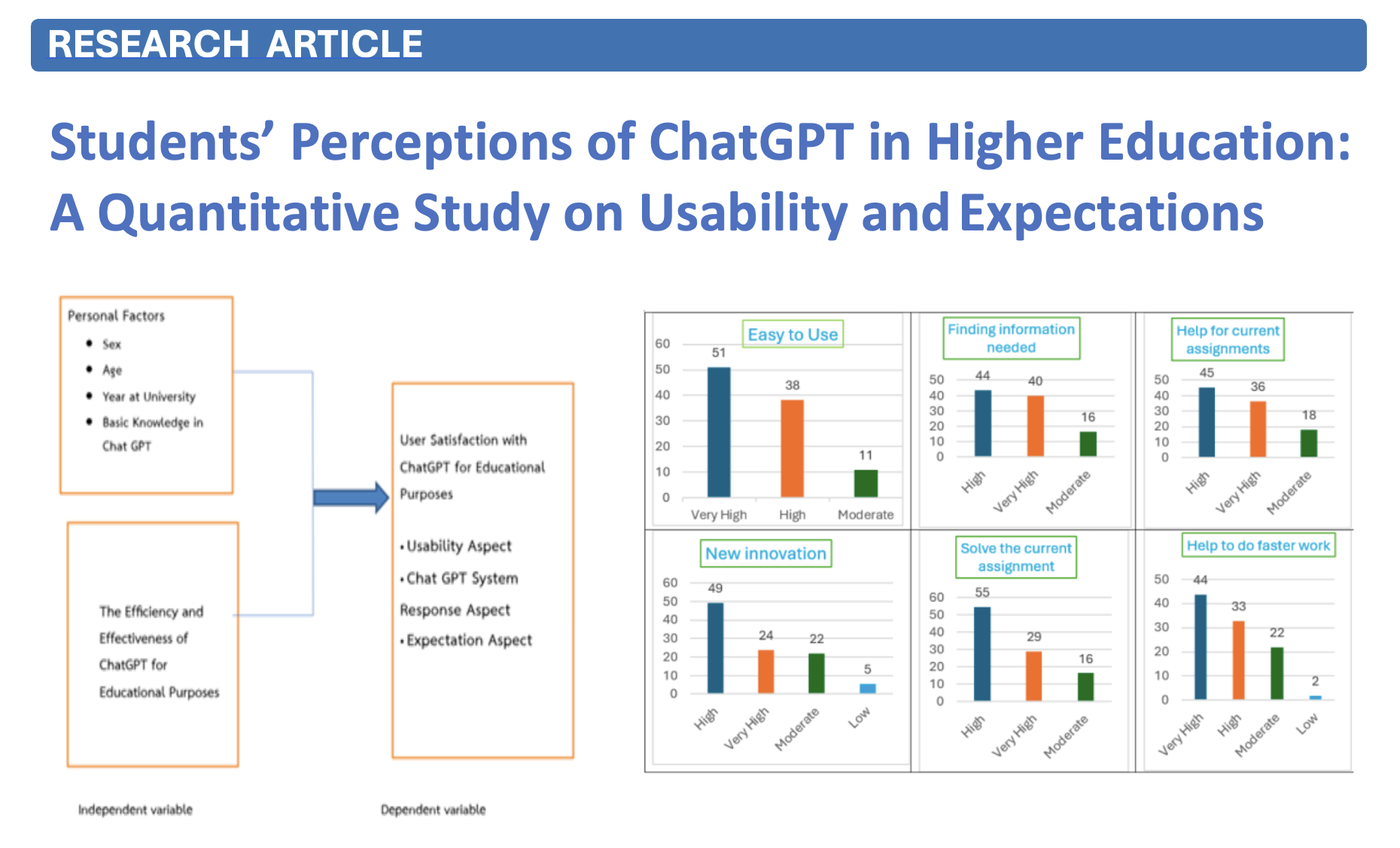
This study investigated the use of ChatGPT in higher education. The objectives were to examine students’ experiences with ChatGPT, assess students’ personal evaluations of the system and its responses, and explore how students’ reflections influenced their expectations regarding ChatGPT’s capabilities. A quantitative research design was employed. Data were collected using a researcher-developed questionnaire administered through Google Forms. The population consisted of 64 students from the Department of Information Technology at Nakhon Phanom University, from which 55 students were selected as the sample. The sample included 27 male and 28 female students aged between 16 and 25 years. The significance level was set at p = 0.05 with a 95% confidence interval. The findings showed that most students (82%) had positive experiences using ChatGPT as a learning support tool, particularly for information retrieval and understanding complex content. Regarding personal evaluation, 78% of the students rated ChatGPT as highly effective and responsive, although 25% expressed concerns about the accuracy of some information. Compared with their expectations before using the tool, 65% of the students reported that ChatGPT exceeded their expectations, particularly in terms of versatility and adaptability to different learning contexts. These findings suggest important implications for the development of policies and practices related to the use of ChatGPT in higher education. The study highlights the need to promote effective and critical use of ChatGPT while strengthening students’ analytical thinking skills and lifelong learning abilities in conjunction with AI technology.
Article Details

This work is licensed under a Creative Commons Attribution-NonCommercial-NoDerivatives 4.0 International License.
All authors need to complete copyright transfer to Journal of Applied Informatics and Technology prior to publication. For more details click this link: https://ph01.tci-thaijo.org/index.php/jait/copyrightlicense
References
Chuenphitthayavu, K. (2023). Advances in ChatGPT, and behavioral science research. The Periodical of Behavioral Science, 29(2):154–173. https://so06.tci-thaijo.org/index.php/BSRI/article/view/264446.
Dwivedi, Y. K., Kshetri, N., Hughes, L., Slade, E. L., Jeyaraj, A., et al. (2023). Opinion paper: “so what if ChatGPT wrote it?” Multidis-
ciplinary perspectives on opportunities, challenges and implications of generative conversational AI for research, practice and policy. International Journal of Information Management, 71:102642. DOI: 10.1016/j.ijinfomgt.2023.102642.
Gulatee, Y. and Combes, B. (2018a). Are you sure this generation are digital natives? Case study: Thailand and Australia. In Proceedings of the 5th International Symposium on Emerging Trends and Technologies in Libraries and Information Services (ETTLIS), pages 147–154. DOI: 10.1109/ETTLIS.2018.8485254.
Gulatee, Y. and Combes, B. (2018b). Owning ICT: Student use and ownership of technology. Walailak Journal of Science and Technology, 15(1):81–94. DOI: 10.48048/wjst.2018.2868.
Gulatee, Y., Pagram, J., and Combes, B. (2018). Which tech will I use? Trends in students’ use and ownership of technology in a Thai university: An ongoing study. Journal of ICT Research and Applications, 12(2):138–156. DOI: 10.5614/itbj.ict.res.appl.2018.12.2.3.
Hair, J. F., Black, W. C., Babin, B. J., and Anderson, R. E. (2014). Multivariate Data Analysis. Pearson Education, Upper Saddle River, NJ, 7 edition.
Nunnally, J. C. and Bernstein, I. H. (1994). Psychometric Theory. McGraw-Hill, New York, 3 edition.
Oates, A. and Johnson, D. (2025). ChatGPT in the classroom: Evaluating its role in fostering critical evaluation skills. International Journal of Artificial Intelligence in Education, 35:1793–1824. DOI: 10.1007/s40593-024-00452-8.
Saxena, D. and Cao, J. (2021). Generative adversarial networks (GANs): Challenges, solutions, and future directions. ACM Computing Surveys, 54(3):1–42. DOI: 10.1145/3446374.
Song, C. and Song, Y. (2023). Enhancing academic writing skills and motivation: Assessing the efficacy of ChatGPT in AI-assisted language learning for EFL students. Frontiers in Psychology, 14. DOI: 10.3389/fpsyg.2023.1260843.
Su, J., Wang, Y., Liu, H., Zhang, Z., Wang, Z., and Li, Z. (2025). Investigating the factors influencing users’ adoption of artificial intelligence health assistants based on an extended utaut model. Scientific Reports, 15(1):18215. DOI: 10.1038/s41598-025-01897-0.
Uppal, K. and Hajian, S. (2025). Students’ perceptions of ChatGPT in higher education: A study of academic enhancement, procrastination, and ethical concerns. European Journal of Educational Research, 14(1):199–211. DOI: 10.12973/eu-jer.14.1.199.
Wang, S., Wang, F., Zhu, Z., Wang, J., Tran, T., and Du, Z. (2024). Artificial intelligence in education: A systematic literature review. Ex-
pert Systems with Applications, 252:124167. DOI: 10.1016/j.eswa.2024.124167.
Zou, M. and Huang, L. (2023). To use or not to use? Understanding doctoral students’ acceptance of ChatGPT in writing through the technology acceptance model. Frontiers in Psychology, 14. DOI: 10.3389/fpsyg.2023.1259531.
