
Multidimensional livelihood-capital deprivation and income-defined household poverty in Sakon Nakhon, Thailand: Explanatory, predictive, and association-rule evidence
DOI:
https://doi.org/10.55674/cs.v18i3.268007Keywords:
Multidimensional poverty, Livelihood capital, Machine learning, Association rule mining, Poverty screeningAbstract
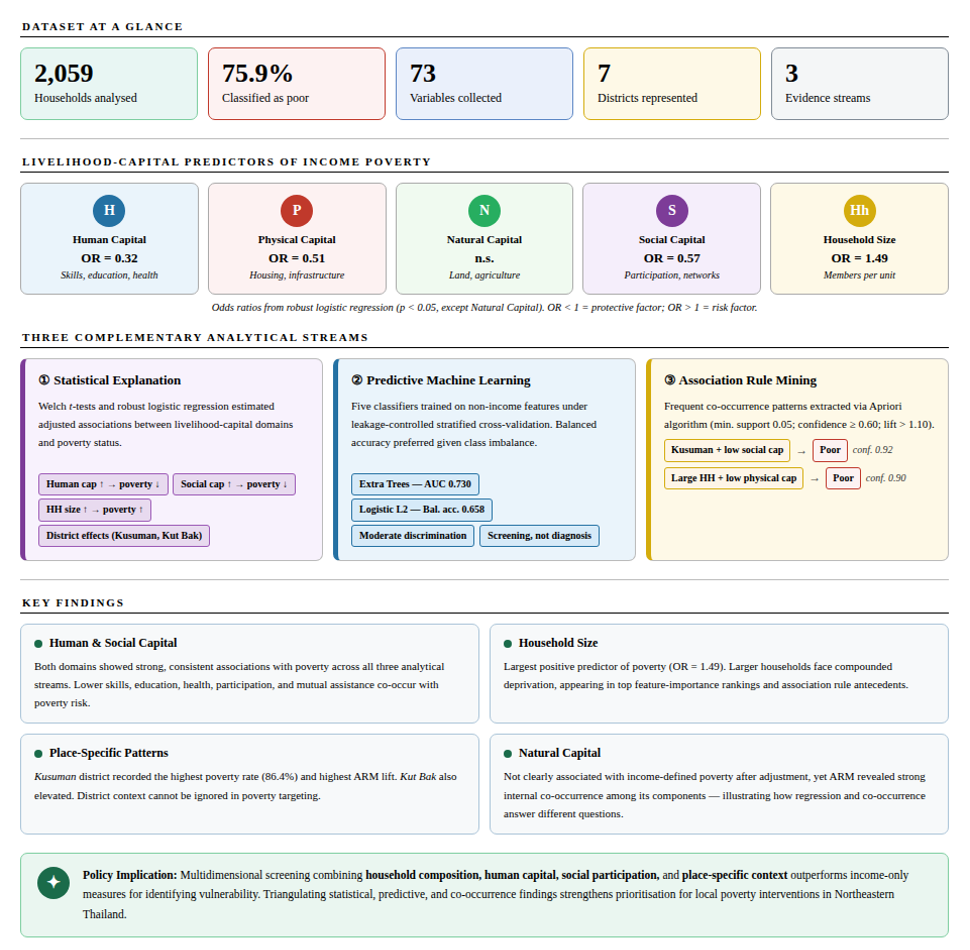
This study examines household poverty in Sakon Nakhon province, Thailand, using a livelihood-capital household survey containing 2,128 records and 73 variables. Household poverty in Sakon Nakhon, Thailand, remains a pressing policy concern, yet existing evidence rarely integrates explanatory, predictive, and co-occurrence evidence within a single locally grounded study. Poverty status was derived by comparing per-capita monthly income with the constant poverty-line field in the dataset; after preprocessing, 1,562 households were classified as poor and 497 as non-poor (poor-class share: 75.86%). Three evidence streams were separated: explanatory statistical analysis, leakage-controlled predictive modeling, and association rule mining (ARM). Group comparisons and robust logistic regression showed that Human Capital (OR = 0.318), Social Capital (OR = 0.568), Physical Capital (OR = 0.513), and agricultural green-book status (OR = 0.721) were associated with lower poverty odds, while household size (OR = 1.487) was associated with higher odds. Extra Trees achieved the strongest ROC-AUC (0.730); L2-regularized logistic regression achieved the strongest balanced accuracy (0.658). ARM identified recurring poverty-associated profiles in Kusuman district, characterized by low social participation and large households with low physical or social capital. This study demonstrates a reproducible, data-driven workflow for community-level poverty screening and policy prioritization in resource-constrained provincial settings. Its creative science contribution lies in integrating livelihood-capital theory, explainable statistical modeling, leakage-controlled machine learning, and association-rule mining into a single practical framework for identifying locally relevant poverty profiles and supporting sustainable community development.
GRAPHICAL ABSTRACT
 HIGHLIGHTS
- Human Capital, Social Capital, and household size are the strongest non-income correlates of income-defined poverty in Sakon Nakhon, Thailand, with logistic regression confirming lower poverty odds for higher human (OR = 0.318) and social capital (OR = 0.568), and higher odds for each additional household member (OR = 1.487).
- Extra Trees achieved the best predictive discrimination (ROC-AUC = 0.730) among leakage-controlled machine-learning models, demonstrating that non-income livelihood-capital features carry meaningful poverty-screening signal, though moderate performance cautions against automated eligibility decisions.
- Association rule mining revealed interpretable deprivation co-occurrence profiles, particularly involving Kusuman district with low social participation and large households with low physical or social capital, providing actionable patterns for local poverty screening and policy prioritization.
References
Alkire, S., & Foster, J. (2011). Counting and multidimensional poverty measurement. Journal of Public Economics, 95(7–8), 476–487. https://doi.org/10.1016/j.jpubeco.2010.11.006
Lu, Y., Chen, L., & Meng, Y. (2023). How do public services supply, livelihood capital, and livelihood strategies affect subjective poverty? PLOS ONE, 18(10), e0292651. https://doi.org/10.1371/journal.pone.0292651
Suppa, N., & Kanagaratnam, U. (2025). The global Multidimensional Poverty Index: Harmonised level estimates and their changes over time. Scientific Data, 12, 153. https://doi.org/10.1038/s41597-024-04269-x
Gomez-Mendez, I., & Amornbunchornvej, C. (2026). Regional and spatial dependence of poverty factors in Thailand, and its use in Bayesian hierarchical regression analysis. Statistical Journal of the IAOS, 42(1), 322–337. https://doi.org/10.1177/18747655261416694
Songleknok, S., & Kuptabut, S. (2023). Combining unsupervised and supervised learning to predict poverty households in Sakon Nakhon, Thailand. International Journal of Advanced Computer Science and Applications, 14(12), 818–828. https://doi.org/10.14569/IJACSA.2023.0141283
Atzmueller, M., Furnkranz, J., Kliegr, T., & Schmid, U. (2024). Explainable and interpretable machine learning and data mining. Data Mining and Knowledge Discovery, 38, 2571–2595. https://doi.org/10.1007/s10618-024-01041-y
Corral, P., Henderson, H., & Segovia, S. (2025). Poverty mapping in the age of machine learning. Journal of Development Economics, 172, 103377. https://doi.org/10.1016/j.jdeveco.2024.103377
Verme, P. (2025). Predicting poverty. The World Bank Economic Review, 39(4), 1039–1064. https://doi.org/10.1093/wber/lhae044
Breiman, L. (2001). Random forests. Machine Learning, 45, 5–32. https://doi.org/10.1023/A:1010933404324
Friedman, J. H. (2001). Greedy function approximation: A gradient boosting machine. The Annals of Statistics, 29(5), 1189–1232. https://doi.org/10.1214/aos/1013203451
Geurts, P., Ernst, D., & Wehenkel, L. (2006). Extremely randomized trees. Machine Learning, 63, 3–42. https://doi.org/10.1007/s10994-006-6226-1
Minh, D., Wang, H. X., Li, Y. F., & Nguyen, T. N. (2022). Explainable artificial intelligence: A comprehensive review. Artificial Intelligence Review, 55, 3503–3568. https://doi.org/10.1007/s10462-021-10088-y
Joshi, A. V. (2023). Machine Learning and Artificial Intelligence. Springer Cham. https://doi.org/10.1007/978-3-031-12282-8
Witten, I. H., Frank, E., Hall, M. A., Pal, C. J., & Foulds, J. R. (2025). Data mining: Practical machine learning tools and techniques (5th ed.). Morgan Kaufmann.
Carrington, A. M., Manuel, D. G., Fieguth, P. W., Ramsay, T., Osmani, V., Wernly, B., Bennett, C., Hawken, S., Magwood, O., Sheikh, Y., McInnes, M., & Holzinger, A. (2023). Deep ROC analysis and AUC as balanced average accuracy, for improved classifier selection, audit and explanation. IEEE Transactions on Pattern Analysis and Machine Intelligence, 45(1), 329–341. https://doi.org/10.1109/TPAMI.2022.3145392
Kim, M., & Hwang, K.-B. (2022). An empirical evaluation of sampling methods for the classification of imbalanced data. PLOS ONE, 17(7), e0271260. https://doi.org/10.1371/journal.pone.0271260
Liu, Y., Li, Y., & Xie, D. (2024). Implications of imbalanced datasets for empirical ROC-AUC estimation in binary classification tasks. Journal of Statistical Computation and Simulation, 94(1), 183–203. https://doi.org/10.1080/00949655.2023.2238235
Chen, H., Yang, M., & Tang, X. (2024). Association rule mining of aircraft event causes based on the Apriori algorithm. Scientific Reports, 14, 13440. https://doi.org/10.1038/s41598-024-64360-6
Diaz-Garcia, J. A., Ruiz, M. D., & Martin-Bautista, M. J. (2023). A survey on the use of association rules mining techniques in textual social media. Artificial Intelligence Review, 56, 1175–1200. https://doi.org/10.1007/s10462-022-10196-3
Hahsler, M., Grun, B., & Hornik, K. (2005). arules: A computational environment for mining association rules and frequent item sets. Journal of Statistical Software, 14(15), 1–25. https://doi.org/10.18637/jss.v014.i15
Mouakher, A., Hajjej, F., & Ayouni, S. (2022). Efficient mining support-confidence based framework generalized association rules. Mathematics, 10(7), 1163. https://doi.org/10.3390/math10071163
Bebbington, A. (1999). Capitals and capabilities: A framework for analyzing peasant viability, rural livelihoods and poverty. World Development, 27(12), 2021–2044. https://doi.org/10.1016/S0305-750X(99)00104-7
Scoones, I. (2009). Livelihoods perspectives and rural development. The Journal of Peasant Studies, 36(1), 171–196. https://doi.org/10.1080/03066150902820503
Tang, L., Xu, Y., Wang, W., & Wang, Y. (2023). Impact of livelihood capital and rural site conditions on livelihood resilience of farm households: Evidence from contiguous poverty-stricken areas in China. Environmental Science and Pollution Research, 30, 123808–123826. https://doi.org/10.1007/s11356-023-30426-7
Zhao, X., & Lan, F. (2023). The impact of livelihood capital endowment on household poverty alleviation: The mediating effect of land transfer. Land, 12(7), 1346. https://doi.org/10.3390/land12071346
Chuong, H. N. (2023). The role of social capital in shaping livelihood for rural Vietnamese households. PLOS ONE, 18(12), e0295292. https://doi.org/10.1371/journal.pone.0295292
Fan, Y., Ning, J., & Qin, H. (2023). Investigating the effectiveness of livelihood capital in reducing re-poverty risk: An empirical analysis of policy withdrawal and income structures in rural China. Frontiers in Environmental Science, 11, 1175315. https://doi.org/10.3389/fenvs.2023.1175315
Xiao, H., Liang, X., Chen, C., & Xie, F. (2022). The impact of multidimensional poverty on rural households’ health: From a perspective of social capital and family care. International Journal of Environmental Research and Public Health, 19(21), 14590. https://doi.org/10.3390/ijerph192114590
Habib, N., Ariyawardana, A., & Aziz, A. A. (2023). The influence and impact of livelihood capitals on livelihood diversification strategies in developing countries: A systematic literature review. Environmental Science and Pollution Research, 30, 69882–69898. https://doi.org/10.1007/s11356-023-27638-2
Aiken, E., Bellue, S., Karlan, D., Udry, C., & Blumenstock, J. E. (2022). Machine learning and phone data can improve targeting of humanitarian aid. Nature, 603, 864–870. https://doi.org/10.1038/s41586-022-04484-9
Downloads
Published
How to Cite
Issue
Section
Categories
License
Copyright (c) 2026 : Pita Jarupunphol, Wichidtra Sudjarid

This work is licensed under a Creative Commons Attribution-NonCommercial-NoDerivatives 4.0 International License.