
Parametric study of wall-mounted annular ring fins for heat transfer enhancement in a flat-bottom cookstove using CFD
DOI:
https://doi.org/10.55674/cs.v18i3.267694Keywords:
Flat-bottom cookstove, Annular ring fin, CFD, Thermal performance factor, SST k–ω turbulence modelAbstract
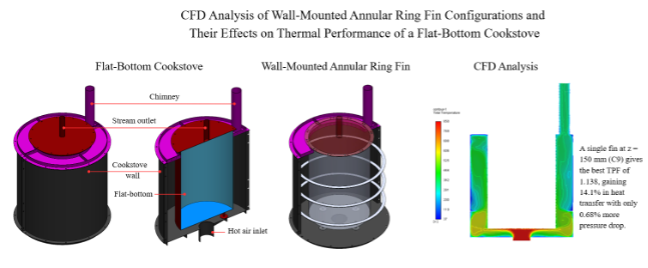
Flat-bottom biomass cookstoves, widely used in developing countries, typically achieve thermal efficiencies below 20% because most combustion energy is lost with the exhaust gas before reaching the pot. Enhancing convective heat transfer at the pot wall therefore represents the most direct pathway to improved efficiency. Although annular fins are well-established passive heat transfer enhancers in industrial heat exchangers, their geometric design space remains unexplored within cookstove combustion chambers. This study addresses that gap through a parametric computational fluid dynamics (CFD) investigation of wall-mounted ring fins in a flat-bottom biomass cookstove. A three-dimensional steady-state CFD model, developed in ANSYS Fluent using the SST k–ω turbulence model with enhanced wall treatment, was validated against measured temperatures at three vertical levels and the chimney outlet. The model showed close agreement at the outlet (2.21% error), while larger discrepancies at the interior levels (16–28%) were attributed to the simplified uniform-inlet boundary condition. Using a one-factor-at-a-time design, thirteen configurations were evaluated across four geometric parameters: fin height, blockage ratio, tier count, and installation height. Fin height showed a non-monotonic effect, with thermal performance peaking at a moderate height before excessive blockage limited further gains. Tier count showed a monotonic trend, reaching a thermal performance factor (TPF) of 1.118 with three tiers. Installation height emerged as the most influential parameter: a single fin positioned near the hot gas inlet achieved the highest performance, with a TPF of 1.138, corresponding to a 14.1% increase in heat transfer to the pot at a pressure-drop penalty of only 0.68%. These findings identify axial position as the primary parameter governing thermal performance. A single fin near the hot inlet offers a low-cost, retrofit-ready route to higher cookstove efficiency, aligned with Sustainable Development Goal 7.
GRAPHICAL ABSTRACT
HIGHLIGHTS
- Annular ring fins welded to the inner wall of a flat-bottom cookstove are proposed as a passive heat transfer enhancement strategy.
- A parametric CFD study covering 12 fin configurations plus a baseline examines the effects of fin height (20–50 mm), number of tiers (1–3), and installation height.
- Blockage ratios of 0.20–0.50 are evaluated using the SST k-ω turbulence model with enhanced wall treatment in ANSYS Fluent.
- Thermal Performance Factor (TPF) is used to identify the optimal configuration balancing heat transfer enhancement against pressure drop penalty.
References
Yunusa, S. U., Mensah, E., Preko, K., Narra, S., Saleh, A., Sanfo, S., Isiaka, M., Dalha, I. B., & Abdulsalam, M. (2023). Biomass cookstoves: A review of technical aspects and recent advances. Energy Nexus, 11, 100225. https://doi.org/10.1016/j.nexus.2023.100225
Smith, K. R. (1994). Health, energy, and greenhouse-gas impacts of biomass combustion in household stoves. Energy for Sustainable Development, 1(4), 23–29. https://doi.org/10.1016/S0973-0826(08)60067-8
Jetter, J., Zhao, Y., Smith, K. R., Khan, B., Yelverton, T., DeCarlo, P., & Hays, M. D. (2012). Pollutant emissions and energy efficiency under controlled conditions for household biomass cookstoves and implications for metrics useful in setting international test standards. Environmental Science & Technology, 46(19), 10827–10834. https://doi.org/10.1021/es301693f
MacCarty, N. A., & Bryden, K. M. (2015). Modeling of household biomass cookstoves: A review. Energy for Sustainable Development, 26, 1–13. https://doi.org/10.1016/j.esd.2015.02.001
Pande, R.R., Kshirsagar, M.P. & Kalamkar, V.R. (2020). Experimental and CFD analysis to study the effect of inlet area ratio in a natural draft biomass cookstove. Environment, Development and Sustainability, 22, 1897–1911. https://doi.org/10.1007/s10668-018-0269-x
Chibuzor, J. N., Olaiya, O. M., & Nwosu, C. R. (2022). CFD analysis of a flat bottom institutional cookstove. Scientific African, 16, e01117. https://doi.org/10.1016/j.sciaf.2022.e01117
Boonloi, A. (2016). Numerical investigation on turbulent forced convection and heat transfer in a square channel with discrete combined V-baffle and V-orifice. Case Studies in Thermal Engineering, 8, 226-235. https://doi.org/10.1016/j.csite.2016.07.003
Eiamsa-ard, S., & Promvonge, P. (2010). Thermal characteristics in round tube fitted with serrated twisted tape. Applied Thermal Engineering, 30(13), 1673–1682. https://doi.org/10.1016/j.applthermaleng.2010.03.026
Promvonge, P., & Eiamsa-ard, S. (2007). Heat transfer behaviors in a tube with combined conical-ring and twisted-tape insert. International Communications in Heat and Mass Transfer, 34(7), 849–859. https://doi.org/10.1016/j.icheatmasstransfer.2007.03.019
Promvonge, P. (2008). Heat transfer behaviors in round tube with conical ring inserts. Energy Conversion and Management, 49(1), 8–15. https://doi.org/10.1016/j.enconman.2007.06.009
Webb, R. L. (1981). Performance evaluation criteria for use of enhanced heat transfer surfaces in heat exchanger design. International Journal of Heat and Mass Transfer, 24(4), 715–726. https://doi.org/10.1016/0017-9310(81)90015-6
Kraus, A. D., Aziz, A., & Welty, J. (2000). Extended surface heat transfer. John Wiley & Sons.
Husain, Z., Tiwari, S. S., Pandit, A. B., & Joshi, J. B. (2020). Computational fluid dynamics study of biomass cook stove — Part 1: Hydrodynamics and homogeneous combustion. Industrial & Engineering Chemistry Research, 59(9), 4161–4176. https://doi.org/10.1021/acs.iecr.9b03181
Ghiwe, S. S., Kalamkar, V. R., & Sawarkar, P. D. (2024). A combined combustion and conjugate heat transfer analysis of a hybrid draft biomass cookstove. Thermal Science and Engineering Progress, 50, 102534. https://doi.org/10.1016/j.tsep.2024.102534
Montgomery, D. C. (2020). Design and analysis of experiments (10th ed.). John Wiley & Sons.
ASM International. (1990). Properties and selection: Irons, steels, and high-performance alloys (ASM Handbook, Vol. 1, 10th ed.). ASM International.
Wilcox, D. C. (1988). Reassessment of the scale-determining equation for advanced turbulence models. AIAA Journal, 26(11), 1299–1310. https://doi.org/10.2514/3.10041
ANSYS Inc. (2025, January 26). ANSYS Fluent theory guide, Release 2024 R2. https://ansyshelp.ansys.com/public/account/secured?returnurl=/Views/Secured/corp/v242/en/flu_th/flu_th.html
Gray, D. D., & Giorgini, A. (1976). The validity of the Boussinesq approximation for liquids and gases. International Journal of Heat and Mass Transfer, 19(5), 545–551. https://doi.org/10.1016/0017-9310(76)90168-X
MacCarty, N. A., & Bryden, K. M. (2016). A generalized heat-transfer model for shielded-fire household cookstoves. Energy for Sustainable Development, 33, 96–107. https://doi.org/10.1016/j.esd.2016.03.003
Versteeg, H. K., & Malalasekera, W. (2007). An introduction to computational fluid dynamics: The finite volume method (2nd ed.). Pearson Education.
Incropera, F. P., DeWitt, D. P., Bergman, T. L., & Lavine, A. S. (2011). Fundamentals of heat and mass transfer (7th ed.). John Wiley & Sons.
Downloads
Published
How to Cite
Issue
Section
Categories
License
Copyright (c) 2026 : Komsan Wongkalasin, Somchat Sonasang, Chuthong Summatta

This work is licensed under a Creative Commons Attribution-NonCommercial-NoDerivatives 4.0 International License.