
Effects of processing methods of dried black soldier fly larvae as top-dressing replacement in layer diets on performance, egg quality, and economic returns
DOI:
https://doi.org/10.55674/cs.v18i3.267573Keywords:
Black soldier fly larvae, Top-dressing, Laying hen performance, Egg quality, Economic returnAbstract
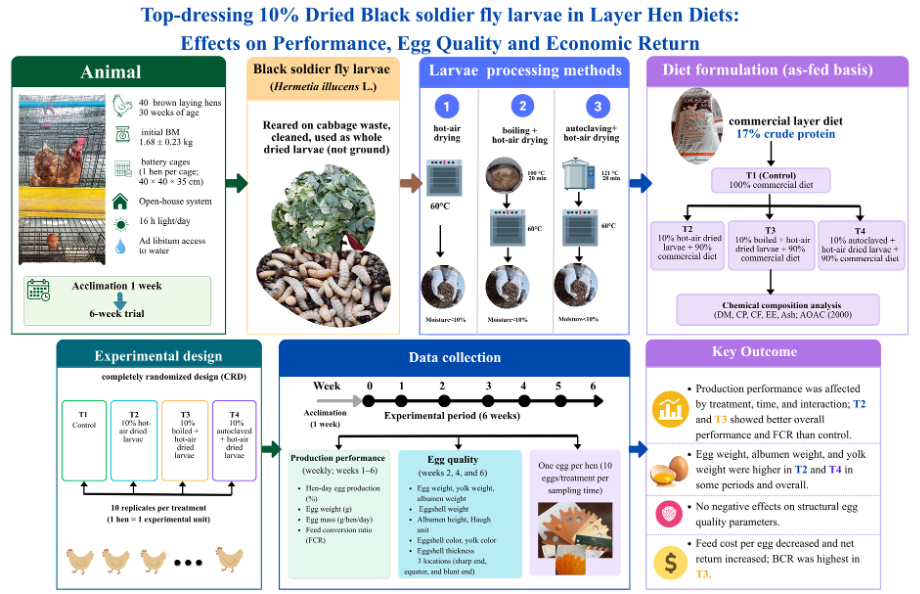
Feed cost is a major egg production expense. This study evaluated the effects of differently processed dried black soldier fly larvae (BSFL) on laying performance, egg quality, and economic returns. Forty commercial brown laying hens (30 weeks old) were assigned to four treatments with 10 replicates each in a completely randomized design for 6 weeks. Treatments comprised a commercial diet (control) and diets with 10% top-dressing replacement using hot-air dried larvae (T2), boiled and hot-air dried larvae (T3), or autoclaved and hot-air dried larvae (T4). Data were analyzed using repeated measures ANOVA. Hen-day egg production, egg weight, egg mass, and feed conversion ratio were significantly affected by treatment, time, and treatment × time interaction (p<0.001). T2 and T3 generally showed improved production performance and feed efficiency compared with the control. Egg weight was affected by treatment (p=0.003) and treatment × time interaction (p=0.025), whereas albumen and yolk proportions were unaffected (p>0.05). Shell proportion (p=0.024), yolk color (p=0.035), and shell thickness at the sharp end (p=0.045) differed among treatments, whereas most internal egg quality and eggshell traits were unaffected. BSFL reduced feed cost per egg by 0.25, 0.37, and 0.05 THB per egg, equivalent to approximately 0.008, 0.012, and 0.002 USD per egg, for T2, T3, and T4, respectively, compared with the control. Net return increased by 109.44, 119.90, and 42.36 THB, equivalent to approximately 3.50, 3.83, and 1.35 USD, respectively. T3 had the highest benefit–cost ratio. Because top-dressing increased dietary protein and fat contents relative to the control, responses may partly reflect differences in nutrient density among treatments. Overall, the results suggest that replacing 10% of commercial feed with dried BSFL using a top-dressing approach can maintain laying performance and may improve economic efficiency, particularly with boiled and hot-air dried larvae, under the conditions of this study.
GRAPHICAL ABSTRACT
HIGHLIGHTS
- Replacement of commercial feed with 10% dried black soldier fly larvae using a top-dressing approach
- Processing methods of larvae influenced production performance, egg quality, and economic returns
- Boiled and hot-air dried larvae showed the most favorable overall performance and benefit–cost ratio
References
Fathi, M. M., Galal, A., Al-Homidan, I., Abou-Emera, O. K., & Rayan, G. N. (2021). Residual feed intake: A limiting economic factor for selection in poultry breeding programs. Annals of Agricultural Sciences, 66(1), 53-57. https://doi.org/10.1016/j.aoas.2021.03.001
Ramankevich, A., Danko, S., Banaszkiewicz, R., Kasperek, K., & Zięba, G. (2025). Residual Feed Intake as a Behavioral, Nutritional and Economic Criterion in Poultry Production. Animals, 15(8), 1115. https://doi.org/10.3390/ani15081115
Javadi, A., Ghahremanzadeh, M., & Soumeh, E. A. (2024). Investigating the price volatility spillover effects in the poultry industry inputs market and the egg market in Iran: using the multivariate DCC-GARCH model. Agriculture & Food Security, 13, 23. https://doi.org/10.1186/s40066-024-00472-6
Lanza, M., Battelli, M., Gallo, L., Soglia, F., Bovera, F., Giunta, F., Primi, R., Biondi, L., Giannuzzi, D., Zampiga, M., Addeo, N. F., Cannas, A., Danieli, P. P., Ronchi, B., & Crovetto, G. M. (2025). Sustainability of Animal Production Chains: Alternative Protein Sources as an Ecological Driver in Animal Feeding: A Review. Animals, 15(22), 3245. https://doi.org/10.3390/ani15223245
Makkar, H. P. S., Tran, G., Heuzé, V., & Ankers, P. (2014). State-of-the-art on use of insects as animal feed. Animal Feed Science and Technology, 197,1-33. https://doi.org/10.1016/j.anifeedsci.2014.07.008
Mwaniki, Z., Shoveller, A. K., Huber, L. A., & Kiarie, E. G. (2020). Complete replacement of soybean meal with defatted black soldier fly larvae meal in Shaver White hens feeding program (28–43 wks of age): impact on egg production, egg quality, organ weight, and apparent retention of components1. Poultry Science, 99(2), 959-965. https://doi.org/10.1016/j.psj.2019.10.032
Su, H., Zhang, B., Shi, J., He, S., Dai, S., Zhao, Z., Wu, D., & Li, J. (2025). Black Soldier Fly Larvae as a Novel Protein Feed Resource Promoting Circular Economy in Agriculture. Insects, 16(8), 830. https://doi.org/10.3390/insects16080830
Romero, C., Cenalmor, J. C., Chamorro, S., & Redondo, C. (2024). Effect of Different Dietary Doses of Black Soldier Fly Meal on Performance and Egg Quality in Free-Range Reared Laying Hens. Animals, 14(22), 3340. https://doi.org/10.3390/ani14223340
Veldkamp, T., Rezaei Far, A., Caimi, C., Gasco, L., Lima, R. C., & Cunha, L. M. (2024). Partial or complete replacement of soybean meal with black soldier fly larvae meal improves feed efficiency in laying hens between 22 to 30 weeks of age. Journal of Insects as Food and Feed, 11(17), 73-88. https://doi.org/10.1163/23524588-00001228
Zhao, J., Kawasaki, K., Miyawaki, H., Hirayasu, H., Izumo, A., Iwase, S.i., & Kasai, K. (2022). Egg quality and laying performance of Julia laying hens fed with black soldier fly (Hermetia illucens) larvae meal as a long-term substitute for fish meal. Poultry Science, 101(8), 101986. https://doi.org/10.1016/j.psj.2022.101986
Rodríguez-Rodríguez, M., Sánchez-Muros, M. J., Vargas-García, M. d. C., Varga, Á. T., Fabrikov, D., & Barroso, F. G. (2024). The Effects of Slaughter Methods and Drying Temperatures on the Protein Hydrolysis of Black Soldier Fly Larvae Meal. Animals, 14(11), 1709. https://doi.org/10.3390/ani14111709
Bejaei, M., & Cheng, K. M. (2024). Inclusion of Dried Black Soldier Fly Larvae in Free-Range Laying Hen Diets: Effects on Production Efficiency, Feed Safety, Blood Metabolites, and Hen Health. Agriculture, 14(1), 31. https://doi.org/10.3390/agriculture14010031
Wongnaa, C. A., Mbroh, J., Mabe, F. N., Abokyi, E., Debrah, R., Dzaka, E., Cobbinah, S., & Adusei Poku, F. (2023). Profitability and choice of commercially prepared feed and farmers’ own prepared feed among poultry producers in Ghana. Journal of Agriculture and Food Research, 12, 100611. https://doi.org/10.1016/j.jafr.2023.100611
Huang, C., Hernandez, C. E., Wall, H., Tahamtani, F. M., Ivarsson, E., & Sun, L. (2024). Live black soldier fly (Hermetia illucens) larvae in feed for laying hens: effects on hen gut microbiota and behavior. Poultry Science, 103(3), 103429. https://doi.org/10.1016/j.psj.2024.103429
AOAC. (2000). Official methods of analysis of AOAC International. In 17th (Ed.), AOAC International. Gaithersburg, MD: AOAC International.
Dale, N. (1994). National Research Council Nutrient Requirements of Poultry – Ninth Revised Edition (1994). Journal of Applied Poultry Research, 3(1), 101. https://doi.org/10.1093/japr/3.1.101
Jahan, A. A., Dao, T. H., Morgan, N. K., Crowley, T. M., & Moss, A. F. (2024). Effects of AM/PM Diets on Laying Performance, Egg Quality, and Nutrient Utilisation in Free-Range Laying Hens. Applied Sciences, 14(5), 2163. https://doi.org/10.3390/app14052163
Bezahegn, D. A., Tamir, B., & Mamo, G. (2025). Production performance and egg quality characteristics of laying hens fed with different levels of fennel (Foeniculum vulgare Mill.) and cinnamon (Cinnamomum cassia) as natural feed additives. Poultry Science and Management, 2(1), 8. https://doi.org/10.1186/s44364-025-00011-4
Cansee, S., Suraporn, S., & Butwong, N. (2025). Enhancing Food Production by Sustainable Cricket Farming in Thailand: Evaluating Black Soldier Fly Larvae as a Cost-Effective Feed Ingredient. Insects, 16(8), 856. https://doi.org/10.3390/insects16080856
Han, G. P., Kim, J. H., Lee, J. H., Kim, H. W., & Kil, D. Y. (2023). Research Note: Effect of increasing fat supplementation in diets on productive performance, egg quality, and fatty liver incidence in laying hens throughout the entire laying cycle. Poultry Science, 102(11), 103069. https://doi.org/10.1016/j.psj.2023.103069
Das, P. K., Ghosh, P. R., Pradhan, S., Roy, B., & Mazumdar, D. (2014). Benefit-cost analysis of Rhode Island Red chicken rearing in backyard on the basis of egg production performance. Veterinary World, 7(8), 605-609. https://doi.org/10.14202/vetworld.2014.605-609
Mwaniki, Z., Neijat, M., & Kiarie, E. (2018). Egg production and quality responses of adding up to 7.5% defatted black soldier fly larvae meal in a corn–soybean meal diet fed to Shaver White Leghorns from wk 19 to 27 of age. Poultry Science, 97(8), 2829-2835. https://doi.org/10.3382/ps/pey118
Heuel, M., Sandrock, C., Leiber, F., Mathys, A., Gold, M., Zurbrügg, C., Gangnat, I. D. M., Kreuzer, M., & Terranova, M. (2021). Black soldier fly larvae meal and fat can completely replace soybean cake and oil in diets for laying hens. Poultry Science, 100(4), 101034. https://doi.org/10.1016/j.psj.2021.101034
Khan, S., Shi, X., Cai, R., Zhao, S., Li, X., Khan, I. M., Yin, Z., Lu, H., Hilal, M. G., Yi, R., Wu, Y., & Guo, J. (2024). Assessing the performance, egg quality, serum analysis, heavy metals and essential trace metals accumulation in laying hen eggs and tissues fed black soldier fly (Hermetia illucens) larvae meal. Poultry Science, 103(12), 104315. https://doi.org/10.1016/j.psj.2024.104315
Gasco, L., Biasato, I., Dabbou, S., Schiavone, A., & Gai, F. (2019). Animals Fed Insect-Based Diets: State-of-the-Art on Digestibility, Performance and Product Quality. Animals, 9(4), 170. https://doi.org/10.3390/ani9040170
De Marco, M., Martínez, S., Hernandez, F., Madrid, J., Gai, F., Rotolo, L., Belforti, M., Bergero, D., Katz, H., Dabbou, S., Kovitvadhi, A., Zoccarato, I., Gasco, L., & Schiavone, A. (2015). Nutritional value of two insect larval meals (Tenebrio molitor and Hermetia illucens) for broiler chickens: Apparent nutrient digestibility, apparent ileal amino acid digestibility and apparent metabolizable energy. Animal Feed Science and Technology, 209, 211-218. https://doi.org/10.1016/j.anifeedsci.2015.08.006
Leeson, S., Summers, J. D., & Caston, L. J. (2001). Response of Layers to Low Nutrient Density Diets. Journal of Applied Poultry Research, 10(1), 46-52. https://doi.org/10.1093/japr/10.1.46
Secci, G., Bovera, F., Nizza, S., Baronti, N., Gasco, L., Conte, G., Serra, A., Bonelli, A., & Parisi, G. (2018). Quality of eggs from Lohmann Brown Classic laying hens fed black soldier fly meal as substitute for soya bean. Animal, 12(10), 2191-2197. https://doi.org/10.1017/S1751731117003603
Lokaewmanee, K., Suttibak, S., Sukthanapirat, R., Sriyoha, R., Chanasakhatana, N., Baotong, S., & Trithalen, U. (2023). Laying hen performance, feed economy, egg quality and yolk fatty acid profiles from laying hens fed live black soldier fly larvae. Czech Journal of Animal Science, 68(4), 169-177. https://doi.org/10.17221/174/2022-cjas
Veldkamp, T., van Duinkerken, G., van Huis, A., Lakemond, C. M. M., Ottevanger, E.., Bosch, G., & van Boekel, M. A. J. S. (2026, May 2). Insects as a sustainable feed ingredient in pig and poultry diets: A feasibility study = Insecten als duurzame diervoedergrondstof in varkens- en pluimveevoeders: Een haalbaarheidsstudie (Report No. 638). Wageningen UR Livestock Research. https://edepot.wur.nl/234247
Janssen, R. H., Vincken, J.-P., Arts, N. J. G., Fogliano, V., & Lakemond, C. M. M. (2019). Effect of endogenous phenoloxidase on protein solubility and digestibility after processing of Tenebrio molitor, Alphitobius diaperinus and Hermetia illucens. Food Research International, 121, 684-690. https://doi.org/10.1016/j.foodres.2018.12.038
Mancini, S., Mattioli, S., Paolucci, S., Fratini, F., Dal Bosco, A., Tuccinardi, T., & Paci, G. (2021). Effect of Cooking Techniques on the in vitro Protein Digestibility, Fatty Acid Profile, and Oxidative Status of Mealworms (Tenebrio molitor). Frontiers in Veterinary Science, 8, 675572.(https://doi.org/10.3389/fvets.2021.675572
Bosch, G., Zhang, S., Oonincx, D. G. A. B., & Hendriks, W. H. (2014). Protein quality of insects as potential ingredients for dog and cat foods. Journal of Nutritional Science, 3, e29. https://doi.org/10.1017/jns.2014.23
Gasco, L., Oddon, S. B., Vandenberg, G. W., Veldkamp, T., & Biasato, I. (2023). Factors affecting the decision-making process of using insect-based products in animal feed formulations. Journal of Insects as Food and Feed, 10(10), 1707-1718. https://doi.org/10.3920/JIFF2022.0164
Mauron, J. (1990). Influence of Processing on Protein Quality. Journal of Nutritional Science and Vitaminology, 36(4-SupplementI), S57-S69. https://doi.org/10.3177/jnsv.36.4-SupplementI_S57
Matin, N., Utterback, P., & Parsons, C. M. (2021). True metabolizable energy and amino acid digestibility in black soldier fly larvae meals, cricket meal, and mealworms using a precision-fed rooster assay. Poultry Science, 100(7), 101146. https://doi.org/10.1016/j.psj.2021.101146
Downloads
Published
How to Cite
Issue
Section
Categories
License
Copyright (c) 2026 : Panut Sooksoi, Janejira Namee

This work is licensed under a Creative Commons Attribution-NonCommercial-NoDerivatives 4.0 International License.