
Tree species diversity and aboveground carbon stocks in Ban Nong Nae community forest: implications for ecosystem rehabilitation
DOI:
https://doi.org/10.55674/cs.v18i3.266274Keywords:
Ecological Resilience, Aboveground Carbon stock, Community Forest ManagementAbstract
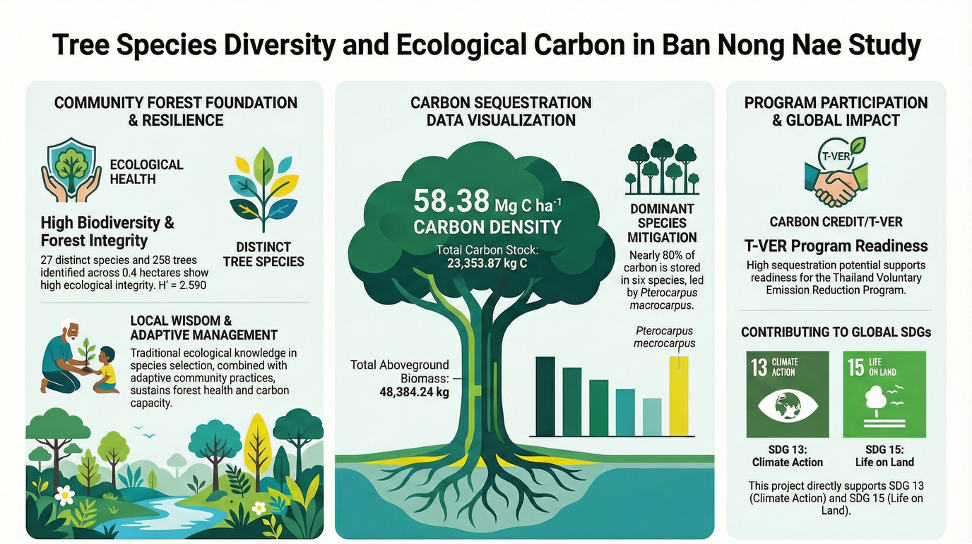
This study investigated tree species diversity, forest structure, and aboveground carbon stocks in the Ban Nong ÍNae Community Forest, Chachoengsao Province, Thailand. The objective was to quantify ecological attributes and examine the relationships between species diversity, forest structure, and carbon storage within a community forest ecosystem. Field data were collected from a 0.4 ha (4,000 m²) permanent plot by recording tree species composition and structural measurements. Aboveground biomass was estimated using the allometric equations developed by Ogawa et al. (1965) combined with standard carbon fraction values. A total of 27 tree species belonging to 19 families and 258 individuals were recorded, corresponding to a stand density of 645 individuals ha⁻¹. The Shannon–Wiener diversity index (H′) was 2.59, and the evenness index (E) was 0.795, indicating moderate species diversity with a relatively even distribution of individuals among species. Total aboveground biomass was estimated at 48,384.24 kg, resulting in a carbon stock of 23,353.87 kg C (58.38 Mg C ha⁻¹). Carbon stocks were unevenly distributed, with 77.8% concentrated in six dominant species, notably Pterocarpus macrocarpus. This pattern indicates that carbon storage was strongly influenced by stand structural composition and species dominance, particularly the contribution of a small number of canopy-forming species. Overall, the findings suggest that aboveground carbon storage is closely associated with forest structural characteristics and dominant species composition. These findings provide baseline data for ecological assessment and carbon accounting in community forest ecosystems and highlight the importance of species diversity and forest structural in supporting ecosystem rehabilitation.
GRAPHICAL ABSTRACT
HIGHLIGHTS
- Ban Nong Nae Community Forest exhibits moderate-to-high tree diversity (H' = 2.590) and high evenness (E = 0.795), indicating a stable and resilient ecosystem structure.
- Aboveground carbon stocks are primarily driven by six key framework species, which account for 77.8% of the total carbon despite high overall species richness.
- Aboveground carbon stocks are primarily driven by six key framework species, which account for 8% of the total carbon despite high overall species richness.
References
Intergovernmental Panel on Climate Change. (2019). Climate change and land: An IPCC special report on climate change, desertification, land degradation, sustainable land management, food security, and greenhouse gas fluxes in terrestrial ecosystems. https://www.ipcc.ch/srccl/
Office of Natural Resources and Environmental Policy and Planning. (2015, July). Thailand climate change master plan 2015–2050. ONEP, Ministry of Natural Resources and Environment. https://www.onep.go.th
Food and Agriculture Organization of the United Nations. (2018, June). The state of the world’s forests 2018: Forest pathways to sustainable development. https://www.fao.org/3/i9535en/i9535en.pdf
Ostrom, E. (1990). Governing the Commons: The Evolution of Institutions for Collective Action. Cambridge University Press. https://doi.org/10.1017/CBO9780511807763
Sikor, T., Gritten, D., Atkinson, J., Huy, B., Dahal, G. R., Duangsathaporn, K., Hurahura, F., Phanvilay, K., Maryudi, A., Pulhin, J., Ramirez, M. A., Win, S., Toh, S., Vaz, J., Sokchea, T., Marona, S., & Yaqiao, Z. (2013, November 1). Community forestry in Asia and the Pacific: Pathway to inclusive development. RECOFTC – The Center for People and Forests. https://www.recoftc.org/publications/
Millennium Ecosystem Assessment. (2005). Ecosystems and human well-being: Synthesis. Island Press. Millennium Ecosystem Assessment Report
Díaz, S., Pascual, U., Stenseke, M., Martín-López, B., Watson, R. T., Molnár, Z., Hill, R., Chan, K. M. A., Baste, I. A., Brauman, K. A., Polasky, S., Church, A., Lonsdale, M., Larigauderie, A., Leadley, P. W., van Oudenhoven, A. P. E., van der Plaat, F., Schröter, M., Lavorel, S., … Shirayama, Y. (2018). Assessing nature’s contributions to people. Science, 359(6373), 270–272. https://doi.org/10.1126/science.aap8826
Government of Thailand. (2019). Community Forest Act B.E. 2562 (2019). Royal Gazette, 136(71A), 1-33. https://library2.parliament.go.th/giventake/content_nla2557/ law136-290562-71.pdf
Uttaruk, Y., Laosuwan, T., Sangpradid, S., Butthep, C., Rotjanakusol, T., Sittiwong, W., & Nilrit, S. (2024). Thailand’s urban forestry programs are assisted by calculations of their ecological properties and economic values. Land, 13(9), 1440. https://doi.org/10.3390/land13091440
Wang, M., Xie, J., & Lyu, M. (2023). Forest soil carbon cycle in response to global change. Forests, 14(11), 2242.
https://doi.org/10.3390/f14112242
Giweta, M. (2020). Role of litter production and its decomposition, and factors affecting the processes in a tropical forest ecosystem: A review. Journal of Ecology and Environment, 44(1), 11. https://doi.org/10.1186/s41610-020-0151-2
Pietrzykowski, M., Świątek, B., Woś, B., Klamerus-Iwan, A., Mąsior, P., Pająk, M., Piotr, G., Likus-Cieślik, J., Tabor, J., Ksepko, M., & Chodak, M. (2025). The effect of forest disturbances and regeneration scenario on soil organic carbon pools and fluxes: A review. Journal of Forestry Research, 36(1), 12. https://doi.org/10.1007/s11676-024-01807-6
Uttaruk, Y., Laosuwan, T., Sangpradid, S., Samek, J. H., Butthep, C., Rotjanakusol, T., Sittiwong, W., Nilrit, S., & Rouylarp, Y. (2026). Species-specific allometric models for biomass and carbon stock estimation in Silver Oak (Grevillea robusta) plantation forests in Thailand: A pilot-scale destructive study. Forests, 17(1), 100. https://doi.org/10.3390/f17010100
Yen, T. M., & Lee, J. S. (2011). Comparing aboveground carbon sequestration between moso bamboo (Phyllostachys heterocycla) and Chinese fir (Cunninghamia lanceolata) forests. Forest Ecology and Management, 261(6), 995–1002. https://doi.org/10.1016/j.foreco.2010.12.015
Nath, A. J., Das, G., & Das, A. K. (2015). Stand structure, density, and diversity of tree species in tropical forests of Northeast India. Journal of Environmental Biology, 36(4), 889–896.
Berkes, F. (2012). Sacred ecology (3rd ed.). Routledge.https://doi.org/10.4324/9780203123843
Shannon, C. E., & Weaver, W. (1949). The mathematical theory of communication. University of Illinois Press.
Pielou, E. C. (1966). Shannon's formula as a measure of specific diversity: Its use and misuse. The American Naturalist, 100(914), 463–465. https://doi.org/10.1086/282439
Ogawa, H., Yoda, K., Ogino, K., & Kira, T. (1965). Comparative ecological studies on three main types of forest vegetation in Thailand: II. Plant biomass. Nature and Life in Southeast Asia, 4, 49–80.
Royal Forest Department. (2014). Manual for carbon stock and biodiversity assessment in community forests. https://cloud.forest.go.th/s/McQ5boGWTn7nQ4K
Tsutsumi, T., Yoda, K., Sahunalu, P., Dhanmanonda, P., & Prachaiyo, B. (1983). Forest: Felling, burning and regeneration. In K. Kyuma & C. Pairintra (Eds.), Shifting cultivation: An experimen at Nam Phrom, Northeast Thailand, and its implications for upland farming in the monsoon tropics (pp. 13–62). Kyoto University, Kyoto, Japan.
Bunyavejchewin, S. (1999). Structure and dynamics of seasonal dry evergreen forest in southwestern Thailand. Journal of Vegetation Science, 10(6), 787-792. https://doi.org/10.2307/3237303
Magurran, A. E. (2004). Measuring biological diversity. Blackwell Science.
Pielou, E. C. (1975). Ecological diversity. Wiley.
Terakunpisut, J., Gajaseni, N., & Ruankawe, N. (2007). Carbon sequestration potential in aboveground biomass of Thong Pha Phum National Forest, Thailand. Applied Ecology and Environmental Research, 5(2), 93–102. https://doi.org/10.15666/aeer/0502_093102
Brown, S. (1997). Estimating biomass and biomass change of tropical forests: A primer. FAO Forestry Paper No. 134. Food and Agriculture Organization of the United Nations.
Chave, J., Réjou-Méchain, M., Búrquez, A., Chidumayo, E., Colgan, M. S., Delitti, W. B. C., Duque, A., Eid, T., Fearnside, P. M., Goodman, R. C., Henry, M., Martínez-Yrízar, A., Mugasha, W. A., Muller-Landau, H. C., Mencuccini, M., Nelson, B. W., Ngomanda, A., Neumann, M., & Vieilledent, G. (2014). Improved allometric models to estimate the aboveground biomass of tropical trees. Global Change Biology, 20(10), 3177–3190. https://doi.org/10.1111/gcb.12629
Poorter, L., van der Sande, M. T., Thompson, J., Arets, E. J. M. M., Alarcón, A., Álvarez-Sánchez, J., Ascarrunz, N., Balvanera, P., Barajas-Guzmán, G., Boit, A., Bongers, F., Caraballo-Ortiz, M. A., Cavender-Bares, J., Castaño-Meneses, G., Colletta, G., Cuchillo-Hilario, M., Dalkmann, S., Derroire, G., & Bongers, F. (2015). Diversity enhances carbon storage via the anthropogenic effect and niche complementarity in Neotropical forests. Science Advances, 1(11), e1500395. https://doi.org/10.1126/sciadv.1500395
Tilman, D., Isbell, F., & Knops, J. M. (2014). Biodiversity and ecosystem functioning. Annual Review of Ecology, Evolution, and Systematics, 45, 471–493. https://doi.org/10.1146/annurev-ecolsys-120213-091917
Downloads
Published
How to Cite
Issue
Section
Categories
License
Copyright (c) 2026 : Sureeporn Thummikkaphong, Puangpaka Kaewkrom, Nutcharin Kleawkla

This work is licensed under a Creative Commons Attribution-NonCommercial-NoDerivatives 4.0 International License.