Investigation of thermoelectric characteristics of MoS₂ in bulk and thin film structures
DOI:
https://doi.org/10.55674/cs.v18i2.266048Keywords:
MoS2 bulk material, Hot pressing, RF sputtering, Thin film materialAbstract
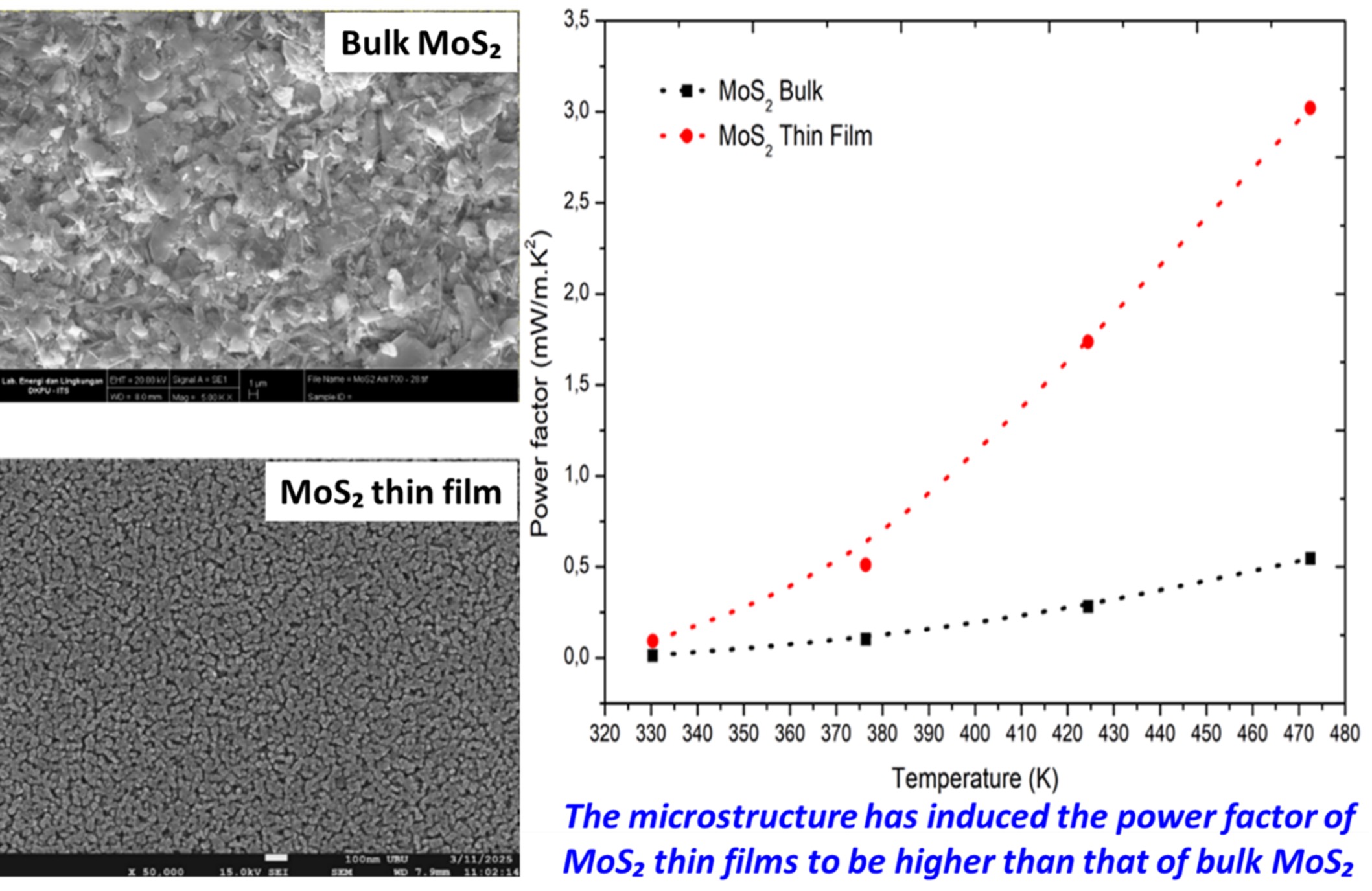
In this work, we investigated and compared the thermoelectric properties of molybdenum disulfide (MoS2) in bulk and thin-film structures. The bulk MoS2 was synthesized by hot pressing (HP) at 700°C from MoS2 nano-powder. While MoS2 thin film was fabricated via radio-frequency (RF) magnetron sputtering at ambient temperature using a MoS2 bulk target and then annealed at 700oC. After bulk and thin-film MoS2 samples were prepared, the characterization of crystal structure, surface morphology, and atomic composition was performed using X-ray diffraction (XRD), scanning electron microscopy (SEM), and energy-dispersive X-ray spectroscopy (EDX), respectively. The electrical resistivity (ρ) and Seebeck coefficient (S) were measured by the ZEM-3 method to determine the thermoelectric power factor (PF). The results revealed that bulk MoS2 exhibited p-type thermoelectricity. In contrast, the MoS2 thin films exhibited n-type thermoelectricity. Among the thermoelectric power factors, the highest power factor of bulk MoS2 was 0.52 mW m⁻¹ K⁻², while the highest power factor of thin film MoS2 was 3.14 mW m⁻¹ K⁻² at the temperature measurement 473K.
GRAPHICAL ABSTRACT
HIGHLIGHTS
• The microstructure of MoS₂ has differed due to three-dimensional (bulk) and two-dimensional (thin film) to show the hexagonal phase for bulk and 2H for thin film.
• The microstructure of MoS₂ has induced a p-type thermoelectricity on bulk structure and transferred to an n-type thermoelectricity on thin film structure.
• The power factor of MoS₂ thin films was higher than that of bulk MoS₂, indicating superior electrical energy conversion efficiency in the thin-film structure.
References
Aditya, I. A., Wijayanto, T., Hakam, D. F. (2025). Advancing renewable energy in Indonesia: A comprehensive analysis of challenges, opportunities, and strategic solutions. Sustainability, 17(5), 2216. https://doi.org/10.3390/su17052216
Muntini, M. S., Suprayoga, E., Wella, S. A., Fatimah, I., Yuwana, L., Seetawan, T., Cahaya, A. B., Nugraha, A. R. T., Hasdeo, E. H. (2022). Spin-tunable thermoelectric performance in monolayer chromium pnictides. Physical Review Materials, 6, 064010. https://doi.org/10.1103/PhysRevMaterials.6.064010
Ahıska R., Mamur, H. (2014). A review: thermoelectric generators in renewable energy. International Journal of Renewable Energy Research, 4(1), 128–136.
Bell, L. E. (2008). Cooling, heating, generating power, and recovering waste heat with thermoelectric systems. Science, 321(5895), 1457–1461. https://doi.org/10.1126/science.1158899
Gautam, A. K., Faraz, M., Khare, N. (2020). Enhanced thermoelectric properties of MoS2 with the incorporation of reduced graphene oxide (RGO). Journal of Alloys and Compounds, 838, 155673. https://doi.org/10.1016/j.jallcom.2020.155673
Khalas, V. A., Parmar, V. B., Vora, A. M. (2017). A density functional theory-based study of transition metal dichalcogenide - MoS2. Materials Today: Proceedings, 67, 165–169. https://doi.org/10.1016/j.matpr.2022.06.012
Thomas, N., Mathew, S., Nair, K. M., O’Dowd, K., Forouzandeh, P., Goswami, A., McGranaghan, G., Pillai, S. C. (2021). 2D MoS2: structure, mechanisms, and Photocatalytic applications. Materials Today Sustainability, 13, 100073. https://doi.org/10.1016/j.mtsust.2021.100073
Kaindl, R., Bayer, B. C., Resel, R., Müller, T., Skakalova, V., Habler, G., Abart, R., Cherevan, A. S., Eder, D., Blatter, M., Fischer, F., Meyer, J. C., Polyushkin, D. K., Waldhauser, W. (2017). Growth, structure and stability of sputter-deposited MoS2 thin films. Beilstein Journal of Nanotechnology, 8, 1115–1126. https://doi.org/10.3762/bjnano.8.113
Archana, C., Harish, S., Abinaya, R., Archana, J., Navaneethan, M. (2022). Interface modified MoS2/CNT with enhanced power factor via energy filtering effect for flexible thermoelectric applications. Sensors and Actuators A: Physical, 348, 113938. https://doi.org/10.1016/j.sna.2022.113938
Rahayu, I., Fatimah, I., Insawang, M., Vora-ud, A., Seetawan, T., Pramono, Y. H. Muntini, M. S. (2025). Effect of annealing techniques on the thermoelectric properties of molybdenum disulfide thin films prepared by RF sputtering. Journal of Physics: Conference Series, 3139, 012035. https://doi.org/10.1088/1742-6596/3139/1/012035
Insawang, M., Ruamruk, S., Vora-ud, A., Singsoog, K., Inthachai, S., Chaarmart, K., Boonkirdram, S., Horprathum, M., Muntini, M. S., Park, S., Phan, T. B., Seetawan, T. (2024). Investigation on thermoelectric properties of SnSe thin films as prepared by RF magnetron sputtering. Radiation Physics and Chemistry, 222, 111789 https://doi.org/10.1016/j.radphyschem.2024.111789
Prainetr, N., Vora-ud, A., Thaowonkaew, S., Horprathum, M., Muthitamongkol, P., T. Seetawan. (2020). Effect of substrates on thermoelectric properties of Ag–Sb–Te thin films within the temperature annealing. Physica B: Condensed Matter, 582, 411977. https://doi.org/10.1016/j.physb.2019.411977
Rahayu, I., Vora-ud, A., Insawang, M., Pramono, Y. H. Muntini, M. S. (2025). Thermoelectric properties of molybdenum disulfide thin film as prepared by RF magnetron sputtering and rapid thermal annealing process. Journal of Physics: Conference Series, 3034, 012008. https://doi.org/10.1088/1742-6596/3034/1/012008
Ruamruk, S., Chayasombat, B., Singsoog, K., Vora-ud, A., Namhongsa, W., Pilasuta, P., Seetawan, T. (2023). Power factor of Bi2Te3 and Sb2Te3 enhanced by high density and hardness. Suranaree Journal of Sciences and Technology, 30, 030145. https://doi.org/10.55766/sujst-2023-05-e02873
Rahayu, I., Insawang, M., Muntini, M. S., Pramono, Y. H., Pham, A. T. T., Park, S., Horprathum, M., Phan, T. B., Han, G. J., Seetawan, T., Vora-ud, A. (2026). Thermoelectric properties of MoS2 thin films prepared by RF magnetron sputtering. Vacuum, 243, 114817. https://doi.org/10.1016/j.vacuum.2025.114817
Ruamruk, S. (2019). Fabrication and Thermoelectric properties of p-Bi0.4Sb1.6Te3.4 and n-Bi2Te3 for thermal sensors. Journal of Material Science and Applied Energy, 8(3), 139–144. https://doi.org/10.55674/ias.v8i3.185069
Long, H., Chan, L., Harley‐Trochimczyk, A., Luna, L. E., Tang, Z., Shi, T., Zettl, A., Carraro, C., Worsley, M. A., Maboudian, R. (2017). 3D MoS2 aerogel for ultrasensitive NO2 detection and its tunable sensing behavior. Advanced Materials Interface, 4, 1700217. https://doi.org/10.1002/admi.201700217
Insawang, M., Vora-ud, A., Seetawan, T., Muntini, M. S., Phan, T.B., Kumar, M. (2025). Enhancing thermoelectric power factor of PEDOT:PSS/SnSe2 nanocomposite sheets by rapid thermal annealing. Journal of Electronic Materials, 54, 3494. https://doi.org/10.1007/s11664-024-11687-5
Hsu, H.-T., Lin, S.-Y., Lu, Y.-T., Chuang, Y.-Y., Chuang, S.-H. (2024). Enhanced fenton-like process over z-scheme MoO3 surface decorated with Fe2O3 under visible light. Scientific Report, 14, 8007. https://doi.org/10.1038/s41598-024-58634-2
Gupta, D., Chauhan, V., Kumar, R. (2022). Sputter deposition of 2D MoS2 thin films -A critical review from a surface and structural perspective. Inorganic Chemistry Communications, 144, 109848. https://doi.org/10.1016/j.inoche.2022.109848
Bae, J. J., Jeong, H. Y., Han, G. H., Kim, J., Kim, H., Kim, M. S., Moon, B. H., Lim, S. C., Lee, Y. H. (2017) Thickness-dependent in-plane thermal conductivity of suspended MoS2 grown by chemical vapor deposition. Nanoscale, 9, 2541–2547. https://doi.org/10.1039/C6NR09484H
Amiri, L., Tchenka, A., Bousseta, M., Elmassi, S., Liang, C.-T., Alsaad, A., Nkhaili, L., Elbacha, A., El kissani, A., Narjis, A., Outzourhit, A. (2024). Fabrication and characterization of ITO/CuS thin films-based thermoelectric generators, Vacuum, 224, 113172. https://doi.org/10.1016/j.vacuum.2024.113172
Downloads
Published
How to Cite
Issue
Section
Categories
License
Copyright (c) 2026 : Melania Suweni Muntini, Irasani Rahayu, Mekhala Insawang, Widya Dewayanti P, Surasak Ruamruk, Somporn Thaowankaew, Iim Fatimah, Tosawat Seetawan, Athorn Voraud

This work is licensed under a Creative Commons Attribution-NonCommercial-NoDerivatives 4.0 International License.