Mangrove forest structure and diversity in Tha Kam Island, Bang Pakong Estuary, Chachoengsao Province: implications for conservation and restoration
DOI:
https://doi.org/10.55674/cs.v18i2.265936Keywords:
Mangrove forestation, Species composition, Bang Pakong Estuary, Blue carbon, Forest structureAbstract
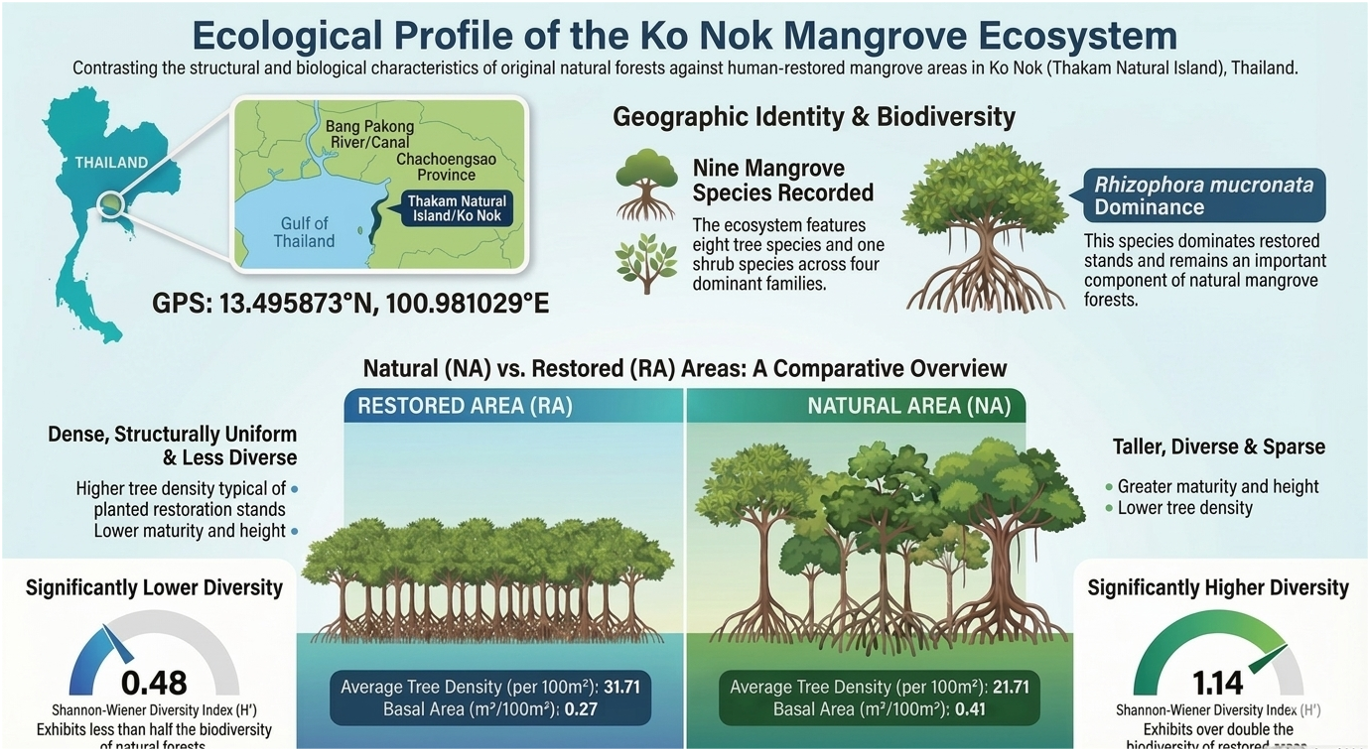
This study evaluated species composition, forest structure, and biodiversity of the natural mangrove area (NA) and the mangrove restoration (RA) areas on Tha Kam Natural Island (13.495873°N, 100.981029°E) in the Bang Pakong estuary, Chachoengsao Province, Thailand. Vegetation surveys were conducted using a systematic line transect method with 10 × 10 m sampling plots established along geomorphological gradients. A total of nine mangrove species were recorded across both sites, including eight tree species and one shrub (Acanthus ilicifolius). The RA exhibited a higher tree density (31.71±19.01 trees per 100 m2) than the NA (21.71±9.54 trees per100 m2). However, the NA showed greater structural maturity, as reflected by a higher basal area (0.41 m2 per 100 m2) and greater species diversity (Shannon–Wiener index, H' = 1.140). In contrast, the RA exhibited lower diversity (H' = 0.480) and evenness (J' = 0.268), indicating dominance by Rhizophora mucronata and reflecting an early successional stage. These findings indicate that although reforestation has increased vegetation density, the restored forest still exhibits lower species diversity and limited structural heterogeneity, reflecting an early successional stage. Enhancing these structural and compositional attributes will be essential for strengthening long-term ecosystem resilience and increasing blue carbon sequestration potential in this estuarine mangrove ecosystem.
GRAPHICAL ABSTRACT
HIGHLIGHTS
- Natural areas (NA) exhibit significantly higher structural maturity with a basal area of 0.41m2/100m2 compared to 0.27m2/100 m2 in restored areas (RA).
- The Shannon-Wiener Diversity Index (H’) in the NA (1.14) is more than double that of the RA (0.48), indicating greater ecological stability.
- Restored areas show higher tree density (71 individuals/100 m2), reflecting uniform, human-restored stand characteristics.
- Pioneer species Avicennia and Sonneratia drive active successional recovery in the RA.
- Ecological profiles of Tha Kam Island serve as a vital baseline for function-oriented mangrove management and blue carbon accounting.
References
Amores, A. E., Maxey, E. A., Aquilar, S. N., & Pentason, J. R. (2024). Distribution of Mangrove Species Diversity Along Environmental Variables Using Canonical Correspondence Analysis in Brgy. Penaplata, Samal City, Philippines. American Journal of Life Sciences, 12(5), 86-94.
Convention on Wetlands. (2021, December 15). Global wetland outlook: Special edition 2021. https://www.ramsar.org/sites/default/files/documents /library/bn12_blue_carbon_ccmitigatione.pdf
Aksornkoae, S. (1998). Ecology and management of mangroves. Kasetsart University Press. (in Thai)
Barbier, E. B., Hacker, S. D., Kennedy, C., Koch, E. W., Stier, A. C., & Silliman, B. R. (2011). The value of estuarine and coastal ecosystem services. Ecological Monographs, 81(2), 169–193. https://doi.org/10.1890/10-1510.1
Alongi, D. M. (2008). Mangrove forests: Resilience, protection from tsunamis, and responses to global climate change. Estuarine, Coastal and Shelf Science, 76(1), 1–13. https://doi.org/10.1016/j.ecss.2007.08.024
Donato, D. C., Kauffman, J. B., Murdiyarso, D., Kurnianto, S., Stidham, M., & Kanninen, M. (2011). Mangroves among the most carbon-rich forests in the tropics. Nature Geoscience, 4, 293–297.
Krauss, K. W., Lovelock, C. E., Chen, L., Berger, U., Ball, M. C., Reef, R., Peters, R., Bowen, H., Vovides, A. G., Ward, E. J., Wimmler, M. C., Carr, J. A., Bunting, P., & Duberstein, J. A. (2022). Mangroves provide blue carbon ecological value at a low freshwater cost. Scientific Reports, 12(1), 17636. https://doi.org/10.1038/s41598-022-21514-8
Sasmito, S. D., Taillardat, P., Clendenning, J. N., Cameron, C., Friess, D. A., Murdiyarso, D., & Hutley, L. B. (2019). Effect of land-use and land-cover change on mangrove blue carbon: A systematic review. Global Change Biology, 25(12), 4291–4302. https://doi.org/10.1111/gcb.14774
McLeod, E., Chmura, G. L., Bouillon, S., Salm, R., Björk, M., Duarte, C. M., Lovelock, C. E., Schlesinger, W. H., & Silliman, B. R. (2011). A blueprint for blue carbon: Toward an improved understanding of the role of vegetated coastal habitats in sequestering CO₂. Frontiers in Ecology and the Environment, 9(10), 552–560. https://doi.org/10.1890/110004
Putchim, L., Thampanya, U., & Kornkanitnan, N. (2002). Species composition and community structure of mangroves in the Bang Pakong Estuary, Chachoengsao Province. Thai Fisheries Gazette, 55(6), 489-497.
Department of Marine and Coastal Resources. (2022, June 8). The state of marine and coastal resources and coastal erosion: Thailand national report 2020 (Executive summary). Ministry of Natural Resources and Environment. https://www.neathailand.in.th/images/Executive%20Summary%20DMCR%20ENG/Executive%20Summary%20DMCR%202563.pdf
Chaiklang, P., Karthe, D., Babel, M., Giessen, L., & Schusser, C. (2024). Reviewing changes in mangrove land use over the decades in Thailand: Current responses and challenges. Trees, Forests and People, 17, 100630.
Mangrove Conservation Division. (2020, June 7). Mangrove species of Thailand (in Thai). Department of Marine and Coastal Resources; Ministry of Natural Resources and Environment. https://pubhtml5.com/gfal/shay/
English, S., Wilkinson, C., & Baker, V. (1997). Survey manual for tropical marine resources (2nd ed.). Australian Institute of Marine Science.
Giesen, W., Wulffraat, S., Zieren, M., & Scholten, L. (2007, June 1). Mangrove guidebook for Southeast Asia. FAO; Wetlands International.
Nakmuay, S., Tasen, W., Duangjai, S., & Chansiri, P. (2023). Plant community composition and carbon storage of mangrove forest at Kung Krabaen Bay Royal Development Study Centre, Chanthaburi Province. Thai Forest Ecological Research Journal, 7(2), 187–202. https://doi.org/10.34044/j.tferj.2023.7.2.04
Paphawasit, N., Piumsomboon, A., Wattayakorn, G., Thamrongnawasawat, T., Aumnuch, E., & Putthichim, L. (2003). Manual of rapid assessment methods for coastal natural resources and environmental management: Mangrove ecosystem. Prasookchai Printing. (in Thai) Prasookchai Printing.
Mangrove Resources Conservation Office. (2009). Mangrove plant species in Thailand (3rd rev. ed.) (in Thai) Department of Marine and Coastal Resources, Ministry of Natural Resources and Environment.
Smitinand, T. (2014). Smitinand’s Thai plant names (Revised ed.). Office of the Herbarium, Department of National Parks, Wildlife and Plant Conservation.
Aksornkoae, S., Maxwell, N., Havanond, S., & Panichsuko, S. (1992). Plants in mangroves. Khuru Sapha Press
World Flora Online. (2026). World Flora Online. http://www.worldfloraonline.org.
Margalef, R. (1972). Homage to Evelyn Hutchinson, or why is there an upper limit to diversity. Transactions of the Connecticut Academy of Arts and Sciences, 44, 211–235
Pielou, E. C. (1975). Ecological diversity. John Wiley & Sons.
Shannon, C. E., & Weaver, W. (1949). The mathematical theory of communication. University of Illinois Press.
Aksornkoae, S. (2012). Mangroves: Coastal treasure of Thailand. The Journal of the Royal Institute of Thailand, 9, 59–77.
Singh, J. K. (2020). Structural characteristics of mangrove forest in different coastal habitats of Gulf of Khambhat arid region of Gujarat, west coast of India. Heliyon, 6(8), e04685. https://doi.org/10.1016/j.heliyon.2020.e04685
Tang, J., Ye, S., Chen, X., Yang, H., Sun, X., Wang, F., Wen, M., & Chen, S. (2018). Coastal blue carbon: Concept, study method, and the application to ecological restoration. Science China Earth Sciences, 61, 637–646. https://doi.org/10.1007/s11430-017-9181-x
Wakushima, S., Kuraishi, S., & Sakurai, N. (1994). Stable soil pH of Thai mangroves and its relation to zonal distribution of mangroves. Journal of Plant Research, 107, 47–52. https://doi.org/10.1007/BF02344529
Chumriang, P., Paduka, N., & Duangon, N. (2021). Plant community composition and carbon storage of mangrove forest at Mangrove Resource Development Station 6 (Phetchaburi). Thai Journal of Forestry, 40(2), 187–200. (in Thai)
Kumar, P. S., & Khan, A. B. (2013). The distribution and diversity of benthic macroinvertebrate fauna in Pondicherry mangroves, India. Aquatic Biosystems, 9, 15. https://doi.org/10.1186/2046-9063-9-15
Limrattanaphattarakun, S., & Nakyos, A. (2024). Environmental impact of industrial waste and marine debris in the Bang Pakong Estuary. Creative Science Journal, 12(1), 15–28. https://doi.org/10.55674/cs.v18i1.262861
Ostrowski, A., Connolly, R. M., & Sievers, M. (2021). Evaluating multiple stressor research in coastal wetlands: A systematic review. Marine Environmental Research, 164, 105239. https://doi.org/10.1016/j.marenvres.2020.105239
Pawar, P. R. (2015). Monitoring of pollution using density, biomass and diversity indices of macrobenthos from mangrove ecosystem of Uran, Navi Mumbai, west coast of India. Journal of Bioremediation & Biodegradation, 6(4), 299. https://doi.org/10.4172/2155-6199.1000299
Pumijumnong, N. (2014). Mangrove forests in Thailand. In I. Faridah-Hanum, A. Latiff, K. Hakeem, & M. Ozturk (Eds.), Mangrove ecosystems of Asia (pp. 61–79). Springer. https://doi.org/10.1007/978-1-4614-8582-7_4
Department of Marine and Coastal Resources. (2018, July). Marine and coastal resources information: Chachoengsao province (in Thai). Ministry of Natural Resources and Environment. https://www.dmcr.go.th
Lovelock, C. E., Adame, M. F., Dittmann, S., Fest, B., Butler, D. W., Kelleway, J. J., King, K. J., Macreadie, P. I., Mitchell, K., Newnham, M., Ola, A., Owers, C. J., & Welti, N. (2022). Modeled approaches to estimating blue carbon accumulation with mangrove restoration to support a blue carbon accounting method for Australia. Limnology and Oceanography, 67, 123–137. https://doi.org/10.1002/lno.12014
Downloads
Published
How to Cite
Issue
Section
Categories
License
Copyright (c) 2026 : Sureeporn Thummikkaphong , Nutcharin Kleawkla

This work is licensed under a Creative Commons Attribution-NonCommercial-NoDerivatives 4.0 International License.