
Valorization of crude glycerol into microbial biomass by robust indigenous saccharomyces cerevisiae BK isolates
DOI:
https://doi.org/10.55674/cs.v18i2.265902Keywords:
Saccharomyces cerevisiae, Crude Glycerol, Bioethanol, Biomass Production, Biodiesel ByproductAbstract
The rapid expansion of biodiesel production has generated a significant surplus of crude glycerol, necessitating effective valorization strategies. This study aimed to isolate and characterize indigenous yeast strains with exceptional capacity for utilizing crude glycerol as a primary carbon source for microbial biomass production. Eight robust yeast isolates (BK004–BK015), identified as Saccharomyces cerevisiae (99.8–100% sequence identity), were obtained from tree canopy soil at Rajabhat Rajanagarindra University, Thailand. Growth performance assays revealed the significant uniqueness of these BK strains; they exhibited remarkable biomass accumulation on crude glycerol (29.60–29.90 g L-1, fresh weight), which was comparable to their growth on glucose. In stark contrast, the reference strain S. cerevisiae TISTR 5596 showed markedly limited growth on glycerol, yielding only 3.80 g L-1—a nearly 8-fold difference in efficiency. The BK isolates achieved a biomass productivity (Qx) of 0.61–0.62 g L-1 h-1and an observed fresh biomass yield (Yx/s) of 2.97 g g-1, significantly outperforming the reference strain (Qx = 0.08 g L-1 h-1; Y x/s = 0.38g g-1). While these isolates produced approximately 40 g L-1of bioethanol from glucose, bioethanol production from glycerol was not observed under the tested conditions. This limitation is attributed to the intrinsic NADH/NAD+ redox imbalance in S. cerevisiae and the requirement for active respiratory activity to drive glycerol metabolism via the oxidative pathway (GUT pathway). Consequently, glycerol utilization in these indigenous strains is predominantly directed toward biomass synthesis rather than fermentative conversion. Overall, the superior performance of the BK isolates underscores the importance of bioprospecting for 'robust' wild-type strains that possess more efficient metabolic pathways for non-fermentable carbon sources than domesticated laboratory strains, offering a promising platform for sustainable industrial biodiesel byproduct valorization.
GRAPHICAL ABSTRACT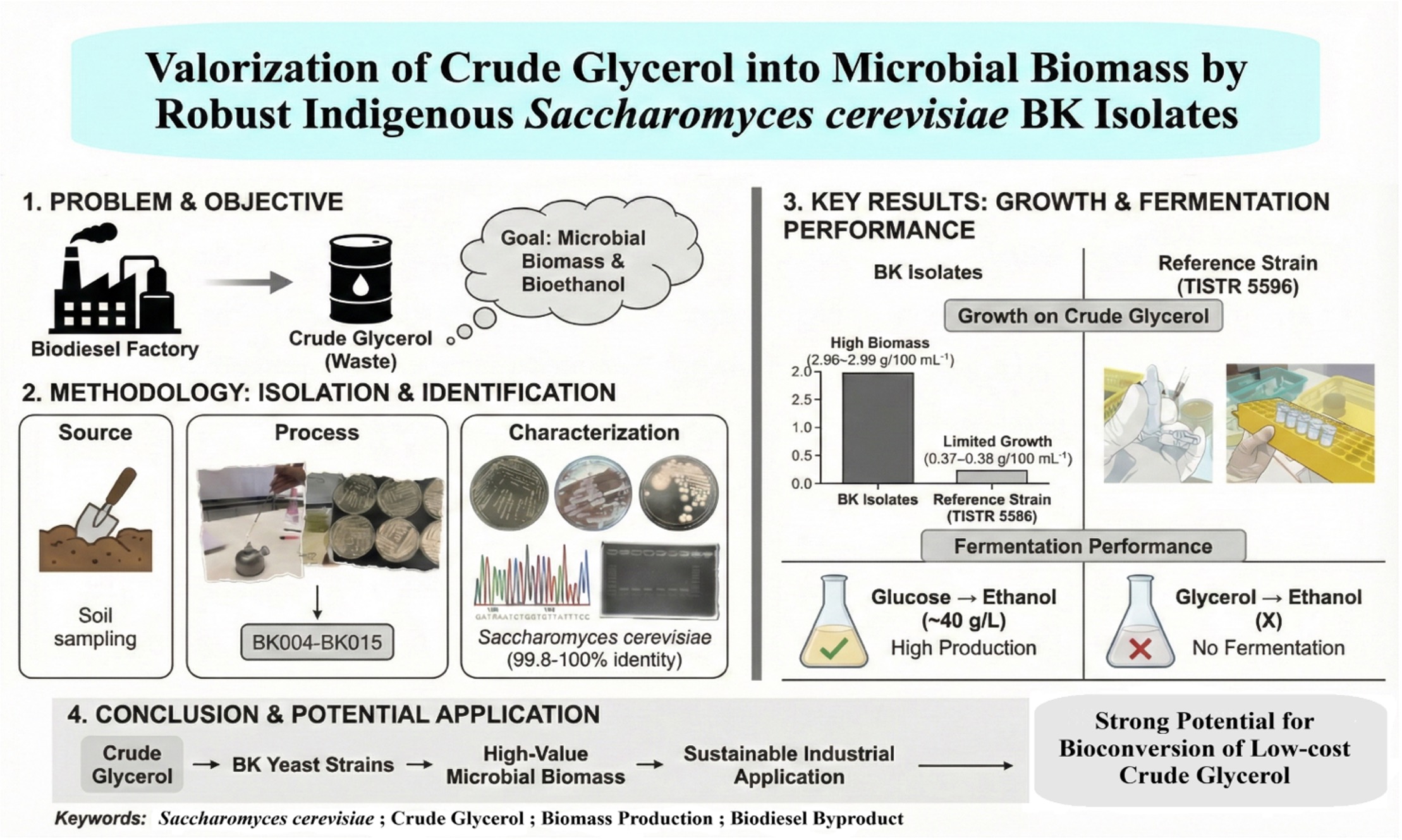
HIGHLIGHTS
- Eight indigenous Saccharomyces cerevisiae strains were isolated from soil and identified via 26S rDNA sequencing
- The isolated strains significantly outperformed the reference strain TISTR 5596 in glycerol utilization.
- Glycerol metabolism in BK isolates follows oxidative pathways, favoring biomass production over ethanol fermentation.
- The study highlights the potential for valorizing biodiesel-derived crude glycerol into value-added microbial biomass.
References
Anitha, M., Kamarudin, S. K., & Kofli, N. T. (2016). The potential of glycerol as a value-added commodity. Chemical Engineering Journal, 295, 119–130. https://doi.org/10.1016/j.cej.2016.03.012
Bhuiya, M. M. K., Rasul, M. G., Khan, M. M. K., Ashwath, N., & Azad, A. K. (2016). Prospects of 2nd generation biodiesel as a sustainable fuel—Part: 1 selection of feedstocks, production reviews and case studies. Renewable and Sustainable Energy Reviews, 55, 1109–1128. https://doi.org/10.1016/j.rser.2015.04.163
Karthikeyan, M., Sathish, S., Soosai, M. R., Prabu, D., & Venkatesan, D. (2026). Optimized production of biodiesel from used (waste) cooking oil by utilizing a heterogeneous catalyst, and its studies for sustainable development. Fuel, 403, 136091. https://doi.org/10.1016/j.fuel.2025.136091
Swinnen, S., Klein, M., Carrillo, M., McInnes, J., Nguyen, H. T. T., & Nevoigt, E. (2013). Re-evaluation of glycerol utilization in Saccharomyces cerevisiae: Characterization of an isolate that grows on glycerol without supporting supplements. Biotechnology for Biofuels, 6, 157. http://www.biotechnologyforbiofuels.com/content/6/1/157
Tan, T., Özbalci, C., Brügger, B., Rapaport, D., & Dimmer, K. S. (2013). Mcp1 and Mcp2, two novel proteins involved in mitochondrial lipid homeostasis. Journal of Cell Science, 126(16), 3563–3574. https://doi.org/10.1242/jcs.121244
Monteiro, M. R., Kugelmeier, C. L., Pinheiro, R. S., Batalha, M. O., & César, A. d. S. (2018). Glycerol from biodiesel production: Technological paths for sustainability. Renewable and Sustainable Energy Reviews, 88, 109–122.
Yang, F., Hanna, M. A., & Sun, R. (2012). Value added uses for crude glycerol--a byproduct of biodiesel production. Biotechnology for Biofuels, 5(1), 1–10. https://doi.org/10.1186/1754-6834-5-13
Russmayer, H., Egermeier, M., Kalemasi, D., & Sauer, M. (2019). Spotlight on biodiversity of microbial cell factories for glycerol conversion. Biotechnology Advances, 37, 107395. https://doi.org/10.1016/j.biotechadv.2019.05.001
Hansen, C. F., Hernandez, A., Mullan, B. P., Moore, K., Trezona-Murray, M., King, R. H., & Pluske, J. R. (2009). A chemical analysis of samples of crude glycerol from the production of biodiesel in Australia, and the effects of feeding crude glycerol to growing-finishing pigs on performance, plasma metabolites and meat quality at slaughter. Australian Journal of Experimental Agriculture, 49(2), 154–161. https://doi.org/10.1071/EA08210
Kaur, J., Sarma, A. K., Jha, M. K., & Gera, P. (2020). Valorisation of crude glycerol to value-added products: Perspectives of process technology, economics and environmental issues. Biotechnology Reports, 27, e00487. https://doi.org/10.1016/j.btre.2020.e00487
Papanikolaou, S., &Aggelis, G. (2002). Lipid production by Yarrowia lipolytica growing on industrial glycerol in a single-stage continuous culture. Bioresource Technology, 82(1), 43-49.
Yahyazadeh, A., Bot, A., Nanda, S., & Dalai, A. K. (2023). Technological insights on glycerol valorization into propanediol through thermocatalytic and synthetic biology approaches. Fermentation, 9(10), 894. https://doi.org/10.3390/fermentation9100894
Perpelea, A., Wijaya, A. W., Martins, L. C., Rippert, D., Klein, M., Angelov, A., Peltonen, K., Teleki, A., Liebl, W., Richard, P., Thevelein, J. M., Takors, R., Sá-Correia, I., & Nevoigt, E. (2022). Towards valorization of pectin-rich agro-industrial residues: Engineering of Saccharomyces cerevisiae for co-fermentation of D-galacturonic acid and glycerol. Metabolic Engineering, 69, 1–14. https://doi.org/10.1016/j.ymben.2021.10.001
Guragain, Y. N., & Vadlani, P. V. (2021). Renewable biomass utilization: A way forward to establish sustainable chemical and processing industries. Clean Technologies, 3(1), 243–259. https://doi.org/10.3390/cleantechnol3010014
Kumla, J., Nundaeng, S., Suwannarach, N., & Lumyong, S. (2020). Evaluation of multifarious plant growth promoting trials of yeast isolated from the soil of Assam tea (Camellia sinensis var. assamica) plantations in northern Thailand. Microorganisms, 8(8), 1168. https://doi.org/10.3390/microorganisms8081168
UAC Global Public Company Limited. (2014, February 24). Annual report 2014: Energy Transformation for Future [Annual report]. http://www.uac.co.th/
Sen, B., Dabir, A. P., Lanjekar, V. B., & Ranade, D. R. (2015). Isolation and partial characterization of a new strain of Klebsiella pneumoniae capable of high 1,3 propanediol production from glycerol. Global Journal of Environmental Science and Management, 1(2), 99–108. https://doi.org/10.7508/gjesm.2015.02.001
Kurtzman, C. P., Fell, J. M., & Boekhout, T. (2011). The yeasts: A taxonomic study (5th ed.). Elsevier.
Wickerham, L. J. (1951). Taxonomy of the yeasts (Technical Bulletin No. 1029). U. S. Department of Agriculture.
Stanbury, P. F., Whitaker, A., & Hall, S. J. (2017). Principles of fermentation technology (3rd ed.). Butterworth-Heinemann.
Kurtzman, C. P., & Robnett, C. J. (1998). Identification and phylogeny of ascomycetous yeast from analysis of nuclear large subunit (26S) ribosomal DNA partial sequences. Antonie van Leeuwenhoek, 73(4), 331–371. https://doi.org/10.1023/A:1001761008817
Saitou, N., & Nei, M. (1987). The neighbor-joining method: A new method for reconstructing phylogenetic trees. Molecular Biology and Evolution, 4(4), 406–425. https://doi.org/10.1093/oxfordjournals.molbev.a040454
Kurtzman, C. P., Boekhout, T., Robert, V., Fell, J. W., & Deak, T. (2003). Methods to identify yeasts. In T. Boekhout & V. Robert (Eds.), Yeasts in food: Beneficial and detrimental aspects (pp. 69–121). B.Behr’s Verlag.
Rice, P., Longden, I., & Bleasby, A. (2000). EMBOSS: The European Molecular Biology Open Software Suite. Trends in Genetics, 16(6), 276–277. https://doi.org/10.1016/S0168-9525(00)02024-2
Jutakanoke, R., Leepipatpiboon, N., Tolieng, V., Kitpreechavanich, V., Srinorakutara, T., & Akaracharanya, A. (2012). Sugarcane leaves: Pretreatment and ethanol fermentation by Saccharomyces cerevisiae. Biomass and Bioenergy, 39, 283–289. https://doi.org/10.1016/j.biombioe.2012.01.018
Strucko, T., Zirngibl, K., Tharwat Tolba Mohamed, E., Feist, A., Patil, K. R., & Förster, J. (2015). Development of an efficient glycerol-utilizing Saccharomyces cerevisiae strain via adaptive laboratory evolution. In Jacobsen, C. S. (Ed.), Danish Microbiological Society Annual Congress 2015 (p. 22). Danish Microbiological Society.
Dmytruk, K., Semkiv, M., & Sibirny, A. (2025). Glycerol bioconversion to biofuel and value-added products by yeasts. FEMS Yeast Research, 25, foaf038.https://doi.org/10.1093/femsyr/foaf038
Dobson, R., Gray, V., & Rumbold, K. (2012). Microbial utilization of crude glycerol for the production of value-added products. Journal of Industrial Microbiology & Biotechnology, 39, 217–226. https://doi.org/10.1007/s10295-011-1038-0
Yu, Z., Chang, Z., Lu, Y., & Xiao, H. (2023). Metabolic engineering of Saccharomyces cerevisiae for glycerol utilization. FEMS Yeast Research, 23, 1–8. https://doi.org/10.1093/femsyr/foad014
Pirzadi, Z., & Meshkani, F. (2022). From glycerol production to its value-added uses: A critical review. Fuel, 329, 125044. https://doi.org/10.1016/j.fuel.2022.125044
Xiberras, J., Klein, M., & Nevoigt, E. (2019). Glycerol as a substrate for Saccharomyces cerevisiae based bioprocesses – Knowledge gaps regarding the central carbon catabolism of this ‘non-fermentable’ carbon source. Biotechnology Advances, 37, 107378. https://doi.org/10.1016/j.biotechadv.2019.03.017
Klein, M., Swinnen, S., Thevelein, J. M., & Nevoigt, E. (2017). Glycerol metabolism and its exploitation in Saccharomyces cerevisiae. Metabolic Engineering, 38, 364–372. https://doi.org/10.1016/j.meteno.2016.09.001
Kaewwichian, R., & Khamthiklang, S. (2017). Yeast in mangrove forest soil from the central Thailand and it ability in degradation of starch, carboxymethylcellulose and xylan. Burapha Science Journal, 22, 411-422.
Pongcharoen, P., Chawneua, J., & Tawong, W. (2018). High temperature alcoholic fermentation by new thermotolerant yeast strains Pichia kudriavzevii isolated from sugarcane field soil. Agriculture and Natural Resources, 52, 511-518.
Yurkov, A. M. (2018). Yeasts of the soil-obscure but precious. Yeast, 35(5), 369-378.
Botha, A. (2011). The Importance and ecology of yeast in soil. Soil Biology and Biochemistry, 43, 1-8.
Limtong, S., & Kaewwichian, R. (2009). Diversity of yeast in soil from national parks in the north eastern part of Thailand and their role in degradation of organic matters in soil (Final report). Department of Microbiology, Faculty of Science, Kasetsart University.
Thanito, K. (2016, July 23). Cultivation of S. cerevisiae using glycerol from biodiesel process in laboratory. Proceedings of the 4th National and 2nd International Academic Conference 2016, Bangkok Thonburi University, 164-171.
Vikromvarasiri, N., Laothanachareon, T., Champreda, V., & Pisutpaisal, N. (2014). Bioethanol production from glycerol by mixed culture system. Energy Procedia, 61, 1213–1218. https://doi.org/10.1016/j.egypro.2014.11.1059
Rakkitkanphun, C., Lomthong, T., Wanlapa, A., Teeka, J., & Areesirisuk, A. (2019). Effect of chemical and physical factors on oleaginous yeast cultivation by using biodiesel-derived crude glycerol as a main carbon source. Nakhon Sawan Rajabhat University Science and Technology Journal, 11(13), 65-78.
Atabani, A. E., Silitonga, A. S., Badruddin, I. A., Mahlia, T. M. I., Masjuki, H. H., & Mekhilef, S. (2012). A comprehensive review on biodiesel as an alternative energy resource and its characteristics. Renewable and Sustainable Energy Reviews, 16(4), 2070–2093. https://doi.org/10.1016/j.rser.2012.01.003
Bansod, Y., Ghasemzadeh, K., & D'Agostino, C. (2025). Techno-economic assessment of biodiesel-derived crude glycerol purification processes. RSC Sustainability, 3(6), 2605–2618. https://doi.org/10.1039/d4su00599f
Selvakumari, I. A., Jayamuthunagai, J., & Bharathiraja, B. (2025). Techno-economic analysis and feasibility study of malic acid production using crude glycerol from biodiesel refineries. Polish Journal of Environmental Studies. https://doi.org/10.15244/pjoes/211640
Attarbachi, T., Kingsley, M., & Spallina, V. (2024). Experimental scale-up and technoeconomic assessment of low-grade glycerol purification from waste-based biorefinery. Industrial & Engineering Chemistry Research, 63(11),4905–4917. https://doi.org/10.1021/acs.iecr.3c03868
Yu, J., Dong, J., Zhang, C., & Xiao, D. (2014). Effect of GPD1 and GPD2 deletion on the production of glycerol and ethanol in the yeast Saccharomyces cerevisiae. In T.C. Zhang, P. Ouyang, S. Kaplan, & B. Skarnes (Eds.), The 2012 International Conference on Applied Biotechnology (ICAB 2012) (Vol. 2, pp. 171–179). Springer. https://doi.org/10.1007/978-3-642-37922-2_17
Swinnen, S., Ho, P. W., Klein, M., & Nevoigt, E. (2016). Genetic determinants for enhanced glycerol growth of Saccharomyces cerevisiae. Metabolic Engineering, 36, 68–79. https://doi.org/10.1016/j.ymben.2016.03.003
Khattab, S. M. R., Katahira, M., & Watanabe, T. (2025). Engineering Saccharomyces cerevisiae for ethanol production from glycerol, xylose, acetic acid, and glucose. Bioresource Technology, 435, 132921.
Nakanishi, A., Zhang, K., Matsumoto, R., & Yamamoto, N. (2022). Estimation of carbon metabolism in Saccharomyces cerevisiae acclimatized to glycerol assimilation with quantitative PCR. Microorganisms, 10(6),1173. https://doi.org/10.3390/microorganisms10061173
Downloads
Published
How to Cite
Issue
Section
Categories
License
Copyright (c) 2026 : Nichanun Udomsaksakul, Phakawan Kongchantree, Apiradee Sripiromrak, Napakan Naikhon

This work is licensed under a Creative Commons Attribution-NonCommercial-NoDerivatives 4.0 International License.