AI-driven multi-response optimization of perforated Ti-6Al-4V sheets via two-point incremental forming using an ANN–GA-based approach
DOI:
https://doi.org/10.55674/cs.v18i2.265879Keywords:
Ti-6Al-4V, TPIF, Taguchi-ANN-GAAbstract
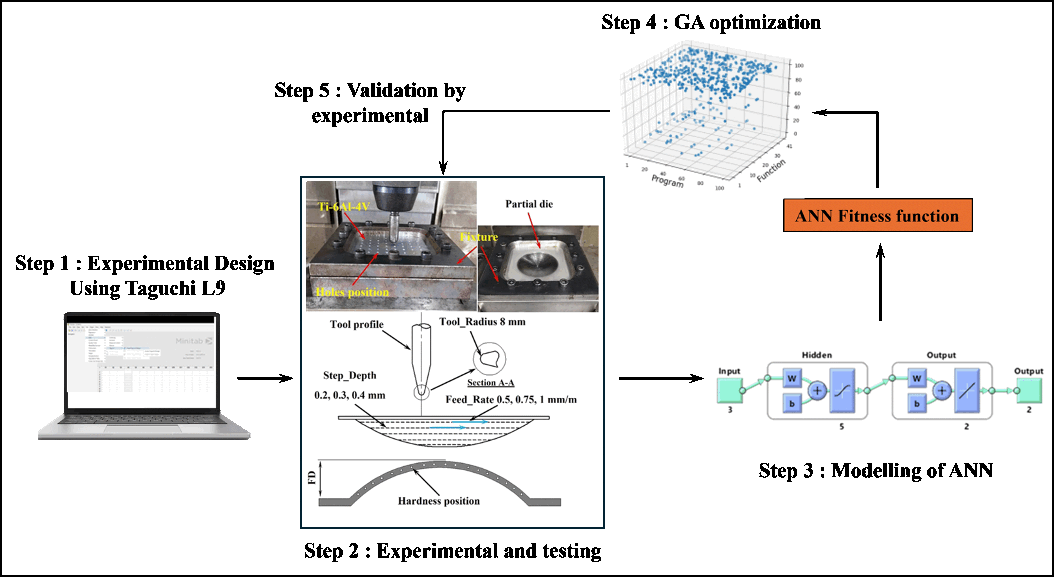
This study investigates two-point incremental forming (TPIF) of perforated Ti-6Al-4V sheets using an integrated experimental–computational framework to optimize surface hardness and formability. Room-temperature TPIF of mill-annealed Grade 5 Ti-6Al-4V sheets (100 × 100 × 1 mm) was performed under dry conditions. Sheets with 2 mm holes at pitches of 6, 8, and 10 mm were formed following a Taguchi L9 design. Holes were produced by precision CNC drilling, ensuring clean edges without a heat-affected zone and preserving the base microstructure. Hole pitch (Hp), incremental step depth (ISD), and feed rate (Fr) were evaluated using Vickers hardness (HV) and forming depth (FD). Hole pitch was the dominant factor, contributing 59.1% to hardness and 69.2% to forming depth. An ANN (3–5–2) accurately predicted both responses (RMSE = 1.37 for HV; 0.0458 for FD) and was coupled with GA for multi-response optimization. The ANN–GA converged within 1000 generations and identified the optimum (Hp = 10 mm, ISD = 0.4 mm, Fr = 0.75 mm·min-1 , yielding HV and FD values of 341 and 9.92 mm, respectively. Validation experiments at the optimal condition showed <2% deviation from predictions. Improved performance was attributed to strain redistribution and localized work hardening around perforations. The novelty of this work lies in integrating perforation-assisted deformation mechanics with AI-driven multi-response optimization for a difficult-to-form titanium alloy. This approach offers a practical pathway for lightweight, high-strength titanium component design in aerospace, biomedical, and EV applications.
GRAPHICAL ABSTRACT
HIGHLIGHTS
- A hybrid ANN–GA framework was developed to model and optimize the TPIF process of perforated Ti-6Al-4V sheets.
- The proposed model accurately predicted hardness and forming depth, showing strong agreement with experimental results.
- ANN–GA optimization identified optimal process parameters that simultaneously enhanced formability and surface hardness.
- The data-driven approach supports smart manufacturing and Industry 4.0 applications for advanced titanium sheet forming.
References
Rabbitt, D., Villapún, V. M., Carter, L. N., Man, K., Lowther, M., O’Kelly, P., & Cox, S. C. (2025). Rethinking biomedical titanium alloy design: A review of challenges from biological and manufacturing perspectives. Advanced Healthcare Materials, 14(4), 2403129. https://doi.org/10.1002/adhm.202403129
Badr, O. M., Barlat, F., Rolfe, B., Lee, M. G., Hodgson, P., & Weiss, M. (2016). Constitutive modelling of high strength titanium alloy Ti-6Al-4V for sheet forming applications at room temperature. International Journal of Solids and Structures, 80, 334–347. https://doi.org/10.1016/j.ijsolstr.2015.08.025
Oleksik, V., Trzepieciński, T., Szpunar, M., Chodoła, Ł., Ficek, D., & Szczęsny, I. (2021). Single-point incremental forming of titanium and titanium alloy sheets. Materials, 14(21), 6372. https://doi.org/10.3390/ma14216372
Morita, T., Oka, Y., Tsutsumi, S., Takesue, S., Higuchi, N., & Sakai, H. (2022). Short-time heat treatment for Ti-6Al-4V alloy produced by selective laser melting. Materials Transactions, 63(6), 854–863. https://doi.org/10.2320/matertrans.MT-M2022018
Charonerat, S., Onbut, K., Prasomthong, S., Pookamnerd, Y., & Thosa, P. (2025). Multi-objective optimization of two-point incremental forming parameters for Ti-6Al-4V using Taguchi approach. EUREKA: Physics and Engineering, (5), 132–143. https://doi.org/10.21303/2461-4262.2025.003904
Prasomthong, S., & Onbat, K. (2023). The optimization of sheet forming on residual stress and surface roughness with two-point incremental forming process (TPIF) of aluminum alloy parts. Applied Science and Engineering Progress, 16(4), 6059. https://doi.org/10.14416/j.asep.2022.06.003
Prasomthong, S., Phatungthane, T., & Chomchalao, C. (2025). Optimization of aluminum matrix composite production in a friction stir process with MgO nanoparticle reinforcement using ANN–GRA modeling. Engineering and Applied Science Research, 52(3), 282–295. https://ph01.tci-thaijo.org/index.php/easr/article/view/259404
Pookamnerd, Y., Thosa, P., Charonerat, S., & Prasomthong, S. (2023). Development of mechanical property prediction model and optimization for dissimilar aluminum alloy joints with the friction stir welding (FSW) process. EUREKA: Physics and Engineering, (3), 112–128. https://doi.org/10.21303/2461-4262.2023.002776
Mayai, A., Prasomthong, S., & Pookamnerd, Y. (2025). Development of hybrid ANN–GA and RSM models for optimizing mechanical properties in SS400–SUS304 welds. EUREKA: Physics and Engineering, (3), 152–165. https://doi.org/10.21303/2461-4262.2025.003606
Tandecka, K., Kacalak, W., Wieczorowski, M., & Mathia, T. G. (2024). Evaluation of Surface Finishing Efficiency of Titanium Alloy Grade 5 (Ti–6Al–4V) After Superfinishing Using Abrasive Films. Materials, 17(21), 5198. https://doi.org/10.3390/ma17215198.
Badr, O. M. (2015). Forming of high strength titanium sheet at room temperature. Materials & Design, 66, 428–437. https://doi.org/10.1016/j.matdes.2014.03.008
Ao, D. (2020). Formability and deformation mechanism of Ti–6Al–4V sheet by incremental forming. Journal of Materials Processing Technology, 282, 116703. https://doi.org/10.1016/j.jmatprotec.2020.116703
Trzepieciński, T., Szpunar, M., Ostrowski, R., Ziaja, W., & Motyka, M. (2024). Advanced FEM insights into pressure-assisted warm single-point incremental forming of Ti–6Al–4V titanium alloy sheet metal. Materials, 14(6), 619. https://doi.org/10.3390/met14060619
Bansal, A., Jiang, B., & Ni, J. (2019). Die-less fabrication of miniaturized parts through single point incremental micro-forming. Journal of Manufacturing Processes, 43, 20–25. https://doi.org/10.1016/j.jmapro.2019.03.046
Emmens, W. C., Sebastiani, G., & van den Boogaard, A. H. (2010). The technology of incremental sheet forming—A brief review of the history. Journal of Materials Processing Technology, 210(8), 981–997. https://doi.org/10.1016/j.jmatprotec.2010.02.014
Ou, L., An, Z., Gao, Z., Zhou, S., & Men, Z. (2020). Effects of Process Parameters on the Thickness Uniformity in Two-Point Incremental Forming (TPIF) with a Positive Die for an Irregular Stepped Part. Materials, 13(11), 2634. https://doi.org/10.3390/ma13112634.
Moharam, L. M., El-Hoshy, A. Z., & Abou-Elenein, K. (2017). The effect of different insertion techniques on the depth of cure and vickers surface micro-hardness of two bulk-fill resin composite materials. Journal of Clinical and Experimental Dentistry, 9 (2), e266 - e271. https://doi.org/10.4317/jced.53356.
Wu, H., Dave, F., Mokhtari, M., Ali, M. M., Sherlock, R., Mcilhagger, A., Tormey, D., & McFadden, S. (2022). On the Application of Vickers Micro Hardness Testing to Isotactic Polypropylene. Polymers, 14(9), 1804. https://doi.org/10.3390/polym14091804.
Charonerat, S., Onbut, K., Prasomthong, S., Pookamnerd, Y., & Thosa, P. (2025). Multi-objective optimization of two-point incremental forming parameters for Ti-6Al-4V using taguchi approach. EUREKA: Physics and Engineering, (5), 132-143. https://doi.org/10.21303/2461-4262.2025.003904.
Tekade, R. K., & Chougule, M. B. (2013). Formulation development and evaluation of hybrid nanocarrier for cancer therapy: Taguchi orthogonal array based design. BioMed Research International, 2013, 712678. https://doi.org/10.1155/2013/712678
Hisam, M. W., Dar, A. A., Elrasheed, M. O., Khan, M. S., Gera, R., & Azad, I. (2024). The versatility of the Taguchi method: Optimizing experiments across diverse disciplines. Journal of Statistical Theory and Applications, 23(4), 365–389. https://doi.org/10.1007/s44199-024-00093-9
Xiao, X., Zhang, X., Zhang, Y., & Tang, J. (2020). RSM and BPNN modeling in incremental sheet forming process for AA5052 sheet: Multi-objective optimization using genetic algorithm. Metals, 10(8), 1003. https://doi.org/10.3390/met10081003
Equbal, A., Khan, M. S., Shandilya, S., & Alam, N. (2020). Application of the combined ANN and GA for multi-response optimization of cutting parameters for the turning of glass fiber-reinforced polymer composites. Mathematics, 8(6), 947. https://doi.org/10.3390/math8060947
Maurya, A. K., Verma, A. K., Singh, P. S., & Singh, N. (2025). Artificial neural network modeling of Ti-6Al-4V alloys to correlate their microstructure and mechanical properties. Materials, 18(5), 1099. https://doi.org/10.3390/ma18051099
Sahib, M. M., & Kovács, G. (2024). Multi-objective optimization of composite sandwich structures using artificial neural networks and genetic algorithm. Results in Engineering, 21, 101937. https://doi.org/10.1016/j.rineng.2024.101937
Downloads
Published
How to Cite
Issue
Section
Categories
License
Copyright (c) 2026 : Apisit Keawchaloon , Suriya Prasomthong, Thanatep Phatungthane, Chaiya Chomchalao

This work is licensed under a Creative Commons Attribution-NonCommercial-NoDerivatives 4.0 International License.