Studies morphological and determination of folic acid, β-glucans, protein and fiber of local edible mushrooms in Loei province
DOI:
https://doi.org/10.55674/cs.v18i3.265617Keywords:
Local Edible Mushrooms, Folic Acid, β-Glucans, Protein, FiberAbstract
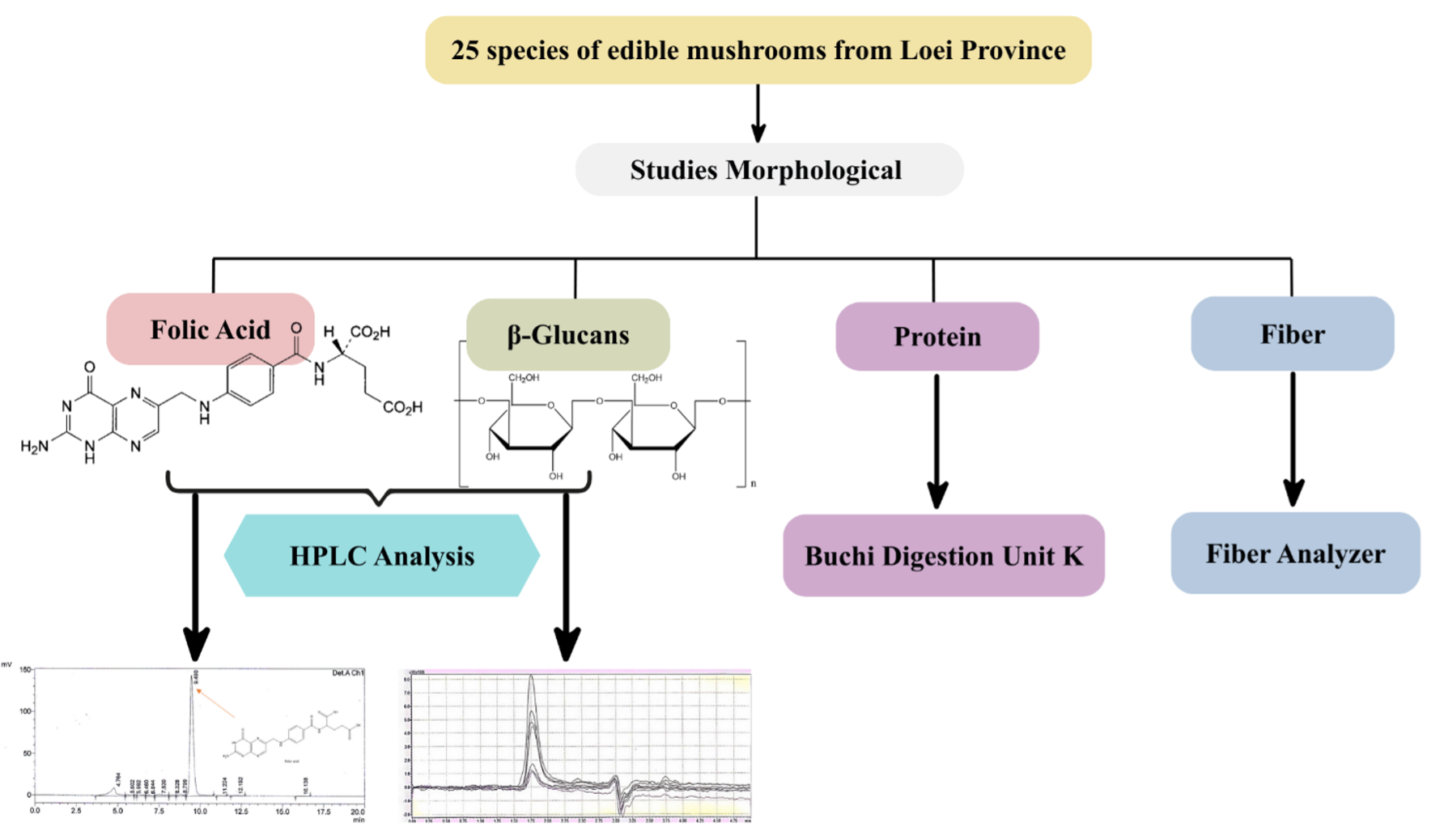
This study examined the morphology and quantified folic acid, β-glucans, protein, and fiber contents in 25 species of local edible mushrooms from Loei Province. This study aimed to analyze the functional nutrients of local edible mushrooms collected from Loei Province. Morphological characteristics of the cap/pileus, stem, gills, flesh, and special features like veils and rings were analyzed, revealing distinct differences useful for effective species classification and reflecting the biodiversity adapted to varied local environments. Quantitative analysis was performed in triplicate using high-performance liquid chromatography for folic acid and beta-glucan. The results showed that folic acid ranged from 0.09 to 1.52 mg 100g-1, β-glucans from 183.46 to 1197.41 mg 100g-1, protein from 1.31 to 35.88%, and fiber from 0.15 to 9.49%. The highest folic acid content was found in Coprinus fimetarrius, β-glucans in Lentinus squarrosulus, protein in Tylopilus plumbeoviolaceus, and fiber in Phallus indusiatus. Variations in these nutritional components were influenced by physiological traits, nutrient accumulation capacity, environmental conditions, soil fertility, temperature, and rainfall in the collection areas. The research findings hold scientific value and can serve as baseline data for further development into products that enhance the economic value of local edible mushrooms while expanding consumer choices for diverse mushroom consumption.
GRAPHICAL ABSTRACT
HIGHLIGHTS
- Morphological traits (cap, gills, stipe, base) enable precise identification of 25 Loei Province edible mushrooms, distinguishing safe species from toxic relatives for food safety.
- Coprinus fimetarrius exhibited highest folic acid (0.15 mg/100g); lowest in Russula virescens (Schaeff.) Fr., Russula emetic (Schaeff. & Fr.) S.F.Gray., Boletus edulis Bulliard ex Fries., Craterellus odoratus (Schwein.) Fr., Russula foetens (Pers.) Fr., and Russula cyanoxantha (Schaeff. Ex Secr.) Fr. (0.01 mg/100g).
- Lentinus squarrosulus showed peak β-glucan content (11.97 mg/g); Boletellus emodensis (Berk.)Sing. lowest (1.83 mg/g), highlighting species-specific soluble fiber variation.
- Tylopilus plumbeoviolaceus contained highest protein (26.39%); Amanita hemibapha (Berk.& Br.) Sacc. lowest (1.31%), reflecting genetic and environmental protein accumulation differences.
- Phallus indusiatus had maximum fiber (9.49%); Galiella rufa (Schweinitz) Nannfeldt & Korf. minimum (0.15%), demonstrating dietary fiber diversity for functional food applications.
- Nutrient variations driven by genetics, soil fertility, temperature, humidity, and growth stage align with global research, supporting biodiversity conservation and economic utilization.
References
Chanluang, S., Nilatawong, P., Sutheerapongs, P., Cherdkoksri, K., Mitwong, W., & Kaewamatawong, R. (2017). Amount of protein, crude fiber and β-glucan, and anti-oxidative activity in edible wild mushrooms used as food in Ubon Ratchathani Province. Journal of Science and Technology, Ubon Ratchathani University, 19(Special Issue), 240-248.
Zhu, F., Du, B., Bian, Z., & Xu, B. (2015). Beta-glucans from edible and medicinal mushrooms: Characteristics, physicochemical and biological activities. Journal of Food Composition and Analysis, 41, 165-173. https://doi.org/10.1016/j.jfca.2015.01.019
Kupradit, C., Ranok, A., Mangkalanan, S., Khongla, C., & Musika, S. (2023). β-glucan and antioxidant activities of four edible mushroom extracts from Thailand. Asian Journal of Agriculture and Biology, 1, 202107285. https://doi.org/10.35495/ajab.2021.07.285
Benchawattananon, R. (2016). Biodiversity of mushrooms in conservative forest in Dansai District of Loei Province, Thailand. Tropical Life Sciences Research, 27(Supp. 1), 103–109. https://doi.org/10.21315/tlsr2016.27.3.14
Mironczuk-Chodakowska, I., Kujawowicz, K., & Witkowska, A. M. (2021). Beta-glucans from fungi: Biological and health-promoting potential in the COVID-19 pandemic era. Nutrients, 13(11), 3960. https://doi.org/10.3390/nu13113960
Cieslik, E., & Cieslik, I. (2018). Occurrence and significance of folic acid. Pteridines, 29(1), 187–195. https://doi.org/10.1515/pteridines-2018-0017
Singla, A., Gupta, O. P., Sagwal, V., Kumar, A., Patwa, N., Mohan, N., Ankush, Kumar, D., Vir, O., Singh, J., Kumar, L., Lal, C., & Singh, G. (2024). Beta-glucan as a soluble dietary fiber source: Origins, biosynthesis, extraction, purification, structural characteristics, bioavailability, biofunctional attributes, industrial utilization, and global trade. Nutrients, 16(6), 900. https://doi.org/10.3390/nu16060900
Inyod, T., Keawsompong, S., Payapanon, A., Lattirasuvan, T., Chawananorasest, K., Termarom, T., Konee, C., Yatsom, S., Bualoi, S., & Eamprasong, P. (2023). Factors influencing mycelial growth, yield, quality and ß-glucan content of Hed Taen Rad (Macrocybe crassa). Journal of Science and Technology, Ubon Ratchathani University, 25(2), 71–86.
Suwanno, S., & Phiraporn, C. (2016). 1, 3-β-glucan content of local medicinal mushrooms from the southern region of Thailand. Walailak Journal of Science and Technology (WJST), 15(3), 189–200.
Paucean, A., Moldovan, O. P., Muresan, V., Socaci, S. A., Dulf, F. V., Alexa, E., Man, S. M., Mureșan, A. E., & Muste, S. (2018). Folic acid, minerals, amino-acids, fatty acids and volatile compounds of green and red lentils. Folic acid content optimization in wheat-lentils composite flours. Chemistry Central Journal, 12, 88. https://doi.org/10.1186/s13065-018-0456-8
Al-Saffar, A. Z., Hadi, N. A., & Khalaf, H. M. (2020). Antitumor activity of β-glucan extracted from Pleurotus eryngii. Indian Journal of Forensic Medicine & Toxicology, 14(4), 2214–2221. https://doi.org/10.37506/ijfmt.v14i4.11880
Puwastien, P., Siong, T. E., Kantasubrata, J., Craven, G., Feliciano, R. R., & Judprasong, K. (2011). ASEAN manual of food analysis. Institute of Nutrition, Mahidol University.
AOAC. (1990). Official Methods of Analysis of AOAC International (15th ed.). AOAC, Association of Official Analytical Chemists.
AOAC. (2000). Official Methods of Analysis of AOAC International (17th ed.). AOAC International.
Kalac, P. (2013). A review of chemical composition and nutritional value of wild‐growing and cultivated mushrooms. Journal of the Science of Food and Agriculture, 93(2), 209–218. https://doi.org/10.1002/jsfa.5960
Dimopoulou, M., Kolonas, A., Mourtakos, S., Androutsos, O., & Gortzi, O. (2022). Nutritional composition and biological properties of sixteen edible mushroom species. Applied Sciences, 12(16), 8074. https://doi.org/10.3390/app12168074
Stojek, K., Bobrowska-Korczak, B., Frączek, J., Piotrowski, M., Krosniak, M., & Jaroszewicz, B. (2025). Protein content and amino acid profile of wild mushrooms depend on environmental conditions. Fungal Biology, 129(6), 101620. https://doi.org/10.1016/j.funbio.2025.101620
The jamovi project. (2025). jamovi (Version 2.7) [Computer Software]. https://www.jamovi.org.
Downloads
Published
How to Cite
Issue
Section
Categories
License
Copyright (c) 2026 : Niramol Srichana, Suwatchai Misuna, Panruethai Putthongsri, Rasamee Nontee

This work is licensed under a Creative Commons Attribution-NonCommercial-NoDerivatives 4.0 International License.