
Influence of seasonal variation on the food safety and shelf-life of homemade dog food from fresh markets in Mueang District, Sakon Nakhon Province
DOI:
https://doi.org/10.55674/cs.v18i2.265567Keywords:
Food safety, Home-made dog food, Season, Shelf-lifeAbstract
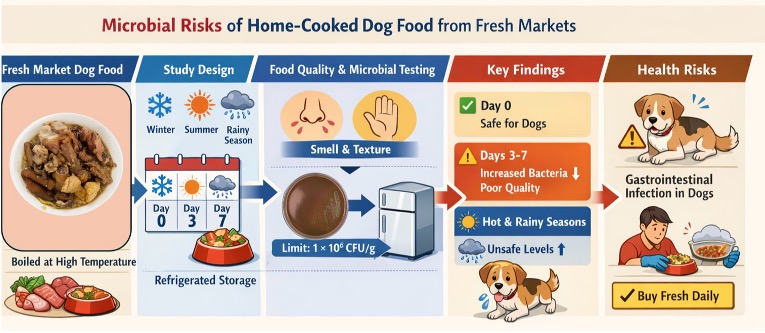
Home-cooked dog food sold in fresh markets is an alternative for dog owners seeking to avoid commercial dried or canned pet food. Although it is typically boiled and subjected to high heat during preparation, improper storage may lead to spoilage. This study aimed to assess the levels of bacteria, and to determine whether these foods remain microbiologically safe for canine consumption after refrigerated storage, especially when purchased in large quantities, across different seasons and from three fresh market vendors. The study found that all three vendors used leftovers and animal by-products from human consumption, such as the lungs, trachea, bones, blood, and chicken carcasses. During the first day of purchase, the physical characteristics and microbiological quality of the food were acceptable for canine consumption. However, by days 3 and 7 of refrigerated storage, food quality such as smell and texture had declined. Notably, in the rainy and hot seasons, when ambient temperatures were higher, the microbial quality deteriorated significantly, making food unsuitable for dogs. From Day 3 the total microbial counts exceeded the acceptable limit of 1 × 10⁶ CFU g-1 for 2 of 3 vendors (6.05±0.03 and 7.12±0.01) in the summer and all vendors in the rainy season (7.32±0.03, 6.25±0.01 and 7.12±0.01), which posed health risks and might lead to gastrointestinal infections. The pathogenic bacteria which found in this study are Escherichia coli and coliform bacteria. Health risks are not limited to dogs; pet owners who prepare and handle this food directly may also be exposed to potential pathogens. This study recommends that dog owners purchase only a daily portion of this type of food to reduce spoilage risks, particularly given Thailand’s predominantly warm climate.
GRAPHICAL ABSTRACT
HIGHLIGHTS
- Homemade dog food in Thailand has gained increasing popularity and is widely available in fresh markets, which typically formulated using by-products from slaughter, such as lungs and blood.
- Refrigerated storage of dog food may lead to spoilage, which can result in gastrointestinal infections in dogs, moreover may pose a health risk to pet owners who come into contact with the contaminated dog food.
- Seasonal variations affect the quality of refrigerated dog food. It is not recommended to stockpile home-cook dog food during the rainy or hot seasons, as it should be consumed on the day of purchase to ensure safety and freshness.
References
Fuchs, M., & Obernhuber, C. (2011). Hypercompetitive rivalries in the pet food industry. In J. Zentes, B. Swoboda, & D. Morschett (Eds.), Fallstudien zum Internationalen Management (pp. 943–962). Gabler Verlag.
Baumann, C., Pfrengle, S., Münzel, S. C., Molak, M., Feuerborn, T. R., Breidenstein, A., & Schuenemann, V. J. (2021). A refined proposal for the origin of dogs: The case study of Gnirshöhle, a Magdalenian cave site. Scientific Reports, 11(1), 1–14. https://doi.org/10.1038/s41598-021-83719-7
Hughes, J., & Macdonald, D. W. (2013). A review of the interactions between free-roaming domestic dogs and wildlife. Biological conservation, 157, 341–351. https://doi.org/10.1016/j.biocon.2012.07.005
Stockman, J., Fascetti, A. J., Kass, P. H., & Larsen, J. A. (2013). Evaluation of recipes of home-prepared maintenance diets for dogs. Journal of the American Veterinary Medical Association, 242(11), 1500–1505.
Remillard, R. L. (2008). Homemade diets: Attributes, pitfalls, and a call for action. Topics in Companion Animal Medicine, 23(3), 137–142. https://doi.org/10.1053/ j.tcam. 2008.04.006
Dodd, S., Cave, N., Abood, S., Shoveller, A. K., Adolphe, J., & Verbrugghe, A. (2020). An observational study of pet feeding practices and how these have changed between 2008 and 2018. Veterinary Record, 186(19), 643. https://doi.org/10.1136/vr.105828
Pedrinelli, V., de O. S. Gomes, M., & Carciofi, A. C. (2017). Analysis of recipes of home-prepared diets for dogs and cats published in Portuguese. Journal of nutritional science, 6, e33. https://doi.org/10.1017/jns.2017.31
Streiff, E. L., Zwischenberger, B., Butterwick, R. F., Wagner, E., Iben, C., & Bauer, J. E. (2002). A comparison of the nutritional adequacy of home-prepared and commercial diets for dogs. The Journal of nutrition, 132(6), 1698S–1700S.
Beynen, A. C. (2013). Thai petfood industry and pet nutrition science. Journal of Mahanakorn Veterinary Medicine, 8(2), 103–113.
Lambertini, E., Buchanan, R. L., Narrod, C., & Pradhan, A. K. (2016). Transmission of bacterial zoonotic pathogens between pets and humans: The role of pet food. Critical reviews in food science and nutrition, 56(3), 364–418.
Homtong, N., Suwanlee, S. R., Keawsomsee, S., Kasa, K., Som-Ard, J., Ninsawat, S., Nuthammachot, N., Spiller, D., & Sarvia, F. (2026). Mapping spatiotemporal agricultural droughts from 2019 to 2024 in Northeast Thailand using multi-temporal and multiple sensor data together with random forest algorithm. Agricultural Water Management, 325, 110216. https://doi.org/10.1016/j.agwat.2026.110216
Maturin, L., & Peeler, J. T. (2001). Chapter 3: Aerobic plate count. In Food and Drug Administration (FDA), Bacteriological analytical manual (8th ed.). Silver Spring.
Adzitey, F., Assoah-Peprah, P., Teye, G. A., Somboro, A. M., Kumalo, H. M., & Amoako, D. G. (2020). Prevalence and Antimicrobial Resistance of Escherichia coli Isolated from Various Meat Types in the Tamale Metropolis of Ghana. International Journal of Food Science, 2020, 8877196. https://doi.org/10.1155/2020/8877196
Ogur, S. (2022b). Microbiological Quality and Safety of Some Dried Spices Obtained from Markets, Spice Shops and Homes. Brazilian Archives of Biology and Technology, 65, e22220315. https://doi.org/10.1590/1678-4324-2022220315
Oliveira, D. A., McLamore, E. S., & Gomes, C. L. (2022). Rapid and label-free Listeria monocytogenes detection based on stimuli-responsive alginate-platinum thiomer nanobrushes. Scientific Reports, 12(1), 21413. https://doi.org/10.1038/s41598-022-25753-7
Miller, J. M., Binnicker, M. J., Campbell, S., Carroll, K. C., Chapin, K. C., Gilligan, P. H., Gonzalez, M. D., Jerris, R. C., Kehl, S. C., Patel, R., Pritt, B. S., Richter, S. S., Robinson-Dunn, B., Schwartzman, J. D., Snyder, J. W., Telford, S., Theel, E. S., Thomson, R. B., Weinstein, M. P., & Yao, J. D. (2018). A Guide to Utilization of the Microbiology Laboratory for Diagnosis of Infectious Diseases: 2018 Update by the Infectious Diseases Society of America and the American Society for MicrobiologyA. Clinical Infectious Diseases, 67(6), e1–e94. https://doi.org/10.1093/cid/ciy381
Kazimierska, K., Biel, W., Witkowicz, R., Karakulska, J., & Stachurska, X. (2021). Evaluation of nutritional value and microbiological safety in commercial dog food. Veterinary Research Communications, 45(2), 111–128. https://doi.org/10.1007/s11259-021-09791-6
Chomvarin, C., Chantarasuk, Y., Srigulbutr, S., Chareonsudjai, S., & Chaicumpar, K. (2006). Enteropathogenic bacteria and enterotoxin producing Staphylococcus aureus isolated from ready-to-eat foods in Khon Kaen, Thailand. Journal of Tropical Medicine & Public Health, 37(5), 983.
Tomaszewska, M., Trafialek, J., Suebpongsang, P., & Kolanowski, W. (2018). Food hygiene knowledge and practice of consumers in Poland and in Thailand – A survey. Food Control, 85, 76–84. https://doi.org/10.1016/j.foodcont.2017.09.022
Dzanis, D. A. (2008). Understanding regulations affecting pet foods. Topics in Companion Animal Medicine, 23(3), 117–120. https://doi.org/10.1053/j.tcam.2008.04.002
Morgan, G., Williams, N., Schmidt, V., Cookson, D., Symington, C., & Pinchbeck, G. (2022). A Dog’s Dinner: Factors affecting food choice and feeding practices for UK dog owners feeding raw meat-based or conventional cooked diets. Preventive veterinary medicine, 208, 105741. https://doi.org/10.1016/j.prevetmed.2022.105741
Kratzer, G. R., Shepherd, M., Delaney, S. J., Winston, J. A., Rudinsky, A. J., & Parker, V. J. (2022). Home-cooked diets cost more than commercially prepared dry kibble diets for dogs with chronic enteropathies. Journal of the American Veterinary Medical Association, 260(S3), S53–S60.
Choi, B., Kim, S., & Jang, G. (2023). Nutritional evaluation of new alternative types of dog foods including raw and cooked homemade-style diets. Journal of Veterinary Science, 24(5), e63. https://doi.org/10.4142/jvs.23037
Ionică, C. N., Daina, S., Pop, R., & Macri, A. (2025). Home-prepared dog food: benefits and downsides. Frontiers in Animal Science, 6, 1506003. https://doi.org/10.3389/fanim.2025.1506003
Orkusz, A., Rampanti, G., Michalczuk, M., Orkusz, M., & Foligni, R. (2024). Impact of refrigerated storage on microbial growth, color stability, and pH of turkey thigh muscles. Microorganisms, 12 (6), 1114.
Preethichandra, D. M. G., Gholami, M. D., Izake, E. L., O'Mullane, A. P., & Sonar, P. (2023). Conducting polymer-based ammonia and hydrogen sulfide chemical sensors and their suitability for detecting food spoilage. Advanced Materials Technologies, 8(4), 2200841. https://doi.org/10.1002/admt.202200841
Uhlig, E., Bucher, M., Strenger, M., Kloß, S., & Schmid, M. (2024). Towards reducing food wastage: Analysis of degradation products formed during meat spoilage under different conditions. Foods, 13(17), 2751.
Liu, X., Gong, M., Hong, L., Xu, Q. G., Wu, W. W., Han, Q. D., & Liu, Y. G. (2025). Species of Gas-Producing Spoilage Microorganisms in Food and Their Control Techniques: A Comprehensive Overview of Recent Advances. Food Reviews International, 41(9), 3488-3505.
Ruangsombat, K., Lim, A., Pradit, S., Cholumpai, V., & Noppradit, P. (2024). Risk factors affecting the bacterial contamination in water of Thailand’s upper south 2020–2022. Trends in Sciences, 21(1), 7158. https://doi.org/10.48048/tis.2024.7158
Zarea, Z. Z., El-Demerdash, G. O., El-Shafei, A. A., & Abd Elkader, S. A. (2021). Occurrence of Escherichia coli as a causative agent of enteritis in dogs with special reference to their multidrug resistance and virulence genes. Journal of Animal Health and Production, 9(s1), 7–13. http://dx.doi.org/10.17582/journal.jahp/2021/9.s1.7.13
Starčič, M., Johnson, J. R., Stell, A. L., Van Der Goot, J., Hendriks, H. G., Van Vorstenbosch, C., & Gaastra, W. (2002). Haemolytic Escherichia coli isolated from dogs with diarrhea have characteristics of both uropathogenic and necrotoxigenic strains. Veterinary microbiology, 85(4), 361–377. https://doi.org/10.1016/S0378-1135(02)00003-2
Kjaergaard, A. B., Carr, A. P., & Gaunt, M. C. (2016). Enteropathogenic Escherichia coli (EPEC) infection in association with acute gastroenteritis in 7 dogs from Saskatchewan. The Canadian veterinary journal, 57(9), 964.
Kidsley, A. K., O’Dea, M., Saputra, S., Jordan, D., Johnson, J. R., Gordon, D. M., & Trott, D. J. (2020). Genomic analysis of phylogenetic group B2 extraintestinal pathogenic E. coli causing infections in dogs in Australia. Veterinary Microbiology, 248, 108783. https://doi.org/10.1016/j.vetmic.2020.108783
Parr, L. W. (1939). Coliform bacteria. Bacteriological reviews, 3(1), 1–48.
Balkrishna, A., Mishra, S., Rana, M., Arya, V., & Singh, S. (2024). Effect of Coliform bacteria on various environmental factors: A review. International Journal of Health Sciences and Research, 14(5), 279–292. https://doi.org/10.52403/ijhsr.20240537
Geldreich, E. E. (1966). Sanitary significance of fecal coliforms in the environment (Vol. 3). US department of interior.
Riekkinen, K., Martikainen, K., & Korhonen, J. (2023b). Effectiveness of High-Pressure Processing Treatment for Inactivation of Listeria monocytogenes in Cold-Smoked and Warm-Smoked Rainbow Trout. Applied Sciences, 13(6), 3735. https://doi.org/10.3390/app13063735.
Chassy, B. M. (2010). Food safety risks and consumer health. New Biotechnology, 27(5), 534–544. https://doi.org/10.1016/j.nbt.2010.05.018
Marshall, B. M., & Levy, S. B. (2011). Food animals and antimicrobials: impacts on human health. Clinical microbiology reviews, 24(4), 718–733.
Ananchaipattana, C., Hosotani, Y., Kawasaki, S., Pongsawat, S., Isobe, S., & Inatsu, Y. (2012). Bacterial contamination in retail foods purchased in Thailand. Food Science and Technology Research, 18(5), 705–712. https://doi.org/10.3136/fstr.18.705
Techavachara, N., Veeramanomai, T., Piyaphanee, W., & Chen, L. H. (2026). Food safety regulations and surveillance in Bangkok, Thailand - with 5-year real world data. Tropical Diseases Travel Medicine and Vaccines, 12(1), 7. https://doi.org/10.1186/s40794-025-00284-x
Finley, R., Reid-Smith, R., Weese, J. S., & Angulo, F. J. (2006). Human health implications of Salmonella-contaminated natural pet treats and raw pet food. Clinical Infectious Diseases, 42(5), 686–691. https://doi.org/10.1086/500211
Setheetham, D., Nathapindhu, G., Namkeaw, J., & Chantra, P. (2013). Situation of microorganism contamination in ready to eat food: The case study at Khon Kaen and Udon Thani Provinces. Journal of Public Health Research, 6(2), 154–159.
Homthong, S., Dangsri, T., & Prasoncharoenchai, N. (2017). A study of total viable count and Staphylococcus aureus contamination in rolled up salad, wrapped noodle and wrapped noodle with vegetables nearby Burapha University, Chonburi Province. Wichcha Journal Nakhon Si Thammarat Rajabhat University, 36(2), 70–79.
Beutin, L. (1999). Escherichia coli as a pathogen in dogs and cats. Veterinary research, 30(2-3), 285–298.
Ramadhani, M. E., Indarjulianto, S., Yanuartono, Nururrozi, A., Raharjo, S., & Nakkeeran, A. (2021). Case Report: Diagnosis and treatment of enteritis caused by bacterial in a dog. BIO Web of Conferences, 33, 06003. https://doi.org/10.1051/bioconf/20213306003
Ting, C. H., Lin, C. Y., Chung, C. W., Shen, P. C., Chang, C. D., & Wu, H. Y. (2020). Prevalence of Salmonella spp. and Escherichia coli in dogs with diarrhoea in Western Taiwan. The Thai Journal of Veterinary Medicine, 50(2), 227–232. https://doi.org/10.56808/2985-1130.3022
Petison, P., & Lekcharoensuk, C. (2019). Cats versus dogs-the impact of species on owner feeding. Veterinary Integrative Sciences, 17(2), 161–169.
Wells, D. L. (2007). Domestic dogs and human health: An overview. British journal of health psychology, 12(1), 145–156.
Kang, J. H., & Hwang, C. Y. (2021). One health approach to genetic relatedness in SCCmec between methicillin-resistant Staphylococcus isolates from companion dogs with pyoderma and their owners. Veterinary Microbiology, 253, 108957. https://doi.org/10.1016/j.vetmic.2020.108957
Bowser, N. H., & Anderson, N. E. (2018). Dogs (Canis familiaris) as sentinels for human infectious disease and application to Canadian populations: A systematic review. Veterinary sciences, 5(4), 83. https://doi.org/10.3390/vetsci5040083
Downloads
Published
How to Cite
Issue
Section
Categories
License
Copyright (c) 2026 : Jakkapat Prachachit, Kanokwan Bootyothee, Titinan Hemadhulin, Benjamabhorn Pumhirunroj, Apisit Sorin

This work is licensed under a Creative Commons Attribution-NonCommercial-NoDerivatives 4.0 International License.