Green innovation in skincare: harnessing cucumber peel extract and gel base selection for enhanced cleansing mask efficacy
DOI:
https://doi.org/10.55674/cs.v18i2.264600Keywords:
Cucumber extract, Antioxidant activity, Cleansing maskAbstract
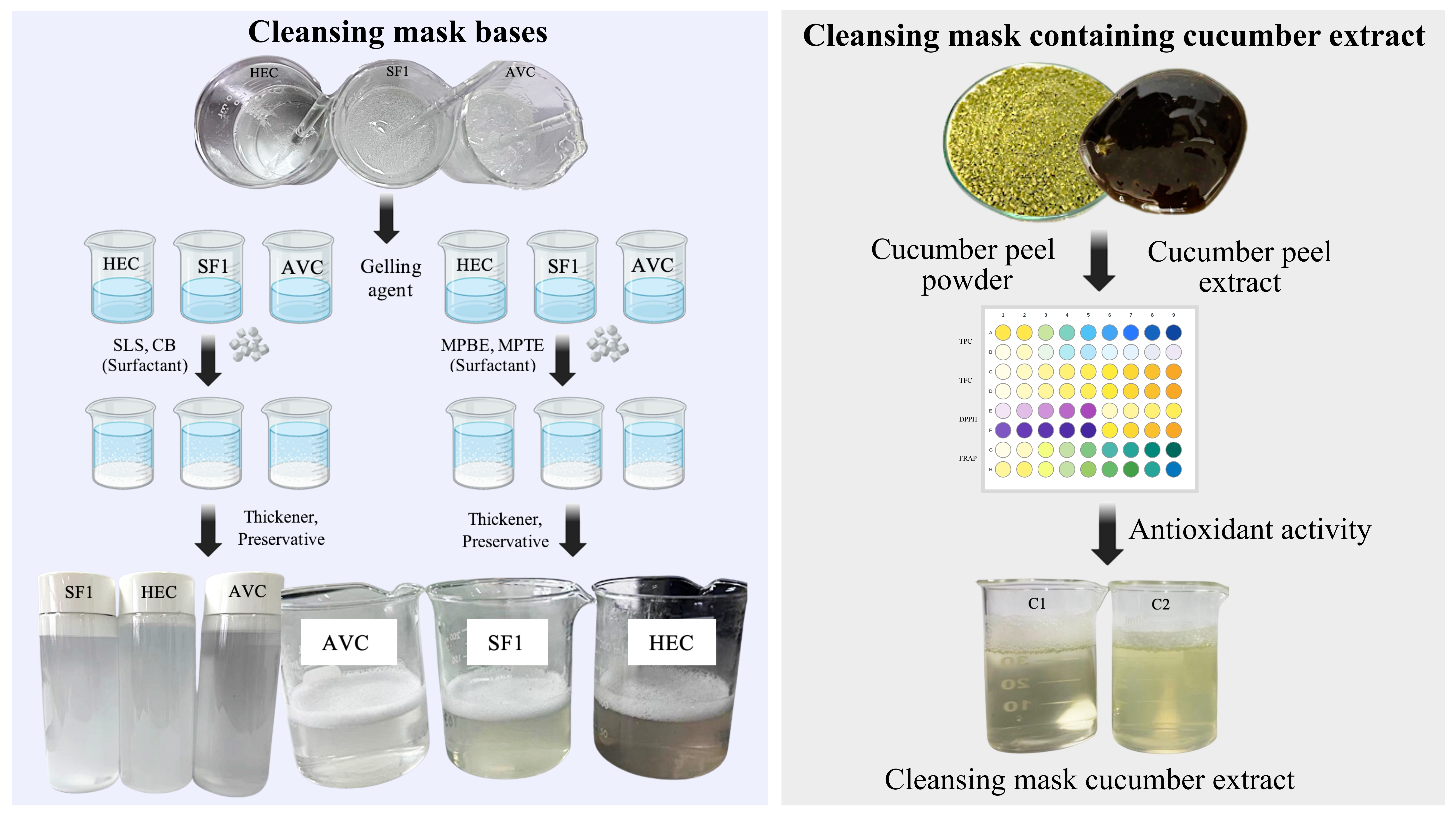
This study aimed to develop a cleansing mask incorporating cucumber peel extract by systematically comparing different base gels and surfactant systems. The extraction was performed by ethanol maceration followed by rotary evaporation, yielding a 6.45 ± 0.33% extract rich in phenolic and flavonoid compounds (26.62 ± 0.51 mg GAE g⁻¹ dry extract and 14.96 ± 0.42 mg QE g⁻¹ dry extract) and exhibiting antioxidant activity (DPPH IC₅₀ = 380.67 ± 1.53 µg mL⁻¹; ABTS IC₅₀ = 384.04 ± 1.94 µg mL⁻¹). Simple gel formulas were developed with bases of Hydroxyethyl cellulose, Carbomer SF1 and Aristoflex AVC, later combined with surfactant systems (SLS/CAB or MPE) containing different proportions of cucumber peel extract. The formulations were evaluated for physical properties, sensory attributes, stability, foaming power and microstructure. Carbomer SF1 gel with SLS and CB showed the best sensorial properties and foam quality, whereas Aristoflex AVC exhibited higher viscosity (3106.08 ± 105.83 cP) and stable appearance throughout the study period. Notably, the C1 (MPBE system) generated finer microfoam and superior cleansing efficacy, underscoring the impact of base and surfactant selection on cleansing performance, antioxidant delivery and consumer acceptability, and supporting the potential of agro‑waste–derived extracts for multifunctional cosmetic masks.
GRAPHICAL ABSTRACT
HIGHLIGHTS
- Cucumber peel extract (6.45 ± 0.33%) contains rich phenolic (gallic acid equivalent: 26.62 ± 0.51mg GAE g-1) and flavonoid content (quercetin equivalent :14.96 ± 0.42mg QE g-1), performs powerful antioxidant activity.
- The foam quality, clarity and aesthetic appearance of cleansing masks are accomplished with a combination of 2% Sodium Lauryl Sulfate and 4% Cocamidopropyl betaine in a Carbomer SF1 gel base.
- The highest viscosity (3106.08 ± 105.83 cP), the best stability, and long enough duration of use can be also obtained using the Aristoflex AVC gel base (0.5%) which could support for a more long-lasting cosmetic formulations containing cucumber peel extract.
References
Ramadhani, N. W., & Bintari, S. H. (2023). Antimicrobial activity of ethanol extract of cucumber (Cucumis sativus L.) peels and formulation as anti-acne cream. Journal of Scientific and Technological Research in Pharmacy, 3(2), 1–9.
Mananggil, K. D., & Malalay, A. P. (2025). Whitening and hydrating property of cucumber fruit extract (Cucumis sativus) as a lightening serum. International Journal of Multidisciplinary Research, 7(2), 1–9.
Sham, I. Z. B. Z., Sham, R. R., Stephan, R. A. A., Lim, G. J. M., Fatokun, E. O., Al-Ansary, H., PonnuThruthi, A. P., Natarajan, S. B., & Shanmugam, N. (2025). Green nano cosmeceuticals: Formulating an eco-friendly, preservative-free cucumber and chamomile oil nano emulsion for advanced skin therapeutics. International Journal of Food, Drug and Cosmetics, 1(2), 77–94. https://doi.org/10.31674/ijfdc.2025.v1i02.004
Kharb, J., & Saharan, R. (2023). Design and synthesis of eco-friendly cucumber peel-based bioplastic materials. Materials Today: Proceedings, 82, 123–128. https://doi.org/10.1016/j.matpr.2022.12.109
Tsegay, Z. T., Gebreegziabher, S. T. B., & Mulaw, G. (2024). Nutritional qualities and valorization trends of vegetable and fruit byproducts: A comprehensive review. Journal of Food Quality, 2024, 5518577.https://doi.org/10.1155/2024/5518577
Jadhav, S. V., Surwase, K. P., & Giri, S. S. (2025). Formulation and evaluation of cucumber aloe cream. International Journal of Advanced Research in Science Communication Technology, 5(1), 889–892.https://doi.org/10.48175/IJARSCT-27391
Li, C., Ma, H., Li, P., Zhang, S., Xu, J., Wang, L., Sheng, W., Xu, T., Shen, L., Wang, W., & Xia, T. (2024). Cucumber (Cucumis sativus L.) with heterologous poly-γ-glutamic acid has skin moisturizing, whitening and anti-wrinkle effects. International Journal of Biological Macromolecules, 262(Pt 1), 130026. https://doi.org/10.1016/j.ijbiomac.2024.130026
Garg, G., Singh, S., & Garg, V. K. (2016). Sunscreen and anti-oxidant activity of herbal gel of cucumber extract. World Journal of Pharmacy Research, 5(7), 1202–1213.
Hanum, I., & Laila, L. (2016). Physical evaluation of anti-aging and anti-acne Andaliman (Zanthoxylum acanthopodium DC.) ethanolic extract peel-off gel mask. Der Pharma Chemica, 8(23), 6–10.
Gonçalves, I. M. C., Sobral-Souza, D. F., Roveda, A. C., Jr., Aguiar, F. H. B., & Lima, D. A. N. L. (2023). Effect of experimental bleaching gels with polymers Natrosol and Aristoflex on the enamel surface properties. Brazilian Dental Journal, 34(2), 56–66. https://doi.org/10.1590/0103-6440202305248
Mukherjee, P. K., Nema, N. K., Maity, N., & Sarkar, B. K. (2013). Phytochemical and therapeutic potential of cucumber. Fitoterapia, 84, 227–236.https://doi.org/10.1016/j.fitote.2012.10.003
Prajapati, K., Patel, M., & Maitreya, B. (2025). Evaluation of phytochemical and antioxidant activity of Cucumis sativus L. International Research Journal of Modernization in Engineering Technology and Science, 7(4), 2386–2393.
Blainski, A., Lopes, G. C., & De Mello, J. C. P. (2013). Application and analysis of the Folin–Ciocalteu method for the determination of the total phenolic content from Limonium brasiliense L. Molecules, 18(6), 6852–6865.https://doi.org/10.3390/molecules18066852
Chandra, S., Khan, S., Avula, B., Lata, H., Yang, M. H., Elsohly, M. A., & Khan, I. A. (2014). Assessment of total phenolic and flavonoid content, antioxidant properties, and yield of aeroponically and conventionally grown leafy vegetables and fruit crops: A comparative study. Evidence-Based Complementary and Alternative Medicine, 2014, 532793.https://doi.org/10.1155/2014/253875
Baliyan, S., & Mukherjee, D. (2022). Determination of antioxidants by DPPH radical scavenging. Frontiers in Chemistry, 10, 763–770. https://doi.org/10.3389/fchem.2022.8878429
Boonyakiat, A., & Jimtaisong, A. (2024). Development of natural-based sunscreen product (Master’s thesis). Mae Fah Luang University.
Jitrangsri, K., Chaidedgumjorn, A., & Satiraphan, M. (2020). Effect of ethanol percentage upon various extraction methods of peanut based on antioxidant activity with trans-resveratrol and total phenolic contents. Pharmaceutical Sciences Asia, 47(2), 164–172. https://doi.org/10.29090/psa.2020
Anjani, A., Srivastava, N., & Mathur, J. (2023). Isolation, purification and characterization of quercetin from Cucumis sativus peels; its antimicrobial, antioxidant and cytotoxicity evaluations. 3 Biotech, 13(2), 46.https://doi.org/10.1007/s13205-023-03464-8
Ilie, E. I., Popescu, L., Luță, E. A., Biță, A., Corbu, A. R., Mihai, D. P., Pogan, A. C., Balaci, T. D., Mincă, A., Duțu, L. E., Olaru, O. T., Boscencu, R., & Gîrd, C. E. (2024). Phytochemical characterization and antioxidant activity evaluation for some plant extracts in conjunction with pharmacological mechanism prediction: Insights into potential therapeutic applications in dyslipidemia and obesity. Biomedicines, 12(7), 1431.https://doi.org/10.3390/biomedicines12071431
Chaves, N., Santiago, A., & Alías, J. C. (2020). Quantification of the antioxidant activity of plant extracts: Analysis of sensitivity and hierarchization based on the method used. Antioxidants, 9(1), 76.https://doi.org/10.3390/antiox9010076
Aygül, İ., Akmeşe, O., Seafli, A., Baltacı, C., Öz, M., & Fidan, M. S. (2025). Enzyme inhibitory, antioxidant, antimicrobial activities, and phenolic profiles of the methanol extract of Gelasia sericea, an endemic species. Notulae Botanicae Horti Agrobotanici Cluj-Napoca, 53(1), Article 14189. https://doi.org/10.15835/nbha53114189
Wanna, C. (2019). Free radical scavenging capacity and total phenolic contents in peel and fleshy crude extracts of selected vegetables. Pharmacognosy Journal, 11(6), 1351–1358. https://doi.org/10.5530/pj.2019.11.209
Pérez, M., Domínguez-López, I., & Lamuela-Raventós, R. M. (2023). The chemistry behind the Folin–Ciocalteu method for the estimation of (poly)phenol content in food: Total phenolic intake in a Mediterranean dietary pattern. Journal of Agricultural and Food Chemistry, 71(43), 17543–17553. https://doi.org/10.1021/acs.jafc.3c05295
Yunusa, A. K., Dandago, M. A., Ibrahim, S. M., Abdullah, N., Rilwan, A., & Barde, A. (2018). Total phenolic content and antioxidant capacity of different parts of cucumber (Cucumis sativus L.). Acta Universitatis Cibiniensis Series E: Food Technology, 22(2), 13–20. https://doi.org/10.2478/aucft-2018-0008
Chandra, S., Khan, S., Avula, B., Lata, H., Yang, M. H., Elsohly, M. A., & Khan, I. A. (2014). Assessment of total phenolic and flavonoid content, antioxidant properties, and yield of aeroponically and conventionally grown leafy vegetables and fruit crops: A comparative study. Evidence-Based Complementary and Alternative Medicine, 2014, 253875. https://doi.org/10.1155/2014/253875
Shanira, A. M., Ahmed, T. A., Rahman, M. M., & Hijji, Y. M. (2021). Determination of total flavonoid content by aluminum chloride assay: A critical evaluation. LWT – Food Science and Technology, 150, 111932.https://doi.org/10.1016/j.lwt.2021.111932
Abifarin, T. O., Afolayan, A. J., & Otunola, G. A. (2019). Phytochemical and antioxidant activities of Cucumis africanus L. f.: A wild vegetable of South Africa. Journal of Evidence-Based Integrative Medicine, 24, 1–11.https://doi.org/10.1177/2515690X19837642
Baliyan, S., Mukherjee, R., Priyadarshini, A., Vibhuti, A., Gupta, A., Pandey, R. P., & Chang, C. M. (2022). Determination of antioxidants by DPPH radical scavenging activity and quantitative phytochemical analysis of Ficus religiosa. Molecules, 27(4), 1326. https://doi.org/10.3390/molecules27041326
Angeli, L., Morozova, K., & Scampicchio, M. (2023). A kinetic-based stopped-flow DPPH method. Scientific Reports, 13, 3163. https://doi.org/10.1038/s41598-023-34382-7
Abbassi, F., Ayari, B., Mhamdi, B., & Toumi, L. (2014). Phenolic contents and antimicrobial activity of squirting cucumber (Ecballium elaterium) extracts against food-borne pathogens. Pakistan Journal of Pharmaceutical Sciences, 27(3), 475–479.
Ilyasov, I. R., Beloborodov, V. L., Selivanova, I. A., & Terekhov, R. P. (2020). ABTS/PP decolorization assay of antioxidant capacity reaction pathways. International Journal of Molecular Sciences, 21(3), 1131.https://doi.org/10.3390/ijms21031131
Rumpf, J., Burger, R., & Schulze, M. (2023). Statistical evaluation of DPPH, ABTS, FRAP, and Folin–Ciocalteu assays to assess the antioxidant capacity of lignins. International Journal of Biological Macromolecules, 233, 123470. https://doi.org/10.1016/j.ijbiomac.2023.123470
Baranova, I. I., Kovalenko, S. M., Khokhlenkova, N. V., Martyniuk, T. V., & Kutsenko, S. A. (2017). Prospects of using synthetic and semi-synthetic gelling substances in development of medicinal and cosmetic gels. Asian Journal of Pharmaceutics, 11(2), 302.
Uongpitakpan, P., & Kitsongsamrthom, J. (2021). Investigation of sodium laurylglucosides hydroxypropyl sulfonate through response surface methodology: Effects of amphoteric surfactant and electrolyte. Thai Journal of Pharmaceutical Sciences, 45(2), 113–121.
Roncoroni, M. A., Romero, P., Montes, J., Bascialla, G., Rodríguez, R., Rodríguez Pons-Españver, R., Mazadiego, L. F., & García-Mayoral, M. F. (2021). Enhancement of a foaming formulation with a zwitterionic surfactant for gas mobility control in harsh reservoir conditions. Petroleum Science, 18(4), 1409–1420.
Nadžrija, S., Bratović, A., Alibegić, D., Miljević, M., & Mehović, M. (2024). The effect of mixed surfactants on viscosity, pH and stability of synthesized liquid soaps. International Journal of Materials and Chemistry, 14(1), 31–36. https://doi.org/10.5923/j.ijmc.20241403.01
Baruah, A., Chauhan, G., Ojha, K., & Pathak, A. K. (2014). Phase behavior and thermodynamic and rheological properties of single- (SDS) and mixed-surfactant (SDS + CAPB)-based fluids with 3-methylbutan-1-ol as the cosurfactant and pine oil as the organic phase. Industrial & Engineering Chemistry Research, 53(50), 19745–19754.https://doi.org/10.1021/ie500987y
Dantas, M. G., Reis, S. A., Damasceno, C. M., Rolim, L. A., Rolim-Neto, P. J., Carvalho, F. O., Quintans-Junior, L. J., & Almeida, J. R. (2016). Development and evaluation of stability of a gel formulation containing the monoterpene borneol. Scientific World Journal, 2016, 7394685. https://doi.org/10.1155/2016/7394685
Navarro-Pérez, Y. M., Cedeño-Liñera, E., Norman-Montenegro, O., Ruiz-Sanjuan, V., Mondeja-Reyes, Y., Hernández-Mendizábal, A. M., & González-Bedia, M. H. (2021). Prediction of the physical stability and quality of O/W cosmetic emulsions using full factorial design. Journal of Pharmacy & Pharmacognosy Research, 9(1), 98–112.
Misar, K. S., & Bhakhede, S. A. (2022). Formulation, development and evaluation of self-foaming no-rinse body wash. International Journal of Scientific Research in Science and Technology, 9(13), 66–71.
Mijaljica, D., Spada, F., & Harrison, I. P. (2022). Skin cleansing without or with compromise: Soaps and syndets. Molecules, 27(6), 2010. https://doi.org/10.3390/molecules27062010
Slavova, T., Stanimirova, R., Marinova, K., & Danov, K. (2025). Cleansing mechanisms and efficacy on artificial skin. Molecules, 30(8), 1813. https://doi.org/10.3390/molecules30081813
Downloads
Published
How to Cite
Issue
Section
Categories
License
Copyright (c) 2026 : Warongporn Rattanabun, Atittaya Meenongwa , Pranudda Pimsee, Nichthima Warinthip, Chonticha Jumneansree, Bencharat Wannapokhin, Panit Phoeiklin, Natnicha Phungsara, Wongnapa Nakyai, Wannisa Keawbankrud

This work is licensed under a Creative Commons Attribution-NonCommercial-NoDerivatives 4.0 International License.