The type and composition of the main elements in the mud that influence the color shades of purple silk
DOI:
https://doi.org/10.55674/cs.v17i3.262179Keywords:
Ban ta long, Thai silk shades, purple silk, Sa Tuek, BuriramAbstract
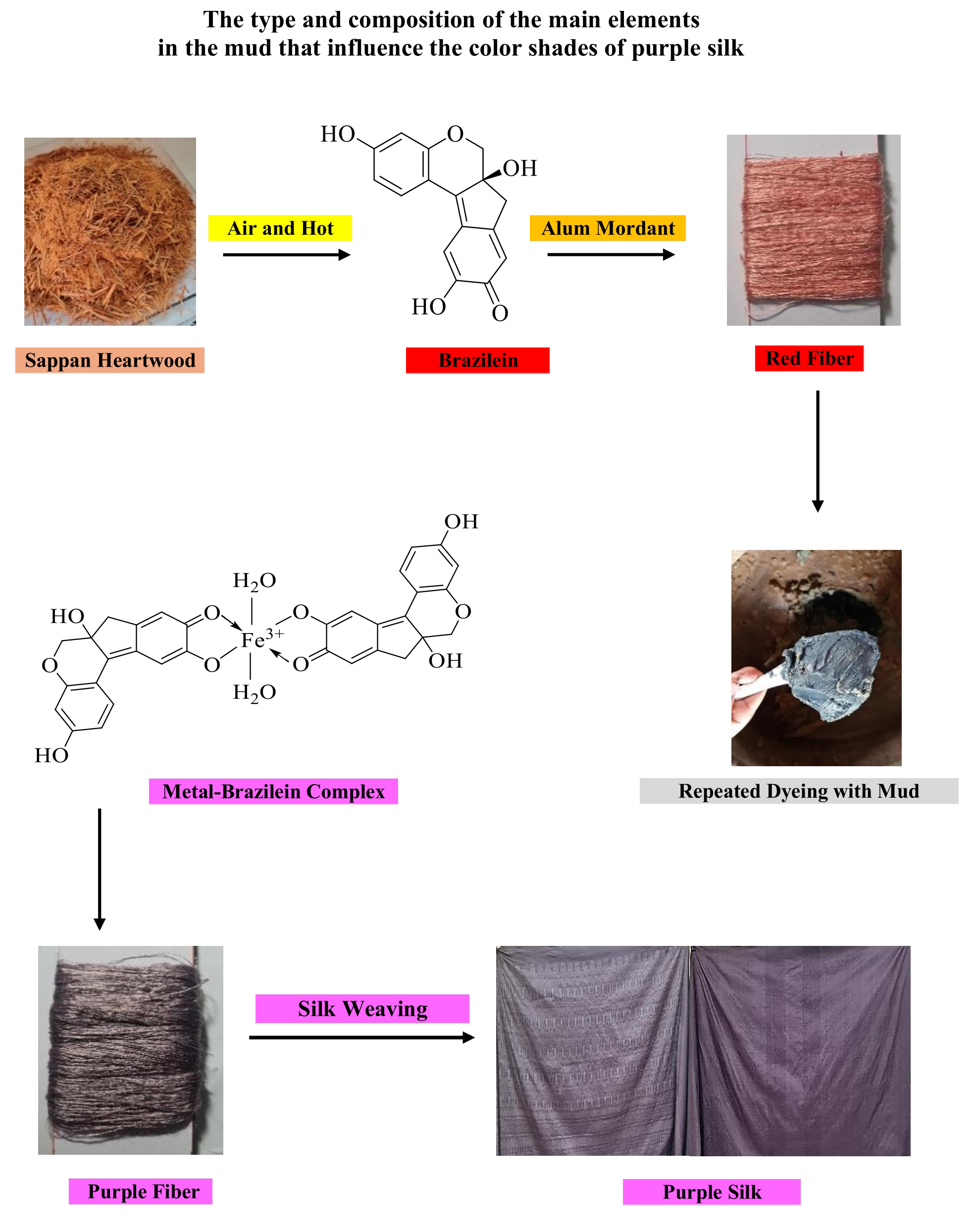
This research aimed to study the types and compositions of main elements in mud that influence the shades of purple silk. The population was purple silk threads, and the sample consisted of purple silk threads dyed with sappan heartwood and subsequently overdyed with mud. All samples were obtained from the Ban ta long silk weaving group, located in tung wang subdistrict, sa tuek district, buriram province. The analysis of the element composition in the mud was conducted using the x-ray fluorescence energy dispersive spectrometer (EDXRF) technique. The results revealed the presence of iron oxide ions in the mud solution at concentrations equivalent to ferrous sulfate ion solutions exceeding 300 ppm. When silk threads are dyed with an extract from sappan heartwood using alum as a mordant, they attain a red hue characterized by CIELAB color values of L* 60.81, a* 30.90, and b* 13.14. Subsequent overdyeing with a mud solution alters the silk's color to purple, with corresponding CIELAB values of L* 43.49, a* 7.90, and b* 0.17. This shift in color is attributed to the presence of iron ions in the mud solution, which interact with the dye, leading to a perceptible change in hue. Furthermore, the extract from sappan heartwood (Caesalpinia sappan) contains a red pigment known as brazilein, which can form an insoluble complex compound with iron ions. This compound exhibits a distinctive purple hue that binds effectively to silk fibers or protein fibers, resulting in uniquely colored natural-dyed silk fabric that reflects a distinctive cultural identity. The findings contribute to community-based knowledge that can be passed on to future generations or individuals interested in studying this valuable traditional wisdom. Moreover, this knowledge has the potential to generate sustainable household income, reduce urban migration, alleviate poverty, and promote environmentally friendly practices.
GRAPHICAL ABSTRACT
HIGHLIGHTS
- “If silk threads dyed with sappan heartwood are then fermented in mud, the result may be a purple color.”
- The color producing compounds in sappan heartwood are brazilin and brazilein.
- The color in silk threads changes from reddish orange to purple after being fermented with mud.
References
Chungkrang, L., & Bhuyan, S. (2020). Natural dye sources and its applications in textiles: A brief review. International Journal of Current Microbiology and Applied Sciences, 9(10), 261– 269. https://doi.org/10.20546/ijcmas.2020.910.034
Introduction to Natural Dyes, (2024, January 28). vibrantacres.ca. https://www.vibrantacres.ca/natural-dyes-introduction/
Lee, B., Pires, E., Pollard, A. M., & McCullagh, J. S. O. (2022). Species identification of silks by
protein mass spectrometry reveals evidence of wild silk use in antiquity. Scientific Reports, 12, 4579. https://doi.org/10.1038/s41598-022-08167-3
Bishal, A., Ali, K. A., Ghosh, S., Parua, P., Bandyopadhyay, B., Mondal, S., Jana, M., Datta, A., Das, K. K., & Debnath, B. (2023). Natural dyes:Its origin, categories and application on textile fabrics in brief. European Chemical Bulletin, 12(8), 9780 – 9802. https://doi.org/10.48047/ecb/2023.12.8.804
Singh, M., Patel, F., & Modi, N. (2020). Effect of mordants on natural dye extracts. International Journal of Research in Culture and Society, 4(6), 109 – 113.
Ban ta long. (2025, May 20). Wikicommunity. https://wikicommunity.sac.or.th/community/124
Sainate, C. (2024). The influence of the main elemental constituents of thousand-year-old barai mud extension of shades of natural dyed silk from marigold flowers. SNRU Journal of Science and Technology,16(2), 1–13. https://doi.org/10.55674/cs.v16i2.253499
Li, S., Mu, B., Wang, X., & Wang, A. (2021). Recent researches on natural pigments stabilized by clay minerals: A review. Dyes and Pigments, 190, 109322. https://doi.org/10.1016/j.dyepig.2021.109322
Ngamwonglumlert, L., Devahastin, S., Chiewchan, N., & Raghavan, G. S. V. (2020). Color and molecular structure alterations of brazilein extracted from Caesalpinia sappan L. under different pH and heating conditions. Scientific Reports, 10(12386),1-10. https://doi.org/10.1038/s41598-020-69189-3
Petdum, A., Sooksimuang, T., Wanichacheva, N., & Sirirak, J. (2019). Natural colorimetric sensor from sappanwood for turn-on selective Fe²⁺ detection in aqueous media and its application in water and pharmaceutical samples. Chemical Letters, 48, 678 – 681. https://doi.org/10.1246/cl.190158
Bukhari, M. N., Wani, M. A., Fatima, M., Bukhari, J. S. S., Shabbir, M., Rather, L. J., & Mohammad, F. (2023). Dyeing of wool with sappan wood natural dye using metal salts for enhancement in color and fastness properties. Journal of Natural Fibers,
(2), 154–168. https://doi.org/10.1080/15440478. 2023. 2208890
Hiraga, R., Gomes, O. d. F. M., & Neumann, R. (2021). Maghemite in Brazilian iron ores: Quantification of the magnetite–maghemite
isomorphic series by X ray diffraction and the Rietveld method, and confirmation by independent methods. Minerals, 11(4), Article346.
https://doi.org/10.339/min11040346
Chen, J., Ni, Y., Mei, B., Jiang, H., Wang, Y., Chen, Y., & Qi, H. (2022). Extraction of pigments from camellia seed husks and their application on silk fabrics. RSC Advances, 12(53), 34715–34723. https://doi.org/10.1039/D2RA06793E
Asare, D., Li, G., Zheng, Y., Tan, B., Zhang, S., Yohana Mpwaga, A., Boateng, A. G., & Bissih, F. (2025). Investigating the effect of acute toxicity exposure to combined FeSO₄ and FeCl₃ in Litopenaeus vannamei through analysis of survival, metal accumulation, oxidative stress, and intestinal flora. Ecotoxicology and Environmental Safety, 292, Article117923. https://doi.org/10.1016/j.ecoenv.2025.117923
The maiwa guide to natural dyes natural dyes what they are and how to use them. (2025, March 27). Maiwa’s Natural Dyes are Classics. https://naturaldyes.ca/maiwa-guide-to-natural-dyes-pdf.
Downloads
Published
How to Cite
Issue
Section
Categories
License
Copyright (c) 2025 : Chuleekant Sainate, Sineenart Ramrit

This work is licensed under a Creative Commons Attribution-NonCommercial-NoDerivatives 4.0 International License.