Development of beverage nutritional assessment application; sugar, fat and sodium for diabetes mellitus
DOI:
https://doi.org/10.55674/cs.v17i3.262068Keywords:
computer application, beverage nutritional assessment, diabetes mellitusAbstract
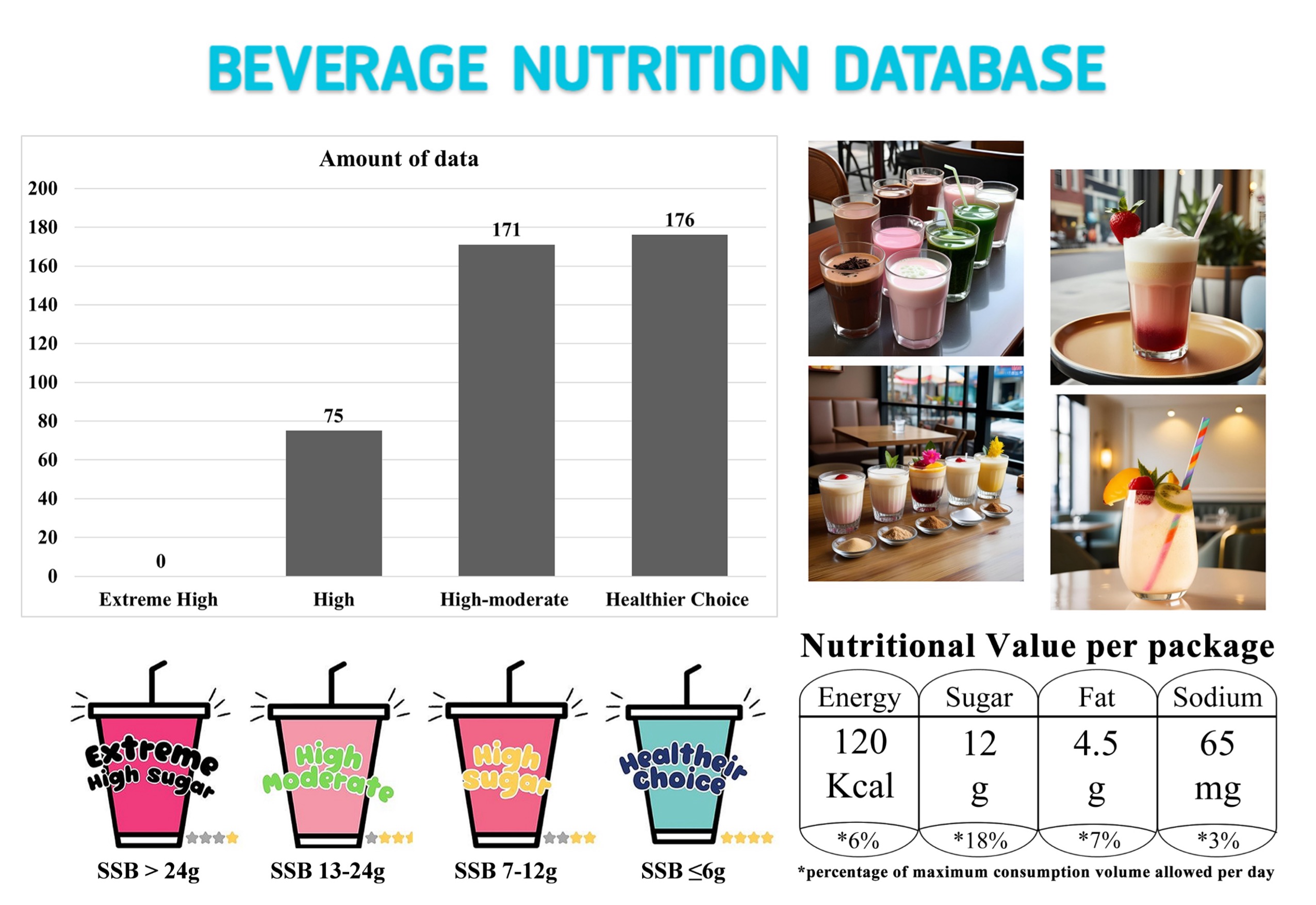
The purpose of this research was to the development of beverage nutritional value assessment application for diabetes mellitus risk group. The nutritional information was collected for 422 popular beverages in the THAT-Tambon Municipality, Chiang Khan District, Loei Province. This included 392 items from convenience stores with Guideline Daily Amounts (GDA) labels that an overview of the nutritional content as the percentage of energy and key nutrients like energy, fat, saturated fat, sugar, and salt/sodium as a percentage of what an average person should consume in a day, and 30 from local cafes, with nutritional content determined by food and nutrition experts through ingredient analysis. The beverages were categorized into 11 groups, including milk and dairy drinks, juices, carbonated drinks, grain-based drinks, coffee, tea, herbal drinks, and others (e.g., Oleang, Plum Lemon, Jelly Shake). The average sugar content was approximately 15.6g per serving, indicating high-moderate sugar levels that require cautious consumption. The application comprises three modules: (1) an administrator module for managing beverage and user data, (2) a general user module for searching beverages, viewing nutritional information, assessing dietary intake, and planning daily consumption, and (3) a member module with additional features for saving and retrieving personal beverage records. The application was developed using HTML5, CSS, JavaScript, PHP, and connected to the relational database using MySQL. Research tools included questionnaires and nutritional analysis based on standard methods. A preliminary evaluation by five software experts showed high effectiveness ( = 3.84, S.D. = 0.15), and user satisfaction from a group of 14 target users was also high ( = 4.10, S.D. = 0.37). The application is expected to support health awareness and help reduce the risk of diabetes by promoting informed beverage choices.
GRAPHICAL ABSTRACT
HIGHLIGHTS
- Assess drink nutrition values.
- Plan daily beverage intake.
- Designed for diabetics.
References
GBD 2021 Diabetes Collaborators. (2023). Global, regional, and national burden of diabetes from 1990 to 2021, with projections of prevalence to 2050: A systematic analysis for the Global Burden of Disease Study 2021. The Lancet, 402, 203–234. https://doi.org/10.1016/S0140-6736(23)01301-6
He, K. J., Wang, H., Xu, J., Gong, G., Liu, X., & Guan, H. (2024). Global burden of type 2 diabetes mellitus from 1990 to 2021, with projections of prevalence to 2044: A systematic analysis across SDI levels for the Global Burden of Disease Study 2021. Frontiers in Endocrinology, 15, 1–13. https://doi.org/10.3389/fendo.2024.1501690
Harreiter, J., & Roden, M. (2023). Diabetes mellitus – Definition, Klassifikation, Diagnose, Screening und Prävention (Update 2023). Wien Klinische Wochenschrift, 135(Suppl 1), S7–S17. https://doi.org/10.1007/s00508-022-02122-y
Ismawanti, Z., Nurzihan, N., & Permatasari, O. (2022). Relationship of sugar, salt, and fat consumption to ratio of waist to hip and blood glucose levels in type 2 diabetes mellitus patients. Jurnal Gizi Prima, 7(1), 48–54. https://doi.org/10.32807/jgp.v7i1.358
Tseng, T. S., Lin, W. T., Gonzalez, G., Kao, Y. H., Chen, L. S., & Lin, H. Y. (2021). Sugar intake from sweetened beverages and diabetes: A narrative review. World Journal of Diabetes, 12(9), 1530–1538. https://doi.org/10.4239/wjd.v12.i9.1530
Sridonpai, P., Sridonpai, P., Puwastien, P., Nakngamanong, Y., & Sirichakwal, P. (2019). Sugar content in sugar-sweetened beverages sold in and surrounding university: Case study at Mahidol University, Salaya Campus. Journal of Public Health, 4(9), 32–44.
Brouns, F. (2015). WHO sugars guideline raises some questions. Agro Food Industry Hi-Tech, 26(5), 8–10.
Health Data Center of the Ministry of Public Health. (2023). Guidelines for managing diabetes patients toward remission service. Ministry of Public Health.
Dittmann, A., Luft, T., Mendoza Pardo, C., & Storcksdieck, S. (2023). Measures to reduce sugar, fat, and salt content of food and beverages in selected European countries. European Journal of Public Health, 33. https://doi.org/10.1093/eurpub/ckad160.278
Green, J. B., Crowley, M. J., Thirunavukkarasu, S., Maruthur, N. M., & Oldenburg, B. (2024). The final frontier in diabetes care: Implementing research in real-world practice. Diabetes Care, 47(8), 1299–1310. https://doi.org/10.2337/dci24-0001
Nguyen, V., Ara, P., Simmons, D., & Levi Osuagwu, U. (2024). The role of digital health technology interventions in the prevention of type 2 diabetes mellitus: A systematic review. Clinical Medicine Insights: Endocrinology and Diabetes, 17, 1–11. https://doi.org/10.1177/11795514241246419
Manmee, C., Niramitmahapanya, S., Sickamann, O.-A., & Srithong, H. (2021). Development of nutrition knowledge-based learning model by information technology for blood sugar control among diabetic patients. Journal of Department of Medical Services, 46(1), 52–63.
Meenasantirak, A., Siripitakchai, C., & Suriya, N. (2024). Development of a web application for controlling blood sugar levels in diabetic patients. Nursing and Health Education Journal, 7(1), 1–14.
Reamrimmadun, D., Jaidee, W., & Wattanaburanon, A. (2024). Development of a blood glucose monitoring web-based application for elderly people with type 2 diabetes. VRU Research and Development Journal Science and Technology, 19(2), 1–15.
Harimahardika, G. S., Agustini, N. L. P. I. B., Megayanti, S. D., & Sari, N. M. C. C. (2023). Diabetes self-management education (DSME) methods using web-based and application. Babali Nursing Research, 4, 796–812. https://doi.org/10.37363/bnr.2023.44246
Arora, P., Ansari, S. H., & Arora, S. (2020). Nutritional beverages. American Journal of PharmTech Research, 10(3), 186–203.
Riley, M. D., Hendrie, G. A., & Baird, D. L. (2019). Drink choice is important: Beverages make a substantial contribution to energy, sugar, calcium and vitamin C intake among Australians. Nutrients, 11(6), 1389. https://doi.org/10.3390/nu11061389
Adulkasem, S., & Noppornchrenkul, W. (2017). Database systems (Revised ed.). Top Publishing.
Dugalic, B., & Mishev, A. (2012). ISO software quality standards and certification. In Local Proceedings of the Fifth Balkan Conference in Informatics, Faculty of Sciences, University of Novi Sad, Serbia, 113–116.
de Carvalho Junior, M. A., & Bandiera-Paiva, P. (2018). Health information system role-based access control current security trends and challenges. Journal of Healthcare Engineering, 2018, Article 6510249, . https://doi.org/10.1155/2018/6510249
Piwein, P., Hunsom, K., & Liewtrakul, P. (2021). Application design and development to support healthy food menu for decision-making. Journal of Bansomdej Engineering and Industrial Technology, 2(1), 54–69. https://ph04.tci thaijo.org/index.php/JEITB/article/view/4776
Reamrimmadun, Y., Jaidee, W., & Wattanaburanon, A. (2024). Development of a blood glucose monitoring web-based application for elderly people with type 2 diabetes. VRU Research and Development Journal Science and Technology, 19(2), 1–15.
Dokduang, K., Totum, B., & Kosapan, P. (2021). A development of diabetic patient healthcare application for elderly people in Ubon Ratchathani Province. Journal of Industrial Technology Ubon Ratchathani Rajabhat University, 11(2), 53–65.
Yeh, M. C., Lau, W., Gong, Z., Horlyck-Romanovsky, M., Tung, H. J., Zhu, L., Ma, G. X., & Wylie-Rosett, J. (2023). Development of a web-based diabetes prevention program (DPP) for Chinese Americans: A formative evaluation approach. International Journal of Environmental Research and Public Health, 20(1), 599. https://doi.org/10.3390/ijerph20010599
Downloads
Published
How to Cite
Issue
Section
Categories
License
Copyright (c) 2025 : Sujitranan Mungklachaiya, Naruwan Yusamran, Suradech Chaitokkia

This work is licensed under a Creative Commons Attribution-NonCommercial-NoDerivatives 4.0 International License.