
Response surface methodology as a statistical model for nutrient optimization to enhance biomass and bioactive phycobiliproteins production in cyanobacterium Nostoc sp. SW02
DOI:
https://doi.org/10.55674/cs.v17i3.261776Keywords:
Response surface methodology, Nutrient optimization, Biomass production, Phycobiliproteins, CyanobacteriaAbstract
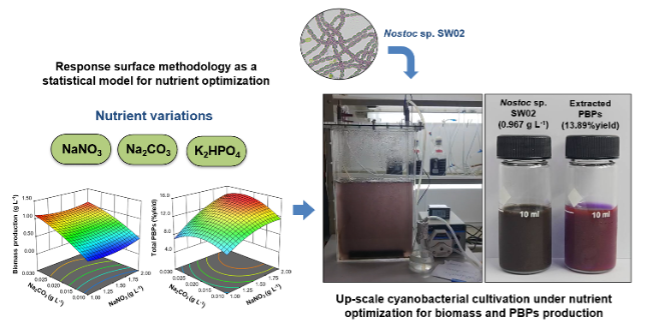
Phycobiliproteins (PBPs) are water-soluble pigments involved in the photosynthesis of cyanobacteria. They are valuable natural colorants for biotechnological applications due to their significant biological properties. This research was the first to study the impact of NaNO3, Na2CO3, and K2HPO4 nutrient variations on the production of biomass and PBPs in the cyanobacterium Nostoc sp. SW02. The experiments utilized the response surface methodology with the Box-Behnken design for nutrient optimization. The quadratic equations showed that the models sufficiently aligned with the experimental data and could explain the combined influence of factors with statistical significance. The addition of NaNO3, Na2CO3, and K2HPO4 at concentrations of 2.0, 0.02, and 0.035 g L-1, respectively, provided the maximum biomass and PBPs production at 0.967 g L-1 and 13.89% yield, representing increases of 30.67% and 8.86%, compared to normal culture medium. The validity of the predicted model was confirmed, indicating its potential application in both small and large-scale cultivations. This study developed a model that could be applied for the commercial production of natural cyanobacterial colorants for their potential use in food and cosmetics industries.
GRAPHICAL ABSTRACT
HIGHLIGHTS
- Key nutrient factors (NaNO3, Na2CO3, and K2HPO4) were analyzed for their impact on productions of biomass and phycobiliproteins.
- Statistical modeling of response surface methodology used for nutrient optimization.
- The quadratic equations could explain the combined influence of factors with statistical significance.
References
Bryant, D. A., Guglielmi, G., de Marsac, N. T., Castets, A.M., & Cohen-Bazire, G. (1979). The structure of cyanobacterial phycobilisomes: a model. Archives of Microbiology, 123, 113-127. https:// doi.org/10.1007/BF00446810.
Hsieh-Lo, M., Castillo, G., Ochoa-Becerra, M. A., & Mojica, L. (2019). Phycocyanin and phycoerythrin: Strategies to improve production yield and chemical stability. Algal Research, 42, 101600. https://doi. org/10.1016/j.algal.2019.101600.
Pagels, F., Guedes, A. C., Amaro, H. M., Kijjoa, A., & Vasconcelos, V. (2019). Phycobiliproteins from cyanobacteria: Chemistry and biotechnological applications. Biotechnology Advances, 37(3), 422-443. https://doi.org/ 10.1016/j.biotechadv.2019.02.010.
Montero-Lobato, Z., Fuentes, J. L., Garbayo, I., Ascaso, C., Wierzchos, J., Vega, J. M., & Vílchez, C. (2020). Identification, biochemical composition and phycobiliproteins production of Chroococcidiopsis sp. from arid environment. Process Biochemistry, 97, 112-120. https://doi.org/10.1016/j. procbio.2020.07.005.
Limrujiwat, K., Supan, S., & Khetkorn, W. (2022). Cyanobacterial biodiversity from Thai karstic caves as a potential source for phycobiliprotein production. Algal Research, 64, 102666. https://doi. org/10.1016/j.algal.2022.102666.
Eriksen, N. T. (2008). Production of phycocyanin—a pigment with applications in biology, biotechnology, foods and medicine. Applied microbiology and biotechnology, 80, 1-14. https://doi.org/10.1007/s00253-008-1542-y.
Manirafasha, E., Ndikubwimana, T., Zeng, X., Lu, Y., & Jing, K. (2016). Phycobiliprotein: Potential microalgae derived pharmaceutical and biological reagent. Biochemical Engineering Journal, 109, 282-296. https://doi.org/ 10.1016/j.bej.2016.01.025
Ji, L., Qiu, S., Wang, Z., Zhao, C., Tang, B., Gao, Z., & Fan, J. (2023). Phycobiliproteins from algae: Current updates in sustainable production and applications in food and health. Food Research International, 167, 112737. https://doi.org/10.1016/j.foodres.2023.112737.
Ashaolu, T. J. (2024). The powerful phycobiliproteins-phycocyanin and phycoerythrin: Pleiotropic applications and biofunctional uses. Algal Research, 82, 103636. https://doi.org/10.1016/ j.algal.2024.103636
Galván-Colorado, C., Chamorro-Cevallos, G. A., Chanona-Pérez, J. J., Zepeda-Vallejo, L. G., Arredondo-Tamayo, B., González-Ussery, S. A., ... & García-Rodríguez, R. V. (2024). Phycobiliprotein from Arthrospira maxima: Conversion to nanoparticles by high-energy ball milling, structural characterization, and evaluation of their anti-inflammatory effect. International Journal of Biological Macromolecules, 275, 133679. https://doi.org/10.1016 /j.ijbiomac.2024.133679
Quintero-Dallos, V., García-Martínez, J. B., Contreras-Ropero, J. E., Barajas-Solano, A. F., Barajas-Ferrerira, C., Lavecchia, R., & Zuorro, A. (2019). Vinasse as a Sustainable Medium for the Production of Chlorella vulgaris UTEX 1803. Water, 11(8), 1526. https://doi.org/10.3390/ w11081526.
Lamela, T., & Márquez-Rocha, F. J. (2000). Phycocyanin production in seawater culture of Arthrospira maxima. Ciencias marinas, 26(4), 607-619. https://doi. org/10.7773/cm.v26i4.619.
Singh, N. K., Parmar, A., & Madamwar, D. (2009). Optimization of medium components for increased production of C-phycocyanin from Phormidium ceylanicum and its purification by single step process. Bioresource Technology, 100(4), 1663-1669. https://doi.org/10. 1016/j.biortech. 2008.09.021.
Suphan, S., Limrujiwat, K., Kula, K., Maneeruttanarungroj, C., Raksajit, W., & Khetkorn, W. (2023). Characterization and exploration of biological properties of phycobiliproteins purified from Thai karstic cave cyanobacterium Nostoc sp. SW02. Biocatalysis and Agricultural Biotechnology, 52, 102826. https://doi. org/10.1016/j.bcab.2023.102826.
Baş, D., & Boyacı, İ. H. (2007). Modeling and optimization I: Usability of response surface methodology. Journal of food engineering, 78(3), 836-845. https://doi. org/10.1016/j.jfoodeng. 2005.11.024.
Lu, Z., He, F., Shi, Y., Lu, M., & Yu, L. (2010). Fermentative production of L (+)-lactic acid using hydrolyzed acorn starch, persimmon juice and wheat bran hydrolysate as nutrients. Bioresource Technology, 101(10), 3642-3648. https:// doi.org/10.1016/j.biortech. 2009.12.119.
Thakur, A., Panesar, P. S., & Saini, M. S. (2018). Parametric optimization of lactic acid production by immobilized Lactobacillus casei using Box-Behnken Design. Periodica Polytechnica Chemical Engineering, 62(3), 274-285. https://doi.org/10.3311/PPch.11403.
Lauceri, R., Zittelli, G. C., & Torzillo, G. (2019). A simple method for rapid purification of phycobiliproteins from Arthrospira platensis and Porphyridium cruentum biomass. Algal Research, 44, 101685. https://doi.org/10.1016/j.algal. 2019.101685.
Krasaesueb, N., Incharoensakdi, A., & Khetkorn, W. (2019). Utilization of shrimp wastewater for poly-β-hydroxybutyrate production by Synechocystis sp. PCC 6803 strain ΔSphU cultivated in photobioreactor. Biotechnology Reports, 23, e00345. https://doi.org/10.1016/j.btre.2019.e00345.
Khuri, A. I., & Mukhopadhyay, S. (2010). Response surface methodology. Wiley interdisciplinary reviews: Computational statistics, 2(2), 128-149. https://doi. org/10.1002/wics.73.
Myers, R. H. (2002). Response surface methodology (RSM). Process and Product optimization using designed experiments, 489-492.
Fazeli Burestan, N., Afkari Sayyah, A. H., & Taghinezhad, E. (2020). Mathematical modeling for the prediction of some quality parameters of white rice based on the strength properties of samples using response surface methodology (RSM). Food Science & Nutrition, 8(8), 4134-4144. https://doi.org/10.1002/fsn3.1703.
Castro, G. F. P. d. S. d., Rizzo, R. F., Passos, T. S., Santos, B. N. C. d., Dias, D. d. S., Domingues, J. R., & Araújo, K. G. d. L. (2015). Biomass production by Arthrospira platensis under different culture conditions. Food Science and technology, 35, 18-24. https://doi. org/10.1590/1678-457X.6421.
Herrero, A., Muro-Pastor, A. M., & Flores, E. (2001). Nitrogen control in cyanobacteria. Journal of bacteriology, 183(2), 411-425. https://doi.org/10.1128/jb.183.2.411-425.2001.
Richmond, A. (2004). Handbook of microalgal culture: biotechnology and applied phycology (Vol. 577). Wiley Online Library.
Solovchenko, A., Khozin-Goldberg, I., Selyakh, I., Semenova, L., Ismagulova, T., Lukyanov, A., Mamedov, I., Vinogradova, E., Karpova, O., & Konyukhov, I. (2019). Phosphorus starvation and luxury uptake in green microalgae revisited. Algal Research, 43, 101651. https://doi.org/10.1016/j.algal. 2019.101651.
Lavrinovičs, A., Murby, F., Zīverte, E., Mežule, L., & Juhna, T. (2021). Increasing phosphorus uptake efficiency by phosphorus-starved microalgae for municipal wastewater post-treatment. Microorganisms, 9(8), 1598. https:// doi.org/10.3390/microorganisms9081598.
Singh, P., & Kumar, D. (2021). Biomass and lipid productivities of cyanobacteria-Leptolyngbya foveolarum HNBGU001. BioEnergy Research, 14, 278-291. https://doi.org/10.1007/s12155-020-10170-3.
Ernst, A., Deicher, M., Herman, P. M., & Wollenzien, U. I. (2005). Nitrate and phosphate affect cultivability of cyanobacteria from environments with low nutrient levels. Applied and Environmental Microbiology, 71(6), 3379-3383. https://doi.org/10.1128/ AEM.71.6.3379-3383.2005.
Humphrey, S. J., James, D. E., & Mann, M. (2015). Protein phosphorylation: a major switch mechanism for metabolic regulation. Trends in Endocrinology & Metabolism, 26(12), 676-687. https:// doi.org/10.1016/j.tem.2015.09.013.
Luo, Z., Li, S., Arifeen, M. Z. U., Fu, F. X., Gao, H., Sun, T., ... & Jiang, H. B. (2025). Physiological and molecular evidence for phycobilisome degradation in maintaining carbon and nitrogen balance of cyanobacteria. Marine Life Science & Technology, 1-13.https://doi.org /10.1007/s42995-025-00290-0
Saha, S. K., Uma, L., & Subramanian, G. (2003). Nitrogen stress induced changes in the marine cyanobacterium Oscillatoria willei BDU 130511. FEMS microbiology ecology, 45(3), 263-272. https://doi.org/10.1016/S0168-6496(03)00162-4.
Richaud, C., Zabulon, G. r., Joder, A., & Thomas, J.C. (2001). Nitrogen or sulfur starvation differentially affects phycobilisome degradation and expression of the nblA gene in Synechocystis strain PCC 6803. Journal of bacteriology, 183(10), 2989-2994.
https://doi.org/10.1128/jb.183.10.2989-2994.2001.
Zhou, W., Sui, Z., Wang, J., Hu, Y., Kang, K. H., Hong, H. R., ... & Que, Z. (2016). Effects of sodium bicarbonate concentration on growth, photosynthesis, and carbonic anhydrase activity of macroalgae Gracilariopsis lemanei formis, Gracilaria vermiculophylla, and Gracilaria chouae (Gracilariales, Rhodophyta). Photosynthesis Research, 128, 259-270. https://doi.org/10.1007 /s11120-016-0240-3
Geider, R. J., & La Roche, J. (2002). Redfield revisited: variability of C [ratio] N [ratio] P in marine microalgae and its biochemical basis. European Journal of Phycology, 37(1), 1-17. https://doi. org/10.1017/S0967026201003456.
Zuorro, A., Leal-Jerez, A. G., Morales-Rivas, L. K., Mogollón-Londoño, S. O., Sanchez-Galvis, E. M., García-Martínez, J. B., & Barajas-Solano, A. F. (2021). Enhancement of phycobiliprotein accumulation in thermotolerant Oscillatoria sp. through media optimization. ACS Omega, 6(16), 10527-10536.https://doi.org/10.1021/acsomega.0c04665.
Johnson, E. M., Kumar, K., & Das, D. (2014). Physicochemical parameters optimization, and purification of phycobiliproteins from the isolated Nostoc sp. Bioresource technology, 166, 541-547. https://doi.org/10.1016/j.bior tech.2014.05.097
Mogany, T., Swalaha, F. M., Kumari, S., & Bux, F. (2018). Elucidating the role of nutrients in C-phycocyanin production by the halophilic cyanobacterium Euhalothece sp. Journal of Applied Phycology, 30, 2259-2271. https://doi.org /10.1007/s10811-018-1477-3
Xing, W., & Lusan, L. (2013). Effects of the different nitrogen, phosphorus and carbon source on the growth and glycogen reserves in Synechocystis and Anabaena. African Journal of Microbiology Research, 7(23), 2820-2827.
Downloads
Published
How to Cite
Issue
Section
Categories
License
Copyright (c) 2025 : Kasinee Kula, Sutthawan Suphan, Wanthanee Khetkorn

This work is licensed under a Creative Commons Attribution-NonCommercial-NoDerivatives 4.0 International License.