
Enhancing the value of reclaimed asphaltic pavement as aggregate material in concrete work
DOI:
https://doi.org/10.55674/cs.v17i3.261732Keywords:
Reclaimed asphalt pavement (RAP), Replacement ratios, Compressive strengthAbstract
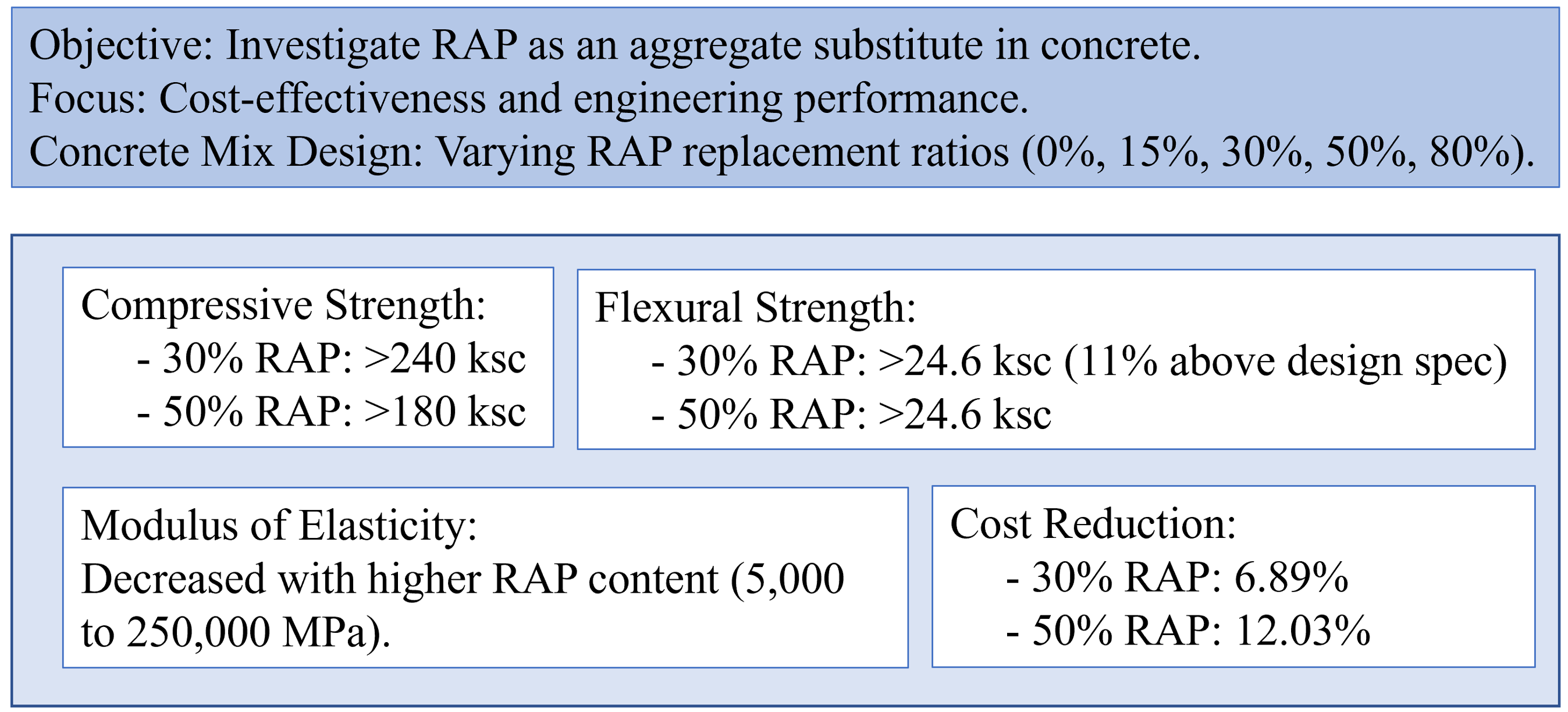
This study explores the use of reclaimed asphalt pavement (RAP) as a sustainable and cost-effective substitute for coarse natural aggregates in concrete. Concrete mixtures were prepared with RAP replacement levels of 0%, 15%, 30%, 50%, and 80% by weight, aiming for a minimum compressive strength of 240 ksc in 15x15x15 cm cube specimens after 28 days of curing. Key engineering properties including compressive strength, flexural strength, and modulus of elasticity were evaluated. The results show that increasing the RAP content leads to greater deviation from optimal aggregate gradation and a gradual decrease in both compressive and flexural strengths. Nevertheless, mixtures containing up to 30% RAP met the target compressive strength (exceeding 240 ksc) and achieved flexural strengths over 24.6 ksc 11% above the design specification. At a 50% RAP replacement, compressive strength remained above 180 ksc and flexural strength still exceeded 24.6 ksc. The modulus of elasticity decreased with higher RAP content, ranging from 5,000 to 25,000 MPa (53,986 to 254,930 ksc). Economically, using 30% RAP reduced the production cost by 6.89%, while a 50% RAP substitution resulted in a 12.03% cost reduction compared to conventional concrete. These findings highlight RAP’s potential as a viable alternative in concrete for applications with moderate strength requirements.
GRAPHICAL ABSTRACT
HIGHLIGHTS
- A 30% RAP replacement in concrete achieved a compressive strength exceeding 240 ksc and a flexural strength greater than 24.6 ksc, which is 11% above the design specification.
- With a 50% RAP replacement, the concrete maintained a compressive strength above 180 ksc and a flexural strength exceeding 24.6 ksc, although the modulus of elasticity decreased with higher RAP content.
- Economically, a 30% RAP replacement reduced production costs by 6.89%, while a 50% replacement resulted in a 12.03% cost reduction compared to conventional concrete.
References
Rout, M. K. D., Sahdeo, S. K., Biswas, S., Roy, K., & Sinha, A. K. (2023). Feasibility study of reclaimed asphalt pavements (RAP) as recycled aggregates used in rigid pavement construction. Materials, 16(4), 1504.
Chaikaew, C., Chaikaew, P., & Na Songkhla, W. (2022). The use of waste materials from RAP and FGD gypsum to compensatory the pavement material. The Journal of Industrial Technology, 18(1), 75-84.
Tsakoumaki, M., & Plati, C. (2024). A critical overview of using reclaimed asphalt pavement (RAP) in road pavement construction. Infrastructures, 9(8), 128.
Bureau of Highway Maintenance, Department of Highways. (2021, April 10). Road maintenance work. http://bmm.doh.go.th/website/
Srichanin, T., & Luakphap, P. (2021, April 29–30). The use of asphalt concrete debris in concrete work to produce car-proof concrete barriers. The 5th National Academic Conference of Suvarnabhumi Rajamangala University of Technology, Rajamangala University of Technology Suvarnabhumi, Huntra Campus, 262–267.
Brand, A. S., & Roesler, J. R. (2016). Bonding in cementitious materials with asphalt-coated particles: Part II – Cement-asphalt chemical interactions. Construction and Building Materials, 130, 182-192. https://doi.org/10.1016/j.conbuildmat.2016.10.013
Russo, N., Filippi, A., Carsana, M., Lollini, F., & Redaelli, E. (2024). Recycling of RAP (reclaimed asphalt pavement) as aggregate for structural concrete: Experimental study on physical and mechanical properties. Discover Civil Engineering, 1, 99. https://doi.org/10.1007/s44290-024-00101-y.
Karthikeyan, K., Kothandaraman, S., & Sarang, G. (2023). Perspectives on the utilization of reclaimed asphalt pavement in concrete pavement construction: A critical review. Case Studies in Construction Materials, 19, e02242.
Safiuddin, M., Alengaram, U. J., Rahman, M. M., Salam, M. A., & Jumaat, M. Z. (2013). Use of recycled concrete aggregate in concrete: a review. Journal of Civil Engineering and Management, 19(6), 796-810. https://doi.org/10.3846/13923730.2013.799093
Nedeljković, M., Visser, J., Šavija, B., Valcke, S., & Schlangen, E. (2021). Use of fine recycled concrete aggregates in concrete: A critical review. Journal of Building Engineering, 38, 102196. https://doi.org/10.1016/j.jobe.2021.102196
Downloads
Published
How to Cite
Issue
Section
Categories
License
Copyright (c) 2025 : Siam Burada, Barames Vardhanabhuti

This work is licensed under a Creative Commons Attribution-NonCommercial-NoDerivatives 4.0 International License.