
Antibiotics removal from water by adsorption activated carbon of bacterial cellulose source
DOI:
https://doi.org/10.55674/cs.v17i3.261573Keywords:
activated carbon, bacterial cellulose, amoxicillin, cephalexinAbstract
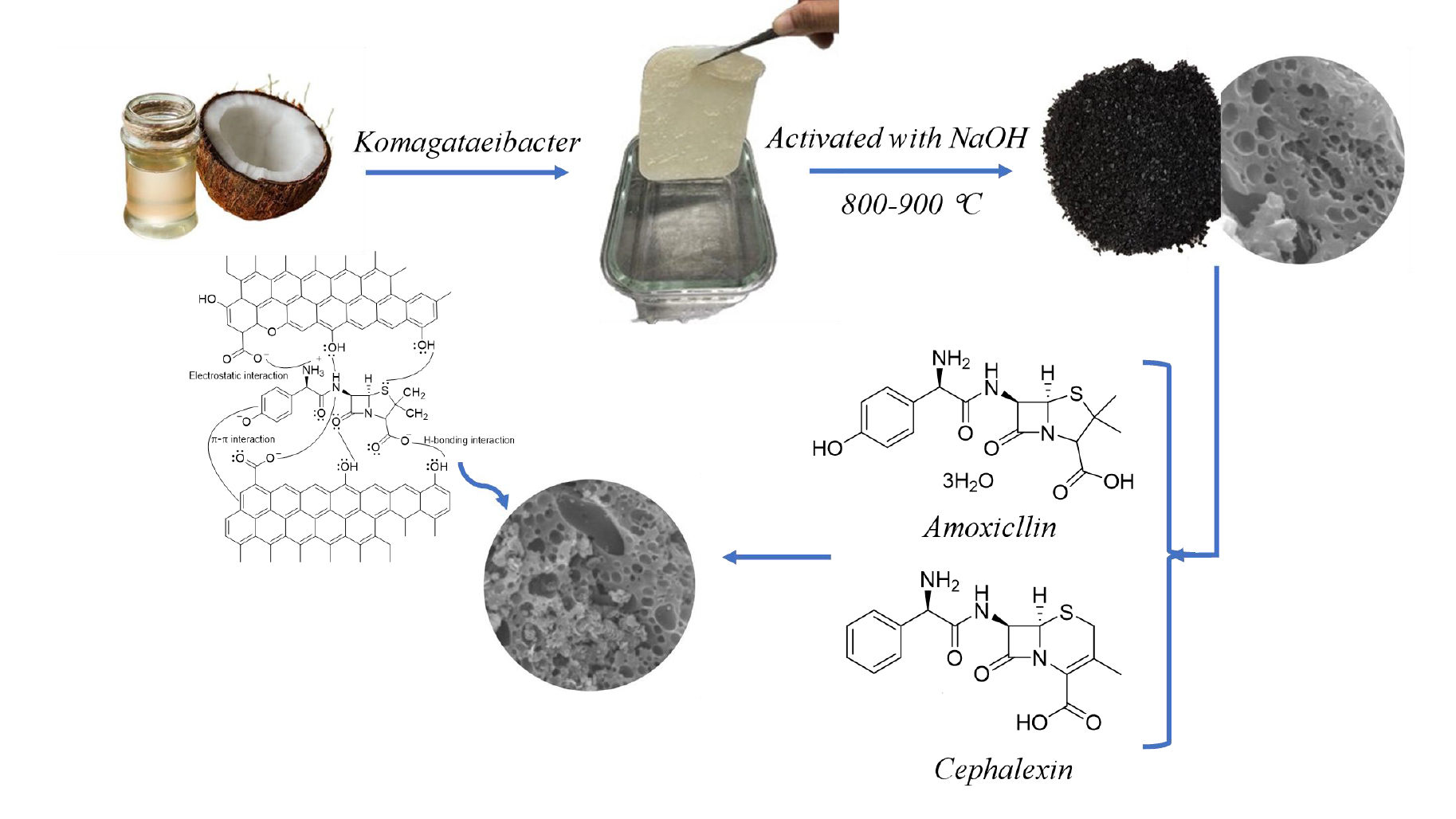
The overuse of antibiotics in developing countries has exacerbated antibiotic resistance, particularly due to contamination of water systems. This study addresses this challenge by synthesizing activated carbon derived from bacterial cellulose (AC-BC) for efficient adsorption of amoxicillin (AMOX) and cephalexin (CEX) from aqueous solutions. Bacterial cellulose (BC), produced sustainably by Komagataeibacter using waste coconut water, served as the precursor for AC-BC. The synthesized AC-BC exhibited a yield of 19.46±3.92% (dry weight basis) and met ASTM standards in proximate analysis, excluding ash content. Structural characterization revealed a hierarchical pore structure, supported by an iodine number of 1360.59 mg g-1 and methylene blue adsorption of 240.10±1.04 mg g-1, with SEM imaging confirming diverse pore sizes. BET analysis demonstrated a high specific surface area (204.68 m² g-1), total pore volume (0.1475 cm³ g-1), and average pore diameter (2.8825 nm). Functional groups (hydroxyl, carboxyl, ether) and a semi-crystalline structure were identified via FTIR and XRD, respectively. Optimal batch adsorption conditions (60 mg L-1 initial concentration, 60-min contact time, 0.2 g adsorbent dosage, pH 7, 30°C) achieved maximum capacities of 4.578 mg g-1 (AMOX) and 4.288 mg g-1 (CEX). Adsorption isotherms aligned with the Langmuir model, indicating monolayer adsorption, while kinetics followed a pseudo-second-order model. Thermodynamic analysis revealed a spontaneous (ΔG° < 0), exothermic (ΔH° < 0), and entropy-driven (ΔS° > 0) process. These findings highlight AC-BC as a promising, low-cost adsorbent for antibiotic removal. The use of renewable BC from agro-industrial waste underscores its environmental and economic viability, offering a sustainable strategy to mitigate water contamination and combat antibiotic resistance.
GRAPHICAL ABSTRACT
HIGHLIGHTS
- Activated carbon of bacterial cellulose sources (AC-BC) has been used as highly effective adsorbent for amoxicillin (AMOX) and cephalexin (CEX)
- Bacterial cellulose source is a natural, renewable, environmentally friendly and low-cost.
References
Miraji, H., & Asha, S. R. (2025). Pollution by antimicrobials and antibiotic resistance genes in East Africa: Occurrence, sources, and potential environmental implications. Toxicology Reports, 14, 101969.
Junaid, S., Zubair, K. B. M., Furqan, T., Tareq, A. A., & Gordon, M. (2025). Environmental impacts and adsorption isotherms of coconut shell activated carbon: Effect of acid activation, water, and fuel. Journal of Carbon Research, 11(1), 22.
Amruta, K., Akshata, P., Shubhangi, M. G., Rohant, D., Ravindra, K., Kalyanrao, G., & Sandip, S. (2024). Agro-waste management through sustainable production of activated carbon for CO₂ capture, dye and heavy metal ion remediation. Waste Management Bulletin, 2(1), 97–121.
Iwona, S., & Remigiusz, G. (2024). Tests on the application of various types of biomass for activated carbon production. Journal of Ecological Engineering, 25(1), 285–302.
Vincent, D. G., Jérémie, C., & Patrick, V. (2024). Bacterial cellulose: A comprehensive review. Journal of Applied Polymer Science, 141(15), 55163.
Oumaima, F., Najlae, Z., Nouhaila, H., Amin, S., Abdellah, E., Hassan, A., & M’hamed, A. (2024). Adsorption-based removeal of amoxicillin form aqueous environments : a mini review.E3S Web of Conferences, 527, 03012.
Atef, E. J., Heba, S. K. A., Mustafa, H. S., Hussein, A. A., Saad, S. S., Amimul, A., Imteaz, M. A., Abdallah, S., Shafiquzzaman, M., Haitham, O., & Nadhir, A. A. (2024). Isotherms, kinetics and thermodynamic mechanism of methylene blue dye adsorption on synthesized activated carbon. Scientific Reports, 14, 970.
Hai, N. T., Eder, C. L., Ruey-S. J., Jean-C. B., & Huan-P. C. (2021). Thermodynamic parameters of liquid–phase adsorption process calculated from different equilibrium constants related to adsorption isotherms: A comparison study. Journal of Environmental Chemical Engineering, 9(6), 106674.
Al-Azzawi, M. Q., & Al-Saffar, J. A. A. (2012). Kinetic spectrophotometric methods for the determination of amoxicillin in pharmaceutical preparation. Iraqi Journal of Science, 53(1), 8–16.
Hanum, F., Bani, O., & Wirani, L. I. (2017). Characterization of activated carbon from rice husk by HCl activation and its application for lead (Pb) removal in car battery wastewater. Materials Science and Engineering, 180, 012151.
Abdul, G. H., Zainal, A. M., & Dan, G. P. (2012). Production of activated carbon from municipal waste with heating and steam methods. Jurnal Purifikasi, 12(3), 59–72.
Hamza, L., Badreddine, B., Omar, K., Aissa, K., & Mohamed, T. (2023). Elimination of amoxicillin by adsorption on coffee waste based activated carbon. Journal of Molecular Structure, 1274(1), 134500.
Juan, Y., & Keqiang, Q. (2010). Preparation of activated carbons from walnut shells via vacuum chemical activation and their application for methylene blue removal. Chemical Engineering Journal, 165(1), 209–217.
Abdessalem, O., & Mourad, B. (2012). Characterization of activated carbon prepared from a new raw lignocellulosic material: Ziziphus spina-christi seeds. Journal de la Société Chimique de Tunisie, 14, 175–183.
Yongbin, J., Tiehu, L., & Li, Z. (2007). Preparation of activated carbons by microwave heating KOH activation. Applied Surface Science, 254(2), 506–512.
Aniagor, C. O., Abdulgalil, A. G. M., Safri, A., Elhmmali, M. M., & Hashem, A. (2022). Preparation of amidoxime modified biomass and subsequent investigation of their lead ion adsorption properties. Cleaner Chemical Engineering, 2, 100013.
Adriano, W. S., Veredas, V., & Santana, C. C. (2005). Adsorption of amoxicillin on chitosan beads: Kinetics, equilibrium and validation of finite bath models. Biochemical Engineering Journal, 7(2), 132–137.
Javad, I., Mohsen, M., Mohammad, D., & Mohammad, R. E. (2021). Adsorption and desorption of amoxicillin antibiotic from water matrices using an effective and recyclable MIL-53(Al) metal−organic framework adsorbent. Journal of Chemical and Engineering Data, 66, 389–403.
Ebelegi, N. A., & Wankasi, D. (2020). Interpretation of adsorption thermodynamics and kinetics Kugustus Newton. Open Journal of Physical Chemistry, 10, 166–182.
Crini, G., & Badot, P. M. (2008). Application of chitosan, a natural aminopolysaccharide, for dye removal from aqueous solutions by adsorption processes using batch studies: A review of recent literature. Progress in Polymer Science, 33(4), 399–447.
Leal, A. N. R., Lima, A. C. A., Azevedo, M. G. F. A., Santos, D. K. D. N., Zaidan, L. E. M. C., Lima, V. F., & Cruz, F. I. J. (2021). Removal of remazol black B dye using bacterial cellulose as an adsorbent. Scientia Plena, 17, 034201.
Downloads
Published
How to Cite
Issue
Section
Categories
License
Copyright (c) 2025 : Sudkamon Lasopha, Sivaram Lasopha

This work is licensed under a Creative Commons Attribution-NonCommercial-NoDerivatives 4.0 International License.