Assessment of resistance spot welding parameters on the strength and reliability of AISI 316L stainless steel joints
DOI:
https://doi.org/10.55674/cs.v17i3.261405Keywords:
Resistance spot welding, Analysis of variance, Reliability, Weibull analysisAbstract
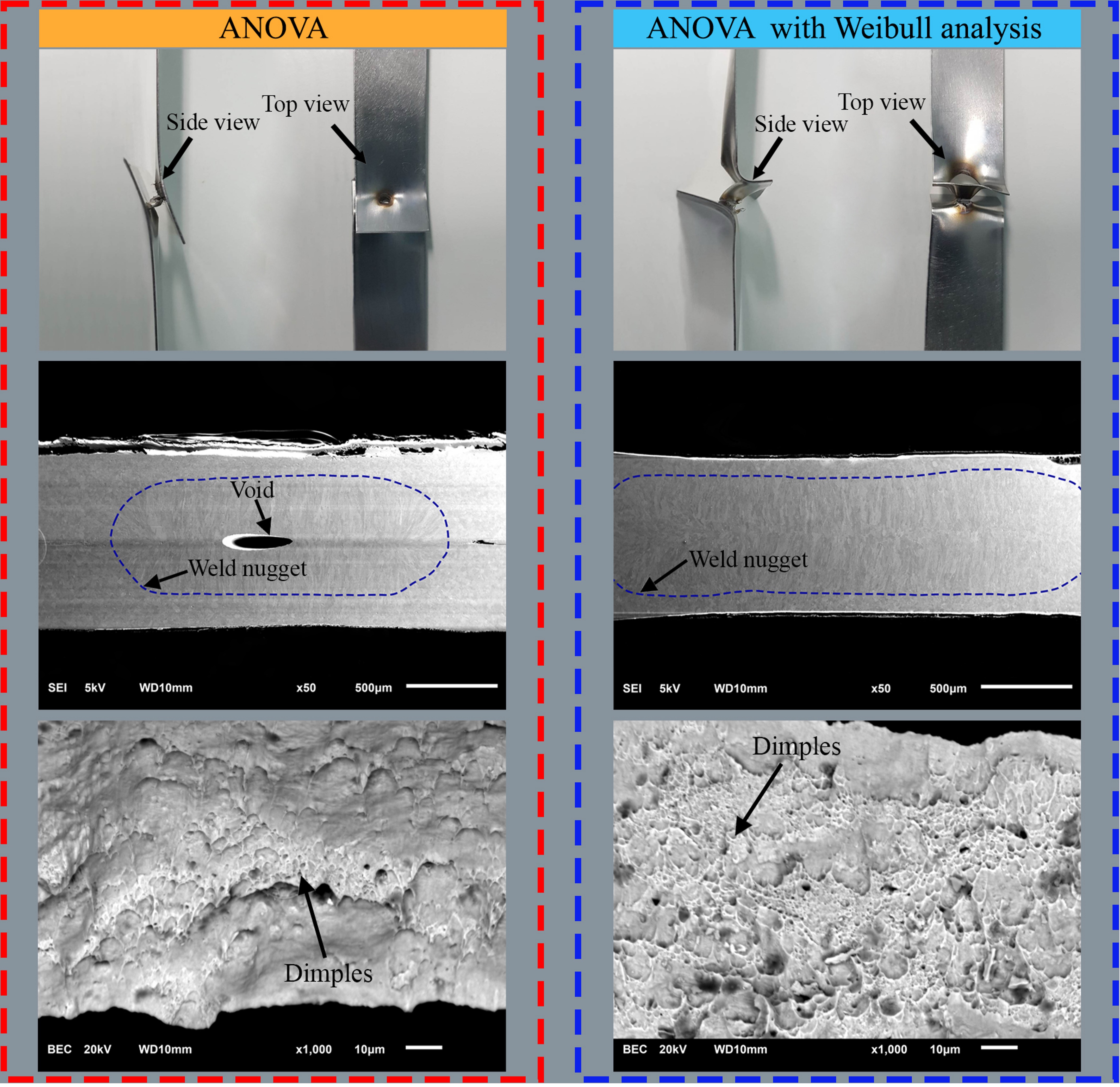
This study investigates how resistance spot welding parameters affect the joint strength and reliability of AISI 316L stainless steel, examining the effects of welding current, welding time, electrode pressure, and holding time. A 2ᵏ full factorial design combined with Weibull analysis was employed to systematically evaluate the influence of each parameter. Results indicate that the optimal welding conditions—4.0 kA welding current, 0.5 s welding time, 0.3 MPa electrode pressure, and 5.0 s holding time—lead to superior joint strength and reliability, achieving an average tensile shear force of 2376.02 N. Examination of the welded specimens revealed a pull-out failure mode and ductile fracture. Unlike previous studies that primarily focused on maximizing strength, this research integrates both strength and reliability assessments, providing a more comprehensive evaluation. The Weibull analysis not only validates findings from conventional analysis of variance, but also provides additional insights into joint reliability, demonstrating an effective alternative methodology for optimizing welding parameters.
GRAPHICAL ABSTRACT
HIGHLIGHTS
- A full factorial design combined with Weibull analysis was utilized to evaluate the effects of resistance spot welding parameters on AISI 316L stainless steel joints.
- High welding current, short welding time, low electrode pressure, and long holding time were identified as optimal conditions for achieving superior joint strength and reliability.
- Weibull analysis provided additional insight beyond ANOVA, enabling simultaneous assessment of strength and reliability, and guiding improved parameter selection for reliable welding.
References
Weman, K. (2011). Welding processes handbook (2nd ed.). Woodhead Publishing Cambridge, UK.
Ghosh, N., Pal, P.K., & Nandi, G. (2016). Parametric Optimization of MIG Welding on 316L Austenitic stainless steel by grey-based taguchi method. Procedia Technology, 25, 1038–1048. https://doi.org/10.1016/j.protcy.2016.08.204
Ghumman, K.Z., Ali, S., Din, E.U., Mubashar, A., Khan, N.B.,&Ahmed, S.W. (2022). Experimental investigation of effect of welding parameters on surface roughness, micro-hardness and tensile strength of AISI 316L stainless steel welded joints using 308L filler material by TIG welding. Journal of Materials Research and Technology, 21, 220–236. https://doi.org/10.1016/j.jmrt.2022.09.016
Krishnan, V., Ayyasamy, E., Paramasivam, & V. (2021). Influence of resistance spot welding process parameters on dissimilar austenitic and duplex stainless steel welded joints. Proceedings of the Institution of Mechanical Engineers, Part E: Journal of Process Mechanical Engineering 2021, 235, 12–23. https://doi.org/10.1177/0954408920933528
Jagadeesha, T., & Jothi, T. J. S. (2017). Studies on the influence of process parameters on the AISI 316L resistance spot-welded specimens. International Journal of Advanced Manufacturing Technology. 93, 73–88. https://doi.org/10.1007/s00170-015-7693-y
Hassoni, S. M., Barrak, O. S., Ismail, M. I., & Hussein, S. K. (2022). Effect of welding parameters of resistance spot welding on mechanical properties and corrosion resistance of 316L. Materials Research, 25(2), e20210117. https://doi.org/10.1590/1980-5373-MR-2021-0117
Vignesh, K., Elaya Perumal, A., & Velmurugan, P. (2017). Optimization of resistance spot welding process parameters and microstructural examination for dissimilar welding of AISI 316L austenitic stainless steel and 2205 duplex stainless steel. International Journal of Advanced Manufacturing Technology, 93, 455–465. https://doi.org/10.1007/s00170-017-0089-4
Mansor, M. S. M., Yusof, F., Ariga, T., & Miyashita, Y. (2018). Microstructure and mechanical properties of micro-resistance spot welding between stainless steel 316L and Ti-6Al-4V. International Journal of Advanced Manufacturing Technology, 96, 2567–2581. https://doi.org/10.1007/s00170-018-1688-4
Vigneshkumar, M., & Varthanan, P. A. (2019). Comparison of RSM and ANN model in the prediction of the tensile shear failure load of spot welded AISI 304/316 L dissimilar sheets. International Journal of Computational Materials Science and Surface Engineering, 8(2), 114–130. https://doi.org/10.1504/IJCMSSE.2019.102292
Safari, M., Mostaan, H., Yadegari Kh, H., & Asgari, D. (2017). Effects of process parameters on tensile-shear strength and failure mode of resistance spot welds of AISI 201 stainless steel. International Journal of Advanced Manufacturing Technology, 89, 1853–1863. https://doi.org/10.1007/s00170-016-9222-z
Ravichandran, P., Anbu, C., Meenakshipriya, B., & Sathiyavathi, S. (2020). Process parameter optimization and performance comparison of AISI 430 and AISI 1018 in resistance spot welding process. Materials Today: Proceedings, 33, 3389–3393, https://doi.org/10.1016/j.matpr.2020.05.197
Cao, X., Li, Z., Zhou, X., Luo, Z., & Duan, J. (2021). Modeling and optimization of resistance spot welded aluminum to Al-Si coated boron steel using response surface methodology and genetic algorithm. Measurement, 171,https://doi.org/10.1016/j.measurement.2020.108766
Ku, M. H., Hung, F. Y., & Lui, T. S. (2019). The effect of hyper-rotation on the Weibull distribution of tensile properties in a friction stirred AA7075 aluminum alloy. Materials Chemistry and Physics, 226, 290–295. https://doi.org/10.1016/j.matchemphys.2018.12.085
Sohn, H. J., Haryadi, G. D., & Kim, S. J. (2014). Statistical aspects of fatigue crack growth life of base metal, weld metal and heat affected zone in FSWed 7075-T651 aluminum alloy. Journal of Mechanical Science and Technology, 28, 3957–3962. https://doi.org/10.1007/s12206-014-0906-8
Brzostek, R. C., Suhuddin, U., & Dos Santos, J. F. (2018). Fatigue assessment of refill friction stir spot weld in AA 2024-T3 similar joints. Fatigue & Fracture of Engineering Materials & Structures, 41, 1208–1223. https://doi.org/10.1111/ffe.12764
Effertz, P. S., Infante, V., Quintino, L., Suhuddin, U., Hanke, S., & Dos Santos, J. F. (2016). Fatigue life assessment of friction spot welded 7050-T76 aluminium alloy using Weibull distribution. International Journal of Fatigue, 87, 381–390.https://doi.org/10.1016/j.ijfatigue.2016.02.030
Lin, C. W., Hung, F. Y., Lui, T. S., & Chen, L. H. (2014). Weibull statistics of tensile-shear strength of 5083 aluminum alloy after friction stir spot welding. Materials Transactions, 56(1), 54–60. https://doi.org/10.2320/matertrans.M2014281
Yang, C. W., Hung, F. Y., Lui, T. S., Chen, L. H., & Juo, J. Y. (2009). Weibull statistics for evaluating failure behaviors and joining reliability of friction stir spot welded 5052 aluminum alloy. Materials Transactions, 50(1), 145–151 https://doi.org/10.2320/matertrans.MRA2008341
Lima, R. S., & Marple, B. R. (2003). Optimized HVOF titania coatings, Journal of Thermal Spray Technology, 12, 360–369. https://doi.org/10.1361/105996303770348230
Wang, Y. R., Mo, Z. H., Feng, J. C., & Zhang, Z. D. (2007). Effect of welding time on microstructure and tensile shear load in resistance spot welded joints of AZ31 Mg alloy. Science and Technology of Welding and Joining, 12, 671–676. https://doi.org/10.1179/174329307X238380
Kianersi, D., Mostafaei, A., & Amadeh, A. A. (2014). Resistance spot welding joints of AISI 316L austenitic stainless steel sheets: Phase transformations, mechanical properties and microstructure characterizations. Materials & Design, 61, 251–263. https://doi.org/10.1016/j.matdes.2014.04.075
Kim, S., Park, S., Kim, M., Kim, D. Y., Park, J., & Yu, J. (2023). Weldability of additive manufactured stainless steel in resistance spot welding. Metals, 13, https://doi.org/10.3390/met13050837
Downloads
Published
How to Cite
Issue
Section
Categories
License
Copyright (c) 2025 : Kannachai Kanlayasiri, Teerawut Khuenkaew, Phoometh Sangrayub, Prajak Jattakul

This work is licensed under a Creative Commons Attribution-NonCommercial-NoDerivatives 4.0 International License.