
Enhancement of antifungal efficacy of Bacillus subtilis AS80 by cold plasma technology
DOI:
https://doi.org/10.55674/cs.v17i3.261267Keywords:
Bacillus subtilis, cold plasma technology, Antifungal activity, Biocontrol, Fruit rot diseaseAbstract
Pathogenic fungi represented in avocado and other fruit orchards rely predominantly on the application of fungicides. However, the employment of synthetic fungicides is increasingly restricted due to the harmful effects of pesticides on human health and the environment. Therefore, this research aimed to enhance the antifungal efficacy of antagonistic bacteria and to elucidate the enzyme activity underlying their inhibition of fungal development. The antagonistic bacteria, Bacillus subtilis AS80, were induced to mutate by cold plasma technology, and an assessment of antifungal activity was performed. It was found that three mutants named MT144, MT163, and MT165 exhibited significant antifungal activity, with mycelial growth inhibition of 86.3%, 85.2%, and 82.8%, respectively, while the wild type showed an inhibition of 76.4% at 14 days after inoculation. In addition, B. subtilis AS80 and antagonistic mutants exhibited chitinase, cellulase, and amylase activities. Interestingly, the MT123 mutant, which was deficient in antifungal activity, showed a contrasting phenotype, with high amylase activity but no detectable chitinase or cellulase activities. This study suggests that chitinase and cellulase are key enzymatic factors in B. subtilis AS80 and its mutants, mediating their ability to inhibit the growth of pathogenic fungi.
GRAPHICAL ABSTRACT
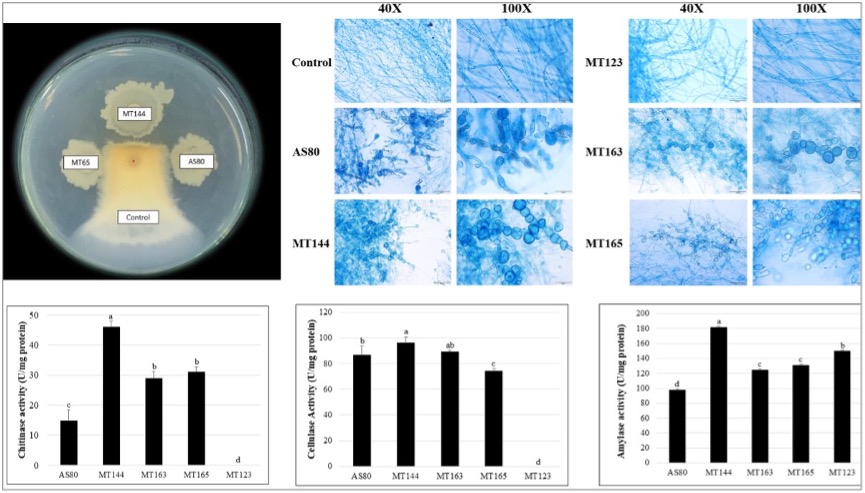
HIGHLIGHTS
- Cold plasma technology is an effective technique to enhance antifungal activity in Bacillus subtilis AS80, which is beneficial to use as a biocontrol agent.
- Chitinase and cellulase are key enzymatic factors in subtilis AS80 and its mutants, mediating their ability to inhibit the growth of pathogenic fungi.
References
Indexbox. (2024, December 1). Thailand-avocados-market analysis, forecast, size, trends and insights.https://www.indexbox.io/store/thailand-avocados-market-analysis-forecast-size-trends-and-insights/
Ramírez-Gil, J. G., Henao-Rojas, J. C., & Morales-Osorio, J. G. (2021). Postharvest diseases and disorders in avocado cv. Hass and their relationship to preharvest management practices. Heliyon, 7 e05905. https://doi.org/10.1016/j.heliyon.2021.e05905.
Garibaldi, A., Bertetti, D., Amatulli, M. T., Cardinale, J., & Gullino, M. L. (2012). First Report of Postharvest Fruit Rot in Avocado (Persea americana) Caused by Lasiodiplodia theobromae in Italy. Plant Disease, 96(3), 460. https://doi.org/10.1094/ PDIS-10-11-0886.
Wanjiku, E. K., Waceke, J. W., & Mbaka, J. N. (2021). Suppression of Stem-End Rot on Avocado Fruit Using Trichoderma spp. in the Central Highlands of Kenya. Advances in Agriculture, 8867858, 16. https://doi.org/10.1155/ 2021/8867858.
Summerell, B. A., Salleh, B., & Leslie J. F. (2003). A utilitarian approach to Fusarium identification. Plant Diseases, 87(2), 117–128. https://doi.org/10.1094/PDIS.2003.87.2.117.
Shimshoni, J. A., Bommuraj, V., Chen, Y., Sperling, R., Barel, S., Maurer, D., & Alkan, N. (2020). Postharvest Fungicide for Avocado Fruits: Antifungal Efficacy and Peel to Pulp Distribution Kinetics. Foods, 9(2), 124. https://doi.org/10.3390/foods9020124.
Konsue, W., Dethoup, T., & Limtong, S. (2020). Biological Control of Fruit Rot and Anthracnose of Postharvest Mango by Antagonistic Yeasts from Economic Crops Leaves. Microorganisms, 8(3), 317. https://doi. org/10.3390/microorganisms8030317.
Swain, M. R., & Ray, R. C. (2009). Biocontrol and other beneficial activities of Bacillus subtilis isolated from cowdung microflora. Microbiological Research, 164(2), 121-130. https://doi.org/10.1016/ j.micres.2006.10.009.
Guevara-Avendaño, E., Carrillo, J. D., Ndinga-Muniani, C., Moreno, K., Méndez-Bravo, A. , Guerrero-Analco, J. A., Eskalen, A., & Reverchon, F. (2018). Antifungal activity of avocado rhizobacteria against Fusarium euwallaceae and Graphium spp., associated with Euwallacea spp. nr fornicatus and Phytophthora cinnamomi. Antonie Van Leeuwenhoek, 111(4), 563-572. https://doi.org/10.1007/s10482-017-0977-5.
Kim, Y. S., Balaraju, K., & Jeon, Y. (2016). Biological Control of Apple Anthracnose by Paenibacillus polymyxa APEC128, an Antagonistic Rhizobacterium. Plant Pathology Journal, 32(3), 251259. https:// doi.org/10.5423/PPJ.OA.01.2016.0015.
Kim, Y. S., Balaraju, K., & Jeon, Y. (2016). Effects of rhizobacteria Paenibacillus polymyxa APEC136 and Bacillus subtilis APEC170 on biocontrol of postharvest pathogens of apple fruits. Journal of Zhejiang University. Science. B., 17(12), 931940. https://doi.org/10.1631/jzus.B1 600117.
Polsa, N., Suyotha, W., Suebsan, S., Anuntalabhochai, S., & Kanta, S. (2020). Increasing xylanase activity of Bacillus subtilis by atmospheric pressure plasma jet for biomass hydrolysis. 3 Biotech, 10, 22. https://doi.org/10.1007/s13205-019-2004-1
Suebsan, S., Mee-u-sah, C., Suyana, S., Onprachoo, M., Sangwijit, K., & Anantalabhochai, S. (2023). Evaluation of Antifungal Activity from Bacillus subtilis strain AS80 Against Pathogenic Fungi Isolated from Hass Avocado Fruits. Chiang Mai Journal of Science, 50(2), 1-11. https://doi.org/10.12982/ CMJS.2023.019.
Idris, H. A., Labuschagne, N., & Korsten, L. (2007). Screening rhizobacteria for biological control of Fusarium root and crown rot of sorghum in Ethiopia. Biological Control, 40(1), 97-106. https://doi.org/10. 1016/j.biocontrol.2006. 07.017.
Roberts, W. K., & Selitrennikoff, C. (1988). Plant and Bacterial Chitinases Differ in Antifungal Activity. Microbiology, 134(1), 169-176. https://doi.org/10.1099/00221287-134-1-169.
Malik, W. A., & Javed, S. (2021). Biochemical Characterization of Cellulase from Bacillus subtilis Strain and its Effect on Digestibility and Structural Modifications of Lignocellulose Rich Biomass. Frontiers in Bioengineering and Biotechnology, 9, 800265. https://doi.org/10.3389/fbioe.2021 .800265
Bradford, M. M. (1976). A rapid and sensitive method for the quantitation of microgram quantities of protein utilizing the principle of protein-dye binding. Analytical Biochemistry, 72(1-2), 248-254. https://doi.org /10.1016/0003-2697(76) 90527-3.
Polsa, N., Songsiriritthigul, C., Suyotha, W., Suebsan, S., Anuntalabhochai, S., & Sangwijit K. (2021). A Single Mutation in the Carbohydrate-Binding Module Enhances Cellulase Activity in Bacillus amyloliquefaciens Mutant. Walailak Journal of Science and Technology, 18(18), 23985. https://doi.org/10.48048/wjst.2021.23985.
Nurnadirah, M. N., Nene, K. C. M. R., & Yuziah, M. Y. N. (2017). Evaluation of Antifungal Activity of Antagonistic Bacteria against Butt Rot Disease Pathogen of Pineapple. Walailak Journal of Science and Technology, 15(4), 283-293. https://doi.org/ 10.48048/wjst.2018.4040.
Liu, Y., Zhang W., Zhang, Z., Kou, Z., Wang, X., Wang, Su, Y., Zhang, X. J., Liu, L., Yan, F., & Tian, Y. (2024). Biocontrol effects of three antagonistic bacteria strains against Codonopsis pilosula wilt disease caused by Fusarium oxysporum. Biological Control, 190, 105446. https://doi.org/10. 1016/j.biocontrol.2024.105446.
Li, Y., Zhang, X., He, K., Song, X., Yu, J., Guo, Z., & Xu, M. (2023). Isolation and Identification of Bacillus subtilis LY-1 and Its Antifungal and Growth-Promoting Effects. Plants, 12(24), 4158. https://doi.org/ 10.3390/plants12244158.
Hong, S., Kim, T. Y., Won, S. J., Moon, J. H., Ajuna, H. B., Kim, K. Y., & Ahn, Y. S. (2022). Control of Fungal Diseases and Fruit Yield Improvement of Strawberry Using Bacillus velezensis CE 100. Microorganisms, 10(2), 365. https://doi.org/10.3390/microor ganisms100 20365.
Downloads
Published
How to Cite
Issue
Section
Categories
License
Copyright (c) 2025 : Supachai Pothi, Kanta Sangwijit, Thamonwan Pankong, Somboon Anuntalabhochai, Sugunya Suebsan

This work is licensed under a Creative Commons Attribution-NonCommercial-NoDerivatives 4.0 International License.