
Upcycling used engine oil into stable water-based emulsions as sustainable concrete mold release agents
Article Sidebar
Main Article Content
Abstract
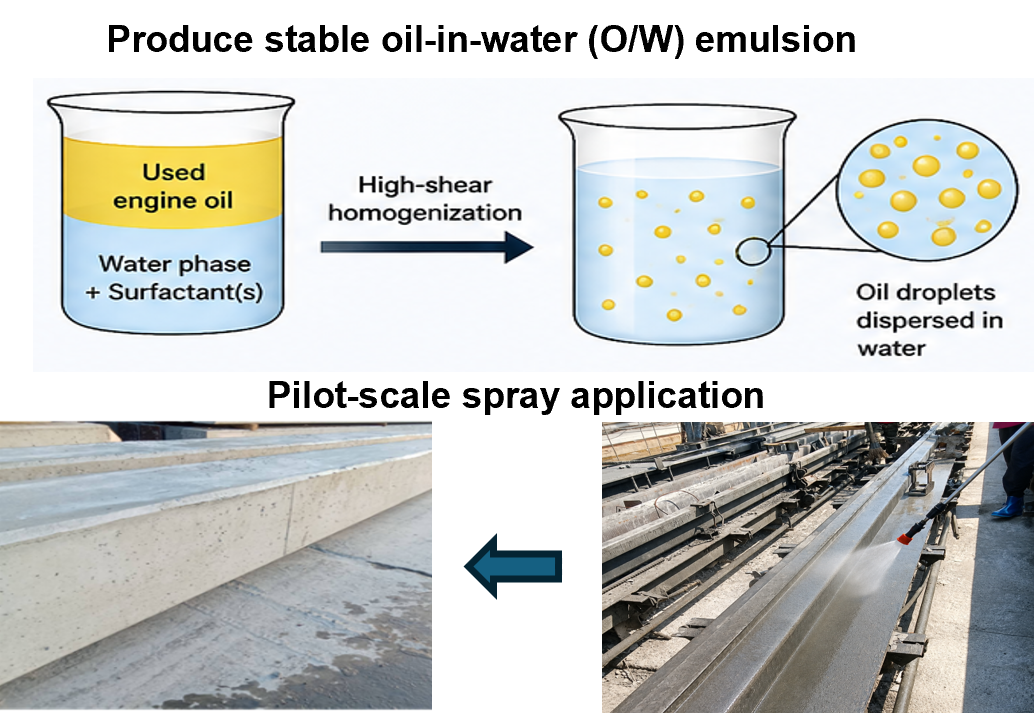
This study presents a practical and scalable approach for converting hazardous used engine oil into a value-added material for construction applications, supporting resource circularity and more sustainable concrete manufacturing. A stable water-based oil-in-water (O/W) emulsion was developed using used engine oil as an environmentally friendly concrete mold release agent. The effects of surfactant type, mixed surfactant composition, and xanthan gum addition on emulsion stability were investigated through long-term storage tests and optical microscopy. Among the surfactants studied, the nonionic surfactant Dehydol LS9 at 5 wt% showed the best performance, producing fine and uniformly dispersed oil droplets with good redispersibility after prolonged storage. The addition of 0.1 wt% xanthan gum further improved emulsion stability and adhesion to concrete mold surfaces, while the use of mixed surfactants did not significantly improve long-term stability. The optimized formulation was further evaluated under pilot-scale industrial conditions and could be uniformly sprayed onto concrete molds, providing effective demolding performance. Compared with conventional solvent-based products, the developed formulation also substantially reduced the use of organic solvents. This water-based formulation provides a low-cost and environmentally friendly alternative for concrete mold release applications, while improving worker safety and promoting the beneficial use of waste engine oil in sustainable construction.
Article Details

This work is licensed under a Creative Commons Attribution-NonCommercial-NoDerivatives 4.0 International License.
References
Barnat-Hunek D, Szafraniec M. Influence of Biodegradable Release Oils on the Physical and Mechanical Properties of Light-Colored Architectural Concrete. Materials. 2021;14(16):4630.
Liang B, Yang Y, Li J. Research progress of water-based release agents. MATEC Web Conf. 2022;358.
Yang M, Li L, Zhu Z, Ma H. Research progress on eco-friendly rubber release agents. Colloid Polym Sci. 2025;303(2):163-74.
Olietti A, Pargoletti E, Diona A, Cappelletti G. A novel optimized mold release oil-in-water emulsion for polyurethane foams production. J Mol Liq. 2018;261:199-207.
Scrivener KL, John VM, Gartner EM. Eco-efficient cements: Potential economically viable solutions for a low-CO2 cement-based materials industry. Cement Concrete Res. 2018;114:2-26.
Moses KK, Aliyu A, Hamza A, Mohammed-Dabo IA. Recycling of waste lubricating oil: A review of the recycling technologies with a focus on catalytic cracking, techno-economic and life cycle assessments. J Environ Chem Eng. 2023;11(6):111273.
Rongsayamanont W, Tongcumpou C, Phasukarratchai N. Diesel-Contaminated Soil Washing by Mixed Nonionic Surfactant Emulsion and Seed Germination Test. Water Air Soil Pollut. 2020;231(6):267.
Mishra A, Mishra NS. Sustainable Utilization of Waste Motor Oil: A Hazardous Hydrocarbon Pollutant. In: Behera ID, Das AP, editors. Environmental Hydrocarbon Pollution and Zero Waste Approach Towards a Sustainable Waste Management. Cham: Springer Nature Switzerland; 2025. p. 241-53.
García-Gutiérrez P, Tonini D, Klenert D, Marschinski R, Saveyn HGM. Environmental and economic assessment of waste lubricant oil management in the EU. J Clean Prod. 2025;492:144878.
Islam Sazzad MR, Rahman MM, Hassan T, Al Rifat A, Al Mamun A, Adib AR, et al. Advancing sustainable lubricating oil management: Re-refining techniques, market insights, innovative enhancements, and conversion to fuel. Heliyon. 2024;10(20):e39248.
Kanokkantapong V, Kiatkittipong W, Panyapinyopol B, Wongsuchoto P, Pavasant P. Used lubricating oil management options based on life cycle thinking. Resour Conserv Recy. 2009;53(5):294-299.
Cabrera-Escobar C, Moreno-Gutiérrez J, Rodríguez-Moreno R, Pájaro-Velázquez E, Calderay-Cayetano F, Durán-Grados V. A Review on Global Recovery Policy of Used Lubricating Oils and Their Effects on the Environment and Circular Economy. Environments. 2025;12(5):135.
Abbas A, Zhang C, Hu G, Hussain S, Gao R, Li J, et al. Facile formulation of sustainable and stable oil-in-dispersion emulsion: A release agent with high demoulding efficacy. Chem Eng J Adv. 2022;12:100394.
Abbas A, Zhang C, Hussain S, Tang Y, Li Y, Gao R, et al. Preparation of ultrastable oil-in-water emulsion as a robust superwettable and sustainable concrete release agent. J Mol Liq. 2023;390:123043.
Tadros TF. Emulsion Formation and Stability. Wiley-VCH; 2013.
Peng L-C, Liu C-H, Kwan C-C, Huang K-F. Optimization of water-in-oil nanoemulsions by mixed surfactants. Colloid Surface A. 2010;370(1):136-42.
Rosen MJ, Kunjappu JT. Surfactants and Interfacial Phenomena. 4th e d. John Wiley & Sons; 2012.
Nsengiyumva EM, Alexandridis P. Xanthan gum in aqueous solutions: Fundamentals and applications. Int J Biol Macromol. 2022;216:583-604.
Zhang J, Tai X, Liu H, Ma X, Gao X, Luo Y. Effect of xanthan gum on stability and rheological behavior of O/W emulsion. J Disper Sci Technol. 2025;46(14):2189-97.
Holmberg K. Natural surfactants. Cur Opin Colloid In. 2001;6(2):148-59.
McClements DJ. Emulsion Design to Improve the Delivery of Functional Lipophilic Components. Annu Rev Food Sci T. 2010;1:241-69.
McClements DJ. Nanoemulsions versus microemulsions: terminology, differences, and similarities. Soft Matter. 2012;8(6):1719-29.
Jafari SM, Assadpoor E, He Y, Bhandari B. Re-coalescence of emulsion droplets during high-energy emulsification. Food Hydrocolloid. 2008;22(7):1191-202.
