
Benchmarking tree-based machine learning surrogates for the coupled Luikov heat and mass transfer system
Article Sidebar
Main Article Content
Abstract
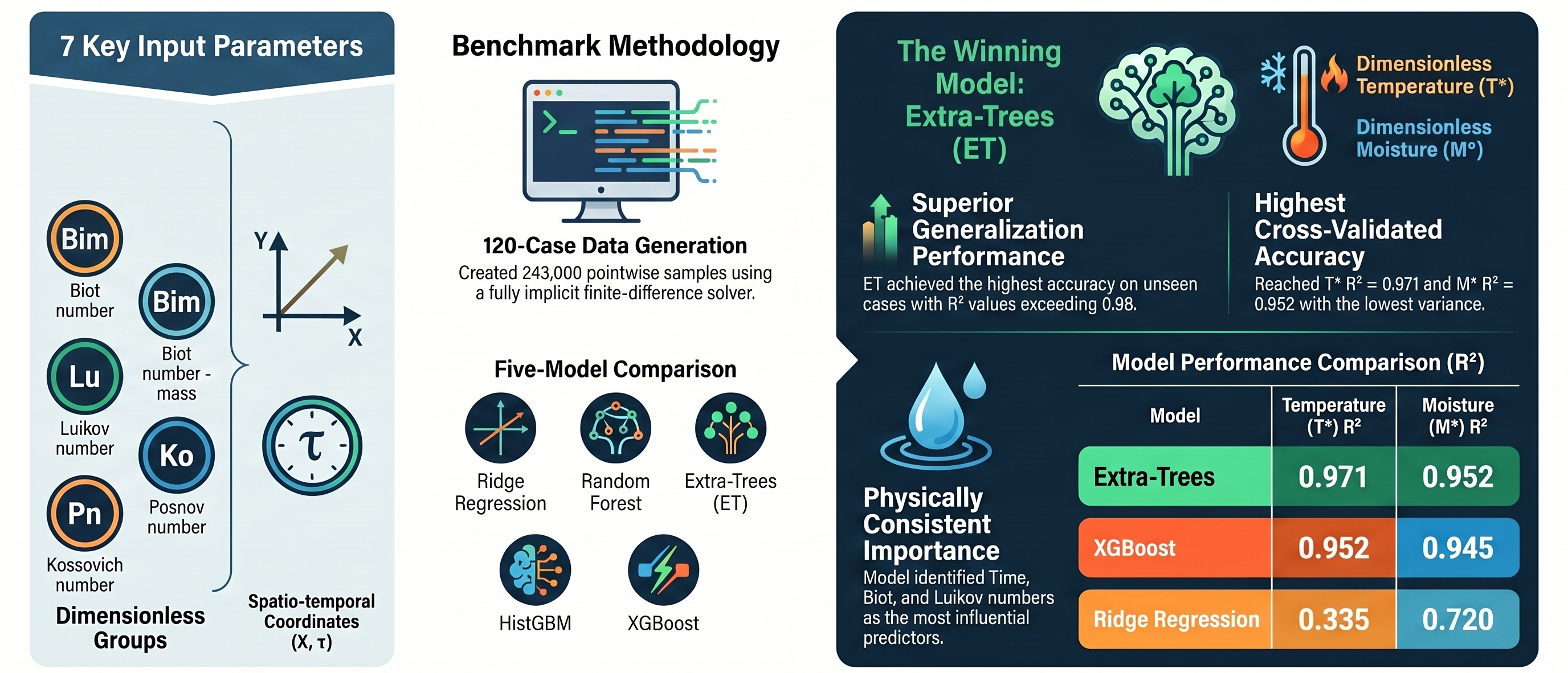
Replacing repeated high-quality simulations with a fast surrogate is central to parametric studies, sensitivity analyses, and inverse design of coupled transport systems, yet the relative merits of tree-based ensembles for this task remain insufficiently characterized. A purely data-driven benchmark is therefore presented, in which five regressors of increasing flexibility — ridge regression, random forest, extremely randomized trees, histogram-based gradient boosting, and XGBoost — are compared as surrogates for the coupled Luikov system of heat and mass transfer, a stiff multiphysics problem whose bidirectional coupling and multi-scale behavior make repeated numerical solution costly. The surrogates map the five governing dimensionless groups (the thermal and mass Biot numbers, the Luikov number, the Kossovitch number, and the Posnov number) together with the spatio-temporal coordinates directly to the dimensionless temperature and moisture fields, with no physics embedded in the model. A dataset of 120 cases was produced with a fully implicit finite-difference solver, yielding 243,000 pointwise samples. The five candidates were then compared on a case-level 80/20 split with five-fold grouped cross-validation, so that accuracy reflects generalization to unseen parameter sets. The extremely randomized trees model attained the highest cross-validated accuracy T*R2 = 0.971, M*R2 = 0.952, with the lowest fold-to-fold variance for the temperature field and generalized to 24 held-out cases T*R2 = 0.980, M*R2 = 0.984; per-case median R2 of 0.990 and 0.984). Averaged over ten independent case-level splits, the held-out R² was 0.978 ± 0.011 (T*) and 0.971 ± 0.010 (M*), the more stable estimate of generalization. Permutation importance singled out dimensionless time as the strongest predictor in both fields, with the thermal Biot number ranking next for temperature and the Luikov number and spatial position next for moisture—an ordering consistent with the underlying transport physics. Extremely randomized trees, and tree-based ensembles more broadly, thus emerged as accurate and interpretable surrogates for the coupled Luikov system that remain inexpensive to evaluate, at least across the five-parameter envelope sampled here.
Article Details

This work is licensed under a Creative Commons Attribution-NonCommercial-NoDerivatives 4.0 International License.
References
Wijerathne ADHT, Joardder MUH, Welsh ZG, Nayak R, Sablani SS, Karim A. Recent advances in food drying modeling: empirical to multiscale physics-informed neural networks. Compr Rev Food Sci Food Saf [internet]. 2025;24:e70194. Available from: https://doi.org/10.1111/1541-4337.70194.
Breiman L. Random forests. Mach Learn [internet]. 2001;45(1):5–32. Available from: https://doi.org/10.1023/A:1010933404324.
Geurts P, Ernst D, Wehenkel L. Extremely randomized trees. Mach Learn [internet]. 2006;63(1):3–42. Available from: https://doi.org/10.1007/s10994-006-6226-1.
Chen T, Guestrin C. XGBoost: a scalable tree boosting system. In: Proc. 22nd ACM SIGKDD Int. Conf. Knowl. Discov. Data Min. [internet]. New York: Association for Computing Machinery; 2016. p. 785–94. Available from: https://doi.org/10.1145/2939672.2939785.
Manavi S, Fattahi E, Becker T. A parameterized physics-informed machine learning approach for solving heat and mass transfer equations in the drying process. Int Commun Heat Mass Transf [internet]. 2024;158:107897. Available from: https://doi.org/10.1016/j.icheatmasstransfer.2024.107897.
Luikov AV. Systems of differential equations of heat and mass transfer in capillary-porous bodies (review). Int J Heat Mass Transf [internet]. 1975;18(1):1–14. Available from: https://doi.org/10.1016/0017-9310(75)90002-2.
Datta AK. Toward computer-aided food engineering: mechanistic frameworks for evolution of product, quality and safety during processing. J Food Eng [internet]. 2016;176:9–27. Available from: https://doi.org/10.1016/j.jfoodeng.2015.10.010.
Koukouch A, Bakhattar I, Asbik M, Idlimam A, Zeghmati B, Aharoune A. Analytical solution of coupled heat and mass transfer equations during convective drying of biomass: experimental validation. Heat Mass Transf [internet]. 2020;56(6):1971–83. Available from: https://doi.org/10.1007/s00231-020-02817-w.
Defraeye T, Blocken B, Carmeliet J. Analysis of convective heat and mass transfer coefficients for convective drying of a porous flat plate by conjugate modelling. Int J Heat Mass Transf [internet]. 2012;55(1–3):112–24. Available from: https://doi.org/10.1016/j.ijheatmasstransfer.2011.08.047.
LeVeque RJ. Finite difference methods for ordinary and partial differential equations: steady-state and time-dependent problems. Philadelphia: SIAM; 2007. Available from: https://doi.org/10.1137/1.9780898717839.
McKay MD, Beckman RJ, Conover WJ. Comparison of three methods for selecting values of input variables in the analysis of output from a computer code. Technometrics [internet]. 1979;21(2):239-45. Available from: https://doi.org/10.1080/00401706.1979.10489755.
Pedregosa F, Varoquaux G, Gramfort A, Michel V, Thirion B, Grisel O, et al. Scikit-learn: machine learning in Python. J Mach Learn Res. 2011;12:2825-30.
Tagnamas Z, Idlimam A, Lamharrar A. Predictive models of beetroot solar drying process through machine learning algorithms. Renew Energy [internet]. 2023;219:119522. Available from: https://doi.org/10.1016/j.renene.2023.119522.
Daliran A, Taki M, Marzban A, Rahnama M, Farhadi R. Experimental evaluation and modeling the mass and temperature of dried mint in greenhouse solar dryer: application of machine learning method. Case Stud Therm Eng [internet]. 2023;47:103048. Available from: https://doi.org/10.1016/j.csite.2023.103048.
Manavi S, Fattahi E, Becker T. Surrogate modeling of shrinkage due to drying using physics-informed machine learning method. Phys Fluids [internet]. 2025;37(7):073134. Available from: https://doi.org/10.1063/5.0274073.
Shirzadi N, Lau D, Stylianou M. Surrogate modeling for building design: energy and cost prediction compared to simulation-based methods. Buildings [internet]. 2025;15(13):2361. Available from: https://doi.org/10.3390/buildings15132361.
Çolak AB. Extreme gradient boosting (XGBoost) prediction of latent heat storage in conical-fin solar thermal units with graphene-alumina hybrid-nano-additives. Heat Mass Transf [internet]. 2026;62:11. Available from: https://doi.org/10.1007/s00231-026-03644-1.
Ploton P, Mortier F, Réjou-Méchain M, Barbier N, Picard N, Rossi V, et al. Spatial validation reveals poor predictive performance of large-scale ecological mapping models. Nat Commun [internet]. 2020;11:4540. Available from: https://doi.org/10.1038/s41467-020-18321-y.
Fisher A, Rudin C, Dominici F. All models are wrong, but many are useful: learning a variable’s importance by studying an entire class of prediction models simultaneously. J Mach Learn Res. 2019;20(177):1-81.
