
Isolation and selection of Lactiplantibacillus plantarum CLT-L01 (TISTR P088) from traditional fermented vegetables for solid-state fermentation of soybean meal (SBM)
Article Sidebar
Main Article Content
Abstract
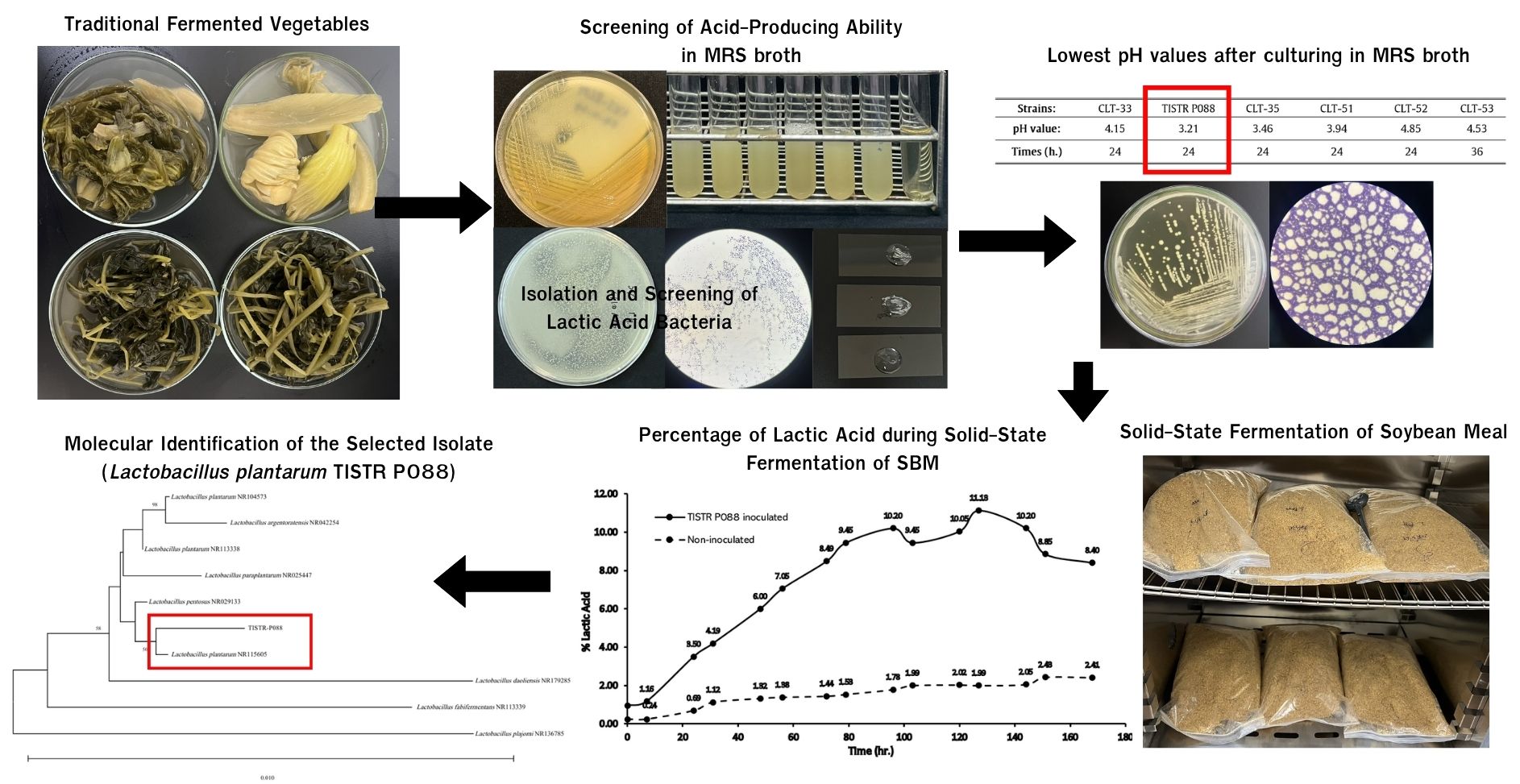
Lactic acid bacteria are widely used as beneficial microorganisms in fermentation processes for animal feed production. In soybean meal, which is an important protein source in animal feed, lactic acid bacteria fermentation can improve nutritional quality by promoting acidification and reducing antinutritional factors. This study aimed to isolate lactic acid bacteria from traditional fermented vegetables and evaluate their potential as starter cultures for the solid-state fermentation of soybean meal. Traditional fermented vegetables were selected as the isolation source because they are locally available, inexpensive, and rich in naturally occurring lactic acid bacteria. Nine acid-producing bacterial isolates were obtained from traditional fermented vegetable samples using MRS agar supplemented with calcium carbonate. The isolates were preliminarily characterized by Gram staining and catalase testing. Six isolates, namely CLT-35, CLT-51, CLT-33, CLT-52, CLT-53, and CLT-L01, were selected for the evaluation of acid production efficiency in MRS broth. Among them, CLT-L01 showed the fastest acid production, with the pH decreasing to 3.21 ± 0.02 after 24 h of incubation. Therefore, CLT-L01 was selected for further evaluation in solid-state soybean meal fermentation. The results showed that soybean meal inoculated with CLT-L01 exhibited a rapid increase in lactic acid content, exceeding 10% after 96 h of fermentation. The highest lactic acid content was 11.13 ± 0.06% at 127 h, whereas the uninoculated control reached only 2.43 ± 0.12% at 151 h. These findings indicate that CLT-L01 enhanced acid production and improved fermentation efficiency compared with natural fermentation. Molecular identification based on 16S rDNA sequencing revealed that CLT-L01 showed more than 99% sequence similarity to the reference strain Lactiplantibacillus plantarum. Overall, CLT-L01 has potential as a starter culture for promoting lactic acid production and acidification during soybean meal fermentation.
Article Details

This work is licensed under a Creative Commons Attribution-NonCommercial-NoDerivatives 4.0 International License.
References
Mukherjee R, Chakraborty R, Dutta A. Role of fermentation in improving nutritional quality of soybean meal-a review. Anim Biosci. 2016;29(11):1523-29.
Murtaza G, Usman M, Ahmed Z, Rizwan M, Iqbal R. Non-wood-based biochars as promising and eco-friendly adsorbents for chromium hexavalent Cr(VI) removal from aquatic systems: state-of-the-art, limitations, and potential future directions. Environ Pollut Bioavailab. 2024;36(1):2387680.
Murtaza G, Deng G, Usman M, Hyder S, Ahmed Z, Iqbal J, et al. Potential of cotton sticks-derived biochar to alleviate aluminium toxicity in cotton. Ind Crops Prod. 2025;229:121022.
Murtaza G, Hassan NE, Usman M, Deng G, Ahmed Z, Iqbal J, et al. Synergistic effects of allantoin and Achyranthes japonica-biochar profoundly alleviate lead toxicity during barley growth. Ecotoxicol Environ Saf. 2025;290:117784.
Su LW, Cheng YH, Hsiao FSH, Han JC, Yu YH. Optimization of mixed solid-state fermentation of soybean meal by Lactobacillus species and Clostridium butyricum. Pol J Microbiol. 2018;67(3):297-305.
Chen L, Zhao Z, Yu W, Zheng L, Li L, Gu W, et al. Nutritional quality improvement of soybean meal by Bacillus velezensis and L. plantarum during two-stage solid-state fermentation. AMB Express. 2021;11:23.
Tamang JP, Watanabe K, Holzapfel WH. Review: diversity of microorganisms in global fermented foods and beverages. Front Microbiol. 2016;7:377.
Swain R, Anandharaj M, Ray RC, Parveen Rani R. Fermented fruits and vegetables of Asia: a potential source of probiotics. Biotechnol Res Int. 2014;2014:250424.
Armenova N, Tsigoriyna L, Arsov A, Petrov K, Petrova P. Microbial detoxification of residual pesticides in fermented foods: current status and prospects. Foods. 2023;12(6):1163.
Baralić K, Živančević K, Bozic D, Đukić-Ćosić D. Probiotic cultures as a potential protective strategy against the toxicity of environmentally relevant chemicals: state-of-the-art knowledge. Food Chem Toxicol. 2023;172:113582.
de Man JC, Rogosa M, Sharpe ME. A medium for the cultivation of lactobacilli. J Appl Bacteriol. 1960;23(1):130-5.
Hwanhlem N, Buradaleng S, Wattanachant S, Benjakul S, Tani A, Maneerat S. Isolation and screening of lactic acid bacteria from Thai traditional fermented fish (Plasom) and production of Plasom from selected strains. Food Control. 2011;22(3-4), 401-7.
Mokoena MP. Lactic acid bacteria and their bacteriocins: classification, biosynthesis and applications against uropathogens: a mini-review. Molecules. 2017;22(8):1255.
Weisburg WG, Barns SM, Pelletier DA, Lane DJ. 16S ribosomal DNA amplification for phylogenetic study. J Bacteriol. 1991;173(2):697-703.
Yang J, Tan H, Cai Y. Characteristics of lactic acid bacteria isolates and their effect on silage fermentation of fruit residues. J Dairy Sci. 2016;99(7):5325-34.
Jeyagowri N, Rameshkumar MR, Kumar V, Anandham R. Phenotypic characterisation and molecular identification of lactic acid bacteria isolated from fermented food. Fermentation. 2023;9(9):807.
Janda JM, Abbott SL. 16S rRNA gene sequencing for bacterial identification in the diagnostic laboratory: pluses, perils, and pitfalls. J Clin Microbiol. 2007;45(9):2761-4.
Jazi V, Ashayerizadeh A, Toghyani M, Shabani A, Tellez G, Toghyani M. Fermented soybean meal exhibits probiotic properties when included in Japanese quail diet in replacement of soybean meal. Poult Sci. 2018;97(6):2113-22.
Leroy F, De Vuyst L. Growth of the bacteriocin-producing Lactobacillus sakei strain CTC 494 in MRS broth is strongly reduced due to nutrient depletion: a nutrient depletion model for the growth of lactic acid bacteria. Appl Environ Microbiol. 2001;67(10):4407-13.
Altschul SF, Madden TL, Schäffer AA, Zhang J, Zhang Z, Miller W, et al. Gapped BLAST and PSI-BLAST: a new generation of protein database search programs. Nucleic Acids Res. 1997;25(17):3389-402.
Stackebrandt E, Goebel BM. Taxonomic note: a place for DNA-DNA reassociation and 16S rRNA sequence analysis in the present species definition in bacteriology. Int J Syst Bacteriol. 1994;44(4):846-9.
de Vries MC, Vaughan EE, Kleerebezem M, de Vos WM. L. plantarum-survival, functional and potential probiotic properties in the human intestinal tract. Int Dairy J. 2006;16(9):1018-28.
Fidanza M, Panigrahi P, Kollmann TR. L. plantarum-nomad and ideal probiotic. Front Microbiol. 2021;12:712236.
