
Effective detection of Thai fake news using machine learning method
Article Sidebar
Main Article Content
Abstract
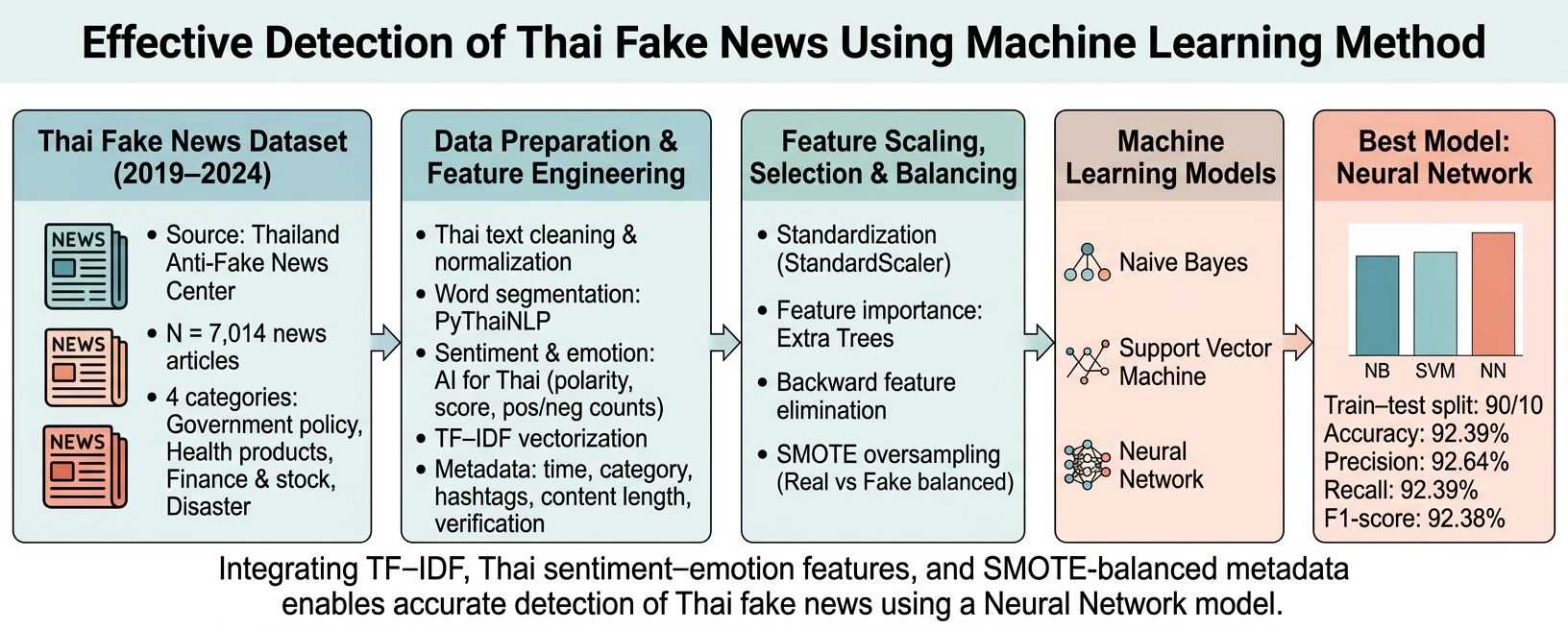
The rapid spread of misinformation on digital platforms has become a critical challenge affecting public trust, social stability, and policy communication in Thailand. The aim of this study is to develop and evaluate a reproducible machine learning framework for Thai fake news detection from real world verified data from the Anti-Fake News Center Thailand during 2019 - 2024. The data set comprises four key data groups including governmental policies, health products, financial and stocks as well as disaster news. The suggested research methodology entails thorough data cleaning and text normalization, sentiment and emotions analysis through the usage of AI for Thai, dimension reduction by selecting relevant features and dealing with unbalanced classes through Synthetic Minority Oversampling Technique (SMOTE). For evaluation, three supervised learning algorithms (Naïve Bayes, Support Vector Machine [SVM] and neural networks) were tested using 80:20 and 90:10 train-test split ratios, K-Fold Cross-Validation and hyperparameter optimization. Based on the experimental findings, the neural network classifier achieved better accuracy rates, that is, 92.39%, with other performance metrics including precision, recall, F1-score, ROC-AUC and AUC-PR at 92.64%, 92.39%, 92.38%, 96.79%, 96.07% respectively. Therefore, the methodological framework was effective in identifying false news stories in the Thai language due to the use of linguistic features and oversampling strategies. The main contribution of this study is an interpretable baseline framework that integrates linguistic, affective, and metadata features for Thai fake news detection in a low-resource language setting.
Article Details

This work is licensed under a Creative Commons Attribution-NonCommercial-NoDerivatives 4.0 International License.
References
Vosoughi S, Roy D, Aral S. The spread of true and false news online. Science. 2018;359(6380):1146-51.
Shu K, Sliva A, Wang S, Tang J, Liu H. Fake News Detection on Social Media. ACM SIGKDD Explorations Newsletter. 2017;19(1):22-36.
Conroy NJ, Rubin VL, Chen Y. Automatic deception detection: Methods for finding fake news. Proceedings of the Association for Information Science and Technology. 2015;52(1):1-4.
Jurafsky D, Martin JH. Speech and Language Processing. 3rd ed. Hoboken (NJ): Pearson; 2020.
Zhou X, Zafarani R. A Survey of Fake News. ACM Computing Surveys. 2020;53(5):1-40.
Kaliyar RK, Goswami A, Narang P. FakeBERT: fake news detection in social media with a BERT-based deep learning approach. Multimed Tools Appl. 2021;80(8):11765-88.
Mookdarsanit P, Mookdarsanit L. The COVID-19 fake news detection in Thai social texts. Bulletin of Electrical Engineering and Informatics. 2021;10(2):988-98. doi:10.11591/eei.v10i2.2745.
Bird S, Klein E, Loper E. Natural Language Processing with Python. Sebastopol (CA): O'Reilly Media; 2009.
Ministry of Digital Economy and Society. Thailand Anti-Fake News Center [Internet]. Bangkok: Ministry of Digital Economy and Society; 2025 [cited 2026 Mar 16]. Available from: https://www.antifakenewscenter.com/.
Phatthiyaphaibun W, Chaovavanich K, Polpanumas C, Suriyawongkul A, Lowphansirikul L, Chormai P, et al. PyThaiNLP: Thai natural language processing in Python. In: Proceedings of the 3rd Workshop for Natural Language Processing Open Source Software (NLP-OSS 2023); 2023. p. 25-36.
Pang B, Lee L. Opinion Mining and Sentiment Analysis. Foundations and Trends in Information Retrieval. 2008;2(1–2):1-135.
NECTEC. AI for Thai: natural language processing services for Thai language [Internet]. Pathum Thani: National Electronics and Computer Technology Center; 2025 [cited 2026 Mar 16]. Available from: https://aiforthai.in.th/.
Zhou JL, Ye Z, Zhang S, Zhao G, Han N, Yang T. Investigating response behavior through TF-IDF and Word2vec text analysis: A case study of PISA 2012 problem-solving process data. Heliyon. 2024;10(16):e35945.
Khamphakdee N, Seresangtakul P. An efficient deep learning for Thai sentiment analysis. Data. 2023;8(5):90. doi:10.3390/data8050090.
Dhiman P, Kaur A, Gupta D, Juneja S, Nauman A, Muhammad G. GBERT: A hybrid deep learning model based on GPT-BERT for fake news detection. Heliyon. 2024 Aug 30;10(16).
Géron A. Hands-On Machine Learning with Scikit-Learn, Keras, and TensorFlow. 3rd ed. Sebastopol (CA): O'Reilly Media; 2022.
Meesad P. Thai fake news detection based on information retrieval, natural language processing and machine learning. SN Computer Science. 2021 Nov;2(6):425.
Dablain D, Krawczyk B, Chawla NV. DeepSMOTE: Fusing Deep Learning and SMOTE for Imbalanced Data. IEEE Transactions on Neural Networks and Learning Systems. 2022;34(9):6390-404.
McCallum A, Nigam K. A comparison of event models for Naïve Bayes text classification. In: Proceedings of AAAI-98 workshop on learning for text categorization; 1998 Jul 27; Madison (WI). Menlo Park (CA): AAAI Press; 1998. p. 41-8.
Cortes C, Vapnik V. Support-vector networks. Machine Learning. 1995;20(3):273-97.
Goodfellow I, Bengio Y, Courville A. Deep learning. Cambridge (MA): MIT Press; 2016.
Rumelhart DE, Hinton GE, Williams RB. Learning representations by back-propagating errors. Nature. 1988;323(6088):533–6.
Kohavi R. A study of cross-validation and bootstrap for accuracy estimation and model selection. In: Proceedings of the International Joint Conference on Artificial Intelligence (IJCAI); 1995. p. 1137-43.
Breiman L. Random forests. Machine Learn. 2001; 45(1):5-32.
Geurts P, Ernst D, Wehenkel L. Extremely randomized trees. Machine Learning. 2006;63(1):3-42.
