
Physical property of 925 sterling silver metal injection molding and morphology of brown parts under varying solvent-based debinding conditions
Article Sidebar
Main Article Content
Abstract
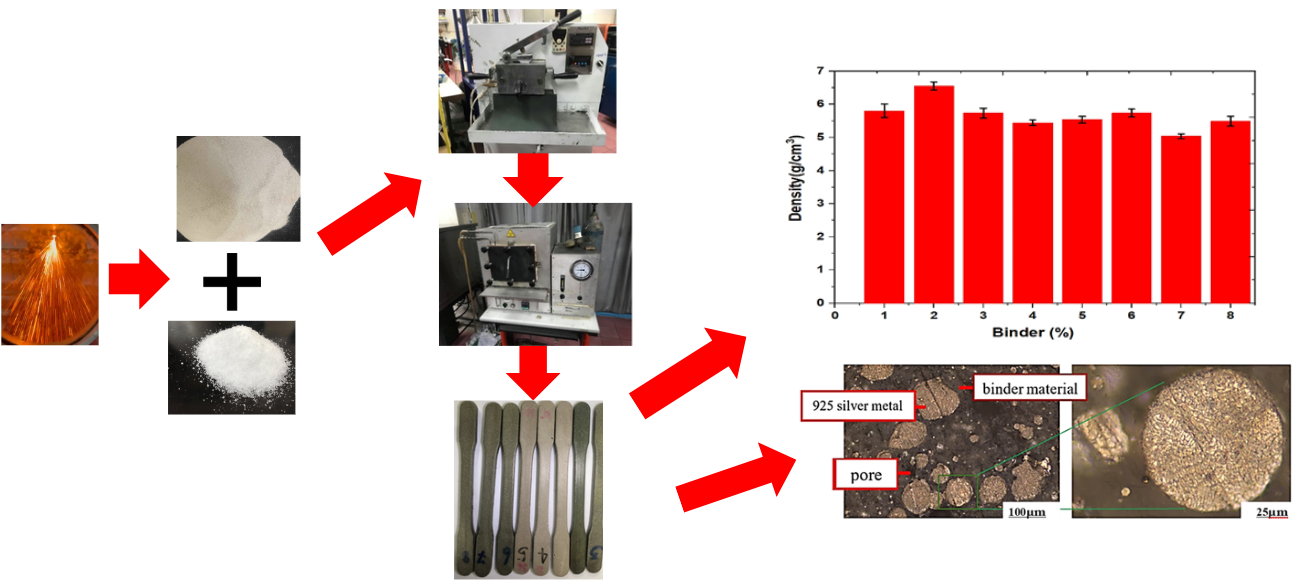
This research aims to study the physical properties of raw parts produced using Metal Injection Molding (MIM), an advanced manufacturing process suitable for the industrial-scale production of highly complex, small, and high-precision three-dimensional metal parts. However, applying this technique to precious metals, especially 925 sterling silver, still has significant limitations and research gaps, particularly regarding the use of atomized metal powders, which are a byproduct and have lower costs than general-purpose specialized metal powders. 925 silver feedstock used to produce the MIM samples consisted of 90% 925 silver powder and 10% binder. Solvent-based binder removal was performed in water for 5 hours at three temperatures: 30°C, 40°C, and 50°C, respectively. Microstructure and particle morphology were examined using a scanning electron microscope (SEM). The goal was to identify the optimal conditions for forming an open porous structure conducive to sintering and shape retention in subsequent industrial processes. The experimental results showed that the optimal material ratio consisted of 90% silver powder and 10% binder by weight, resulting in an average material density of 4.507 g/cm³ and an average material tensile strength of 17.70 MPa. The results indicated that the binder removal process using distilled water at 50°C for 5 hours was the most efficient method.
Article Details

This work is licensed under a Creative Commons Attribution-NonCommercial-NoDerivatives 4.0 International License.
References
Georgarakis K, Kvashnin VI. Metallic glass-reinforced metal matrix composites: Design, interfaces and properties. Materials. 2022;15(23):8278.
Georgarakis K. Core-shell particle reinforcements-A new trend in the design and development of metal matrix composites. Materials. 2022;15(7):2629.
Chorney MP, Downey JP, Tripathy PK. On the sintering behavior of Nb2O5 and Ta2O5 mixed oxide powders. Materials. 2022;15(14):5036.
Kazior J. Influence of sintering atmosphere, temperature and the solution-annealing treatment on the properties of precipitation-hardening sintered 17-4 PH stainless steel. Materials. 2023;16(2):760.
Song YQ, Savvakin D, Xu X, Stasiuk O, Ivasishin O, Cheng T. In situ Ti6Al4V/TiB composites prepared by hydrogen-assisted sintering of blends containing TiH2 and ball-milled Ti+TiB2 powders. Materials. 2022;15(3):1049.
Moser S, Vrel D, Perrière L, Pirès-Brazuna R, Couque H, Bernard F. Elaboration and characterization of WMoTaNb high entropy alloy prepared by powder metallurgy processes. Materials. 2022;15(15):5416.
Edosa OO, Gupta K. A review on the influence of process parameters on powder metallurgy parts. Eng Appl Sci Res. 2021;49(3):433-43.
Fayyazi S, Kasraei M. Optimizing high-velocity oxygen fuel-sprayed WC–17Co coating using Taguchi experimental design to improve tribological properties. Trans Indian Inst Met. 2018;71(12):3045-62.
Li YY, Zhang DT, Long Y, Xia W. Effect of die wall lubrication on warm compaction powder metallurgy. J Mater Process Technol. 2002;129(1-3):354-8.
Ward M, Billington JC. Effect of zinc stearate on apparent density, mixing, and compaction/ejection of iron powder compacts. Powder Metall. 1979;22(4):201-8.
Kurgan N. Effects of sintering atmosphere on microstructure and mechanical property of sintered powder metallurgy 316L stainless steel. Mater Des. 2013;52:995-8.
Huang X, Wang G, Alexandrov S. Effect of powder size on microstructure and mechanical properties of 2A12Al compacts fabricated by hot isostatic pressing. Adv Mater Sci Eng. 2018;2018:1-7.
Jamaludin SB. The effect of sintering on the properties of powder metallurgy (PM) F-75 alloy. Adv Mater Res. 2013;795:573-7.
Guo RQ, Rohatgi PK, Nath D. Preparation of aluminium-fly ash particulate composite by powder metallurgy technique. J Mater Sci. 1997;32(15):3971-4.
Doremus P, Imbault D, Puente G. High-velocity compaction and conventional compaction of metallic powders; comparison of process parameters and green compact properties. Proc Inst Mech Eng E J Process Mech Eng. 2010;224(3):177-85.
El-Bassuony AAH, Abdelsalam HK. Impact of different magnetic materials added to silver-magnetite nanoparticles on the structural, magnetic and antimicrobial properties. Eur Phys J Spec Top. 2023;232:1339-51.
Hamad A, Hadi A. Silver nanoparticles and silver ions as potential antibacterial agents. J Inorg Organomet Polym Mater. 2020;30(12):4811-28.
Niculescu AG, Grumezescu AM. Magnetite nanoparticles: Synthesis methods - a comparative review. Methods. 2022;199:16-27.
Vasiliev G, Kubo AL, Vija H, Kahru A, Bondar D, Karpichev Y, Bondarenko O. Synergistic antibacterial effect of copper and silver nanoparticles and their mechanism of action. Sci Rep. 2023;13(1):9202. doi: 10.1038/s41598-023-36460-2.
Montri K, Sirichai T. Morphology of 925 silver powder particles produced from gas atomization. J Appl Eng Sci Technol (JAETS). 2024;5(2):966-76.
Pramakhamo S, Chaekrathok S, Wannasri S, Wannarumon Kielarova S, Budchar N, Kraiklang R, et al. Investigating of mixture ratio of 925 sterling silver compound for the metal injection molding process. Journal of Manufacturing and Management Technology. 2022;1(2):63-71.
Cubberly WH. Metals Handbook Powder Metallurgy. Vol. 9. Metals Park, OH: American Society for Metals; 1984.
Sharp DH. An overview of Rayleigh-Taylor instability. Physica D Nonlinear Phenom. 1984;12(1-3):3-18.
German RM. Powder Metallurgy Science. Princeton, NJ: Metal Powder Industries Federation; 1994.
Dai Y, Song C, Han Q, Zhai Q. Solidification structure of C2.08Cr25.43Sil.19Mn0.43Fe70.87. Mater Charact. 2010;61(1):116-22.
Waters C, Ajinola S. Porosity comparative analysis of porous copper and OOF modelling. J Porous Mater. 2015;22(4):989-95.
Seerane M, Ndlangamandla P, Machaka R. Influence of particle size distribution on the properties of metal-injection-moulded 17-4 PH stainless steel. Journal of the Southern African Institute of Mining and Metallurgy. 2016;116(11):1045-1050.
ASTM International. ASTM E8/E8M-11: Standard Test Methods for Tension Testing of Metallic Materials. West Conshohocken. PA, 2011
German RM. Metal Injection Molding: A Handbook of Handbook of Powder Technology. Elsevier, 2013.
Ji CH, Loh NH, Khor KA, Tor SB. Study on sintering behavior of 925 sterling silver powder by metal injection molding. Journal of Materials Processing Technology. 2001;111(1-3):103-7.
Hwang KS, Hu SC. Analysis of pore evolution and swelling during solvent extraction of powder injection molded parts. Metallurgical and Materials Transactions A. 2005;36(5):1293-301.
Enneti RK, Park SJ, Atre SV, German RM. Effect of solvent debinding parameters on the diffusion coefficient of polyethylene glycol (PEG) in metal injection molded (MIM) parts. Materials Letters. 2012;71:105-7.
Lin HP, Samal S. Study on solvent debinding kinetics of water-soluble binder systems in metal injection molding. Journal of Materials Processing Technology. 2018;252:452-9.
Omar MA, Subuki I, Ismail MH, Muhamad N. Influence of solvent debinding temperature on the defect formation and properties of metal injection molded compacts. Journal of Solid State Science and Technology. 2010;18(1):12-21.
