
Isolation, screening, and production of poly-γ-glutamic acid by Bacillus sp. KMUTT06 using glucose syrup from cassava starch and monosodium glutamate
Article Sidebar
Main Article Content
Abstract
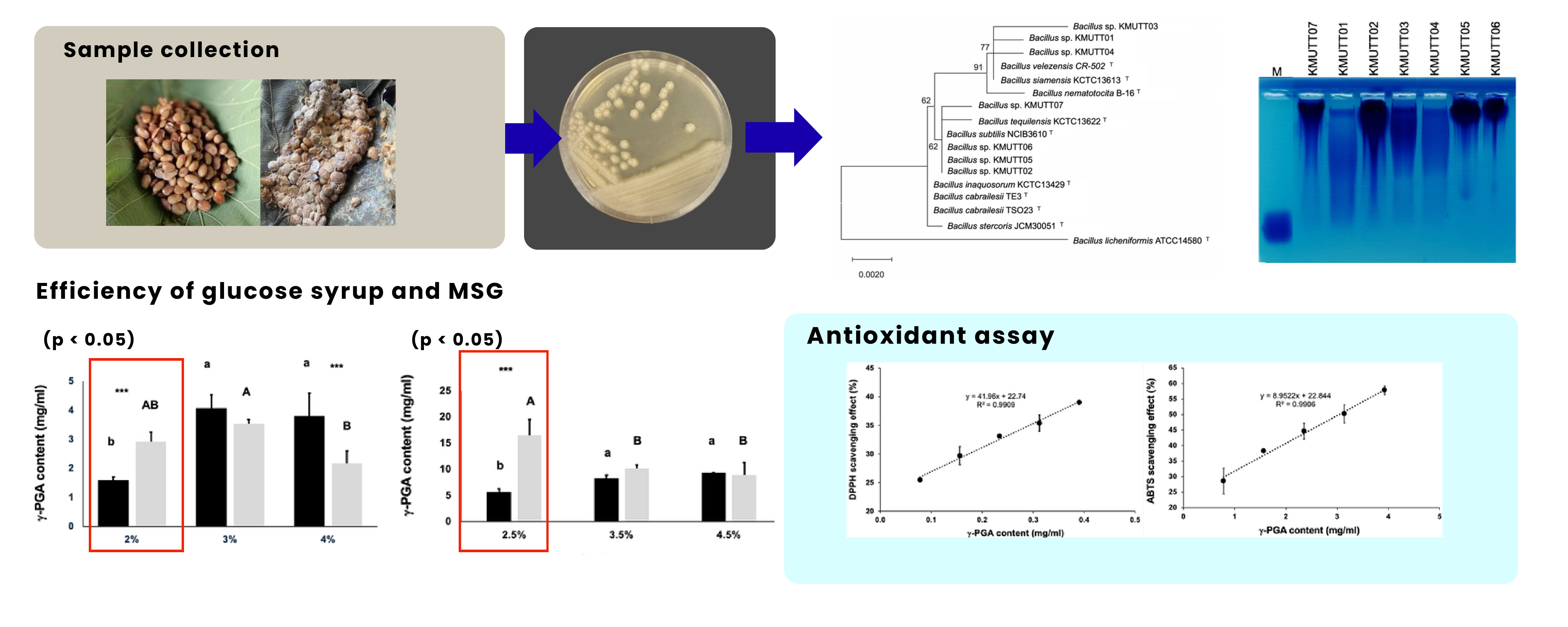
Poly-g-glutamic acid (γ-PGA) is a versatile biopolymer characterized by its non-toxic, water soluble, biodegradable making it suitable for a wide range of application. However, the high cost of production remains a major challenge. This study aimed to isolate Bacillus sp. strains from fermented soybean products for γ-PGA production, evaluate production using glucose syrup and monosodium glutamate (MSG), and assess antioxidant activity. Seven isolates of Bacillus sp. were obtained from fermented soybean samples. The isolate KMUTT06 showed that 99.93% similarity to B. tequilensis KCTC13622T, B. inaquosorum KCTC13429T, B. cabrialesii TE3T and B. cabrialesii TSO23T and exhibited the highest γ-PGA production at 1.116 mg/ml, with highest relative viscosity. Using 2.5% (w/v) glucose syrup concentration (w/v) showed that highest of g-PGA (16.546 ± 2.988 mg/mL) compared to 2.0% (w/v) dextrose and 2% (w/v) MSG produced the highest of γ-PGA (2.589 ± 0.328 mg/mL) compared to L-glutamic acid. Antioxidant activity of γ-PGA produced by Bacillus sp. KMUTT06 had IC50 values of 0.650 ± 0.022 mg/mL (DPPH), 3.050 ± 0.148 mg/mL (ABTS), and a FRAP value of 8.806 ± 0.358 μmol Fe2+/g. In conclusion, Bacillus sp. KMUTT06 may be regarded as a candidate strain for γ-PGA production, demonstrating that glucose syrup and MSG can be used instead of dextrose and L-glutamic acid respectively, for producing g-PGA with discernible antioxidant activity, further study needed suggesting its potential for various functional industrial applications.
Article Details

This work is licensed under a Creative Commons Attribution-NonCommercial-NoDerivatives 4.0 International License.
References
Schallmey M, Singh A, Ward OP. Developments in the use of Bacillus species for industrial production. Can J Microbiol. 2004;50(1):1-17.
Akagi T, Matsusaki M, Akashi M. Pharmaceutical and medical applications of poly-gamma-glutamic acid. In: Amino acid homopolymers occurring in nature. Berlin, Heidelberg: Springer; 2010. p. 119-54.
Elbanna K, Alsulami FS, Neyaz LA, Abulreesh HH. Poly (γ) glutamic acid: A unique microbial biopolymer with diverse commercial applicability. Front Microbiol. 2024;15:1348411.
do Prado FG, Pagnoncelli MGB, de Melo Pereira GV, Karp SG, Soccol CR. Fermented soy products and their potential health benefits: A review. Microorganisms. 2022;10(8):1606.
Bhatt SN, Raut SV. Microbial production of poly (γ-) glutamic acid and its use as an anti-thawing agent and as prebiotic. World J Adv Res Rev. 2022;16(1): 851-63.
Parati M. The role of γ-polyglutamic acid in a circular economy: cost-effective production and wide-ranging applications of a bio-derived, biodegradable, and nonimmunogenic biomaterial. University of Wolverhampton; 2025. Available from: https://wlv.openrepository.com/handle/2436/626059.
Zhang D, Feng X, Zhou Z, Zhang Y, Xu H. Economical production of poly (γ-glutamic acid) using untreated cane molasses and monosodium glutamate waste liquor by Bacillus subtilis NX-2. Bioresour Technol. 2012;114:583-8.
Tang B, Lei P, Xu Z, Jiang Y, Xu Z, Liang J, et al. Highly efficient rice straw utilization for poly-(γ-glutamic acid) production by Bacillus subtilis NX-2. Bioresour Technol. 2015;193:370-6.
Kasetsart University Research and Development Institute. Cassava: Cassava planting areas in Thailand [Internet]. KURDI; 2023 [cited 2024 May 22]. Available from: https://www3.rdi.ku.ac.th/?p=18045.
Musdalifa M, Laga A, Rahman AN. Glucose syrup production through enzymatic methods and acid hydrolysis using different starch sources: a systematic review. J Food Meas Charact. 2024;18(11):8976-92.
Quach NT, Vu THN, Nguyen TTA, Ha H, Ho P-H, Chu-Ky S, et al. Structural and genetic insights into a poly-γ-glutamic acid with in vitro antioxidant activity of Bacillus velezensis VCN56. World J Microbiol Biotechnol. 2022;38(10):173.
Zeng W, Chen G, Guo Y, Zhang B, Dong M, Wu Y, et al. Production of poly-γ-glutamic acid by a thermotolerant glutamate-independent strain and comparative analysis of the glutamate dependent difference. AMB Express. 2017;7(1):213.
Thapa P, Thapa A, Khadka S, Sapkota S, Panta OP, Sharma S, et al. Screening and characterization of potent poly glutamic acid producing Bacillus sp. isolated from Kinema, water and soil samples. Heliyon. 2021;7(8):1-9.
Yamaguchi F, Ogawa Y, Kikuchi M, Yuasa K, Motai H. Detection of γ-polyglutamic acid (γ-PGA) by SDS-PAGE. Biosci Biotechnol Biochem. 1996;60(2):255-8.
Tahara Y, Urushibata Y, Terahara H, Tokuyama S. -polyglutamic acid biosynthesis and metabolic pathway in Bacillus subtilis NR-1. In: Proceedings of the International Conference on Bacilli; 1998; Osaka, Japan.
Gaikwad AB. DNA extraction: Comparison of methodologies. PLOS Biol. 2002;20:162-73.
Kumar S, Stecher G, Suleski M, Sanderford M, Sharma S, Tamura K. MEGA12: Molecular Evolutionary Genetic Analysis version 12 for adaptive and green computing. Mol Biol Evol. 2024;41(12):msae263.
Wang D, Zhou D, Gao J, Bai W. Enhanced poly--glutamic acid production by a newly isolated Bacillus tequilensis BL01 [Internet]. Research Square [Preprint]; 2022. [cited 2024 May 22]. Available from: https://doi.org/10.21203/rs.3.rs-1695166/v1
Kubo Y, Kobori M, Nakagawa R, Yoshiura T, Asano T, Takeda A, et al. A high-accuracy method for quantifying poly-gamma-glutamic acid content in natto. Food Sci Technol Res. 2021;27(3):463-71.
Shah P, Modi H. Comparative study of DPPH, ABTS and FRAP assays for determination of antioxidant activity. Int J Res Appl Sci Eng Technol. 2015;3(6):636-41.
Manika V, Devi PB, Singh SP, Reddy GB, Kavitake D, Shetty PH. Microbial poly-glutamic acid: Production, biosynthesis, properties, and their applications in food, environment, and biomedicals. Fermentation. 2025;11(4):208.
Qian J, Wang Y, Hu Z, Shi T, Wang Y, Ye C, et al. Bacillus sp. as a microbial cell factory: Advancements and future prospects. Biotechnol Adv. 2023;69:108278.
Pasotti L, Massaiu I, Magni P, Calvio C. Metabolic Engineering of Bacillus subtilis for the production of poly-γ-glutamic acid from glycerol feedstock. Fermentation. 2024;10(6):319.
Cai D, Rao Y, Zhan Y, Wang Q, Chen S. Engineering Bacillus for efficient production of heterologous protein: current progress, challenge and prospect. J Appl Microbiol. 2019;126(6):1632-42.
Elshaghabee FM, Rokana N, Gulhane RD, Sharma C, Panwar H. Bacillus as potential probiotics: status, concerns, and future perspectives. Front Microbiol. 2017;8:1490.
Regestein née Meissner L, Arndt J, Palmen TG, Jestel T, Mitsunaga H, Fukusaki E, et al. Investigation of poly (γ-glutamic acid) production via online determination of viscosity and oxygen transfer rate in shake flasks. J Biol Eng. 2017;11:1-16.
Radu JÉF, Novak L, Hartmann JF, Beheshti N, Kjøniksen AL, Nyström B, et al. Structural and dynamical characterization of poly-gamma-glutamic acid-based cross-linked nanoparticles. Colloid Polym Sci. 2008;286:365-76.
Wang LL, Chen JT, Wang LF, Wu S, Zhang G, Yu HQ, et al. Conformations and molecular interactions of poly-γ-glutamic acid as a soluble microbial product in aqueous solutions. Sci Rep. 2017;7(1):1-11.
Ashiuchi M, Kamei T, Baek DH, Shin SY, Sung MH, Soda K, et al. Isolation of Bacillus subtilis (chungkookjang), a poly-γ-glutamate producer with high genetic competence. Appl Microbiol Biotechnol. 2001;57:764-9.
Richard A, Margaritis A. Rheology, oxygen transfer, and molecular weight characteristics of poly (glutamic acid) fermentation by Bacillus subtilis. Biotechnol Bioeng. 2003;82(3):299-305.
Ho GH, Yang J, Yang TH, inventors; Bio-Polymer International Co., Ltd., assignee. Gamma Polyglutamic Acid (Gamma-Pga, H Form), Gamma-Polyglutamate Hydrogels for Use as Super Moisturizers in Cosmetic and Personal Care Products. European patent EP 1690525A1. 2006 Aug 16.
Xu H, Jiang M, Li H, Lu D, Ouyang P. Efficient production of poly (γ-glutamic acid) by newly isolated Bacillus subtilis NX-2. Process Biochem. 2005;40(2):519-23.
Shih I, Van Y, Yeh L, Lin H, Chang Y. Production of a biopolymer flocculant from Bacillus licheniformis and its flocculation properties. Bioresour Technol. 2001;78(3):267-72.
Fan B, Blom J, Klenk HP, Borriss R. Bacillus amyloliquefaciens, Bacillus velezensis, and Bacillus siamensis form an “operational group B. amyloliquefaciens” within the B. subtilis species complex. Front Microbiol. 2017;8:22.
Chen XH, Koumoutsi A, Scholz R, Eisenreich A, Schneider K, Heinemeyer I, et al. Comparative analysis of the complete genome sequence of the plant growth-promoting bacterium Bacillus amyloliquefaciens FZB42. Nat Biotechnol. 2007;25(9):1007-14.
Wang D, Hwang JS, Kim DH, Lee S, Kim DH, Joe MH. A newly isolated Bacillus siamensis SB1001 for mass production of poly-γ-glutamic acid. Process Biochem. 2020;40(2):9164-73.
Zeng W, Liu Y, Shu L, Guo Y, Wang L, Liang Z. Production of ultra‐high‐molecular‐weight poly‐γ‐glutamic acid by a newly isolated Bacillus subtilis strain and genomic and transcriptomic analyses. Biotechnol J. 2024;19(4):2300614.
Kim SJ, Dunlap CA, Kwon SW, Rooney AP. Bacillus glycinifermentans sp. nov., isolated from fermented soybean paste. Int J Syst Evol Microbiol. 2015;65(10):3586-90.
Amend J, Helgeson H. Solubilities of the common L-α-amino acids as a function of temperature and solution pH. Pure Appl Chem. 1997;69(5):935-42.
Fleck M, Petrosyan AM. Salts of amino acids. Crystallization, Structure and Properties. Cham, Switzerland: Springer International Publishing. 2014;10:978-3.
Thuy LN, Salanta L, Tofana M, Socaci SA, Fărcaș AC, Pop C. A mini review about monosodium glutamate. Bull UASVM Food Sci Technol. 2020;77(1):1-12.
Kashiwagi T, Sano C, Kawakita T, Nagashima N. Monosodium L-glutamate pentahydrate. Cryst Struct Commun. 1995;51(6):1053-6.
Lim JS, Garcia CV, Lee SP. Optimized production of GABA and γ-PGA in a turmeric and roasted soybean mixture co-fermented by Bacillus subtilis and Lactobacillus plantarum. Food Sci Technol Res. 2016;22(2):209-17.
Wei X, Tian G, Ji Z, Chen S. A new strategy for enhancement of poly‐γ‐glutamic acid production by multiple physicochemical stresses in Bacillus licheniformis. J Chem Technol Biotechnol. 2015;90(4):709-13.
Hull P. Glucose syrups: technology and applications. Chichester: John Wiley & Sons; 2010.
Roychoudhury S, Parulekar SJ, Weigand WA. Cell growth and α‐amylase production characteristics of Bacillus amyloliquefaciens. Biotechnol Bioeng. 1989;33(2):197-206.
Li J, Chen S, Fu J, Xie J, Ju J, Yu B, et al. Efficient molasses utilization for low-molecular-weight poly-γ-glutamic acid production using a novel Bacillus subtilis strain. Microb Cell Fact. 2022;21(1):140.
Zhan Y, Sheng B, Wang H, Shi J, Cai D, Yi L, et al. Rewiring glycerol metabolism for enhanced production of poly-γ-glutamic acid in Bacillus licheniformis. Biotechnol Biofuels. 2018;11(1):306.
Anju AJ, Binod P, Pandey A. Production and characterization of microbial poly--glutamic acid from renewable resources. Indian J Exp Biol. 2017;55(7):405-10.
Lee NR, Lee SM, Cho KS, Jeong SY, Hwang DY, Kim DS, et al. Improved production of poly-γ-glutamic acid by Bacillus subtilis D7 isolated from Doenjang, a Korean traditional fermented food, and its antioxidant activity. Appl Biochem Biotechnol. 2014;173:918-32.
Charlton NC, Mastyugin M, Török B, Török M. Structural features of small molecule antioxidants and strategic modifications to improve potential bioactivity. Molecules. 2023;28(3):1057.
Nair P, Navale GR, Dharne MS. Poly-gamma-glutamic acid biopolymer: A sleeping giant with diverse applications and unique opportunities for commercialization. Biomass Conv Bioref. 2023;13(6):4555-73.
Sandrini RMLM, Silva BG, Angelucci CA. Electrochemical quantification of gallic acid: The role of voltammetric parameter optimization via multivariate experimental design. Electroanalysis. 2025;37(8):e70033.
Liu Y, Liu C, Li J. Comparison of vitamin C and its derivative antioxidant activity: evaluated by using density functional theory. ACS Omega. 2020;5(39):25467-75.
