
Fake news detection through multi-level contextual and sequential modeling
Article Sidebar
Main Article Content
Abstract
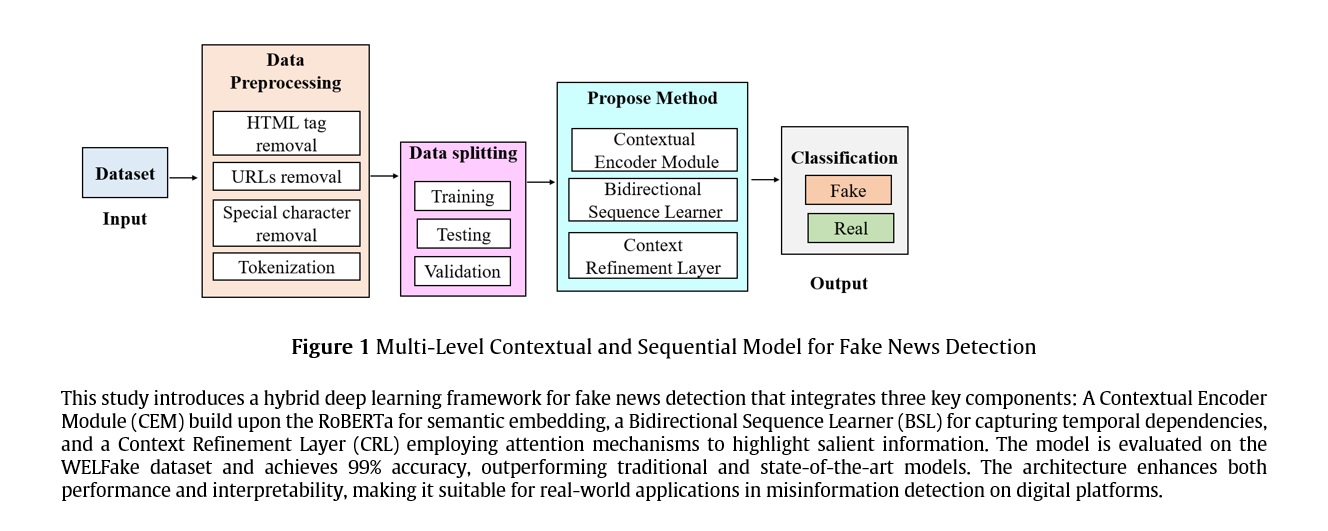
The spread of false information on digital platforms destabilizes democratic societies and undermines public trust. Conventional machine-learning models often fail to capture the subtle contextual cues and long‑range linguistic dependencies required for accurate verification. To address these limitations, we propose a hybrid deep‑learning architecture that integrates three modules: A Contextual Encoder Module (CEM) using RoBERTa to generate relational embeddings for deep semantic extraction; a Bidirectional Sequence Learner (BSL) to model long‑range temporal dependencies; and a Context Refinement Layer (CRL) that employs attention mechanisms to highlight the most salient deceptive markers. We evaluated the model on the WELFake dataset, which contains 72,134 news articles. Our proposed method achieved 99% accuracy, precision, recall, and F1‑score, significantly outperforming state‑of‑the‑art baselines, including BERT (95%) and BiLSTM (97%). The CRL's attention outputs provide transparency into the model's decision‑making process, an essential feature for applications in misinformation detection and automated content moderation. Beyond its technical contributions, this research supports society by enabling early and reliable detection of false information, reducing harm from misinformation, and promoting a safer, more trustworthy digital environment.
Article Details

This work is licensed under a Creative Commons Attribution-NonCommercial-NoDerivatives 4.0 International License.
References
Paliwal S, Bharti R. Reviewing the landscape: Fake news detection methods and social media user behavior. Indian J Tech Educ. 2025;48(2):207-16.
Nuri Y, Senyurek E. Research Abstracts Similarity Implementation By Using TF-IDF Algorithm. IOSR J Comput Eng. 2025;27(1):4-10.
Shah S, Patel S. A Comprehensive Survey on Fake News Detection Using Machine Learning. J Comput Sci. 2025;21(4):982-90.
Padalko H, Chomko V, Chumachenko D. A novel approach to fake news classification using LSTM-based deep learning models. Front Big Data. 2023;6:1-18.
Haqi Al-Tai M, Nema BM, Al-Sherbaz A. Deep Learning for Fake News Detection: Literature Review. Al-Mustansiriyah J Sci. 2023;34(2):70-81.
Alghamdi J, Lin Y, Luo S. Towards COVID-19 fake news detection using transformer-based models. Knowl Based Syst. 2023;274:110642.
Aremu T, Akinwehinmi O, Nwagu C, Ahmed SI, Orji R, Amo PAD, et al. On the reliability of Large Language Models to misinformed and demographically informed prompts. AI Mag. 2025;46(1):1-15.
Vaswani A, Shazeer NM, Parmar N, Uszkoreit J, Jones L, Gomez AN, et al. Attention is All you Need. Neural Inf Process Syst. 2017:6000-10.
Boukouvalas Z, Shafer A. Role of Statistics in Detecting Misinformation: A Review of the State of the Art, Open Issues, and Future Research Directions. Annu Rev Stat Appl. 2024;11(1):27-50.
Alghamdi J, Lin Y, Luo S, editors. Modeling Fake News Detection Using BERT-CNN-BiLSTM Architecture. 2022 IEEE 5th International Conference on Multimedia Information Processing and Retrieval (MIPR). 2022; 354-357
Xiaoyan L, Raga RC, Xuemei S, Liguori R. GloVe-CNN-BiLSTM Model for Sentiment Analysis on Text Reviews. J Sens. 2022;1-12.
Sun W, Cai Z, Li Y, Liu F, Fang S, Wang G. Data Processing and Text Mining Technologies on Electronic Medical Records: A Review. J Healthc Eng. 2018;4302425.
Shuhai Zhang, Zeng You , Yaofo Chen , Zhiquan Wen, Qianyue Wang , Zhijie Qiu , et al., editors. Curse of High Dimensionality Issue in Transformer for Long Context Modeling. Forty-second International Conference on Machine Learning; 2025; Vancouver, Canada: PMLR.
Tan KL, Lee CP, Anbananthen KSM, Lim KM. RoBERTa-LSTM: A Hybrid Model for Sentiment Analysis With Transformer and Recurrent Neural Network. IEEE Access. 2022;10:21517-25.
Xu S, Li X, Xie C, Chen H, Chen C, Song Z. A High-Precision Implementation of the Sigmoid Activation Function for Computing-in-Memory Architecture. Micromachines. 2021;12(10).
Verma PK, Agrawal P, Amorim I, Prodan R. WELFake: Word Embedding Over Linguistic Features for Fake News Detection. IEEE Trans Computl Soc Syst. 2021;8(4):881-93.
Salman T, Ghubaish A, Unal D, Jain R. Safety Score as an Evaluation Metric for Machine Learning Models of Security Applications. IEEE Netw Lett. 2020;2(4):207-11.
Rama Moorthy H, Avinash NJ, Krishnaraj Rao NS, Raghunandan KR, Dodmane R, Blum JJ, et al. Dual stream graph augmented transformer model integrating BERT and GNNs for context aware fake news detection. Sci Rep. 2025;15(1):25436.
Hashmi E, Yayilgan SY, Yamin MM, Ali S, Abomhara M. Advancing Fake News Detection: Hybrid Deep Learning With FastText and Explainable AI. IEEE Access. 2024;12:44462-80.
Raza N, Abdulkadir SJ, Abid YA, Albouq SS, Alwadain A, Rehman AU, et al. Enhancing fake news detection with transformer-based deep learning: A multidisciplinary approach. PLoS One. 2025;20(9):e0330954.
Trisna NJ, Sohan MFAA, Joy RM, Joy RD, editors. A Novel Machine Learning Approach for Detecting Fake News in WELFake Dataset. Proceedings of the International Conference on Industrial Engineering and Operations Management. 2024; p. 994-1002.
Al-Quayed F, Javed D, Jhanjhi NZ, Humayun M, Alnusairi TS. A Hybrid Transformer-Based Model for Optimizing Fake News Detection. IEEE Access. 2024;12:160822-160834.
Padalko H, Chomko V, Chumachenko D. A novel approach to fake news classification using LSTM-based deep learning models. Front Big Data. 2024;6(1):1320800.
Abbas F, Taeihagh A. A multi-level fusion-based framework for multimodal fake news classification using semantic feature extraction. Int J Mach Learn Cybern. 2025;16(1):6531–60.
