
Establishing practical guidelines for microalbuminuria screening using J48 algorithm decision tree in data mining
Article Sidebar
Main Article Content
Abstract
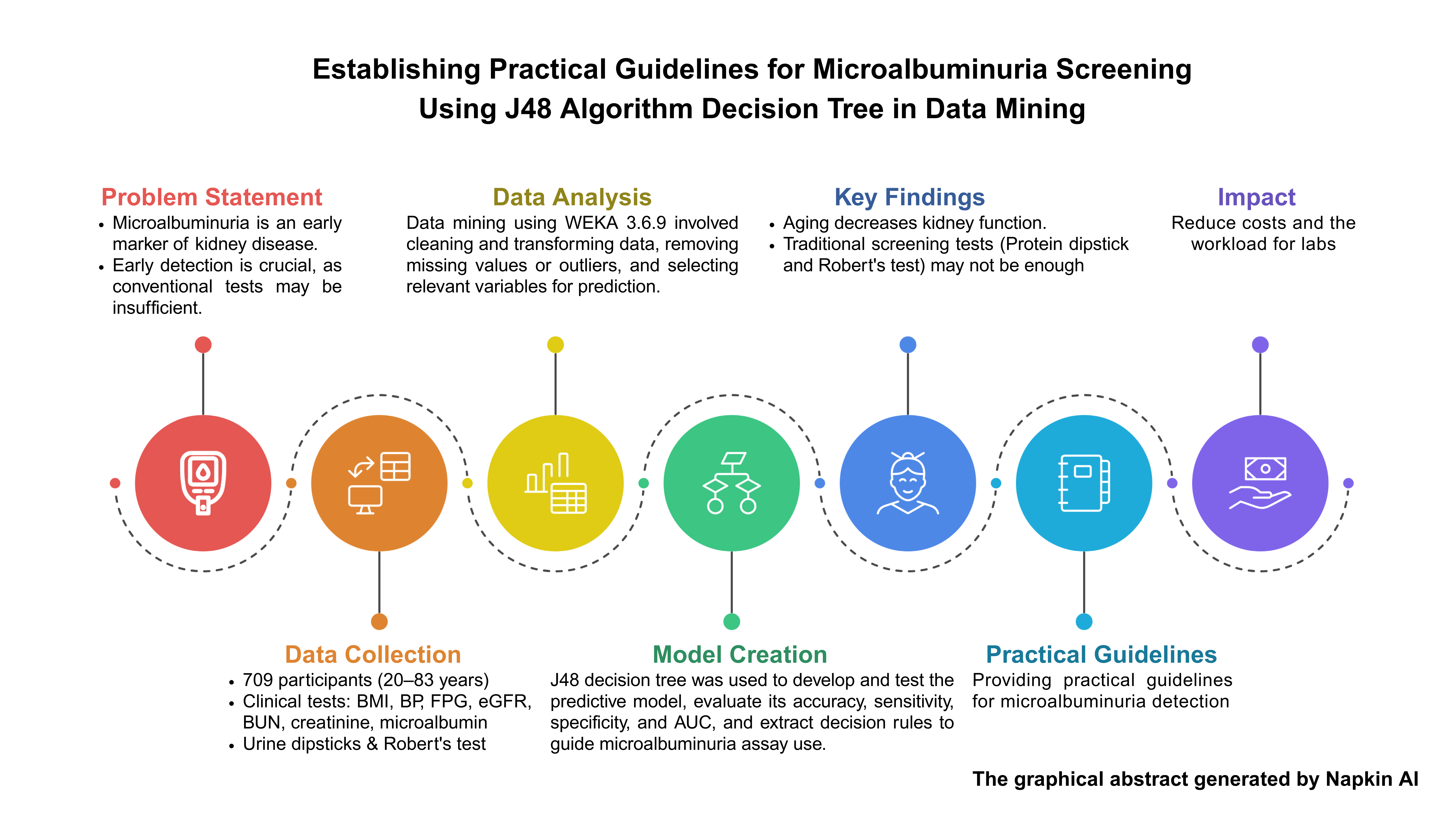
This study aimed to develop practical, cost-effective screening guidelines using Robert's Test and J48 decision tree algorithm to optimize microalbuminuria detection in health screening programs. Data were collected from random spot urine samples during daytime from 709 participants who received routine health checks at the Center of Medical Laboratory Service, Medical Technology Program, Nakhonratchasima College. The samples were screened with protein and microalbumin dipsticks, confirmed by Robert's test, and analyzed for the microalbumin-to-creatinine ratio (MA/CR). Kruskal-Wallis and Pearson correlation tests assessed statistical significance at p < 0.05 and 95% confidence intervals. Several significant correlations were found, including the relationship between increasing age and higher blood pressure, fasting plasma glucose, creatinine, and urea nitrogen levels. The reduced estimated glomerular filtration rate (eGFR) was significantly correlated with microalbuminuria (p < 0.01) among participants younger than 83 years. The J48 analysis showed that Robert's test and fasting plasma glucose (FPG) were effective for screening. Participants with a negative Robert's test and FPG < 96 mg/dL had 97.7% normal microalbumin levels. However, participants with trace protein and FPG > 84 mg/dL had a 35% chance of microalbuminuria. This algorithm can develop practical guidelines for detecting microalbuminuria, potentially reducing costs and laboratory burden and identifying high-risk groups in population health.
Article Details

This work is licensed under a Creative Commons Attribution-NonCommercial-NoDerivatives 4.0 International License.
References
Inker LA, Coresh J, Levey AS, Tonelli M, Muntner P. Estimated GFR, albuminuria, and complications of chronic kidney disease. J Am Soc Nephrol. 2011;22(12):2322-31.
Chen TK, Knicely DH, Grams ME. Chronic kidney disease diagnosis and management: a review. JAMA-J Am Med Assoc. 2019;322(13):1294-304.
Toto RD. Microalbuminuria: definition, detection, and clinical significance. J Clin Hypertens . 2004;6(11 Suppl 3):2-7.
Lambrecht S, Speeckaert M, Oyaert M. Optimization of screening strategy for chronic kidney disease by urine test strips using the albumin-creatinine read-out. BMC Nephrol. 2025;26(1):130.
Kooman JP. Estimation of renal function in patients with chronic kidney disease. J Magn Reson Imaging. 2009;30(6):1341-6.
Samsu N. Diabetic nephropathy: challenges in pathogenesis, diagnosis, and treatment. Biomed Res Int. 2021;2021(1):1497449.
Natesan V, Kim SJ. Diabetic nephropathy - a review of risk factors, progression, mechanism, and dietary management. Biomol Ther (Seoul). 2021;29(4):365-72.
Kang M, Kwon S, Lee J, Shin JI, Kim YC, Park JY, et al. Albuminuria within the normal range can predict all-cause mortality and cardiovascular mortality. Kidney360. 2022;3(1):74-82.
Hliel A, Ahmed H, Hasan H. Assessment and prediction of diabetic kidney disease in patients with type 2 diabetes mellitus by using advanced biomarkers. Nefrologia. 2025;45:101330.
Ilyas H, Ali S, Ponum M, Hasan O, Mahmood MT, Iftikhar M, et al. Chronic kidney disease diagnosis using decision tree algorithms. BMC Nephrol. 2021;22(1):273.
Almustafa KM. Prediction of chronic kidney disease using different classification algorithms. Inform. Med. Unlocked. 2021;24:100631.
Waas T, Schulz A, Lotz J, Rossmann H, Pfeiffer N, Beutel ME, et al. Distribution of estimated glomerular filtration rate and determinants of its age dependent loss in a German population-based study. Sci Rep-UK. 2021;11(1):10165.
Hwang S, Lee K, Park J, Kim DH, Jeon J, Jang HR, et al. Prognostic significance of albuminuria in elderly of various ages with diabetes. Sci Rep-UK. 2023;13(1):7079.
Fabre L, Rangel É B. Age-related markers and predictors of diabetic kidney disease progression in type 2 diabetes patients: a retrospective cohort study. Ther Adv Endocrinol. 2024;15:20420188241242947.
Jaques DA, Vollenweider P, Bochud M, Ponte B. Aging and hypertension in kidney function decline: a 10 year population-based study. Front Cardiovasc Med. 2022;9:1035313.
Zhang X, Hu H, He L, Huang X, Zhang Z, Tu L, et al. Association between triglyceride to high-density lipoprotein cholesterol ratio and microalbuminuria in the Chinese population. Sci Rep-UK. 2024;14(1):30960.
Sánchez-Ospina D, Mas-Fontao S, Palencia MM, Prieto BH, Sánchez CG, Carcedo SP, et al. Impact of albuminuria screening in primary care on the detection and management of chronic kidney disease: findings from the ONDAAS study. Clin Kidney J. 2025;18(5).
Van Abswoude DH, Pellikaan K, Nguyen N, Rosenberg AGW, Davidse K, Hoekstra FME, et al. Kidney disease in adults with Prader-Willi syndrome: international cohort study and systematic literature review. Front Endocrinol. 2023;14:1168648.
Zhang H, Wang K, Zhao H, Qin B, Cai X, Wu M, et al. Diabetic kidney disease: from pathogenesis to multimodal therapy-current evidence and future directions. Front Med-Lausanne. 2025;12:1631053.
Hojs R, Ekart R, Bevc S, Vodošek Hojs N. Chronic Kidney Disease and Obesity. Nephron. 2023;147(11):660-4.
Li C, Liu J, Fu P, Zou J. Artificial Intelligence Models in Diagnosis and Treatment of Kidney Diseases: Current Status and Prospects. Kidney Dis-Basel. 2025;11(1):491-507.
