
Implication of calcium silicate in growth enhancement and alternaria leaf spot disease control in chinese cabbage
Article Sidebar
Main Article Content
Abstract
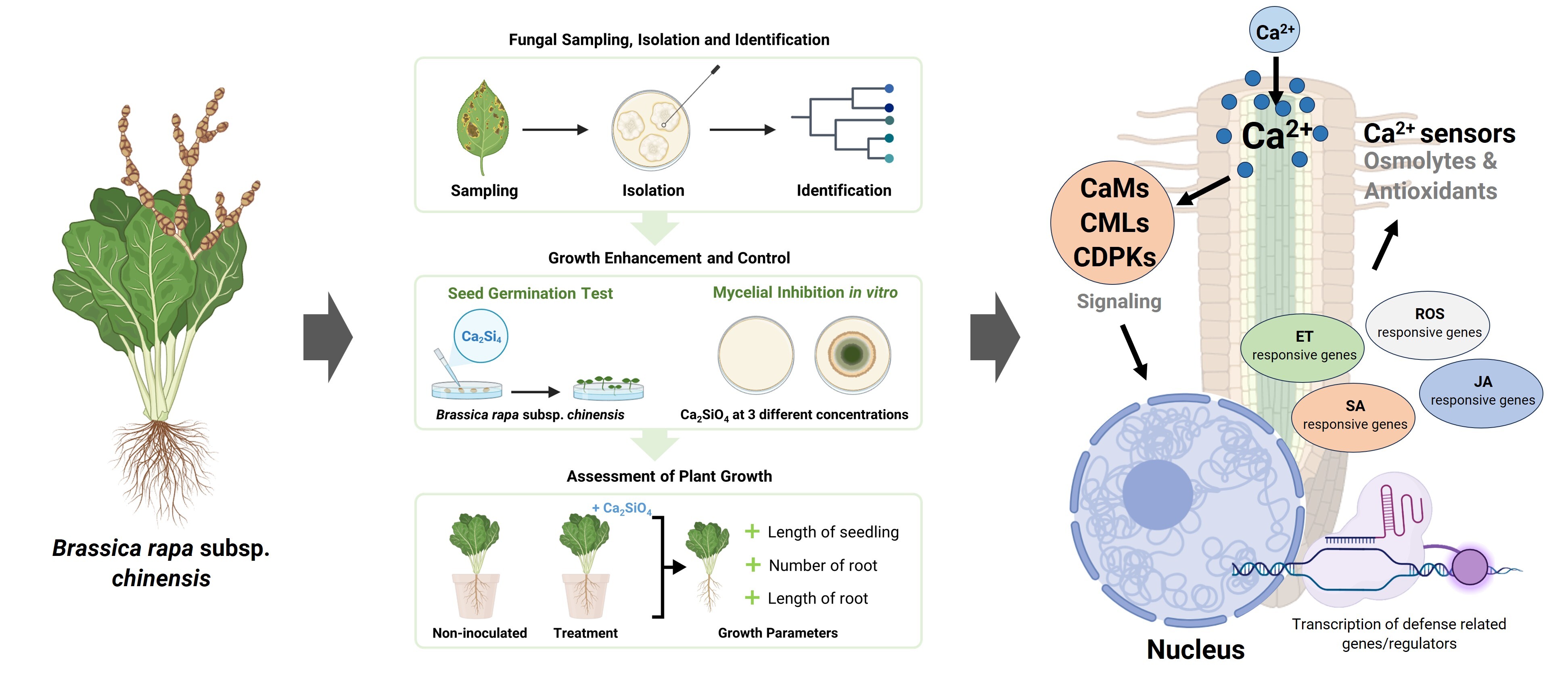
Calcium silicate is an inorganic compound that strengthens plant cell walls, enhancing resistance to environmental stress and fungal pathogens. Moreover, it has been reported to promote plant growth and defense mechanisms through physiological and biochemical pathways. In this research, the efficacy of calcium silicate in promoting seed germination and seedling physiological development, as well as its potential for inhibiting fungal pathogens that cause leaf spot disease in Chinese cabbage (Brassica rapa subsp. chinensis) was investigated. The fungal pathogen was isolated from diseased Chinese cabbage in Phra Nakhon Si Ayutthaya Province, Thailand. Based on morphological identification and molecular techniques using PCR amplification of the ITS1-5.8S-ITS2 region, the pathogen was identified as Alternaria brassicicola, with an identity level of 98.00-100.00%. The effect of calcium silicate on seed germination was investigated at three different concentrations (1%, 2%, and 3%). The finding indicated that calcium silicate did not affect on seed germination at 72 hrs. All treatments showed that 100% germination. Moreover, the 3% calcium silicate presented the highest concentration for plant-induced, with seedlings at 28 days exhibiting an average height of 15.80 cm, an average of 7 roots per plant, and a mean root length of 5.43 cm, significantly greater than the control. For the possibility of fungal control using the poisoned food technique, calcium silicate at the highest concentration could inhibit mycelial growth by 28.21%. This research suggests that calcium silicate may be a potential growth-promoting agent for Chinese cabbage, especially for enhancing the root system, while also inhibiting fungal mycelium. Therefore, calcium silicate could be considered as an effective seed coating or soil amendment to protect seeds during early germination and seedling establishment.
Article Details

This work is licensed under a Creative Commons Attribution-NonCommercial-NoDerivatives 4.0 International License.
References
Gupta R, Jindal S, Sharma P. Nano-calcium applications in modern agriculture: A review. J Plant Nutr [internet]. 2023;46(2):123-35. Available from: https://doi.org/10.10 16/j.plana.2025.100147.
Majláth I, Éva C, Tajti J, Khalil R, Elsayed N, Darko E, et al. Exogenous methylglyoxal enhances the reactive aldehyde detoxification capability and frost-hardiness of wheat. Plant Physiol Biochem [internet]. 2020;149:75-85. Available from: https://doi.org/10.1016/j.plaphy. 2020.02.003.
Prasad R, Bhattacharyya A, Nguyen QD. Nanotechnology in sustainable agriculture: Recent developments, challenges, and perspectives. Front Microbiol [internet]. 2017;8:1014. Available from: https://doi.org/10.3389/fmicb.2017.01014.
Shelar A, Nile SH, Singh AV, Rothenstein D, Bill J, Xiao J, et al. Recent advances in nano-enabled seed treatment strategies for sustainable agriculture: Challenges, risk assessment, and future perspectives. Nanomicro Lett [internet]. 2023;15: 54. Available from: https://doi.org/10.1007/s40820-023-01025-5.
Chakraborty S, Newton AC, Tubiello FN, Pathak H, Thornton P, Campbell BM. Climate change effects on plant disease: Interactions between climate variables and pathogens. Annu Rev Phytopathol [internet]. 2022;60:229-51. Available from: https://doi.org/10.1146/annurev-phyto-020620-095104.
Steinweg JM, Dukes JS, Paul EA, Wallenstein MD. Microbial responses to multi-factor climate change: effects on soil enzymes. Front microbiol [internet]. 2013;4:146. Available from: https://doi.org/10.3389/fmicb.2013.00146.
Kumar S, Nowicki M. Alternaria brassicicola-Brassicaceae pathosystem: Insights into the infection process and resistance mechanisms. Eur J Plant Pathol [internet]. 2018;152(3):1-15. Available from: https://doi.org/10.1007/s10658-018-1548-y.
Lee YH, Jang SJ, Han JH, Bae JS, Shin H, Park HJ, et al. Enhanced tolerance of Chinese cabbage seedlings mediated by Bacillus aryabhattai H26-2 and B. siamensis H30-3 against high temperature stress and fungal infections. Plant Pathol J [internet]. 2018;34(6):555-66. Available from: https://doi.org/10.5423/PPJ.OA.07.2018.0130.
Hageman A, Van Volkenburgh E. Sink strength maintenance underlies drought tolerance in common bean. Plants [internet]. 2021;10(3):489. Available from: https://doi.org/10.3390/plants10030489.
Ahammed GJ, Yang Y. Mechanisms of silicon-induced fungal disease resistance in plants. Plant Physiol. Biochem [internet]. 2021;165:200-6. Available from: https://doi.org/10.1016/j.plaphy.2021.05.031.
Huang X, Chen J, Wang Y, Liu L, Li H. Climate change exacerbates the impact of soilborne pathogens on Brassica crops in East Asia. Front Plant Sci [internet]. 2023;14:1123498. Available from: https://doi.org/10.3389/fpls.2023.1123498.
Pongpisutta R, Bincader S, Rattanakreetakul C, Khienman S, Tiangsawang T, Promkhlibnil T, et al. Leaf spot disease of cos lettuce (Lactuca sativa var. longifolia) and potential of fungicides for residual fungal protection in soilless cultivation. In: The 6th National Academic Conference of Rajamangala University of Technology Suvarnabhumi: "Driving research and innovation to create an economic model for sustainable development". Phra Nakhon Si Ayutthaya, Thailand: Rajamangala University of Technology Suvarnabhumi; 2022. p. 360-9.
Lal R, Nawaz M, de Medeiros J. Nano primers in sustainable seed treatment: Molecular insights into seed germination and stress tolerance. Sci Total Environ [internet]. 2023;789:147-58. Available from: https://doi.org/10.1016/j.scitotenv.2023.147158.
Shelar A, Nile SH, Singh AV, Rothenstein D, Bill J, Xiao J, et al. Recent advances in nano-enabled seed treatment strategies for sustainable agriculture: Challenges, risk assessment, and future perspectives. Nanomicro Lett [internet]. 2023;15:54. Available from: https://doi.org/10.1007/s40820-023-01025-5.
Majláth I, Éva C, Tajti J, Khalil R, Elsayed N, Darko E, et al. Exogenous methylglyoxal enhances the reactive aldehyde detoxification capability and frost-hardiness of wheat. Plant Physiol Biochem [internet]. 2020;149:75-85. Available from: https://doi.org/10.1016/j.plaphy.2020.02.003.
Gupta R, Jindal S, Sharma P. Nano-calcium applications in modern agriculture: A review. J Plant Nutr [internet]. 2023;46(2):123-35. Available from: https://doi.org/10.1016/j.plana.2025.100147.
Bincader S, Pongpisutta R, Tiansawang T, Khienman S, Boonyaritthongchai P, Phuntumart V, et al. Brassica oleracea var. sabellica: A new host of Agroathelia delphinii in soilless cultivation systems in Central Thailand. Horticulturae [internet]. 2025;11(4):411. Available from: https://doi.org/10.3390/horticulturae11040411.
Rattanakreetakul C, Keawmanee P, Bincader S, Mongkolporn O, Phuntumart V, Chiba S, et al. Two newly identified Colletotrichum species associated with mango anthracnose in Central Thailand. Plants [internet]. 2023;12(5):1130. Available from: https://doi.org/10.3390/plants12051130.
White TJ, Bruns T, Lee S, Taylor J. Amplification and direct sequencing of fungal ribosomal RNA genes for phylogenetics. In: Innis MA, Gelfand DH, Sninsky JJ, White TJ, Eds. PCR Protocols: A Guide to Methods and Applications. San Diego, CA, USA: Academic Press; 1990. p. 315-22.
Thompson JD, Higgins DG, Gibson TJ. Clustal W. Improving the sensitivity of progressive multiple sequence alignment through sequence weighting, position-specific gap penalties and weight matrix choice. Nucleic Acids Res. 1994;22:4673-80.
Kannan L, Wheeler WC. Maximum parsimony on phylogenetic networks. Algorithms Mol Biol [internet]. 2012;7(1):9. Available from: https://doi.org/10.1186/1748-7188-7-9.
Felsenstein J. Confidence limit on phylogenies: An approach using the bootstrap. Evol Lett. 1985;39(4):783-91.
Kumar S, Stecher G, Li M, Knyaz C, Tamura K. MEGA X: Molecular Evolutionary Genetics Analysis across computing platforms. Mol Biol Evol. 2018;35(6):1547-9.
Bejarano-Herrera WF, Marcillo-Paguay CA, Rojas-Tapias DF, Estrada-Bonilla GA. Effect of mineral fertilization and microbial inoculation on cabbage yield and nutrition: A field experiment. Agronomy [internet]. 2024;14(1):210. Available from: https://doi.org/10.3390/agronomy14010210.
Barnett HL, Hunter BB. Illustrated Genera of Imperfect Fungi. Minneapolis, Minnesota, USA: Burgess Publishing Company; 1972.
Woudenberg JHC, Groenewald JZ, Binder M, Crous PW. Alternaria redefined. Stud Mycol [internet]. 2013;75:171-212. Available from:https://doi.org/10.3114/sim0015.
Woudenberg JHC, Truter M, Groenewald JZ, Crous PW. Large-spored Alternaria pathogens in section Porri disentangled. Stud Mycol [internet]. 2014; 79: 1-47. Available from: http://dx.doi.org/10.1016/j.simyco.2014.07.003.
Woudenberg JHC, Seidl MF, Groenewald JZ, de Vries M, Stielow JB, Thomma BPHJ, et al. Alternaria section Alternaria: species, formae speciales or pathotypes?. Stud Mycol [internet]. 2015; 82: 1-21. Available from: http://dx.doi.org/10.1016/j.simyco.2015.07.001.
Zhu AH, Song ZK, Wang JF, Guan HW, Qu Z, Ma HX. Multi-gene phylogenetic analyses reveal Heteroxylaria Gen. Nov. and new contributions to Xylariaceae (Ascomycota) from China. J Fungi [internet]. 2024;10(9):645. Available from: https://doi.org/10.3390/jof10090645.
Liu K, Zhao H, Ren D, Ma D, Liu S, Mao J. FungiLT: A Deep learning approach for species-level taxonomic classification of fungal ITS sequences. Computers [internet]. 2025;14(3):85. Available from: https://doi.org/10.3390/computers14030085.
Neyaz M, Adebisi O, Cook D, Creamer R. Morphological and phylogenetic characterization of Alternaria section undifilum fungal endophytes from Astragalus and Swainsona spp. J Fungi [internet]. 2025;11(7):541. Available from: https://doi.org/10.3390/jof11070541.
Punja ZK, Tittlemier SA, Walkowiak S. Fusarium species infecting greenhouse-grown cannabis (Cannabis sativa) plants show potential for mycotoxin production in inoculated inflorescences and from natural inoculum sources. J Fungi [internet]. 2025;11(7):528. Available from: https://doi.org/10.3390 /jof11070528.
Wang M, Gao L, Dong S, Sun Y, Shen Q, Guo S. Role of silicon on plant-pathogen interactions. Front. Plant Sci [internet]. 2017;5(8):701. Available from: https://doi.org/10.3389/fpls.2017.00701.
Ahammed GJ, Yang Y. Mechanisms of silicon-induced fungal disease resistance in plants. Plant Physiol. Biochem [internet]. 2021;165:200-6. Available from: https://doi.org/10.1016/j.plaphy.2021.05.031.
Denarié ME, Nielsen UN, Hartley SE, Johnson SN. Silicon-mediated interactions between plant antagonists. Plants [internet]. 2025;14(8):1204. Available from: https://doi.org/10.3390/plants14081204.
Zargar SM, Mahajan R, Bhat JA, Nazir M, Deshmukh R. Role of silicon in plant stress tolerance: opportunities to achieve a sustainable cropping system. 3 Biotech [internet]. 2019;9(3):73. Available from: https://doi.org/10.1007/s13205-019-1613-z.
Li N, Wang K, Lv Y, Zhang Z, Cao B, Chen Z. et al. Silicon enhanced the resistance of Chinese cabbage (Brassica rapa L. ssp. pekinensis) to ofloxacin on the growth, photosynthetic characteristics, and antioxidant system. Plant Physiol Biochem [internet]. 2022;175:44-57. Available from: https://doi.org/10.1016/j.plaphy.2022.02.010.
Eichi VR, Okamato M, Haefele SM, Jewell N, Brien C, Garnett T, et al. Understanding the interactions between biomass, grain production and grain protein content in high and low protein wheat genotypes under controlled environments. Agronomy [internet]. 2019;9(11):706. Available from: https://doi.org/10.3390/agronomy 9110706.
