
Enhancing protein content and functional properties of gluten-free black glutinous rice flour and tapioca starch pasta fortified with chicken meat
Article Sidebar
Main Article Content
Abstract
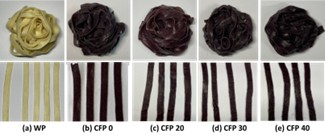
The growing demand for gluten-free foods has increased interest in developing pasta products with improved nutritional value and quality attributes. This study aimed to formulate gluten-free pasta using black glutinous rice flour and tapioca starch fortified with minced chicken meat and to evaluate the effects of chicken meat incorporation on physicochemical properties, antioxidant capacity, texture, nutritional composition, and sensory acceptability. Chicken meat–fortified pasta (CFP) was prepared by replacing black glutinous rice flour and tapioca starch with minced chicken meat at 0, 20, 30, and 40 g /100 g of total flour and compared with conventional wheat pasta (WP). Chicken meat incorporation significantly affected pasta qualities (p < 0.05). CFP samples exhibited darker color, higher redness, and lower lightness and yellowness than WP due to the presence of anthocyanins from black glutinous rice flour. Antioxidant activity, total phenolic content, and anthocyanin levels were significantly higher in CFP than in WP but decreased with increasing chicken meat levels as a result of phenolic dilution. Increasing chicken meat content prolonged optimum cooking time and increased water absorption, while reducing cooking loss, volume expansion, and water solubility, indicating improved cooking stability. Texture profile analysis showed that moderate chicken meat incorporation (20 g/100 g) enhanced hardness and gumminess, partially compensating for the absence of gluten, whereas higher meat levels negatively affected cohesiveness, springiness, and chewiness. Proximate analysis revealed progressive increases in protein, fat, ash, and moisture contents with increasing chicken meat levels, with the highest protein content observed at 40 g/100 g of chicken meat sample. Sensory evaluation indicated that all CFP samples were acceptable, with the 20 g/100 g formulation achieving the highest overall acceptability among gluten-free samples. In conclusion, chicken meat–fortified gluten-free pasta based on black glutinous rice flour and tapioca starch is a promising functional food, with 20 g/100 g of chicken meat providing the optimal balance between nutritional enhancement and product qualities.
Article Details

This work is licensed under a Creative Commons Attribution-NonCommercial-NoDerivatives 4.0 International License.
References
Sissons M. Development of novel pasta products with evidence-based impacts on health-A review. Foods. 2022;11(1):123.
Scarton M, Clerici MTPS. Gluten-free pastas: Ingredients and processing for technological and nutritional quality improvement. Food Sci Technol. 2022;42:65622.
da Silva Ramos NJ, Rocha EBM, Gusmão TAS, Nascimento A, Lisboa HM, de Gusmão RP. Optimizing gluten-free pasta quality: The impacts of transglutaminase concentration and kneading time on cooking properties, nutritional value, and rheological characteristics. LWT. 2023;189:115485.
Poonia A, Pandey S. Bioactive compounds, nutritional benefits and food applications of black rice: A review. NFS. 2021;52(3):466-82.
Phonsakhan W, Kong-Ngern K. A comparative proteomic study of white and black glutinous rice leaves. Electron J Biotechnol. 2015;18(1):29-34.
Kong S, Kim DJ, Oh SK, Choi IS, Jeong HS, Lee J. Black rice bran as an ingredient in noodles: chemical and functional evaluation. J Food Sci. 2012;77(3):C303-7.
Musika J, Kapcum C, Itthivadhanapong P, Musika T, Hanmontree P, Piayura S. Enhancing nutritional and functional properties of gluten-free Riceberry rice pasta supplemented with cricket powder using D-optimal mixture design. Front Sustain Food Syst. 2024;8:1417045.
Subanmanee N, Sarasuk C, Wongtom R, Khampaen W. Changes in the physical, chemical and sensory properties of pasta made by partially substituting wheat flour with black glutinous rice flour. AJFAND. 2024;24(8):24138-60.
Raungrusmee S, Shrestha S, Sadiq MB, Anal AK. Influence of resistant starch, xanthan gum, inulin and defatted rice bran on the physicochemical, functional and sensory properties of low glycemic gluten-free noodles. LWT. 2020;126:109279.
Sirichokworrakit S, Phetkhut J, Khommoon A. Effect of partial substitution of wheat flour with riceberry flour on quality of noodles. Procedia Soc Behav Sci. 2015;197:1006-12.
Yilmaz MT, Yildiz Ö, Yurt B, Toker OS, Karaman S, Baştürk A. A mixture design study to determine interaction effects of wheat, buckwheat, and rice flours in an aqueous model system. LWT. 2015;61(2):583-9.
Messia MC, Cuomo F, Falasca L, Trivisonno MC, De Arcangelis E, Marconi E. Nutritional and technological quality of high protein pasta. Foods. 2021;10(3):589.
Milde LB, Chigal PS, Olivera JE, González KG. Incorporation of xanthan gum to gluten-free pasta with cassava starch. Physical, textural and sensory attributes. LWT. 2020;131:109674.
Rachman A, Brennan MA, Morton J, Brennan CS. Gluten-free pasta production from banana and cassava flours with egg white protein and soy protein addition. Int J Food Sci Technol. 2020:55(8):3053-60.
Cai J, Chiang JH, Tan MYP, Saw LK, Xu Y, Ngan-Loong MN. Physicochemical properties of hydrothermally treated glutinous rice flour and xanthan gum mixture and its application in gluten-free noodles. J Food Eng. 2016;186:1-9.
Sanguinetti AM, Secchi N, Del Caro A, Fadda C, Fenu PA, Catzeddu P, et al. Gluten-free fresh filled pasta: The effects of xanthan and guar gum on changes in quality parameters after pasteurisation and during storage. LWT. 2015;64(2):678-84.
Susanna S, Prabhasankar P. A study on development of Gluten free pasta and its biochemical and immunological validation. LWT. 2013;50(2):613-21.
Norma VM, García‐Zepeda R A, Mitzy Belén O H, Morales‐Guerrero JC. Gluten‐free pasta as an alternative in the diet of patients with celiac disease. J Food Sci. 2024;89(6):3384-99.
Olson R, Gavin-Smith B, Ferraboschi C, Kraemer K. Food fortification: The advantages, disadvantages and lessons from sight and life programs. Nutr. 2021;13(4):1118.
Smith DP, Northcutt JK, Steinberg EL. Meat quality and sensory attributes of a conventional and a Label Rouge-type broiler strain obtained at retail. Poult Sci. 2012;91(6):1489-95.
Hailemariam A, Esatu W, Abegaz S, Urge M, Assefa G, Dessie T. Nutritional composition and sensory characteristics of breast meat from different chickens. Appl Food Res. 2022;2(2):100233.
Cakmak H, Altinel B, Kumcuoglu S, Tavman S. Chicken meat added bread formulation for protein enrichment. Food Feed Res. 2013;40(1):33-42.
Cakmak H, Altinel B, Kumcuoglu S, Kisla D, Tavman S. Production of crispy bread snacks containing chicken meat and chicken meat powder. An Acad Bras Ciênc. 2016;88(4):2387-99.
Liu Y, Chen K, Zeng Q, Wang P, Zhang Y. The impact of dietary fibers on the construction and molecular network of extrusion-based 3D-printed chicken noodles: Unlocking the potential of specialized functional food. Food Chem. 2025;463:141065.
Verma AK, Pathak V, Singh VP. Quality characteristics of value-added chicken meat noodles. J Nutr Food Sci. 2014;4(1):1.
Lee C, Choi G, Cho S. Physicochemical and sensory characteristics of gluten-free noodles added with chicken breast meat: a comparative study with wheat flour noodle. Food Sci Biotechnol. 2024;33(6):1351-58.
Gopalakrishnan J, Menon R, Padmaja G, Sajeev MS, Moorthy SN. Nutritional and functional characteristics of protein-fortified pasta from sweet potato. FNS. 2011;2(9):944-55.
Sethi S, Nanda SK, Bala M. Quality assessment of pasta enriched with anthocyanin‐rich black rice bran. J Food Process Preserv. 2020;44(12):e14952.
Mohamad A, Shah NNAK, Sulaiman A, Adzahan NM, Aadil RM. Characterization of rice noodles fortified with different levels of stabilized rice bran. Food Res. 2024;8(7):16-27.
Pang Y, Ahmed S, Xu Y, Beta T, Zhu Z, Shao Y, et al. Bound phenolic compounds and antioxidant properties of whole grain and bran of white, red and black rice. Food Chem. 2018;240:212-21.
AOAC. Official methods of analysis (17th ed). The Association of Official Analytical Chemists. 2000
Chen T, Xie L, Wang G, Jiao J, Zhao J, Yu Q, et al. Anthocyanins-natural pigment of colored rice bran: Composition and biological activities. Food Res Int 2024;175:113722.
ElShamey EA, Yang X, Yang J, Pu X, Yang L, Ke C, et al. Occurrence, Biosynthesis, and Health Benefits of Anthocyanins in Rice and Barley. Int J Mol Sci. 2025;26(13):6225
Sompong R, Siebenhandl-Ehn S, Linsberger-Martin G, Berghofer E. Physicochemical and antioxidative properties of red and black rice varieties from Thailand, China, and Sri Lanka. Food Chem. 2011;124(1):132-40.
Kraithong S, Rawdkuen S. Effects of food hydrocolloids on quality attributes of extruded red Jasmine rice noodle. PeerJ. 2020;8:e10235.
Chhikara N, Kushwaha K, Jaglan S, Sharma P, Panghal A. Nutritional, physicochemical, and functional quality of beetroot (Beta vulgaris L.) incorporated Asian noodles. Cereal Chem. 2019;96(1):154-61.
Sofi SA, Singh J, Chhikara N, Panghal A, Gat Y. Quality characterization of gluten free noodles enriched with chickpea protein isolate. Food Biosci. 2020;36:100626.
Chang HC, Chen HH, Hu HH. Textural changes in fresh egg noodles formulated with seaweed powder and full or partial replacement of cuttlefish paste. J Texture Stud. 2011;42(1):61-71.
Martins SIFS, Jongen WMF, van Boekel MAJS. A review of Maillard reaction in food and implications to kinetic modelling. Trends Food Sci Technol. 2001;11(9–10):364-73.
Pal GK, Kumar SB, Prabhasankar P, Suresh PV. Inclusion of poultry-based food ingredients in the formulation of noodles and their effects on noodle quality characteristics. J Food Meas. Charact. 2017;11:939-47.
Pongpichaiudom A, Songsermpong S. Evaluation of microstructure and quality characteristics of microwave-dried instant noodles enriched with chicken meat, egg yolk, and seaweed. J Food Meas Charact. 2018;12:22-34.
Tian Y, Zhang L, Xu X, Xie Z, Zhao J, Jin Z. Effect of temperature-cycled retrogradation on slow digestibility of waxy rice starch. Int J Biol Macromol. 2012;51(5):1024-27.
Tam LM, Corke H, Tan WT, Li J, Collado LS. Production of bihon‐type noodles from maize starch differing in amylose content. Cereal Chem. 2004;81(4):475-80.
Liu XL, Mu TH, Sun HN, Zhang M, Chen JW. Influence of potato flour on dough rheological properties and quality of steamed bread. J Integr Agric. 2016;15(11):2666-76.
Liu Y, Xu M, Wu H, Jing L, Gong B, Gou M, et al. The compositional, physicochemical and functional properties of germinated mung bean flour and its addition on quality of wheat flour noodle. J. Food Sci Technol. 2018;55:5142-52.
Nimalaratne C, Lopes-Lutz D, Schieber A, Wu J. Free aromatic amino acids in egg yolk show antioxidant properties. Food Chem. 2011;129(1):155-61.
Marti A, Pagani MA. What can play the role of gluten in gluten free pasta? Trends in Food Science and Technology. 2013;31(1):63-71.
Abdel-Aal ESM, Young JC, Rabalski I. Anthocyanin composition in black, blue, pink, purple, and red cereal grains. J Agric Food Chem. 2006;54(13):4696-704.
Okarini IA, Purnomo H, Aulanni'am AA, Radiati LE. Proximate, total phenolic, antioxidant activity and amino acids profile of Bali indigenous chicken, spent laying hen and broiler breast fillet. Int J Poult Sci. 2013;12(7):415-20.
Widelska G, Wójtowicz A, Kasprzak K, Dib A, Oniszczuk T, Olech M, et al. Impact of xanthan gum addition on phenolic acids composition and selected properties of new gluten-free maize-field bean pasta. Open Chem. 2019;17(1):587-98.
Hua Y, Cui SW, Wang Q. Gelling property of soy protein–gum mixtures. Food Hydrocoll. 2003;17(6):889-94.
Ainsa A, Roldan S, Marquina PL, Roncalés P, Beltrán JA, Calanche Morales JB. Quality parameters and technological properties of pasta enriched with a fish by‐product: A healthy novel food. J Food Process. Preserv. 2022;46(2):e16261.
Barak S, Mudgil D, Khatkar BS. Effect of compositional variation of gluten proteins and rheological characteristics of wheat flour on the textural quality of white salted noodles. Int J Food Prop. 2014;17(4):731-40.
Bouasla A, Wójtowicz A. Gluten-free rice instant pasta: Effect of extrusion-cooking parameters on selected quality attributes and microstructure. Processes. 2021;9(4):693.
Larrosa V, Lorenzo G, Zaritzky N, Califano A. Improvement of the texture and quality of cooked gluten-free pasta. LWT. 2016;70:96-103.
Halim Y, Angelina B, Hardoko H, Handayani R. Characteristics of dried noodle analogue made from sorghum flour and rice flour added with konjac glucomannan. In IOP Conference Series: Earth and Environmental Science. IOP Publishing. 2023;1200(1):012032.
Szczesniak AS. Texture is a sensory property. Food Qual. Prefer. 2002;13(4):215-25.
Sozer N, Dalgıç AC, Kaya A. Thermal, textural and cooking properties of spaghetti enriched with resistant starch. J Food Eng. 2007;81(2):476-84.
Zayas JF. Functionality of Proteins in Food, 1st ed.; Springer: Berlin/Heidelberg, Germany, 1997.
Kumar S, Khanna N, Vaquil RD, Yadav S. Development and evaluation of quality of noodles enriched with chicken meat powder. Int J Curr Microbiol App Sci. 2019;8(8):2282-9.
Verma AK, Pathak V, Umaraw P, Singh VP. Quality characteristics of refined wheat flour (maida) based noodles containing chicken meat stored at ambient temperature under aerobic conditions. Nutr Food Sci. 2015;45(5):753-65.
Litaay C, Indriati A, Mayasti NKI, Tribowo RI, Andriana Y, Andriansyah RCE. Physical, chemical, and sensory quality of noodles fortification with anchovy (Stolephorus sp.) flour. JFST. 2022;42:e75421.
