
Process simulation of fast pyrolysis of Wolffia globosa using aspen plus for sustainable bio-oil production
Article Sidebar
Main Article Content
Abstract
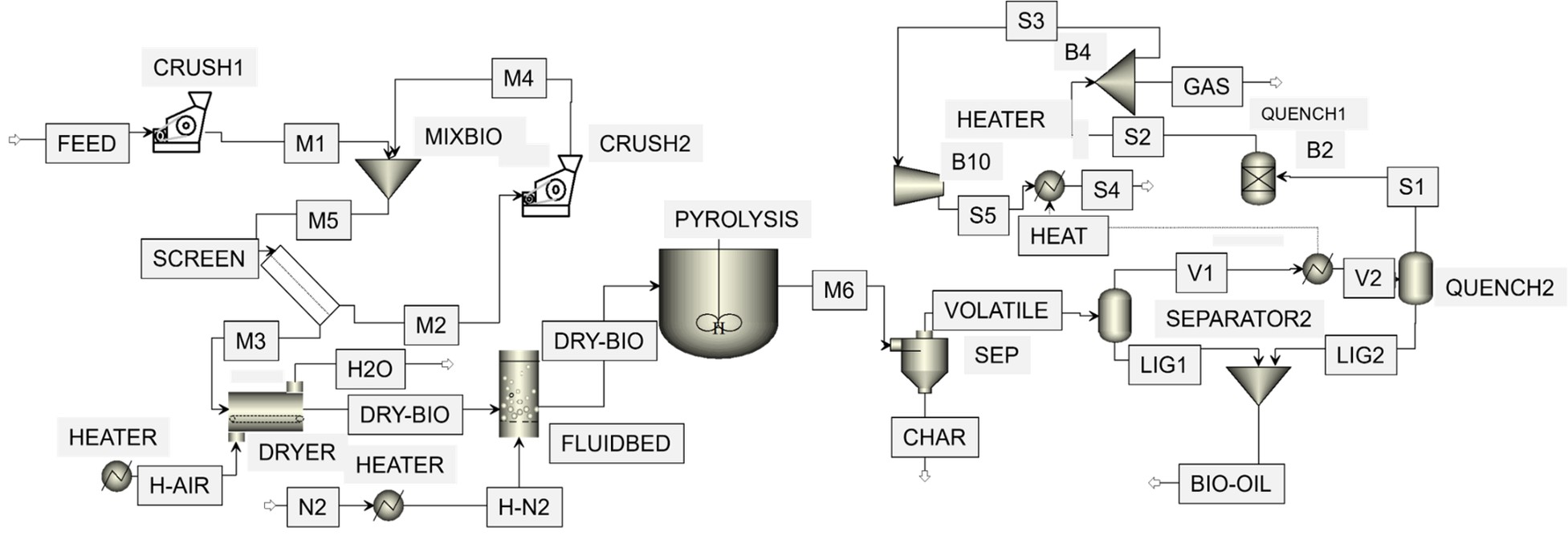
Fast pyrolysis has emerged as an efficient thermo-chemical route for converting biomass into liquid fuels under moderate temperatures and short vapor residence times. This study presents a systematic Aspen Plus simulation framework for the fast pyrolysis of Wolffia globosa, a protein-rich aquatic plant with low lignin and high volatile matter content. The model employed a multi-stage RYield reactor configuration to represent progressive decomposition processes, integrated with separation and quenching units to preserve vapor quality and bio-oil composition. To establish model credibility, the framework was benchmarked against a published sawdust simulation and compared with reported pyrolysis trends of aquatic biomass. Simulations were performed across 400–600 °C with a fixed vapor residence time of 1.25 s. The results demonstrated that bio-oil yield increased with temperature, peaking at 58.62 wt% at 550 °C before slightly declining at higher temperatures due to secondary cracking. At this optimum condition, the simulated bio-oil contained approximately 89.25% organic compounds and 10.75% water by mass, indicating favorable properties for downstream upgrading. Gas yields increased monotonically with temperature, while char yields decreased, reflecting enhanced volatilization at higher thermal severity. The validated model showed less than 10% deviation from literature data and provides a replicable approach for simulating protein-rich aquatic biomass. Overall, this study highlights Wolffia globosa as a viable feedstock for sustainable bio-oil production and offers a transparent simulation methodology that can support future optimization and integration with circular wastewater treatment systems.
Article Details

This work is licensed under a Creative Commons Attribution-NonCommercial-NoDerivatives 4.0 International License.
References
Bridgwater AV. Review of fast pyrolysis of biomass and product upgrading. Biomass Bioenergy. 2012;38:68-94.
Mohan D, Pittman CU Jr, Steele PH. Pyrolysis of wood/biomass for bio-oil: a critical review. Energy Fuels. 2006;20(3):848-89.
Heo HS, Park HJ, Park YK, Ryu C, Suh DJ, Suh YW, et al. Bio-oil production from fast pyrolysis of waste furniture sawdust in a fluidized bed. Bioresour Technol. 2010;101 Suppl 1: S91-6. doi: 10.1016/j.biortech.2009.06.003.
Salehi E, Abedi J, Harding TG, Seyedeyn-Azad F. Bio-oil from sawdust: design, operation, and performance of a bench-scale fluidized-bed pyrolysis plant. Energy Fuels. 2013;27(6):3332-40.
Zhao C, Xia Q, Wang S, Lu X, Yue W, Chen A, et al. A study on machine learning prediction of bio-oil yield from biomass and plastic co-pyrolysis. J Energy Inst. 2025;120:102069.
Shi H, Huang Y, Qiu Y, Zhang J, Li Z, Song H, et al. Modelling of biomass gasification for fluidized bed in Aspen Plus: Using machine learning for fast pyrolysis prediction. Energy Convers Manag. 2025;332:119695.
Yahaya N, Hamdan NH, Zabidi AR, Mohamad AM, Suhaimi MLH, Johari MAAM, et al. Duckweed as a future food: evidence from metabolite profile, nutritional and microbial analyses. Future Foods. 2022;5:100128.
Appenroth KJ, Sree KS, Böhm V, Hammann S, Vetter W, Leiterer M, et al. Nutritional value of duckweeds (Lemnaceae) as human food. Food Chem. 2017;217:266-73.
Kaplan A, Zelicha H, Tsaban G, Meir AY, Rinott E, Kovsan J, et al. Protein bioavailability of Wolffia globosa duckweed, a novel aquatic plant - a randomized controlled trial. Clin Nutr. 2019;38(6):2576-82.
Sree KS, Appenroth KJ. Duckweeds: bioremediation of surface wastewater and biorefinery. In: Bioremediation and Bioeconomy. Elsevier; 2024. p. 311-35.
Jaroenkhasemmeesuk C, Tippayawong N, Shimpalee S, Ingham DB, Pourkashanian M. Improved simulation of lignocellulosic biomass pyrolysis plant using chemical kinetics in Aspen Plus® and comparison with experiments. Alex Eng J. 2023;63:199-209.
Mahinpey N, Murugan P, Mani T, Raina R. Analysis of bio-oil, biogas, and biochar from pressurized pyrolysis of wheat straw using a tubular reactor. Energy Fuels. 2009;23(5):2736-42.
de Oliveira TR, Lisboa ACL. Simulation and techno-economic analysis of energy cane pyrolysis for bio-oil production using Aspen Plus. Heliyon. 2025;11(2):e41642.
Hu Z, Fang Y, Yi Z, Tian X, Li J, Jin Y, et al. Determining the nutritional value and antioxidant capacity of duckweed (Wolffia arrhiza) under artificial conditions. LWT. 2022;153:112477.
