
Mathematical analysis of a smoking model with anti-smoking campaign rate in Thailand
Article Sidebar
Main Article Content
Abstract
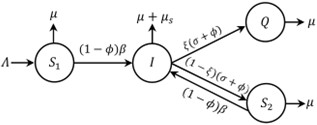
Smoking is one of the leading causes of preventable mortality worldwide, affecting multiple organ systems and contributing to numerous chronic diseases. It is well established that smoking increases the risk of lung cancer, cardiovascular diseases such as heart attacks and strokes, and chronic respiratory conditions, including chronic obstructive pulmonary disease (COPD). In Thailand, mathematical modeling has not yet been applied to the study of smoking behavior. To better understand smoking behavior and the effects of anti-smoking interventions, this study develops a nonlinear mathematical model of smoking in Thailand that incorporates the influence of anti-smoking campaigns. The population is categorized into non-smokers, active smokers, permanent quitters, and temporary quitters. This simplification makes the model easier to analyze and more practical to use. The model assumes that non-smokers may become smokers through social interactions and that smokers may quit either temporarily or permanently, with temporary quitters susceptible to relapse. The boundedness of the model is proven, and the basic reproductive number (R0) is derived using the next-generation matrix method. Stability analyses of both the smoking-free and smoking-present equilibrium points using the Routh–Hurwitz criteria show that the system is locally asymptotically stable when R0 < 1, indicating effective control of smoking prevalence under these conditions. Numerical simulations further demonstrate that increasing the rate of anti-smoking campaigns significantly reduces the number of active smokers, highlighting the importance of sustained public health interventions. Overall, this combined analytical and numerical framework offers valuable insights into smoking dynamics and provides a practical tool for designing and evaluating strategies to reduce smoking rates and associated health burdens.
Article Details

This work is licensed under a Creative Commons Attribution-NonCommercial-NoDerivatives 4.0 International License.
References
Patanavanich R, Aekplakorn W, Suriyawongpaisal P. Trend analysis of smoking-attributable hospitalizations in Thailand, 2007-2014. Tob Induc Dis. 2018;16:52. doi: 10.18332/tid/98913.PubMedPMID:31516449.
Wipatayotin A. Secondhand smoke kills 9,400 per year [Internet]. 2024 [cited 2025 Mar 28]. Available from: https://www.bangkokpost.com/thailand/general/2848698/secondhand-smoke-kills-9-400-per-year.
Pitayarangsarit S. New tobacco product control act [Internet]. 2014 [cited 2025 Mar 31]. Available from: https://www.trc.or.th/en/new-tobacco-product-control-act/.
Aungkulanon S, Pitayarangsarit S, Bundhamcharoen K, Akaleephan C, Chongsuvivatwong V, Phoncharoen R, et al. Smoking prevalence and attributable deaths in Thailand: predicting outcomes of different tobacco control interventions. BMC Public Health. 2019;19(1):984. doi: 10.1186/s12889-019-7332-x.PubMedPMID:31337385.
Lwin P. Cigarette addiction in Thailand 2024 [Internet]. 2024 [cited 2025 Mar 28]. Available from: https://thethaiger.com/guides/best-of/ health/cigarette-addiction-in-thailand.
Thammawongsa P, Laohasiriwong W, Yotha N, Nonthamat A, Prasit N. Influence of socioeconomics and social marketing on smoking in Thailand: a national survey in 2017. Tob Prev Cessat. 2023;9:28. doi: 10.18332/tpc/169501.PubMedPMID:37662972.
Jitnarin N, Kosulwat V, Rojroongwasinkul N, Boonpraderm A, Haddock CK, Poston WS. Socioeconomic status and smoking among Thai adults: results of the national Thai food consumption survey. Asia Pac J Public Health. 2011;23(5):672-81. doi: 10.1177/1010539509352200.PubMedPMID:20460275.
Haupala A, Sangkaew P, Kongsakon R. The study of prevalence and factors related to smoking of Thai families during the COVID-19 pandemic. J Med Assoc Thai. 2022;105(5):372-80. doi: 10.35755/jmedassocthai.2022.05.13310.
World Health Organization. WHO global report on trends in prevalence of tobacco use 2000-2030 [Internet]. Geneva: World Health Organization; 2024 [cited 2025 Apr 12]. Available from: https://iris.who.int/bitstream/handle/10665/375711/9789240088283-eng.pdf.
Institute for Health Metrics and Evaluation. Smoking and tobacco [Internet]. [cited 2025 Apr 5]. Available from: https://www.healthdata.org/smoking-and-tobacco.
Campaign for Tobacco-Free Kids. Tobacco control success story: Brazil [Internet]. [cited 2025 Apr 9]. Available from: https://www.tobaccofreekids.org/problem/toll-global/latinamerica/brazil/case-study-brazil.
Verma V, Bhadauria AS. Global dynamics of a mathematical model on smoking: impact of anti-smoking campaign. J Math Model. 2019;7(1):49-62. doi: 10.22124/jmm.2018.10117.1153.
Khyar O, Danane J, Allali K. Mathematical analysis and optimal control of giving up the smoking model. Int J Differ Equ. 2021;2021:8673020. doi: 10.1155/2021/8673020.
Said M, Jung JH, Jung IH. Mathematical analysis of a smoking model with social factor. IOSR J Math. 2022;18(1):28-38. doi: 10.9790/5728-1801012838.
Sofia IR, Bandekar SR, Ghosh M. Mathematical modeling of smoking dynamics in society with impact of media information and awareness. Results Control Optim. 2023;11:100233. doi: 10.1016/j.rico.2023.100233.
Jia J, Xiao J. Stability analysis of a disease resistance SEIRS model with nonlinear incidence rate. Adv Differ Equ-NY. 2018;75. doi: 10.1186/s13662-018-1494-1.
Bodson M. Explaining the Routh-Hurwitz criterion [Internet]. University of Utah; 2019 [cited 2025 Mar 15]. Available from: https://my.ece.utah.edu/~bodson/ifs/routh.pdf
Institute for Population and Social Research (IPSR). Population of Thailand, 2024 [Internet]. 2024 [cited 2025 Mar 13]. Available from: https://ipsr.mahidol.ac.th/wp-content/uploads/2024/01/Gazette2024EN.pdf.
Kendall D. Vaping a way to cut smoking death toll? [Internet]. 2025 [cited 2025 Mar 2]. Available from: https://www.bangkokpost.com/thailand/general/2981286/vaping-a-way-to-cut-smoking-death-toll-.
National Statistical Office. Executive summary: Survey on smoking and alcohol consumption in the population, 2024 [Internet]. 2025 [cited 2025 Mar 2]. Available from: https://www.nso.go.th/nsoweb/storage/survey_detail/2025/20250324110058_77905.pdf.
National Statistical Office. The 2024 survey on smoking and drinking situation of population [Internet]. 2025 [cited 2025 Apr 15]. Available from: https://www.nso.go.th/nsoweb/storage/survey_detail/2025/20250401100215_15169.pdf.
Zaman G, Kang YH, Jung IH. Dynamics of a smoking model with smoking death rate. Appl Math. 2017;44(2):281-95. doi: 10.4064/am2249-8-2017.
