
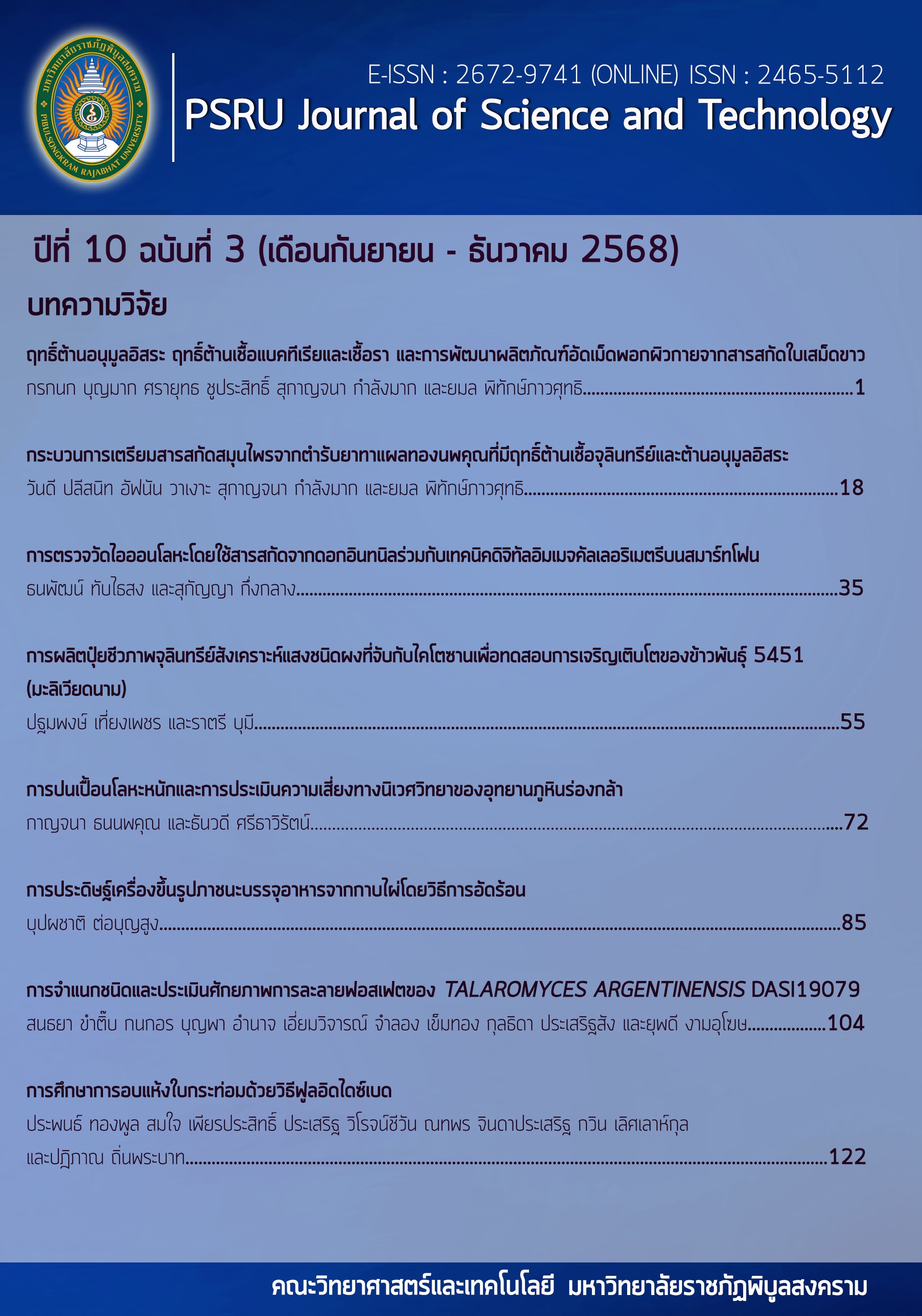
การจำแนกชนิดและประเมินศักยภาพการละลายฟอสเฟตของ TALAROMYCES ARGENTINENSIS DASI19079
คำสำคัญ:
ปุ๋ยชีวภาพ , จุลินทรีย์ละลายฟอสเฟต , จุลินทรีย์ดินบทคัดย่อ
งานวิจัยนี้มีวัตถุประสงค์เพื่อจำแนกชนิดและประเมินศักยภาพในการละลายฟอสเฟตของราไอโซเลท DASI19079 ภายใต้สภาวะค่าความเป็นกรด-ด่าง (pH) ต่างๆ รา DASI19079 ถูกนำมาศึกษาลักษณะทางสัณฐานวิทยาโดยเพาะเลี้ยงบนอาหารชนิดต่างๆ ผลการศึกษา พบว่า โคโลนีมีลักษณะและสีที่แตกต่างกันขึ้นอยู่กับชนิดของอาหารและช่วงระยะเวลาการบ่มรา DASI19079 สามารถเจริญและสร้างแอสโคมาได้ดีที่สุดในอาหาร Oat meal agar (OMA) หลังบ่ม 7 วัน และ 14 วัน การศึกษาภายใต้กล้องจุลทรรศน์ พบว่า รา DASI19079 สร้างแอสโคมาและแอสคัส รูปร่างกลม (Globose) หรือค่อนข้างกลม (Subglobose) ภายในแอสคัสบรรจุแอสโคสปอร์ที่มีลักษณะรูปรี (Ellipsoidal) ผนังมีหนาม จำนวน 8 แอสโคสปอร์ นอกจากนี้ยังพบการสร้างโคนิดิโอฟอร์ทั้งแบบ Biverticillate และ Monoverticillate อีกด้วย ส่วนการวิเคราะห์ลำดับนิวคลีโอไทด์ของตำแหน่ง Internal transcribed spacer (ITS) พบว่า มีความคล้ายคลึงกับ Talaromyces argentinensis NRRL 28750 (NR_165525.1) มากที่สุด เท่ากับ 99.43 เปอร์เซ็นต์ (Query cover 97 เปอร์เซ็นต์) ผลการวิเคราะห์ความสัมพันธ์เชิงวิวัฒนาการยังบ่งชี้ว่ารา DASI19079 มีความใกล้ชิดกับ T. argentinensis มากที่สุด ส่วนการประเมินศักยภาพการละลายอลูมิเนียมฟอสเฟต แคลเซียมฟอสเฟต และเฟอร์ริกฟอสเฟตของรา DASI19079 ภายใต้ pH 3-10 พบว่า รา DASI19079 สามารถละลายอลูมิเนียมฟอสเฟตและแคลเซียมฟอสเฟตได้ดีในสภาวะเป็นกรดถึงเป็นกลาง ขณะที่ความสามารถลดลงเมื่อค่าความเป็นกรด-ด่างสูงขึ้น สำหรับการละลายเฟอร์ริกฟอสเฟต พบว่ามีประสิทธิภาพสูงสุดในช่วง pH 4-10 จากข้อมูลข้างต้นแสดงถึงความสามารถของรา DASI19079 ในการละลายฟอสเฟตภายใต้สภาวะ pH ที่หลากหลาย ซึ่งเป็นประโยชน์ในการประยุกต์ใช้รา DASI19079 ในรูปแบบของปุ๋ยชีวภาพละลายฟอสเฟต
เอกสารอ้างอิง
สนธยา ขำติ๊บ, และกนกอร บุญพา. (2567). การคัดแยกแบคทีเรียละลายฟอสเฟตที่สามารถผลิตเอนไซม์ ACC DEAMINASE จากพื้นที่แล้งในภาคตะวันออกเฉียงเหนือของประเทศไทย. PSRU Journal of Science and Technology, 9(2), 58-71.
Airin, A.A., Arafat, M.I., Begum, R.A., Islam, M.R., & Seraj, Z.I. (2023). Plant growth-promoting endophytic fungi of the wild halophytic rice Oryza coarctata. Annals of Microbiology, 73, 36.
Felsenstein, J. (1985). Confidence limits on phylogenies: An approach using the bootstrap. Evolution, 39, 783–791.
Illmer, P.A., & Schinner, F. (1995). Solubilization of inorganic calcium phosphates solubilization mechanism. Soil Biology and Biochemistry, 27, 257–263.
Jones, D.L., & Oburger, E. (2011). Solubilization of phosphorus by soil microorganisms. In: Bünemann, E., Oberson, A. & Frossard, E. (eds.). Phosphorus in action: biological processes in soil phosphorus cycling. Berlin: Springer Berlin Heidelberg.
Kalayu, G. (2019). Phosphate solubilizing microorganisms: promising approach as biofertilizers. International Journal of Agronomy, 4917256.
Khan, M.S., Zaidi, A., & Wani, P.A. (2007). Role of phosphate-solubilizing microorganisms in sustainable agriculture – A review. Agronomy for Sustainable Development, 27, 29–43.
Kanse, O.S., Whitelaw-Weckert, M., Kadam, T.A., & Bhosale H.J. (2015). Phosphate solubilization by stress-tolerant soil fungus Talaromyces funiculosus SLS8 isolated from the Neem rhizosphere. Annals of Microbiology, 65, 85–93.
Murphy, J., & Riley, J.P. (1962). A modified single solution method for the determination of phosphate in natural water. Analytica Chimica Acta, 27, 31–36.
Peterson, S.W., & Jurjević, Z. (2019). The Talaromyces pinophilus species complex. Fungal Biology, 123(10), 745-762.
Pikovskaya, R.I. (1948). Mobilization of phosphorus in soil in connection with the vital activity of some microbial species. Mikrobiologiya, 17, 362–370.
Rayner, R.W. (1970). A mycological colour chart. London: The British Mycological Society.
Riddell, R.W. (1950). Permanent stained mycological preparations obtained by slide culture. Mycologia, 42, 265–270.
Saitou, N., & Nei, M. (1987). The neighbor-joining method: A new method for reconstructing phylogenetic trees. Molecular Biology and Evolution, 4, 406–425.
Sharma, S.B., Sayyed, R.Z., Trivedi, M.H., & Gobi, T.A. (2013). Phosphate solubilizing microbes: sustainable approach for managing phosphorus deficiency in agricultural soils. Springerplus, 2, 587.
Stefanoni Rubio, P.J., Godoy, M.S., Della Mónica, I.F., Pettinari, M.J., Godeas, A.M., & Scervino, J.M. (2016). Characterization of phosphate-solubilizing fungal strains from agricultural soils. Current Microbiology, 72, 41–47.
Stolk, A.C., & Samson, R.A. (1972). The genus Talaromyces studies on Talaromyces and related genera II. Studies in Mycology, 2, 1-65.
Suleman, D., Asrul, S., Suaib, S., Ambardini, S., Yanti, N.A., Boer, D., Yusuf, D.N., & Faad, H. (2021). Screening and identification of phosphate solubilizing fungi from Indonesian rhizosphere soils. In Proceedings of The First Asian PGPR Indonesian Chapter International e-Conference 2021 (p. 99–109). Bali: Udayana University.
Tamura, K., Stecher, G., & Kumar, S. (2021). MEGA 11: Molecular evolutionary genetics analysis version 11. Molecular Biology and Evolution, 38(7), 3022–3027.
Vassilev, N., Vassileva, M., & Nikolaeva, I. (2006). Simultaneous P-solubilizing and biocontrol activity of microorganisms: potentials and future trends. Applied Microbiology and Biotechnology, 71, 137–144.
White, T.J., Bruns, T., Lee, S., & Taylor, J. (1990). Amplification and direct sequencing of fungal ribosomal RNA genes for phylogenetics. In Innis, M.A., Gelfand, D.H., Sninsky, J.J. & White, T.J. (eds.). PCR protocols: a guide to methods and applications (p.315-322). New York: Academic Press.
ดาวน์โหลด
เผยแพร่แล้ว
รูปแบบการอ้างอิง
ฉบับ
ประเภทบทความ
สัญญาอนุญาต
ลิขสิทธิ์ (c) 2025 PSRU Journal of Science and Technology

อนุญาตภายใต้เงื่อนไข Creative Commons Attribution-NonCommercial-NoDerivatives 4.0 International License.
กองบรรณาธิการขอสงวนสิทธิ์ในการปรับปรุงแก้ไขตัวอักษรและคำสะกดต่างๆ ที่ไม่ถูกต้อง และต้นฉบับที่ได้รับการตีพิมพ์ในวารสาร PSRU Journal of Science and Technology ถือเป็นกรรมสิทธิ์ของคณะวิทยาศาสตร์และเทคโนโลยี มหาวิทยาลัยราชภัฏพิบูลสงคราม และ
ผลการพิจารณาคัดเลือกบทความตีพิมพ์ในวารสารให้ถือมติของกองบรรณาธิการเป็นที่สิ้นสุด




 0-5526-7000 Ext. 4100

