
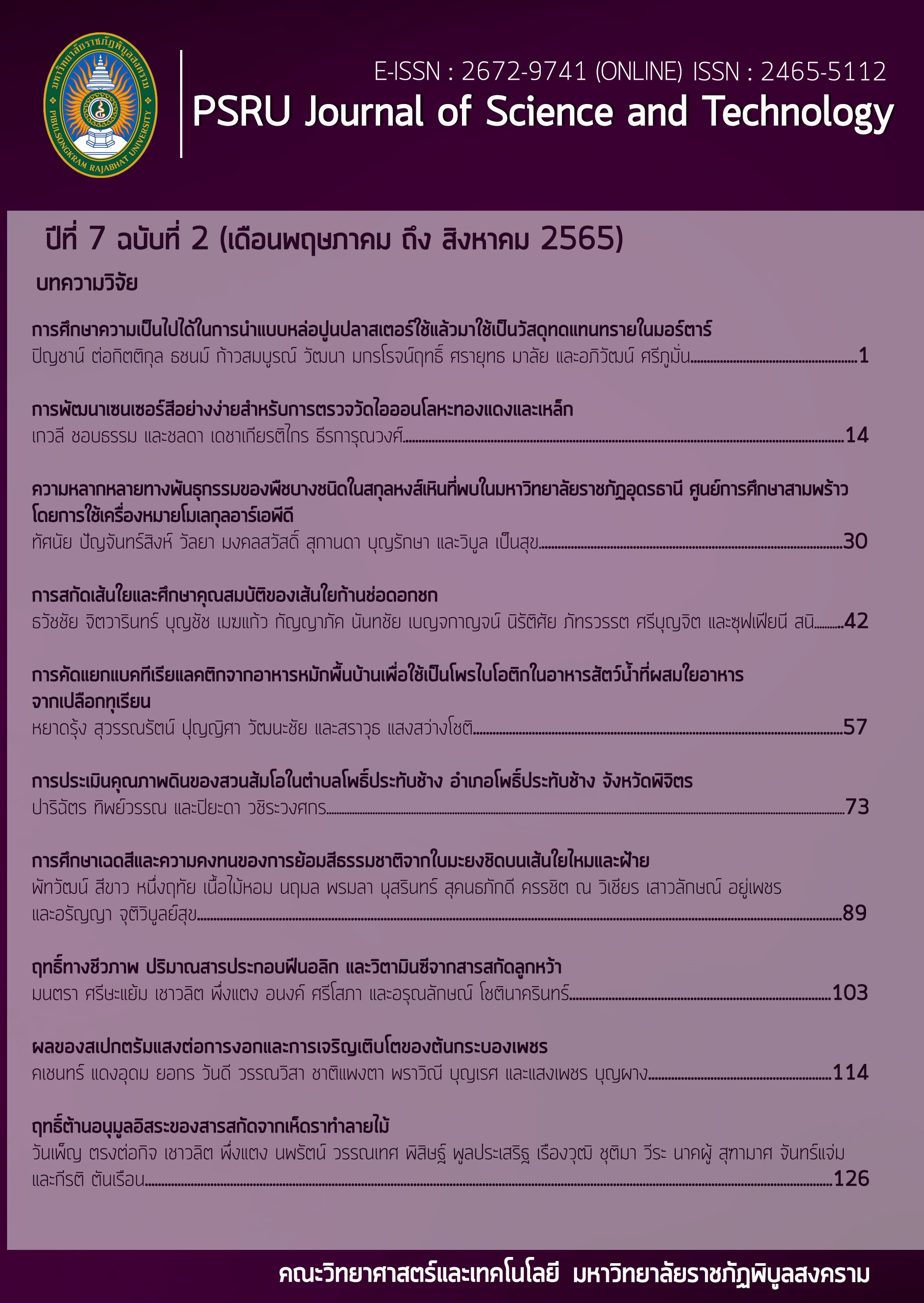
การศึกษาความเป็นไปได้ในการนำแบบหล่อปูนปลาสเตอร์ใช้แล้วมาใช้เป็นวัสดุทดแทนทรายในมอร์ตาร์
คำสำคัญ:
แบบหล่อปูนปลาสเตอร์ใช้แล้ว, ทดแทนทราย, มอร์ตาร์, กำลังอัด, การนำความร้อนบทคัดย่อ
งานวิจัยนี้มีวัตถุประสงค์ที่จะศึกษาความเป็นไปได้ในการใช้แบบหล่อปูนปลาสเตอร์ที่ใช้แล้วจากโรงงานอุตสาหกรรมเซรามิกในจังหวัดลำปาง มาผลิตเป็นวัสดุผนังในงานก่อสร้าง โดยจะนำแบบหล่อปูนปลาสเตอร์ใช้แล้วมาย่อยและทำการคัดขนาดให้มีการกระจายตัวของอนุภาคเป็นแบบเดียวกับทราย จากนั้นใช้เป็นส่วนผสมทดแทนทรายในมอร์ตาร์ปริมาณร้อยละ 10 30 50 60 80 90 และ 100 โดยปริมาตร ทำการศึกษาผลของปูนพลาสเตอร์ที่มีต่อสมบัติทางกายภาพ สมบัติเชิงกล และสมบัติการนำความร้อน จากผลการทดลองพบว่า ค่ากำลังอัด กำลังดึง และกำลังดัดของมอร์ตาร์มีค่าลดลง เมื่อใช้ปูนปลาสเตอร์ที่ใช้แล้วทดแทนทรายเพิ่มขึ้น โดยค่ากำลังอัดของมอร์ตาร์ที่ใช้ปูนปลาสเตอร์ที่ใช้แล้วทดแทนทรายในปริมาณร้อยละ 50 และ 100 โดยปริมาตร ที่อายุ 28 วัน มีค่าเท่ากับ 10.50 และ 7.00 เมกะปาสคาล ตามลำดับ อย่างไรก็ตามค่าการนำ
ความร้อนของมอร์ตาร์ผสมปูนปลาสเตอร์ปริมาณร้อยละ 100 มีค่าเท่ากับ 0.38 วัตต์ต่อเมตรองศาเคลวิน ซึ่งลดลงถึงร้อยละ 78 เมื่อเปรียบเทียบกับมอร์ตาร์ควบคุม และมีความหนาแน่นประมาณ 1.60 กรัมต่อลูกบาศก์เซนติเมตร ดังนั้นการนำปูนปลาสเตอร์ที่ใช้แล้วทดแทนทรายอาจสามารถพัฒนาเป็นวัสดุผนังน้ำหนักเบาที่มีสมบัติเป็นฉนวนความร้อนได้ในอนาคต
เอกสารอ้างอิง
กรมโรงงานอุตสาหกรรม (2551). ข้อมูลวัสดุเหลือทิ้งจากโรงงานอุตสาหกรรมเซรามิก. กรุงเทพฯ: สำนักบริหารจัดการกากอุตสาหกรรม.
มยุรี ปาลวงศ์. (2552). ประโยชน์ของยิปซัม. กรุงเทพฯ: หจก. ไอเดีย สแควร์.
Alencar, L.H., Mota, C.M., & Alencar, M.H. (2011). The problem of disposing of plaster waste from building sites: Problem structuring based on value focus thinking methodology. Waste Management, 31, 2512–2521.
Camarini, G., Pinto, M.C.C., Moura, A.G.M., & Manzo, N.R. (2016). Effect of citric acid on properties of recycled gypsum plaster to building components. Construction and Building Materials, 124, 383-390.
Cao, W., Yi, W., Peng, J., Li, J., & Yin, S. (2022). Recycling of phosphogypsum to prepare gypsum plaster: Effect of calcination temperature. Journal of Building Engineering, 45, 103511.
Chandara, C., Azizli, K.A.M., Ahmad, Z.A., & Sakai, E. (2009). Use of waste gypsum to replace natural gypsum as set retarders in Portland cement. Waste Management, 29, 1675–1679.
Erbs, A., Nagalli, A., Carvalho, K.Q., Mazer, W., Erbs, M.M., Paz, D.H.F., & Lafayette, K.P.V. (2021). Development of plasterboard sheets exclusively from waste. Journal of Building Engineering, 44, 102524.
Geraldo, R.H., Souza, J.D., Campos, S.C., Fernandes, L.F.R., & Camarini, G. (2018) Pressured recycled gypsum plaster and wastes: Characteristics of eco-friendly building components. Construction and Building Materials, 191, 136-144.
Guan, B., Kong, B., Fu, H., Yu, J., Jiang, G., & Yang, L. (2012). Pilot scale preparation of a-calcium sulfate hemihydrate from FGD gypsum in Ca–K–Mg aqueous solution under atmospheric pressure. Fuel, 98, 48–54.
Guan, B., Yang, L., Fu, H., Kong, B., Li, T., & Yang, L. (2011). -calcium sulfate hemihydrate preparation from FGD gypsum in recycling mixed salt solutions. Chemical Engineering Journal, 174, 296–303.
Gutiérrez-González, S., Gadea, J., Rodríguez, A., Blanco-Varela, M.T., & Calderón, V. (2012). Compatibility between gypsum and polyamide powder waste to produce lightweight plaster with enhanced thermal properties. Construction and Building Materials, 34, 179-185.
Ismail, B., Belayachi, N., & Hoxha, D. (2020). Optimizing performance of insulation materials based on wheat straw, lime and gypsum plaster composites using natural additives. Construction and Building Materials, 254, 118959.
Kangavar, M.E., Lokuge, W., Manalo, A., Karunasena, W., & Frigione, M. (2022). Investigation on the properties of concrete with recycled polyethylene terephthalate (PET) granules as fine aggregate replacement. Case Studies in Construction Materials, 16, e00934.
Li, Z., Xu, K., Peng, J., Wang, J., Ma, X., & Niu, J. (2019). Study on hydration and mechanical property of quicklime blended recycled plaster materials. Construction and Building Materials, 202, 440-448.
Ouakarroucha, M., Azharya, K.E., Laaroussi, N., Garoum, M., & Kifani-Sahban, F. (2020). Thermal performances and environmental analysis of a new composite building material based on gypsum plaster and chicken feathers waste. Thermal Science and Engineering Progress, 19, 100642.
Pedreno-Rojas, M.A., De Brito, J., Flores-Colen, I., Pereira, M.F.C., & Rubio-de-Hita, P. (2020). Influence of gypsum wastes on the workability of plasters: Heating process and microstructural analysis. Journal of Building Engineering, 29, 101143.
Pereira, V.M., Geraldo, R.H., Cruz, T.A.M., & Camarini, G. (2021). Valorization of industrial by-product: Phosphogypsum recycling as green binding material. Cleaner Engineering and Technology, 5, 100310.
Rivero, A.J., Báez, A.G., & Navarro, J.G. (2014). New composite gypsum plaster – ground waste rubber coming from pipe foam insulation. Construction and Building Materials, 55, 146-152.
Sadique, M., Nageim, H.A., Atherton, W., Seton, L., & Dempster, N. (2012). A new composite cementitious material for construction. Construction and Building Materials, 35, 846–855.
Torkittikul, P., Nochaiya, T., Wongkeo, W., & Chaipanich, A. (2015). Utilization of coal bottom ash to improve thermal insulation of construction material. Journal of Material Cycles and Waste Management, Doi: 10.1007/s10163-015-0419-2.
Waseem, S.A., Thakur, N., Islam, S., Kumar, M., & Saini, J.S. (2021). Cupola slag as partial replacement of fine aggregate in concrete – An experimental study. Journal of Building Engineering, 44, 103343.
ดาวน์โหลด
เผยแพร่แล้ว
รูปแบบการอ้างอิง
ฉบับ
ประเภทบทความ
สัญญาอนุญาต
ลิขสิทธิ์ (c) 2022 PSRU Journal of Science and Technology

อนุญาตภายใต้เงื่อนไข Creative Commons Attribution-NonCommercial-NoDerivatives 4.0 International License.
กองบรรณาธิการขอสงวนสิทธิ์ในการปรับปรุงแก้ไขตัวอักษรและคำสะกดต่างๆ ที่ไม่ถูกต้อง และต้นฉบับที่ได้รับการตีพิมพ์ในวารสาร PSRU Journal of Science and Technology ถือเป็นกรรมสิทธิ์ของคณะวิทยาศาสตร์และเทคโนโลยี มหาวิทยาลัยราชภัฏพิบูลสงคราม และ
ผลการพิจารณาคัดเลือกบทความตีพิมพ์ในวารสารให้ถือมติของกองบรรณาธิการเป็นที่สิ้นสุด




 0-5526-7000 Ext. 4100

