
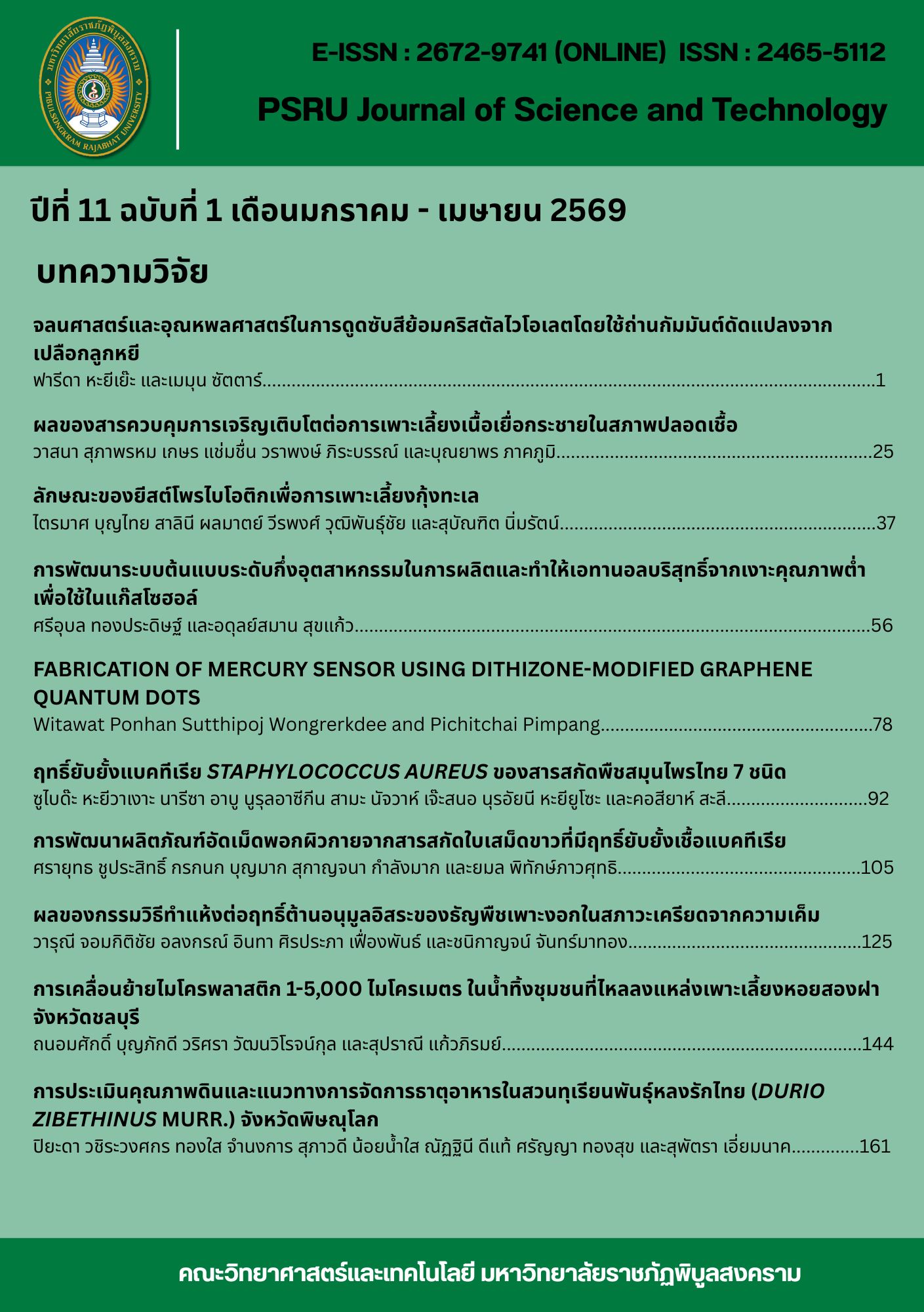
DEVELOPMENT OF A SEMI-INDUSTRIAL SCALE PROTOTYPE SYSTEM FOR THE PRODUCTION AND PURIFICATION OF ETHANOL FROM LOW-GRADE RAMBUTAN (NEPHELIUM LAPPACEUM) FOR GASOHOL APPLICATIONS
Keywords:
Ethanol, Rambutan, Fermentation, Gasohol, Renewable energyAbstract
This research explores ethanol production from low-quality rambutan as an alternative energy source. It aims to determine optimal fermentation conditions and study the distillation process for ethanol extraction during scale-up. The findings indicate that the ideal fermentation conditions involve preparing low-quality rambutan with 20 %w/v fruit pulp (weight per volume of rambutan juice), adding 0.96 g/L of Di-ammonium Phosphate; DAP as a nitrogen source, and sterilizing with 0.18 g/L Potassium Metabisulfite; KMS. Fermentation with selected S. cerevisiae TISTR 5339 yeast yielded a maximum ethanol concentration of 5.83 %v/v. Scaling up the fermentation to 18 liters in a 20-liter fermenter for 21 days increased ethanol production to 8.83 %v/v. Distillation using a fractional distillation system at 90 °C resulted in 50 %v/v ethanol concentration, which increased to 95 %v/v after four rounds of distillation. Further purification using zeolite molecular sieves (100 g) produced ethanol at 99.20 %v/v, suitable for blending with gasoline to create gasohol. The study demonstrates the feasibility of developing a semi-industrial ethanol production model, contributing to future renewable energy sources.
References
AOAC. (1990). Official methods of analysis: The association of official analytical chemists. Virginia: Arlington.
Afedzi, A.E.K., Rattanaporn, K., Sultan, I.N., Khan, M.W., Tareen, A.K., & Parakulsuksatid, P. (2023). Comparison of marine and rushton impeller in high solid loading of two-step pretreated oil palm trunk using simultaneous saccharification and fermentation for ethanol production. Results in Engineering, 19, 101273.
Devi, A., Singh, A., Bajar, S., Pant, D., & Din, Z.U. (2021). Ethanol from lignocellulosic biomass: An in-depth analysis of pre-treatment methods, fermentation approaches and detoxification processes. Journal of Environmental Chemical Engineering, 9(5), 105798.
Erkan, S.B., Coban, H.B., & Turhan, I. (2022). Evaluation of the inhibitory effect of 5-hydroxymethylfurfural (HMF) on ethanol fermentation by using immobilized Saccharomyces cerevisiae in stirred-tank bioreactor and mathematical modeling. Fuel, 317, 123499.
Fang, R., Xia, T., Wu, S., He, J., & Xiao, G. (2025). Btn2p influences arginine metabolism and ethanol tolerance in Saccharomyces cerevisiae during Huangjiu fermentation. Food Bioscience, 65, 105958.
Granjo, J.F.O., Nunes, D.S., Duarte, B.P.M., & Oliveira, N.M.C. (2020). A comparison of process alternatives for energy-efficient bioethanol downstream processing. Separation and Purification Technology, 238, 116414.
Kamsuwan, C., Tanprasert, S., Nimmanterdwong, P., Piemjaiswang, R., Saencharee, K., Pumchumpol, T., & Chalermsinsuwan, B. (2023). Process simulation of cassava cellulosic ethanol production with low to medium-pressure steam heat integration. Energy Reports, 9, 11-17.
Khanpanuek, S., Lunprom, S., Reungsang, A., & Salakkam, A. (2022). Repeated-batch simultaneous saccharification and fermentation of cassava pulp for ethanol production using amylases and Saccharomyces cerevisiae immobilized on bacterial cellulose. Biochemical Engineering Journal, 177, 108258.
Kiatkittipong, W., Thipsunet, P., Goto, S., Chaisuk, C., Praserthdam, P., & Assabumrungrat, S. (2008). Simultaneous enhancement of ethanol supplement in gasoline and its quality improvement. Fuel Processing Technology, 89(12), 1365-1370.
Mogg, R. (2004). Biofuels in Asia: Thailand relaunches ‘Gasohol’ for automotive use. Refocus, 5(3), 44-47.
Nomura, M., Bin, T., & Nakao, S.-i. (2002). Selective ethanol extraction from fermentation broth using a silicalite membrane. Separation and Purification Technology, 27(1), 59-66.
Rattanapan, A., Limtong, S., & Phisalaphong, M. (2011). Ethanol production by repeated batch and continuous fermentations of blackstrap molasses using immobilized yeast cells on thin-shell silk cocoons. Applied Energy, 88(12), 4400-4404.
Salakkam, A., Phukoetphim, N., Laopaiboon, P., & Laopaiboon, L. (2023). Mathematical modeling of bioethanol production from sweet sorghum juice under high gravity fermentation: Applicability of Monod-based, logistic, modified Gompertz and Weibull models. Electronic Journal of Biotechnology, 64, 18-26.
Silva, M.L.B. d., & Corseuil, H.X. (2012). Groundwater microbial analysis to assess enhanced BTEX biodegradation by nitrate injection at a gasohol-contaminated site. International Biodeterioration & Biodegradation, 67, 21-27.
Siriwong, T., Laimeheriwa, B., Aini, U.N., Cahyanto, M.N., Reungsang, A., & Salakkam, A. (2019). Cold hydrolysis of cassava pulp and its use in simultaneous saccharification and fermentation (SSF) process for ethanol fermentation. Journal of Biotechnology, 292, 57-63.
Sriputorn, B., Laopaiboon, P., Phukoetphim, N., Uppatcha, N., Phuphalai, W., & Laopaiboon, L. (2021). Very high gravity ethanol fermentation from sweet sorghum stem juice using a stirred tank bioreactor coupled with a column bioreactor. Journal of Biotechnology, 332, 1-10.
Wang, W., Porninta, K., Aggarangsi, P., Leksawasdi, N., Li, L., Chen, X., Zhuang, X., Yuan, Z., & Qi, W. (2021). Bioenergy development in Thailand based on the potential estimation from crop residues and livestock manures. Biomass and Bioenergy, 144, 105914.
Wu, X., Zhang, J., Xu, E., Liu, Y., Cheng, Y., Addy, M., Zhou, W., Griffith, R., Chen, P., & Ruan, R. (2016). Microbial hydrolysis and fermentation of rice straw for ethanol production. Fuel, 180, 679-686.
Zheng, Y., Lee, C., Yu, C., Cheng, Y.-S., Zhang, R., Jenkins, B.M., & VanderGheynst, J.S. (2013). Dilute acid pretreatment and fermentation of sugar beet pulp to ethanol. Applied Energy, 105, 1-7.
Downloads
Published
How to Cite
Issue
Section
License
Copyright (c) 2026 PSRU Journal of Science and Technology

This work is licensed under a Creative Commons Attribution-NonCommercial-NoDerivatives 4.0 International License.
กองบรรณาธิการขอสงวนสิทธิ์ในการปรับปรุงแก้ไขตัวอักษรและคำสะกดต่างๆ ที่ไม่ถูกต้อง และต้นฉบับที่ได้รับการตีพิมพ์ในวารสาร PSRU Journal of Science and Technology ถือเป็นกรรมสิทธิ์ของคณะวิทยาศาสตร์และเทคโนโลยี มหาวิทยาลัยราชภัฏพิบูลสงคราม และ
ผลการพิจารณาคัดเลือกบทความตีพิมพ์ในวารสารให้ถือมติของกองบรรณาธิการเป็นที่สิ้นสุด




 0-5526-7000 Ext. 4100

