A Comparative Study of Academic Achievement and Satisfaction between using the Cisco Packet Tracer Simulator and Real Laboratory Study
Keywords:
Comparison study, Simulation, Real practice, Laboratory, CISCOAbstract
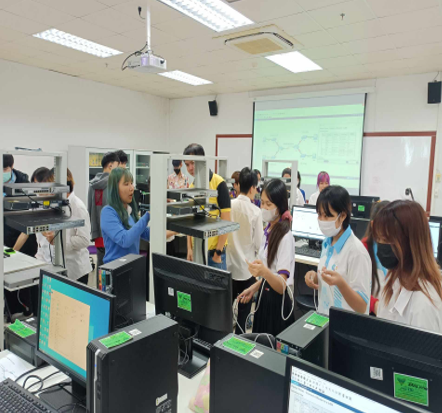
This research presents a comparative study on the learning achievement and satisfaction between using the Cisco Packet Tracer simulation program and practicing with real equipment. The research was conducted with a sample group of 60 students from the Faculty of Information and Communication Technology, University of Phayao, academic year 2022. They were divided into two groups of 30 students each to learn through the simulation program and practice with real equipment. The results of the study found that the group learning through the simulation program showed a significantly higher level of learning satisfaction than the group practicing with real equipment at the 0.05 level. The simulation group had a mean satisfaction score of 3.82 and a standard deviation of 0.74, while the group practicing with real equipment had a mean satisfaction score of 3.64 and a standard deviation of 0.65. The results of this study reflect that the use of simulation programs in teaching can effectively create satisfaction and enhance the learning experience of students in the field of information technology.
References
Ahmed, T., Bumbacher, E., Blikstein, P., & Riedel-Kruse, Ingmar H. (2024). Large-scale and versatile deployment of biology cloud labs in schools through teacher driven curricula design. Atlanta, GA, USA: Association for Computing Machinery, 524–529. Form https://doi.org/10.1145/3657604.3664713.
Alsaleh, S., Tepljakov, A., Kose, A., Belikov, J., & Petlenkov, E. (2022). ReImagine Lab: Bridging the Gap Between Hands-On, Virtual and Remote Control Engineering Laboratories Using Digital Twins and Extended Reality. IEEE Access, 10, 89924–89943. Form https://doi.org/10.1109/access.2022.3199371.
Azhari, A. D., Sulaiman, N. A., & Kassim, M. (2021, November 1). Secured Internet Office Network with the Internet of Things Using Packet Tracer Analysis. Form https://doi.org/10.1109/ICSET53708.2021.9612554.
Baun, C., Kappes, M., Cocos, H.-N., Koch, M., & Petrozziello, M. (2025). The Virtual Computer Networks Lab: On the Design and Implementation of a Location Independent Networks Laboratory in Higher Education. Proceedings of the 17th International Conference on Computer Supported Education, 199–207. Form https://doi.org/10.5220/0013199400003932.
Bharat Ratnala, T. Anuradha, Vidya Maddali, & Harsha Vardhan Chintalapudi. (2023). Designing Smart Room Using Cisco Packet Tracer Simulator. 2023 5th International Conference on Smart Systems and Inventive Technology (ICSSIT). Form https://doi.org/10.1109/icssit55814.2023.10061048.
Darejeh, A., Huynh, L., Ji, X., Marcus, N., & Polly, P. (2024). Assessing the Efficacy of Virtual Reality-Based Laboratories Versus Real-Life Settings for PCR Procedures, within Medical Science Laboratories. 2022 IEEE International Symposium on Mixed and Augmented Reality Adjunct (ISMAR-Adjunct), 489–492. Form https://doi.org/10.1109/ismar-adjunct64951.2024.00142.
Dunn, S., Wünsche, Burkhard C, Allison, J. R., Samuel, & Lange-Nawka, D. (2023). Hands-on DNA: Exploring the impact of virtual reality on teaching DNA structure and function. Christchurch, New Zealand: Association for Computing Machinery. Form https://doi.org/10.1145/3611659.3615684.
Ersoy Cangir, Ö., Yıldırım, M., & Bostan, N. (2023). Faculty network system implementation using cisco packet tracer. Journal of Computer & Electrical and Electronics Engineering Sciences, 1(1), 20–24. Form https://doi.org/10.51271/jceees-0005.
Gede Saindra Santyadiputra, None Purnomo, Waras Kamdi, Syaad Patmanthara, & Didik Nurhadi. (2024). Vilanets: An advanced virtual learning environments to improve higher education students’ learning achievement in computer network course. Cogent Education, 11(1). Form https://doi.org/10.1080/2331186x.2024.2393530.
Holly, M., Brettschuh, S., Tiwari, A. S., Bhagat, K. K., & Pirker, J. (2024). Game-based motivation: Enhancing learning with achievements in a customizable virtual reality environment. Trier, Germany: Association for Computing Machinery. Form https://doi.org/10.1145/3641825.3687741.
Jiang, G., Xia, X., Li, Y., Liang, H.-N., & Hui, P. (2024). ChemistryVR: Enhancing educational experiences through virtual chemistry lab simulations. Association for Computing Machinery. Form https://doi.org/10.1145/3680533.3697068.
Lin, X., & Chen, Z. (2023). Knowledge Transfer Happen in Virtual Simulation Experiment Teaching: A Factor Study Based on Educational Experiment. Proceedings of the 2023 6th International Conference on Educational Technology Management, 137–147. Form https://doi.org/10.1145/3637907.3637966.
Muhammad Fadly Atjo, Djami Olii, Hiskia Manggopa, & Tino, P. (2023). Effect of Packet Tracer Simulator Media on Motivation and Learning Outcomes of Basic Network TKJ Students of Cokroaminoto Vocational School, Kotamobagu. Deleted Journal, 2(2), 26–44. Form https://doi.org/10.62711/ijite.v2i2.103.
None Thobiyah T, Franciscus, A., None Fakrurrozi, Ilyas Wichaksono, Baqi, A., Ridwan Daeli, & Riko Tarigan. (2024). Design and Simulation of a LAN Network for Optimizing IT Infrastructure at SMKS XYZ Depok Using Cisco Packet Tracer. International Journal Software Engineering and Computer Science (IJSECS), 4(2), 731–744. Form https://doi.org/10.35870/ijsecs.v4i2.2673.
Oikonomou, N. V., & Oikonomou, D. V. (2024). Educational Applications and Comparative Analysis of Network Simulators: Protocols, Types, and Performance Evaluation. Journal of Engineering Research and Sciences, 3(6), 18–32. Form https://doi.org/10.55708/js0306003.
Runtuwene, S. J., Abdulgani, A. N., Pakan, O. M. L., Pinontoan, F. C. G., Mangaronda, D. I., & Kambey, T. N. (2024). Network Simulation Using Cisco Packet Tracer in Computer Network Learning in Higher Education. Jurnal Syntax Admiration, 5(11), 5099–5106. Form https://doi.org/10.46799/jsa.v5i11.1774.
Schaumont, P. (2021). Socially-distant hands-on labs for a real-time digital signal processing course. 425–430. Virtual Event, USA: Association for Computing Machinery. Form https://doi.org/10.1145/3453688.3461490.
Shen, Y., & Pan, Z. (2022). Evaluating the Impact of Immersive Virtual Reality Learning Environments with a Cognitive Load on Students in Various Interaction Modes. 2022 8th International Conference on Virtual Reality (ICVR), 210–215. Form https://doi.org/10.1109/icvr55215.2022.9848091.
Singhal, I., Guru Ratan Satsangee, Bhardwaj, L., Sharma, G. S., Anand Swarup Chandrakar, Gupta, H., … Rahul Swarup Sharma. (2024). 3D-PRINTING VIRTUAL SIMULATION LAB. IEEE Transactions on Learning Technologies, 17, 1530–1543. Form https://doi.org/10.1109/tlt.2024.3384556.
Thomay, C., Fermitsch, A., Fessler, J., Garatva, P., Gollan, B., Lietz, A. K., … Wagner, M. (2023). Towards Cognitive Load-Based Decision Making in VR Training. 2023 IEEE 2nd International Conference on Cognitive Aspects of Virtual Reality (CVR), 000023–000028. Form https://doi.org/10.1109/cvr58941.2023.10395602.
Triejunita, C. N., Putri, A., & Rosmansyah, Y. (2021, November 1). A Systematic Literature Review on Virtual Laboratory for Learning. Form https://doi.org/10.1109/ICoDSE53690.2021.9648451.
Uhl, J. C., Gutierrez, R., Regal, G., Schrom-Feiertag, H., Schuster, B., & Tscheligi, M. (2024). Choosing the right reality: A comparative analysis of tangibility in immersive trauma simulations. Honolulu, HI, USA: Association for Computing Machinery. Form https://doi.org/10.1145/3613904.3641912.