
Perception and Preventive Behaviors Regarding Pesticide Use among Farmers in Wang Mai Sub-district, Wang Sombun District, Sa Kaeo Province Thailand
Article Sidebar
Main Article Content
Abstract
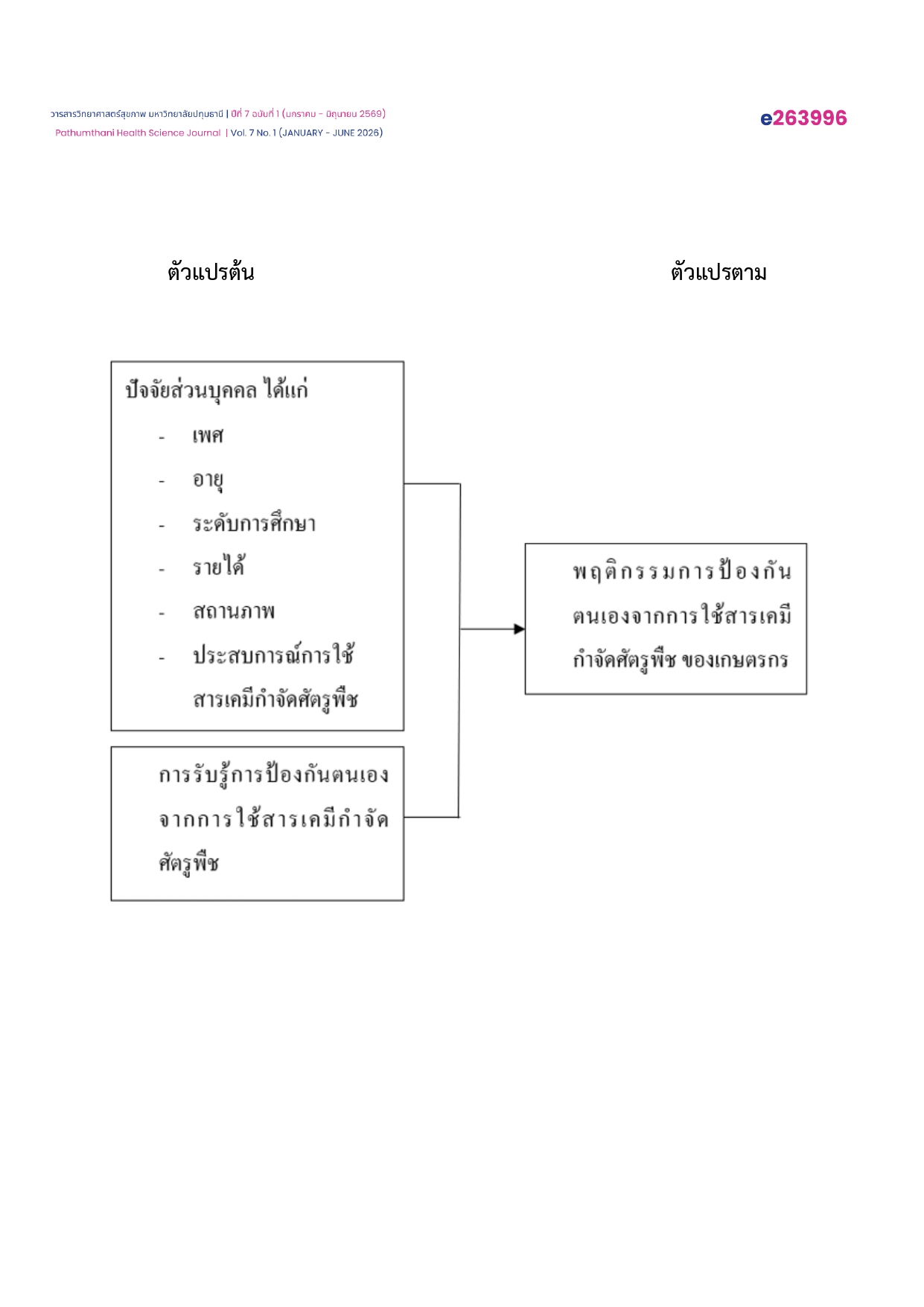
This study aimed to examine (1) the level of risk perception regarding self-protection from pesticide use, (2) the level of preventive behaviors, and (3) the relationships between personal factors and preventive behaviors among farmers in Wang Mai Subdistrict, Wang Sombun District, Sa Kaeo Province. This quantitative study applied relevant behavioral theories. The sample comprised 274 registered farmers who used pesticides across nine villages within the service area of Ban Thung Kabin Subdistrict Health Promoting Hospital, selected using systematic random sampling based on the Krejcie and Morgan (1970) formula (confidence level = 0.95; margin of error = 0.05). Data were collected using a four-part questionnaire with verified content validity (IOC) and an overall reliability coefficient of 0.93. Data were analyzed using descriptive statistics, the Chi-square test, Spearman’s rank correlation coefficient, and Pearson’s correlation coefficient.
The results showed that the level of risk perception regarding pesticide self-protection was moderate, while the level of preventive behaviors was high. Educational level, marital status, and farming experience were significantly associated with preventive behaviors at the .05 level, whereas sex, age, and income were not. In addition, risk perception was positively correlated with preventive behaviors at a moderate level (r = .312, p < .01).
These findings suggest that relevant agencies should continuously promote education and risk perception among farmers to strengthen appropriate preventive behaviors and reduce long-term health impacts.
Article Details

This work is licensed under a Creative Commons Attribution-NonCommercial-NoDerivatives 4.0 International License.
ความคิดเห็นและข้อเสนอแนะใดๆ ที่นำเสนอในบทความเป็นของผู้เขียนแต่เพียงผู้เดียว โดยบรรณาธิการ กองบรรณาธิการ และคณะกรรมการวารสารวิทยาศาสตร์และเทคโนโลยี มหาวิทยาลัยปทุมธานี ไม่ได้มีส่วนเกี่ยวข้องแต่อย่างใด มหาวิทยาลัย บรรณาธิการ และกองบรรณาธิการจะไม่รับผิดชอบต่อข้อผิดพลาดหรือผลที่เกิดจากการใช้ข้อมูลที่ปรากฏในวารสารฉบับนี้
References
เอกสารอ้างอิง (References)
กมลวรรณ นวลใย. (2564). ปัจจัยที่มีความสัมพันธ์กับพฤติกรรมการป้องกันตนเองจากการสัมผัสสารเคมีกำจัดศัตรูพืชของเกษตรกร. วิทยานิพนธ์ปริญญามหาบัณฑิต, มหาวิทยาลัยมหาสารคาม.
กรมควบคุมโรค. (2567). รายงานประจำปี 2567 (สำนักงานป้องกันควบคุมโรคที่ 9 นครราชสีมา). กรมควบคุมโรค กระทรวงสาธารณสุข.
ณัฐวดี วงศ์พาณิชย์. (2564). ปัจจัยที่มีผลต่อพฤติกรรมการป้องกันตนเองจากอันตรายของสารเคมีทางการเกษตรของเกษตรกร. วิทยานิพนธ์ปริญญามหาบัณฑิต, มหาวิทยาลัยนเรศวร.
ปุณยนุช คำสอน. (2565). พฤติกรรมการใช้สารเคมีกำจัดศัตรูพืชของเกษตรกรผู้ปลูกผักในจังหวัดลำพูน. การค้นคว้าอิสระ, มหาวิทยาลัยราชภัฏเชียงใหม่.
พรรณทิพย์ มูลเมือง. (2565). การรับรู้ความเสี่ยงและพฤติกรรมการใช้สารเคมีกำจัดศัตรูพืชของเกษตรกรในจังหวัดน่าน (วิทยานิพนธ์ปริญญามหาบัณฑิต, มหาวิทยาลัยพะเยา)
มยุรี ศรีบุตร. (2563). การศึกษาความสัมพันธ์ระหว่างบทบาทในครอบครัวกับพฤติกรรมการใช้สารเคมีกำจัดศัตรูพืชของเกษตรกรในจังหวัดขอนแก่น. รายงานวิจัย, มหาวิทยาลัยขอนแก่น.
โรงพยาบาลส่งเสริมสุขภาพตำบลบ้านทุ่งกบินทร์. (2567). รายงานการเฝ้าระวังอาการผิดปกติจากการสัมผัสสารเคมีกำจัดศัตรูพืชในพื้นที่รับผิดชอบ ปีงบประมาณ 2566–2567 [รายงานภายใน/เอกสารไม่เผยแพร่]. โรงพยาบาลส่งเสริมสุขภาพตำบลบ้านทุ่งกบินทร์.
ศุภชัย แก้วสุวรรณ์. (2564). การศึกษาความสัมพันธ์ระหว่างปัจจัยส่วนบุคคลกับพฤติกรรมการใช้สารเคมีกำจัดศัตรูพืชของเกษตรกรในจังหวัดลพบุรี (การค้นคว้าอิสระ, มหาวิทยาลัยเกษตรศาสตร์).
Ahmadipour, H., Nakhei, Z. (2024). The effect of education on safe use of pesticides based on the health belief model. BMCResearchNotes,17(1), Article134.
Boateng, K. O., Dankyi, E., Amponsah, I. K., Awudzi, G. K., Amponsah, E., & Darko, G. (2023). Knowledge, perception, and pesticide application practices among smallholder cocoa farmers in four Ghanaian cocoa-growing regions. Toxicology Reports, 10, 46–55. https://doi.org/10.1016/j.toxrep.2022.12.008
Endalew, M., Gebrehiwot, M., and Dessie, A. (2022). Pesticide use knowledge, attitude, practices and practices associated factors among floriculture workers in Bahirdar City, North West, Ethiopia, 2020. Environmental Health Insights, 16, 11786302221076250.
Karki, R., Tharu, N., and Kaphle, M. (2025). Knowledge and practices regarding safe pesticide use among farmers in the Bardiya District, Nepal: A cross-sectional study. Journal of PublicHealthResearch,14(2),22799036251350211
Keleb, A., Ademas, A., Abebe, M., Berihun, G., Desye, B., & Bezie, A. E. (2024). Knowledge of health risks, safety practices, acute pesticide poisoning, and associated factors among farmers in rural irrigation areas of northeastern Ethiopia. Frontiers in Public Health, 12, 1474487. https://doi.org/10.3389/fpubh.2024.1474487
Krejcie, R. V., Morgan, D. W. (1970). Determining sample size for research activities. Educational and Psychological Measurement, 30(3), 607-610.
Rosenstock, I. M. (1974). Historical origins of the health belief model. Health Education Monographs, 2(4), 328–335. https://doi.org/10.1177/109019817400200403
World Health Organization. (2021). The public health impact of chemicals: Knowns and unknowns. World Health Organization. https://shorturl.asia/R6to4
