
Project Evaluation of Development Program to Enhance Skills, Knowledge, and Capacity of Infection Control Personnel, Pathum Thani Hospital, Fiscal Year 2024
Article Sidebar
Main Article Content
Abstract
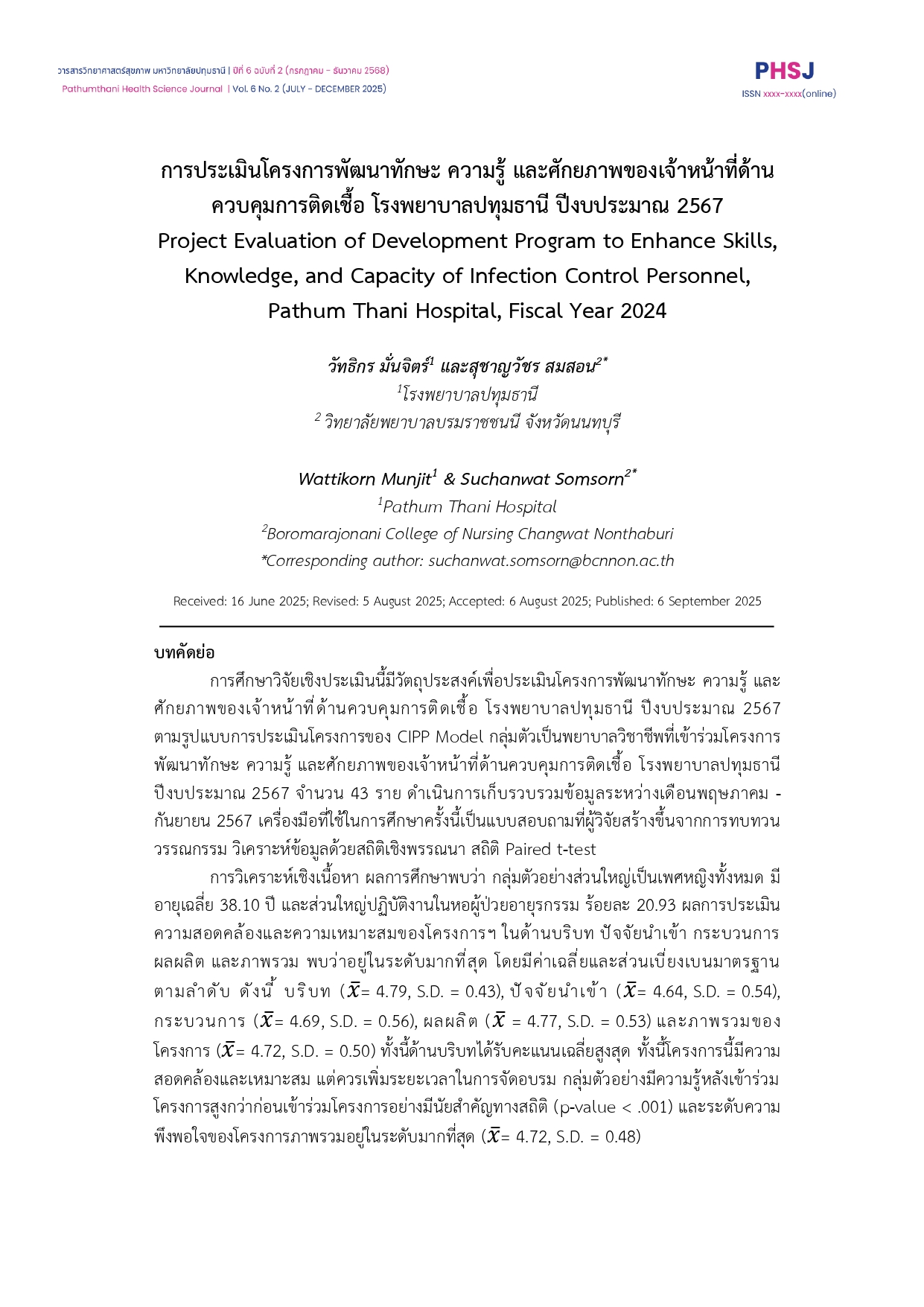
This evaluative research aimed to assess the project on developing the skills, knowledge, and capacity of infection control personnel at Pathum Thani Hospital for the fiscal year 2024, using the CIPP (Context, Input, Process, Product) evaluation model. The sample consisted of 43 registered nurses who participated in the project. Data were collected between May and September 2024. The research instrument was a questionnaire developed by the researcher based on a literature review. Data were analyzed using descriptive statistics, paired t-tests, and content analysis. The results revealed that all participants were female, with a mean age of 38.10 years. Most participants (20.93%) worked in internal medicine wards.
The evaluation showed that the program's relevance and appropriateness in all CIPP dimensions were rated at the highest level: context = 4.79, S.D. = 0.43), input (= 4.64, S.D. = 0.54), process (= 4.69, S.D. = 0.56), product = 4.77, S.D. = 0.53), and overall program assessment (= 4.72, S.D. = 0.50). Among these, the context dimension received the highest mean score. Although the program was found to be consistent and appropriate, the findings suggested that the training duration should be extended. The post-training knowledge of participants was significantly higher than pre-training levels (p-value < .001). Overall satisfaction with the program was also rated at the highest level (= 4.72, S.D. = 0.48). It is recommended that infection control training programs be continuously implemented in hospitals.
Training duration should be increased, and consistent budgetary support should be provided to ensure continuity. These improvements would allow participants to gain sufficient hands-on experience and contribute to the long-term sustainability and capacity development of infection control personnel.
Article Details

This work is licensed under a Creative Commons Attribution-NonCommercial-NoDerivatives 4.0 International License.
ความคิดเห็นและข้อเสนอแนะใดๆ ที่นำเสนอในบทความเป็นของผู้เขียนแต่เพียงผู้เดียว โดยบรรณาธิการ กองบรรณาธิการ และคณะกรรมการวารสารวิทยาศาสตร์และเทคโนโลยี มหาวิทยาลัยปทุมธานี ไม่ได้มีส่วนเกี่ยวข้องแต่อย่างใด มหาวิทยาลัย บรรณาธิการ และกองบรรณาธิการจะไม่รับผิดชอบต่อข้อผิดพลาดหรือผลที่เกิดจากการใช้ข้อมูลที่ปรากฏในวารสารฉบับนี้
References
ก่อศักดิ์ จันทรวิจิตร. (2566). การประเมินผลการดําเนินงานโครงการเฝ้าระวัง ป้องกัน ควบคุม โรคเบาหวานและความดันโลหิตสูงด้วย“ปิงปองจราจรชีวิต 7 สี” จังหวัดสิงห์บุรี โดยใช้ CIPP Model. วารสารสาธารณสุขและวิทยาศาสตร์สุขภาพ, 6(2), 80-93.
กัลยพัทธ์ นิยมวิทย์, กัญญดา ประจุศิลป์. (2558). สมรรถนะพยาบาลวิชาชีพควบคุมการติดเชื้อประจำหอผู้ป่วย. วารสารพยาบาลตำรวจและวิทยาศาสตร์สุขภาพ, 7(1), 153–165.
บัวจันทร์ ธงเชื้อ, ปัทมา คำฟู, สุทธิพันธ์ ถนอมพันธ์. (2560). ผลของโปรแกรมการล้างมือต่อความรู้ และการปฏิบัติด้านการป้องกันและควบคุมการติดเชื้อดื้อยาของบุคลากรทางการพยาบาล ผู้ป่วยและญาติในแผนกศัลยกรรม ศัลยกรรมกระดูกและข้อ โรงพยาบาลนครพิงค์. วารสารสมาคมพยาบาลแห่งประเทศไทยฯ สาขาภาคเหนือ, 23(2), 12–23.
นาตยา ปริกัมศีล, ศุภา เพ็งเลา, สมใจ สายสม. (2561). ผลของการใช้โปรแกรมการพยาบาลผู้ป่วยติดเชื้อแบคทีเรียดื้อยาควบคุมพิเศษต่อความรู้และการปฏิบัติการพยาบาลผู้ป่วยติดเชื้อแบคทีเรียดื้อยาควบคุมพิเศษของบุคลากรสุขภาพผู้ป่วยหนักในโรงพยาบาลโพธาราม. วารสารหัวหินสุขใจไกลกังวล, 3(2), 49–57.
พัชนา ใจดี, วนัสรา เชาวน์นิยม, วัลลภ ใจดี. (2564). โครงการประเมินผลภายนอก “รูปแบบการพัฒนาระบบสุขภาพอำเภอที่พึงประสงค์”เพื่อสนับสนุนการสร้างเสริมสุขภาพทุกกลุ่มวัย ในเขตสุขภาพที่ 2 คณะแพทยศาสตร์ มหาวิทยาลัยนเรศวร จังหวัดพิษณุโลก.
โรงพยาบาลปทุมธานี. (2566). ข้อมูลการประเมินสมรรถนะด้านการป้องกันและควบคุมการติดเชื้อในโรงพยาบาลของพยาบาลควบคุมการติดเชื้อประจำหอผู้ป่วย โรงพยาบาลปทุมธานี ปีงบประมาณ 2566. ปทุมธานี: โรงพยาบาลปทุมธานี.
โรงพยาบาลปทุมธานี. (2567). รายงานผลการดำเนินงานโครงการโครงการพัฒนาทักษะ ความรู้ และศักยภาพของเจ้าหน้าที่ด้าน IC ปีงบประมาณ 2567. ปทุมธานี: โรงพยาบาลปทุมธานี.
ศศิณัฎฐ์ สรรคบุรานุรักษ์. (2559). การประเมินโครงการศึกษาดูงานภาคฤดูร้อนด้านภาษา ศิลปะและวัฒนธรรมจีนของคณะศึกษาศาสตร์ มหาวิทยาลัยศิลปากร. วารสารมหาวิทยาลัยพายัพ, 26(2), 55-73.
สาคร อินโท่โล่, ทัศนีย์ สีหาบุญนาค, ณัฐพร สายแสงจันทร์. (2564). พยาบาลควบคุมการติดเชื้อกับบทบาทการจัดการควบคุมการระบาดของ โรคโควิด 19 ในหน่วยบริการสุขภาพ. วารสารการพยาบาลและการดูแลสุขภาพ, 39(1), 14–21.
สมาคมพยาบาลด้านการป้องกันและควบคุมโรคติดเชื้อ. (2567). สมรรถนะในงานด้านการป้องกันและควบคุมการติดเชื้อสำหรับพยาบาลควบคุมการติดเชื้อ. กรุงเทพฯ: สำนักพิมพ์อักษรกราฟฟิคแอนด์ดีไซน์.
สุจินดา ศรีบัวโรย. (2567). สมรรถนะของพยาบาลด้านการควบคุมและการเฝ้าระวังการติดเชื้อ สถาบันบำราศนราดูร. วารสารสถาบันบำราศนราดูร, 18(1), 1–12.
สุชาญวัชร สมสอน. (2567). การประเมินโครงการรณรงค์ป้องกันการแพร่ระบาดของโรคติดต่อและโรคอุบัติใหม่ ขององค์การบริหารส่วนจังหวัดลพบุรี ปีงบประมาณ 2567. วารสารวิทยาศาสตร์และเทคโนโลยีสู่ชุมชน, 2(6), 1–13.
สุรภี ดอกยอ. (2567). ผลของโปรแกรมส่งเสริมการรับรู้สมรรถนะแห่งตนต่อความรู้และพฤติกรรมการพยาบาลผู้ป่วยติดเชื้อในกระแสเลือดของพยาบาลวิชาชีพ โรงพยาบาลบ่อพลอย. วารสารวิชาการและการพยาบาล วิทยาลัยพยาบาลบรมราชชนนี จักรีรัช, 4(2), e001920.
อรวิชชา ศรีขาวรส, กัญญดา ประจุศิลป. (2565). ผลของการใช้รูปแบบการดูแลตามมาตรฐานการพยาบาลผู้ป่วยเด็กระบบทางเดินหายใจติดเชื้อเฉียบพลันร่วมกับการคัดกรองด้วยระบบสัญญาณเตือนอาการเปลี่ยนแปลงต่อความพึงพอใจของพยาบาลวิชาชีพ. วารสารพยาบาลศาสตร์ จุฬาลงกรณ์มหาวิทยาลัย, 34(1), 51-64.
Centers for Disease Control and Prevention. (2024). [Online]. Infection control in healthcare personnel: Epidemiology and control of selected infections. Retrieved. (2025, 30 May). Retrieved from: https://www.cdc.gov/infection-control/hcp/healthcare-personnel-epidemiology-control/index.html.
Jaidee, P. H., Junphum, S., Assawamaitree, S., Na Phuket, N. R., Sittisaman, N., & Chaoniyom, W. (2025). Evaluation of the project to develop an information system for promoting community health. International Journal of Public Health Science (IJPHS), 14(3), 1468. https://doi.org/10.11591/ijphs.v14i3.25879
Stufflebeam, D. L. (1968). Evaluation as Enlightenment for Decision – Making. Ohio: Ohio State University Evaluation Center.
Stone, P. W., Pogorzelska-Maziarz, M., Herzig, C. T. A., Weiner, L. M., Furuya, E. Y., Dick, A., & Larson, E. L. (2020). State of infection prevention in US hospitals enrolled in the National Health and Safety Network. American Journal of Infection Control, 48(5), 431–435.
World Health Organization. (2011). Report on the burden of endemic health care‑associated infection worldwide. Geneva: WHO.
