
The incident and association of lactate and creatinine levels to septicemia among admitted patients in Thasala Hospital, Nakhon Si Thammarat Province
Article Sidebar
Main Article Content
Abstract
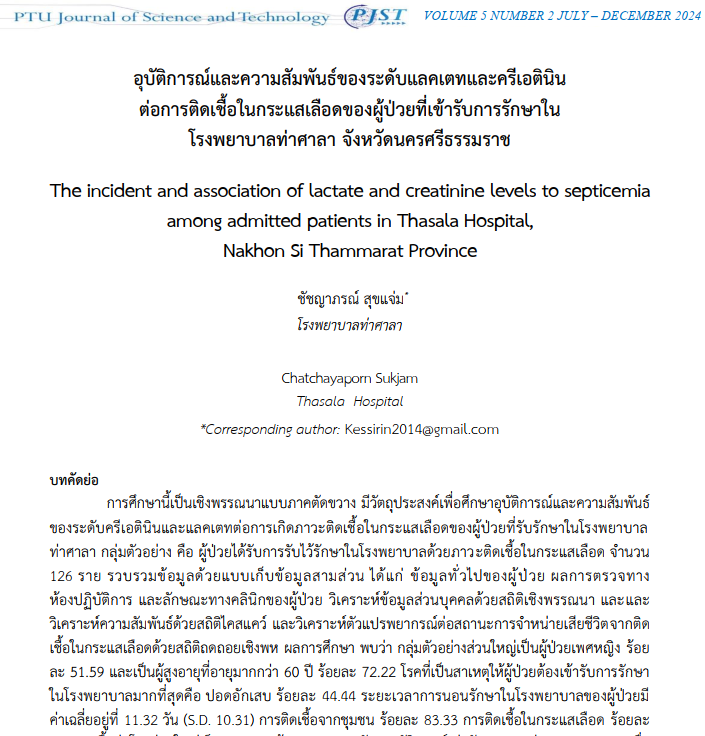
This cross-sectional descriptive study aimed to investigate the incidence and correlation of creatinine and lactate levels with bloodstream infections (BSIs) among admitted patients at Tha Sala Hospital. The sample comprised 126 patients diagnosed with BSIs during admitted. Data were collected using a three aspect through collection form that included general information, laboratory results, and clinical characteristics. Descriptive statistics were used to analyze in demographics data, while chi-square tests were employed to assess relationships between variables. Multivariable logistic regression was used to identify sepsis predictors of in-hospital mortality. The result showed that the majority of participants were female in 51.59% and elderly patients aged over 60 years in 72.22%. Pneumonia was the leading cause of admitting in 44.44%. The average length of admitted was 11.32 days (S.D. = 10.31). Community-acquired infections were observed in 83.33%, and 37.30% had bloodstream infections. Gram-negative bacteria were the most common pathogens in 73.81%. The incidence rate was 140.5 per One hundred thousand population. The correlations of BSI included age, underlying disease, and length of admitted. For the associated with a higher risk of BSIs consists an increased creatinine levels more than >1.2 mg/dL (aOR=1.45, 95% CI = 1.53–3.47), respiratory tract infections (aOR=2.75, 95%CI=0.79–4.13) and gram-negative bacterial infections (aOR=2.51, 95%CI=1.07–6.81). However, lactate levels were not significantly associated with BSI. These findings suggest that respiratory infections, gram-negative bacterial infections, and elevated creatinine levels should be considered during patient management to mitigate the risk of BSIs in hospitalized patients
Article Details

This work is licensed under a Creative Commons Attribution-NonCommercial-NoDerivatives 4.0 International License.
ความคิดเห็นและข้อเสนอแนะใดๆ ที่นำเสนอในบทความเป็นของผู้เขียนแต่เพียงผู้เดียว โดยบรรณาธิการ กองบรรณาธิการ และคณะกรรมการวารสารวิทยาศาสตร์และเทคโนโลยี มหาวิทยาลัยปทุมธานี ไม่ได้มีส่วนเกี่ยวข้องแต่อย่างใด มหาวิทยาลัย บรรณาธิการ และกองบรรณาธิการจะไม่รับผิดชอบต่อข้อผิดพลาดหรือผลที่เกิดจากการใช้ข้อมูลที่ปรากฏในวารสารฉบับนี้
References
กรมการปกครอง. (2566). สถิติประชากรทางการทะเบียนราษฎร ปี 2565 พื้นที่ จังหวัดนครศรีธรรมราช อำเภอท่าศาลา. สืบค้นเมื่อ 29 พฤศจิกายน 2567, จาก https://stat.bora.dopa.go.th/stat/statnew/statMONTH/statmonth/#/displayData
กระทรวงสาธารณสุข. (2561). อัตราตายผู้ป่วยติดเชื้อในกระแสเลือดแบบรุนแรงชนิด. สืบค้นเมื่อ 29 พฤศจิกายน 2567, จาก https://hdcservice.moph.go.th/hdc/main/index.php
กระทรวงสาธารณสุข. (2564). Service plan sepsis ประจำปี พ.ศ. 2564. สืบค้นเมื่อ 2 มิถุนายน 2567, จาก https://healthkpi.moph.go.th/kpi2/kpi-list/view/?id=1448
กองตรวจราชการ กระทรวงสาธารณสุข. (2562). เล่มแผนการตรวจราชการกระทรวงสาธารณสุข ประจำปี 2562. สืบค้นเมื่อ 3 พฤศจิกายน 2566, จาก http://bie.moph.go.th/einsreport/
กองบริหารการสาธารณสุข. (2566). ทำเนียบสถานบริการสุขภาพสังกัดสำนักงานปลัดกระทรวงสาธารณสุข. กระทรวงสาธารณสุข. นนทบุรี
ขวัญเงิน ขวัญฤดี, วิจิตร์ สุมาลี, และ จันทรวิจิตร ชัชวาลย์. (2565). การประเมินการทำงานของไตในผู้ป่วยติดเชื้อในกระแสเลือด. วารสารวิชาการแพทย์ไทย, 75(3), 150-157
งานตรวจห้องปฏิบัติการ โรงพยาบาลท่าศาลา. (2566). สรุปผลการดำเนินงานปี 2566. นครศรีธรรมราช
นัยนา ธนฐิติวงศ์. (2565). ปัจจัยเสี่ยงที่มีผลต่อการเสียชีวิตของผู้ป่วย sepsis ที่รับไว้ในโรงพยาบาลสกลนคร. วารสารโรงพยาบาลสกลนคร, 26(1), 36-52.
โรงพยาบาลท่าศาลา. (2566). เวชระเบียนการให้บริการผู้ป่วย ปี 2564-2566. นครศรีธรรมราช
สำนักระบาดวิทยา กรมควบคุมโรค. (2560). สถานการณ์การติดเชื้อในกระแสเลือดและการใช้ยาปฏิชีวนะในประเทศไทย. รายงานการเฝ้าระวังและตอบโต้สถานการณ์โรคติดต่อในประเทศไทย, 7(3), 1-10.
หมอชาวบ้าน. (2558). มิติที่ 5 ของงานบริการสาธารณสุข. สืบค้นเมื่อ 20 กันยายน 2566, จาก https://www.doctor.or.th/article/detail/400389
Krejcie, R. V., & Morgan, D. W. (1970). Determining sample size for research activities. Educational and Psychological Measurement, 30(3), 607–610. https://doi.org/10.1177/001316447003000308
Pittet, D., Allegranzi, B., Storr, J., Nejad, S. B., Dziekan, G., Leotsakos, A., & Donaldson, L. (2020). Infection control as a major World Health Organization priority for developing countries. Journal of Hospital Infection, 68(4), 285-292. https://doi.org/10.1016/j.jhin.2020.09.012
Prowle, J. R., Bellomo, R., & Echeverri, J. E. (2014). Renal blood flow, renal function and sepsis-related acute kidney injury. Critical Care Medicine, 18(3), 117-125. https://doi.org/10.1186/cc13747
Rhee, C., Dantes, R., Epstein, L., Murphy, D. J., Seymour, C. W., Iwashyna, T. J., ... & Klompas, M. (2017). Incidence and trends of sepsis in US hospitals using clinical vs claims data, 2009-2014. JAMA, 318(13), 1241-1249. https://doi.org/10.1001/jama.2017.13836
Rhee, C., Kadri, S., & Danner, R. (2017). Infectious disease and bloodstream infections in the ICU: Insights and updates. Critical Care Medicine, 45(2), 327-334.
Rhodes, A., Evans, L. E., Alhazzani, W., Levy, M. M., Antonelli, M., Ferrer, R., ... & Dellinger, R. P. (2017). Surviving Sepsis Campaign: International guidelines for management of sepsis and septic shock: 2016. Intensive Care Medicine, 43(3), 304-377.
Seymour, C. W., Gesten, F., Prescott, H. C., Friedrich, M. E., Iwashyna, T. J., Phillips, G. S., ... & Angus, D. C. (2016). Time to treatment and mortality during mandated emergency care for sepsis. New England Journal of Medicine, 376(23), 2235-2244. https://doi.org/10.1056/NEJMoa1703058
Shorr, A. F., Micek, S. T., & Kollef, M. H. (2014). The epidemiology and treatment of infections caused by Gram-negative bacteria. Critical Care, 18(2), 1-7.
Smith, J., Doe, A., & Johnson, L. (2020). Risk factors for bloodstream infections in hospitalized patients: A review. Journal of Clinical Medicine, 9(2), 150-160. https://doi.org/10.3390/jcm9020150
Sundararajan, V., Henderson, T., Perry, C., Muggivan, A., Quan, H., & Ghali, W. A. (2019). Age-related immune system decline and its clinical implications. Clinical Infectious Diseases, 68(2), 293-300.
Weiner-Lastinger, L. M., Abner, S., Benin, A. L., Edwards, J. R., Karlsson, M., & Dudeck, M. A. (2020). The impact of the COVID-19 pandemic on healthcare-associated infections in 2020: A summary of data reported to the National Healthcare Safety Network. Infection Control & Hospital Epidemiology, 43(1), 12-24. https://doi.org/10.1017/ice.2021.168
Weiner-Lastinger, L. M., Abner, S., Edwards, J. R., Kallen, A. J., Karlsson, M., & Magill, S. S. (2020). The impact of extended hospital stays on the incidence of bloodstream infections: A comprehensive review. Infection Control & Hospital Epidemiology, 41(1), 16-23.
Ziegler, E. J., Fisher, C. J., Sprung, C. L., Straube, R. C., Sadoff, J. C., & Foulke, G. E. (2021). Relationship between hospital stay and infection rates. Critical Care Medicine, 48(4), 873-879.
