ฤทธิ์ยับยั้งเชื้อแบคทีเรียที่ก่อให้เกิดสิว (Cutibacterium acnes) จากสารสกัดดอกกุหลาบมอญ
Article Sidebar
Main Article Content
บทคัดย่อ
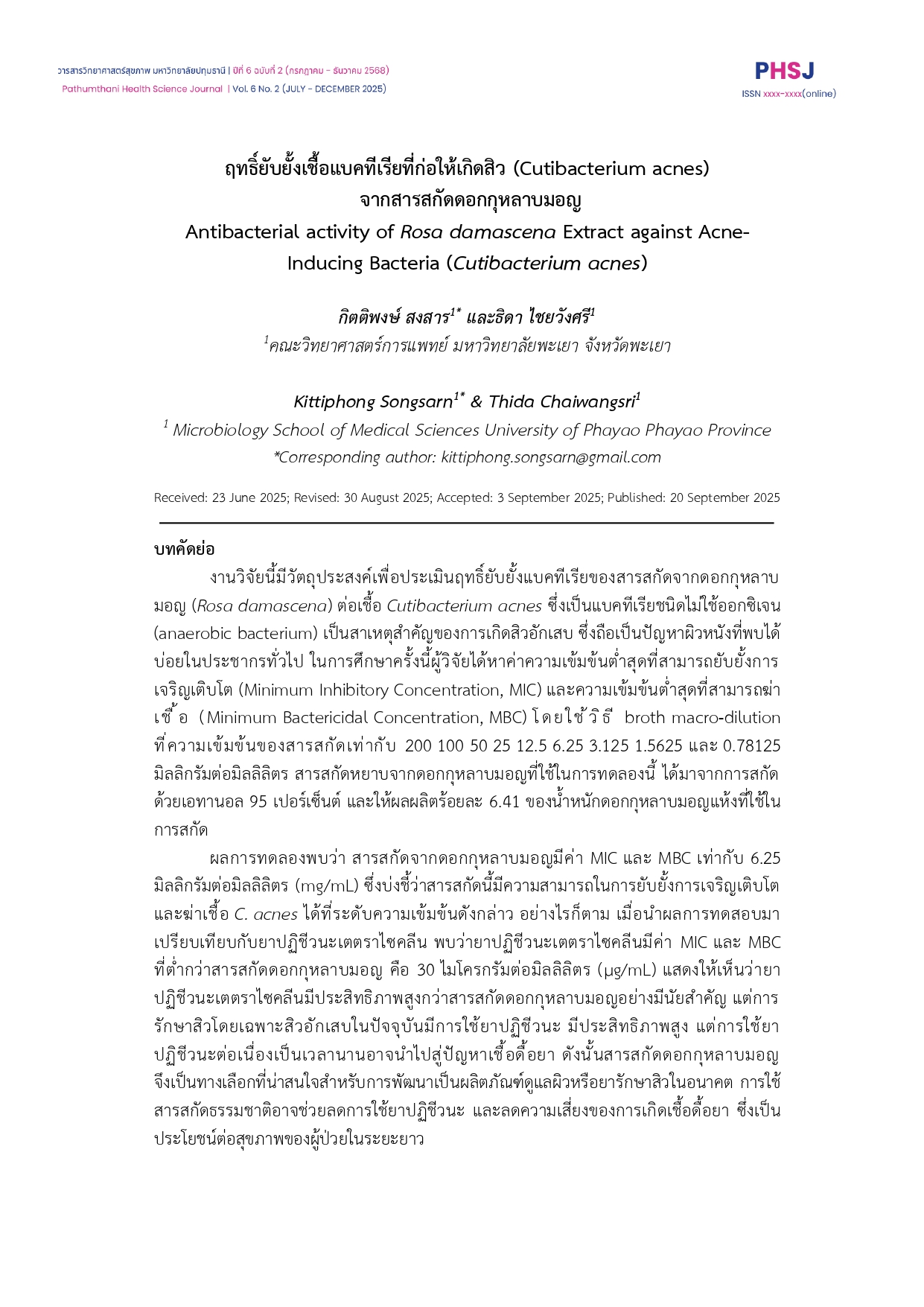
งานวิจัยนี้มีวัตถุประสงค์เพื่อประเมินฤทธิ์ยับยั้งแบคทีเรียของสารสกัดจากดอกกุหลาบมอญ (Rosa damascena) ต่อเชื้อ Cutibacterium acnes ซึ่งเป็นแบคทีเรียชนิดไม่ใช้ออกซิเจน(anaerobic bacterium) เป็นสาเหตุสำคัญของการเกิดสิวอักเสบ ซึ่งถือเป็นปัญหาผิวหนังที่พบได้บ่อยในประชากรทั่วไป ในการศึกษาครั้งนี้ผู้วิจัยได้หาค่าความเข้มข้นต่ำสุดที่สามารถยับยั้งการเจริญเติบโต (Minimum Inhibitory Concentration, MIC) และความเข้มข้นต่ำสุดที่สามารถฆ่าเชื้อ (Minimum Bactericidal Concentration, MBC) โดยใช้วิธี broth macro-dilution ที่ความเข้มข้นของสารสกัดเท่ากับ 200 100 50 25 12.5 6.25 3.125 1.5625 และ 0.78125 มิลลิกรัมต่อมิลลิลิตร สารสกัดหยาบจากดอกกุหลาบมอญที่ใช้ในการทดลองนี้ ได้มาจากการสกัดด้วยเอทานอล 95 เปอร์เซ็นต์ และให้ผลผลิตร้อยละ 6.41 ของน้ำหนักดอกกุหลาบมอญแห้งที่ใช้ในการสกัด
ผลการทดลองพบว่า สารสกัดจากดอกกุหลาบมอญมีค่า MIC และ MBC เท่ากับ 6.25 มิลลิกรัมต่อมิลลิลิตร (mg/mL) ซึ่งบ่งชี้ว่าสารสกัดนี้มีความสามารถในการยับยั้งการเจริญเติบโตและฆ่าเชื้อ C. acnes ได้ที่ระดับความเข้มข้นดังกล่าว อย่างไรก็ตาม เมื่อนำผลการทดสอบมาเปรียบเทียบกับยาปฏิชีวนะเตตราไซคลีน พบว่ายาปฏิชีวนะเตตราไซคลีนมีค่า MIC และ MBC ที่ต่ำกว่าสารสกัดดอกกุหลาบมอญ คือ 30 ไมโครกรัมต่อมิลลิลิตร (µg/mL) แสดงให้เห็นว่ายาปฏิชีวนะเตตราไซคลีนมีประสิทธิภาพสูงกว่าสารสกัดดอกกุหลาบมอญอย่างมีนัยสำคัญ แต่การรักษาสิวโดยเฉพาะสิวอักเสบในปัจจุบันมีการใช้ยาปฏิชีวนะ มีประสิทธิภาพสูง แต่การใช้ยาปฏิชีวนะต่อเนื่องเป็นเวลานานอาจนำไปสู่ปัญหาเชื้อดื้อยา
ดังนั้นสารสกัดดอกกุหลาบมอญ จึงเป็นทางเลือกที่น่าสนใจสำหรับการพัฒนาเป็นผลิตภัณฑ์ดูแลผิวหรือยารักษาสิวในอนาคต การใช้สารสกัดธรรมชาติอาจช่วยลดการใช้ยาปฏิชีวนะ และลดความเสี่ยงของการเกิดเชื้อดื้อยา ซึ่งเป็นประโยชน์ต่อสุขภาพของผู้ป่วยในระยะยาว
Article Details

อนุญาตภายใต้เงื่อนไข Creative Commons Attribution-NonCommercial-NoDerivatives 4.0 International License.
ความคิดเห็นและข้อเสนอแนะใดๆ ที่นำเสนอในบทความเป็นของผู้เขียนแต่เพียงผู้เดียว โดยบรรณาธิการ กองบรรณาธิการ และคณะกรรมการวารสารวิทยาศาสตร์และเทคโนโลยี มหาวิทยาลัยปทุมธานี ไม่ได้มีส่วนเกี่ยวข้องแต่อย่างใด มหาวิทยาลัย บรรณาธิการ และกองบรรณาธิการจะไม่รับผิดชอบต่อข้อผิดพลาดหรือผลที่เกิดจากการใช้ข้อมูลที่ปรากฏในวารสารฉบับนี้
เอกสารอ้างอิง
วาสนา ประภาเลิศ และวิมลรัตน์ พจน์ไตรทิพย์. (2565). ปริมาณสารสำคัญ ฤทธิ์ทางชีวภาพ และเทคนิคการสกัดน้ำมันหอมระเหยจากดอกกุหลาบอินทรีย์จากกลุ่มเกษตรกรในอำเภอเชียงดาว จังหวัดเชียงใหม่ สู่การพัฒนาผลิตภัณฑ์น้ำหอมและเครื่องสำอาง. รายงานวิจัย, มหาวิทยาลัยเชียงใหม่.
พสุธร อุ่นอมรมาศ และสรณะ สมโน. (2559). การวิเคราะห์หาสารสำคัญและฤทธิ์การต่อต้านอนุมูลอิสระของดอกไม้กินได้บางชนิด. วารสารเกษตร, 32(3), 435–445.
รัตนา อินทรานุปกรณ์. (2550). การตรวจสอบและการสกัดแยกสารสำคัญจากสมุนไพร (พิมพ์ครั้งที่ 2). กรุงเทพมหานคร: แอคทีฟ พรินท์.
Bojar, R. A., & Holland, K. T. (2004). Acne and Propionibacterium acnes. Clinics in Dermatology, 22(5), 375–379. https://doi.org/10.1016/j.clindermatol.2004.03.005
Chroho, M., Bouymajane, A., Oulad El Majdoub, Y., Cacciola, F., Mondello, L., Aazza, M., Zair, T., & Bouissane, L. (2022). Phenolic composition, antioxidant and antibacterial activities of extract from flowers of Rosa damascena from Morocco. Separations, 9(9), 247. https://doi.org/10.3390/separations9090247
Chroho, S., El Mihyaoui, A., El Omari, N., Kandri, N., Aanniz, T., & El Mouahid, A. (2022). Antibacterial activity of Rosa damascena essential oil against Gram-positive and Gram-negative bacteria. Microbial Pathogenesis, 165, 105472.
Cock, I. E. (2025). Ficus racemosa L. leaf extracts inhibit the growth of the acne vulgaris causing bacterium Cutibacterium acnes. Pharmacognosy Communications, 15(3), 141–148. https://doi.org/10.5530/pc.2025.3.17
Del Rosso, J. Q., Leyden, J. J., et al. (2016). Mechanisms of antibiotic resistance in Cutibacterium acnes. Journal of Clinical and Aesthetic Dermatology, 9(10), 25–32.
Dréno, B., Pécastaings, S., Corvec, S., Veraldi, S., Khammari, A., & Roques, C. (2018). Cutibacterium acnes-induced inflammation in acne. Journal of the European Academy of Dermatology and Venereology, 32(S2), 5–14. https://doi.org/10.1111/jdv.15043
Fatemeh, F., Karimi, A., Abbassion, M., Rad, P. K., & Yazdi, M. K. (2015). Extraction of Rosa damascena as an antibacterial agent. International Journal of Mycobacteriology, 4, 169. https://doi.org/10.1016/j.ijmyco.2014.11.053
Field, A. (2013). Discovering statistics using IBM SPSS Statistics (4th ed.). Sage Publications.
Girsang, V., Nufus, N., Saptawati, T., Sa’adah, A., Wibowo, A. D. K., & Vidiani, A. A. P. P. (2025). Antibacterial effectiveness of glodokan tiang (Polyalthia longifolia) leaf extract against Cutibacterium acnes and Staphylococcus epidermidis. Journal of Pharmaceutical and Sciences, 8(2), 761–769. https://doi.org/10.36490/journal-jps.com.v8i2.815
Gu, M. K., Song, H. Y., Hong, E. A., Jung, Y. J., Jo, Y. J., & Kim, K. Y. (2024). Skin microbiota growing effects and physicochemical properties of medicinal plant extracts. Journal of the Korean Society of Food Science and Nutrition, 53(10), 1065–1073. https://doi.org/10.3746/jkfn.2024.53.10.1065
Hajhashemi, V., Ghannadi, A., & Hajiloo, M. (2010). Analgesic and anti-inflammatory effects of Rosa damascena hydroalcoholic extract and its essential oil in animal models. Iranian Journal of Pharmaceutical Research: IJPR, 9(2), 163–168.
Kılıç, G., Yeşilada, E., & Bedir, E. (2019). Inhibitory activity of Turkish medicinal plants on acne vulgaris. Journal of Ethnopharmacology, 241, 111978.
Kılıç, S., Okullu, S., Kurt, Ö., Sevinç, H., Dündar, C., Altınordu, F., & Türkoğlu, M. (2019). Efficacy of two plant extracts against acne vulgaris: Initial results of microbiological tests and cell culture studies. Journal of Cosmetic Dermatology, 18(4), 1061–1065. https://doi.org/10.1111/jocd.12814
Kumar, B., Pathak, R., Mary, P. B., Jha, D., Sardana, K., & Gautam, H. K. (2016). New insights into acne pathogenesis: Exploring the role of acne-associated microbial populations. Dermatologica Sinica, 34(2), 67–73. https://doi.org/10.1016/j.dsi.2015.12.004
Liu, Y., Zhu, J., Liu, Z., Zhi, Y., Mei, C., & Wang, H. (2025). Flavonoids as promising natural compounds for combating bacterial infections. International Journal of Molecular Sciences, 26(6), 2455. https://doi.org/10.3390/ijms26062455
Nakatsuji, T., Liu, Y. T., Huang, C. P., Gallo, R. L., & Huang, C. M. (2016). Antibiotic resistance in Propionibacterium acnes: Global concerns and future perspectives. Future Microbiology, 11(6), 763–771.
Nayebi, N., Khalili, N., Kamalinejad, M., & Emtiazy, M. (2017). A systematic review of the efficacy and safety of Rosa damascena Mill. with an overview on its phytopharmacological properties. Complementary Therapies in Medicine, 34, 129–140. https://doi.org/10.1016/j.ctim.2017.08.014
Paulsen, A. Q., Seaman, J. L., & Lall, N. (2025). Anti-acne and anti-hyperpigmentation potential of selected South African bryophytes with identification of oleamide as a lead compound. South African Journal of Botany, 184, 193–204. https://doi.org/10.1016/j.sajb.2025.05.055
Ramburrun, P., Kumar, S., Lall, N., & Soliman, M. E. (2024). Herbal antimicrobials: New solutions to multidrug-resistant acne-inducing pathogens. Phytomedicine Plus, 4(1), 100249.
Ross, J. I., Snelling, A. M., Carnegie, E., Coates, P., Cunliffe, W. J., Bettoli, V., Tosti, G., Katsambas, A., Galvan Peréz Del Pulgar, J. I., Rollman, O., Török, L., Eady, E. A., & Cove, J. H. (2003). Antibiotic-resistant acne: Lessons from Europe. The British Journal of Dermatology, 148(3), 467–478. https://doi.org/10.1046/j.1365-2133.2003.05067.x
Salazar, J. (2025). Role of polyphenols in dermatological diseases: Exploring pharmacotherapeutic mechanisms and clinical implications. Pharmaceuticals, 18(2), 247. https://doi.org/10.3390/ph18020247
Shah, M., Suhagia, B., Goswami, S., & Patwari, A. (2025). Anti-acne activity of minocycline hybrids. Journal of Young Pharmacists, 17(1), 160–165. https://doi.org/10.5530/jyp.20251401
Shohayeb, M., Saleh, E.-S., Bazaid, S., & Maghrabi, I. (2014). Antibacterial and antifungal activity of Rosa damascena MILL. essential oil, different extracts of rose petals. Global Journal of Pharmacology, 8, 1–7.
Silva, N. C. C., & Fernandes Júnior, A. (2020). Biological properties of medicinal plants: A review of their antimicrobial activity. Journal of Venomous Animals and Toxins including Tropical Diseases, 26, e20200007. https://doi.org/10.1590/S1678-91992010000300006
Sutaria, A. H., Masood, S., Saleh, H. M., et al. [Online]. (2023). Acne vulgaris. Retrieved (2024, 17 August). Retrieved from https://www.ncbi.nlm.nih.gov/books/NBK459173/
Tan, J. K. L., & Bhate, K. (2015). A global perspective on the epidemiology of acne. British Journal of Dermatology, 172(S1), 3–12. https://doi.org/10.1111/bjd.13462
Trendafilova, A., Staleva, P., Petkova, Z., Ivanova, V., Evstatieva, Y., Nikolova, D., Rasheva, I., Atanasov, N., Topouzova-Hristova, T., Veleva, R., Moskova-Doumanova, V., Dimitrov, V., & Simova, S. (2023). Phytochemical profile, antioxidant potential, antimicrobial activity, and cytotoxicity of dry extract from Rosa damascena Mill. Molecules, 28(22), 7666. https://doi.org/10.3390/molecules28227666
Trendafilova, A., Todorova, M., & Nikolova, M. (2023). Antibacterial potential of essential oils and phenolic compounds: Mechanisms and synergy. Pharmaceuticals, 16(3), 331.
Ulusoy, S., Bosgelmez-Tinaz, G., & Sezik, E. (2009). Chemical composition and antimicrobial activity of Rosa damascena essential oil. Chemistry of Natural Compounds, 45(2), 265–268.
White, R. L., Burgess, D. S., Manduru, M., & Bosso, J. A. (1996). Comparison of three different in vitro methods of detecting synergy: Time-kill, checkerboard, and E test. Antimicrobial Agents and Chemotherapy, 40(8), 1914–1918. https://doi.org/10.1128/AAC.40.8.1914
Zaenglein, A. L. (2018). Acne vulgaris. New England Journal of Medicine, 379(14), 1343–1352. https://doi.org/10.1056/NEJMcp1702493
Zhang, H., Guo, L., & Li, X. (2022). Plant-derived flavonoids and their mechanisms in antibacterial resistance: A review. Frontiers in Pharmacology, 13, 849432.
