
Simplified Models for Obtaining Monthly Average Hourly Global Solar Radiation from Daily Radiation Data at Four Main Regions in Thailand
Article Sidebar
Main Article Content
Abstract
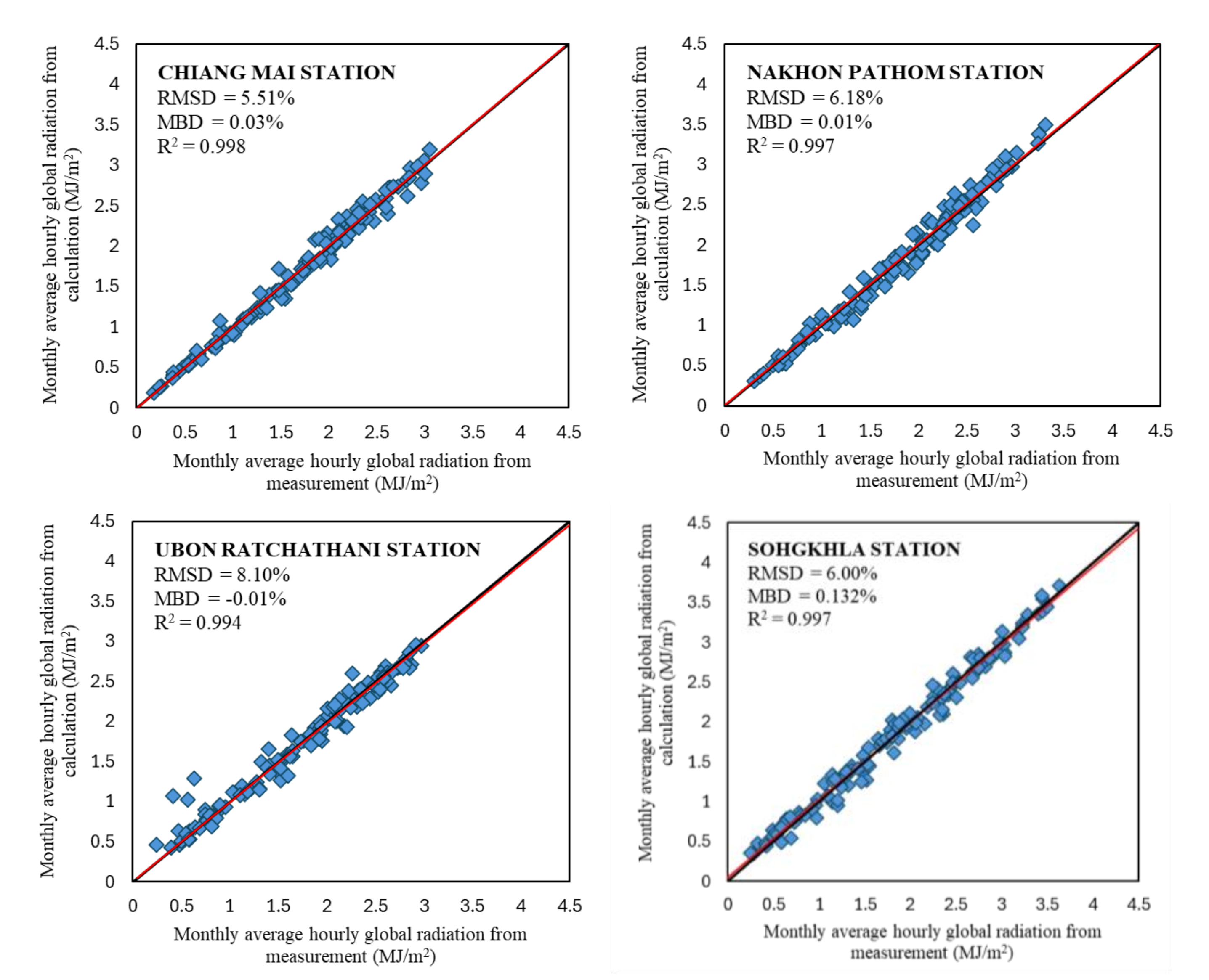
Solar energy has become a significant alternative renewable energy source due to its clean, emission-free, and user-friendly characteristics. However, an efficient utilization of solar energy system requires accurate and reliable solar radiation data, which could not be fulfilled by the ground measurement. Therefore, this study aims to evaluate two simplified models including Collares-Pereira and Rabl (CPR) model and the CPR model combined with Liu and Jordan (CPR-JL) model for estimating a monthly average hourly global solar radiation from monthly average daily global solar radiation, solar geometry, and extraterrestrial solar radiation using the data from four different regions across Thailand, namely Chiang Mai (18.78°N, 98.98°E), Nakhon Pathom (13.82°N, 100.04°E), Ubon Ratchathani (15.25°N, 104.87°E), and Songkhla (7.20°N, 100.60°E) for a period of the year 1995 - 2023. Subsequently, a performance of these models was investigated through statistical indicators such as Root Mean Square Difference, (RMSD), Mean Bias Difference, (MBD), and the coefficient of determination, (R²) using the data of the year 2024. The Results indicated that CPR model provided the best agreement between the measured and calculated monthly average hourly global solar radiation. Thus, this is recommended to apply this model for gathering the hourly average data in other regions, which have similar climate characteristics to the studied locations.
Article Details

This work is licensed under a Creative Commons Attribution-NonCommercial-NoDerivatives 4.0 International License.
References
Ahmad, M.J. and Tiwari, G.N. (2011). Solar radiation models—A review. International Journal of Energy Research 35(4): 271 - 290.
Akarslan, E., Hocaoğlu, F.O. and Edizkan, R. (2014). A novel MD (multi-dimensional) linear prediction filter approach for hourly solar radiation forecasting. Energy 73: 978 - 986.
Ayvazoğluyüksel, Ö. and Filik, Ü.B. (2017). Estimation of monthly average hourly global solar radiation from the daily value in Çanakkale, Turkey. Journal of Clean Energy Technologies 5(5): 389 - 393.
Benchrifa, M., Tadili, R., Idrissi, A., Essalhi, H. and Mechaqrane, A. (2021). Development of new models for the estimation of hourly components of solar radiation: tests, comparisons, and application for the generation of a solar database in Morocco. International Journal of Photoenergy 2021(1): 8897818.
Collares-Pereira, M. and Rabl, A. (1979). The average distribution of solar radiation-correlations between diffuse and hemispherical and between daily and hourly insolation values. Solar energy 22(2): 155 - 164.
Hollands, K.G.T. and Huget, R.G. (1983). A probability density function for the clearness index, with applications. Solar Energy 30(3): 195 - 209.
Iqbal, M. (1983). An Introduction to Solar Radiation. New York: Academic Press.
Jain, P.C. (1984). Comparison of techniques for the estimation of daily global irradiation and a new technique for the estimation of hourly global irradiation. Solar & Wind Technology 1(2): 123 - 134.
Janjai, S. (2014). Solar radiation (In Thai). Nakhon Pathom: Phetkasem Printing Group.
Jiang, N., Li, F., Tan, M., Yu, H., Qu, A. and Feng, H. (2025). Three-dimensional shading models for estimating global radiation on photovoltaic module. Renewable Energy 242: 122333.
Jomwinyan, W. (2017). Geography of Thailand. UdonThani: Faculty of Humanities and Social Sciences, UdonThani Rajabhat University.
Kalogirou, S.A. (2023). Solar energy engineering: Processes and systems. Elsevier.
Khorasanizadeh, H., Aghaei, A., Ehteram, H., Dehghani Yazdeli, R. and Hataminasar, N. (2014). Attaining optimum tilts of flat solar surfaces utilizing measured solar data: case study for Ilam, Iran. Iranica Journal of Energy and Environment 5(3): 224 - 232.
Liu, B.Y. and Jordan, R.C. (1960). The interrelationship and characteristic distribution of direct, diffuse and total solar radiation. Solar Energy 4(3): 1 - 19.
Madhlopa, A. (2006). Solar radiation climate in Malawi. Solar Energy 80(8): 1055 - 1057.
Nik, W.W., Ibrahim, M.Z., Samo, K.B. and Muzathik, A.M. (2012). Monthly mean hourly global solar radiation estimation. Solar Energy 86(1): 379 - 387.
Runghathaithum, K., Tohsing, K. and Janjai, S. (2025). A Model for Estimating the Monthly Average Hourly Global Solar Radiation at Four Main Regions in Thailand. In: Proceedings of the 16th Science Research Conference 27 – 28 February 2025. Mahasarakham University, Mahasarakham. 700 - 709.
Satpathy, P.R., Babu, T.S., Shanmugam, S.K., Popavath, L.N. and Alhelou, H.H. (2021). Impact of uneven shading by neighboring buildings and clouds on the conventional and hybrid configurations of roof-top PV arrays. IEEE Access 9: 139059 - 139073.
Teke, A., Yıldırım, H.B. and Çelik, Ö. (2015). Evaluation and performance comparison of different models for the estimation of solar radiation. Renewable and Sustainable Energy Reviews 50: 1097 - 1107.
Whillier, A. (1956). The determination of hourly values of total solar radiation from daily summations. Archiv für Meteorologie, Geophysik und Bioklimatologie, Serie B 7: 197 - 204.
Widén, J. and Munkhammar, J. (2019). Solar radiation theory. (1st ed). Uppsala: Uppsala University. pp. 50.
