
แบบจำลองอย่างง่ายสำหรับการประมาณค่ารังสีรวมรายชั่วโมงเฉลี่ยต่อเดือนจากรังสีรวมรายวันที่ 4 ภูมิภาคหลักในประเทศไทย
Article Sidebar
Main Article Content
บทคัดย่อ
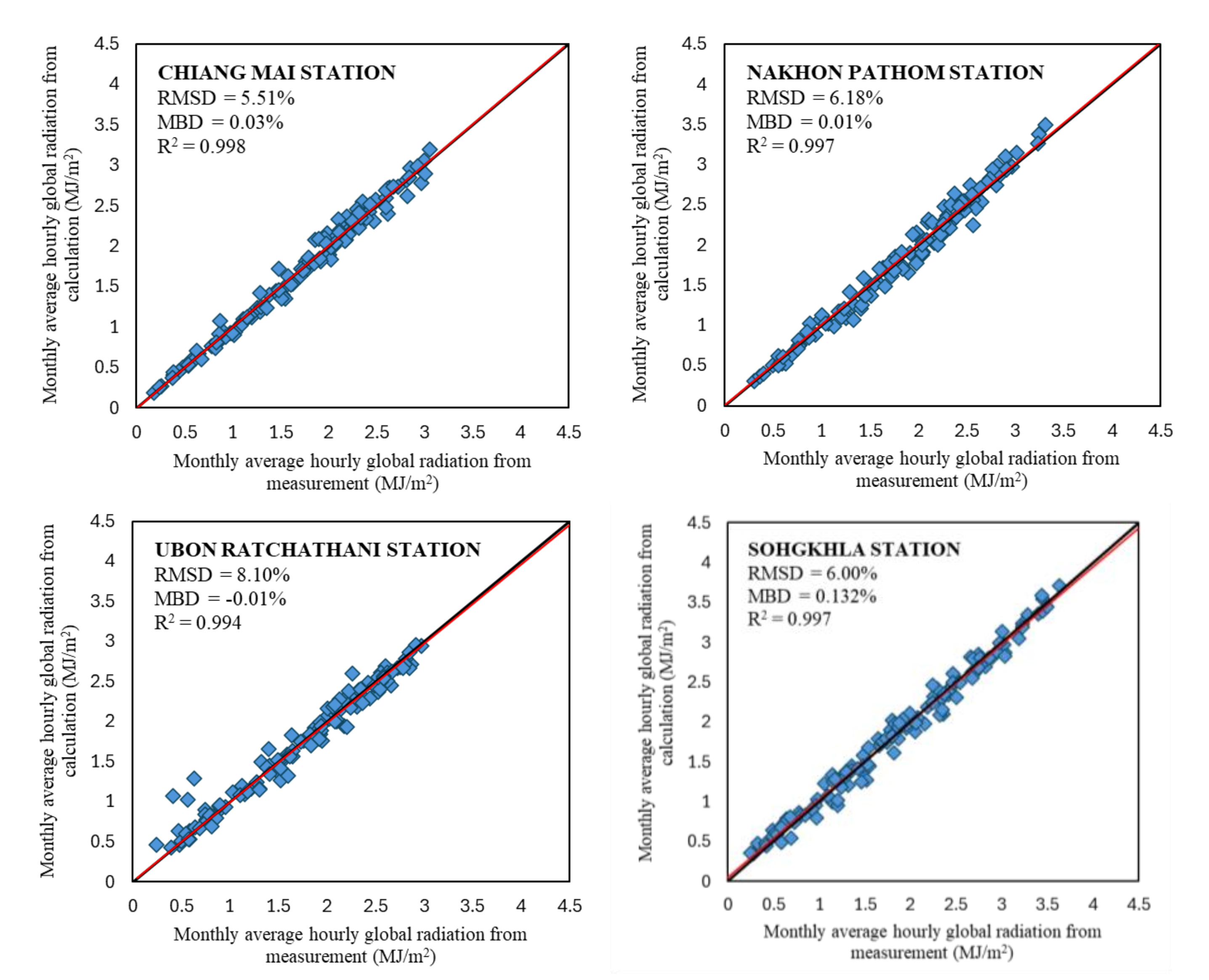
พลังงานแสงอาทิตย์ได้กลายเป็นแหล่งพลังงานทางเลือกที่สำคัญเนื่องจากเป็นพลังงานที่สะอาด ปราศจากการปล่อยมลพิษ และเป็นมิตรต่อผู้ใช้ อย่างไรก็ตาม การใช้ระบบพลังงานแสงอาทิตย์อย่างมีประสิทธิภาพนั้นจำเป็นต้องทราบข้อมูลรังสีอาทิตย์ที่แม่นยำและมีความเชื่อถือได้ ซึ่งไม่สามารถทำได้ด้วยการวัดจากภาคพื้นดินได้ครอบคลุมทุกพื้นที่ ดังนั้น การศึกษานี้จึงมีวัตถุประสงค์ในการสร้างแบบจำลองอย่างง่ายสองแบบจำลอง ได้แก่ แบบจำลอง Collares-Pereira and Rabl (CPR) และแบบจำลอง CPR ร่วมกับแบบจำลอง Liu and Jordan (CPR-JL) เพื่อประมาณค่ารังสีรวมรายชั่วโมงเฉลี่ยต่อเดือนจากรังสีรวมรายวัน ตำแหน่งของดวงอาทิตย์ และรังสีอาทิตย์นอกบรรยากาศโลก โดยใช้ข้อมูลจากภูมิภาคต่าง ๆ 4 ภูมิภาคหลักในประเทศไทย ได้แก่ เชียงใหม่ (18.78°N 98.98°E) นครปฐม (13.82°N 100.04°E) อุบลราชธานี (15.25°N 104.87°E) และสงขลา (7.20°N 100.60°E) ในช่วงปี พ.ศ. 2538 - 2566 หลังจากนั้น ทำการตรวจสอบประสิทธิภาพของแบบจำลองทั้งสองด้วยข้อมูลในปี พ.ศ. 2567 โดยใช้ตัวชี้วัดทางสถิติ ได้แก่ ค่ารากที่สองของค่าเฉลี่ยความแตกต่างยกกำลังสอง (Root Mean Square Difference, RMSD) ค่าความเอนเอียงเฉลี่ย (Mean Bias Difference, MBD) และค่าสัมประสิทธิ์การตัดสินใจ (Coefficient of Determination, R²) จากผลลัพธ์แสดงให้เห็นว่า แบบจำลอง CPR มีความสอดคล้องกับค่าที่วัดได้จริงมากที่สุด ดังนั้นจึงแนะนำให้ใช้แบบจำลอง CPR สำหรับประมาณค่ารังสีอาทิตย์รายชั่วโมงเฉลี่ยต่อเดือนในพื้นที่อื่นที่มีลักษณะภูมิอากาศใกล้เคียงกับพื้นที่ที่ศึกษา
Article Details

อนุญาตภายใต้เงื่อนไข Creative Commons Attribution-NonCommercial-NoDerivatives 4.0 International License.
เอกสารอ้างอิง
Ahmad, M.J. and Tiwari, G.N. (2011). Solar radiation models—A review. International Journal of Energy Research 35(4): 271 - 290.
Akarslan, E., Hocaoğlu, F.O. and Edizkan, R. (2014). A novel MD (multi-dimensional) linear prediction filter approach for hourly solar radiation forecasting. Energy 73: 978 - 986.
Ayvazoğluyüksel, Ö. and Filik, Ü.B. (2017). Estimation of monthly average hourly global solar radiation from the daily value in Çanakkale, Turkey. Journal of Clean Energy Technologies 5(5): 389 - 393.
Benchrifa, M., Tadili, R., Idrissi, A., Essalhi, H. and Mechaqrane, A. (2021). Development of new models for the estimation of hourly components of solar radiation: tests, comparisons, and application for the generation of a solar database in Morocco. International Journal of Photoenergy 2021(1): 8897818.
Collares-Pereira, M. and Rabl, A. (1979). The average distribution of solar radiation-correlations between diffuse and hemispherical and between daily and hourly insolation values. Solar energy 22(2): 155 - 164.
Hollands, K.G.T. and Huget, R.G. (1983). A probability density function for the clearness index, with applications. Solar Energy 30(3): 195 - 209.
Iqbal, M. (1983). An Introduction to Solar Radiation. New York: Academic Press.
Jain, P.C. (1984). Comparison of techniques for the estimation of daily global irradiation and a new technique for the estimation of hourly global irradiation. Solar & Wind Technology 1(2): 123 - 134.
Janjai, S. (2014). Solar radiation (In Thai). Nakhon Pathom: Phetkasem Printing Group.
Jiang, N., Li, F., Tan, M., Yu, H., Qu, A. and Feng, H. (2025). Three-dimensional shading models for estimating global radiation on photovoltaic module. Renewable Energy 242: 122333.
Jomwinyan, W. (2017). Geography of Thailand. UdonThani: Faculty of Humanities and Social Sciences, UdonThani Rajabhat University.
Kalogirou, S.A. (2023). Solar energy engineering: Processes and systems. Elsevier.
Khorasanizadeh, H., Aghaei, A., Ehteram, H., Dehghani Yazdeli, R. and Hataminasar, N. (2014). Attaining optimum tilts of flat solar surfaces utilizing measured solar data: case study for Ilam, Iran. Iranica Journal of Energy and Environment 5(3): 224 - 232.
Liu, B.Y. and Jordan, R.C. (1960). The interrelationship and characteristic distribution of direct, diffuse and total solar radiation. Solar Energy 4(3): 1 - 19.
Madhlopa, A. (2006). Solar radiation climate in Malawi. Solar Energy 80(8): 1055 - 1057.
Nik, W.W., Ibrahim, M.Z., Samo, K.B. and Muzathik, A.M. (2012). Monthly mean hourly global solar radiation estimation. Solar Energy 86(1): 379 - 387.
Runghathaithum, K., Tohsing, K. and Janjai, S. (2025). A Model for Estimating the Monthly Average Hourly Global Solar Radiation at Four Main Regions in Thailand. In: Proceedings of the 16th Science Research Conference 27 – 28 February 2025. Mahasarakham University, Mahasarakham. 700 - 709.
Satpathy, P.R., Babu, T.S., Shanmugam, S.K., Popavath, L.N. and Alhelou, H.H. (2021). Impact of uneven shading by neighboring buildings and clouds on the conventional and hybrid configurations of roof-top PV arrays. IEEE Access 9: 139059 - 139073.
Teke, A., Yıldırım, H.B. and Çelik, Ö. (2015). Evaluation and performance comparison of different models for the estimation of solar radiation. Renewable and Sustainable Energy Reviews 50: 1097 - 1107.
Whillier, A. (1956). The determination of hourly values of total solar radiation from daily summations. Archiv für Meteorologie, Geophysik und Bioklimatologie, Serie B 7: 197 - 204.
Widén, J. and Munkhammar, J. (2019). Solar radiation theory. (1st ed). Uppsala: Uppsala University. pp. 50.
